
PPWR Timeline for Beauty Brands: 2026–2040
The EU Packaging and Packaging Waste Regulation (PPWR), formally Regulation (EU) 2025/40, starts applying on 12 August 2026. For beauty brands, that date is the beginning of a longer transition—not a single compliance finish line. Labelling, packaging minimisation, recyclability, recycled-plastic content and transport-packaging requirements arrive in stages through 2040.
The short answer: Beauty brands should treat 12 August 2026 as the start of the PPWR compliance regime, prepare for harmonised packaging labels from 2028 at the earliest, redesign packs for minimisation and recyclability before 2030, check recycled-plastic thresholds for cosmetic contact-sensitive packaging, and plan for stricter recyclability and recycled-content requirements in 2038 and 2040.
The dates below come from the final legal text published in the Official Journal, not from the earlier PPWR proposal. Where a deadline depends on a future delegated or implementing act, this guide says so. That distinction matters: several obligations apply on a stated date or a set period after secondary legislation enters into force, whichever is later.
Why PPWR matters to beauty brands
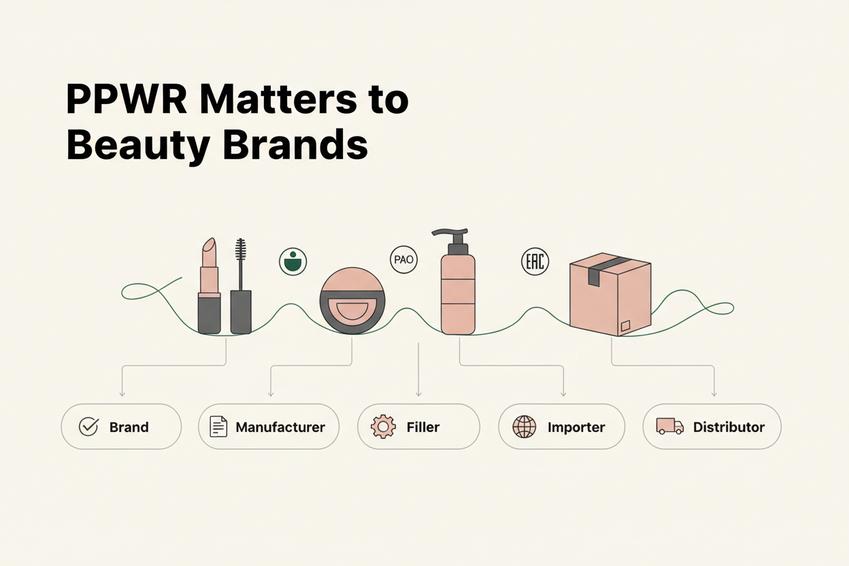
PPWR covers packaging placed on the EU market, including primary packs such as lipstick components, mascara tubes, compacts and skincare bottles; secondary cartons; grouped packs; and e-commerce or transport packaging. It applies to packaging regardless of material.
Cosmetics deserve particular attention under the recycled-content rules. PPWR Article 3(49) defines “contact-sensitive packaging” by referring to product legislation that includes the EU Cosmetics Regulation, Regulation (EC) No 1223/2009. Cosmetic plastic packaging may therefore fall into one of the contact-sensitive categories in Article 7, rather than automatically taking the percentage for “other plastic packaging.” The actual classification still depends on the material, pack type and format.
For a private label cosmetics project, packaging compliance cannot be separated from product development. The beauty brand, packaging manufacturer, filler, importer and EU distributor may each have obligations. Contracts should make clear who provides material specifications, conformity documents, recycled-content evidence, label artwork data and change-control notices.
PPWR timeline for beauty brands at a glance
| Date | What PPWR says | Practical meaning for beauty brands |
|---|---|---|
| 12 August 2026 | PPWR generally applies; the former Packaging and Packaging Waste Directive is repealed, subject to transitional provisions. | Confirm the legal role of each supply-chain party. Build a packaging bill of materials and a compliance file for every SKU sold in the EU. |
| By 31 December 2026 | The Commission is due to establish calculation and verification methods for recycled plastic, documentation formats, recycling-technology criteria and third-country equivalence methods. | Ask suppliers how they will update recycled-content evidence when the final methods are available. Do not rely only on an informal resin declaration. |
| 12 February 2027 | Member States must have rules on penalties. The Commission must also request standards for packaging minimisation by this date. | Monitor the national rules in every EU country where the brand sells, because enforcement and penalties are national. |
| By 1 January 2028 | The Commission is due to adopt design-for-recycling criteria and performance grades by packaging category. | Recheck pumps, mirrors, magnets, mixed-material compacts, metallised parts, labels, adhesives and decorative finishes against the final criteria. |
| 12 February 2028 | Empty space in sales packaging must be reduced to the minimum necessary for functionality. The Commission is also due to establish the method for calculating the 50% empty-space limit for grouped, transport and e-commerce packaging. | Document why headspace, inserts, trays or protective gaps are technically needed. “Luxury presentation” alone may not justify extra volume. |
| From 12 August 2028, conditionally | Harmonised material-composition labels apply from this date or 24 months after the relevant implementing acts enter into force, whichever is later. | Reserve artwork space, but do not invent the symbol. Use the final harmonised format and make the same information available before an online purchase. |
| From 12 February 2029, conditionally | Reusable packaging must carry a reusability label and, generally, a QR code or other data carrier from this date or 30 months after the relevant implementing act enters into force, whichever is later. | Refillable beauty packs need more than a “refillable” claim: the brand should evaluate the applicable reuse-system and information requirements. |
| 1 January 2030, with conditional dates for some rules | Packaging minimisation applies. Packaging must meet recyclability grades A, B or C, subject to the later-date clause. Minimum recycled-plastic targets also begin, subject to their later-date clause. A 50% maximum empty-space ratio applies to grouped, transport and e-commerce packaging, again subject to the relevant implementing-act timing. | This is the principal redesign deadline. Brands need evidence, not simply an eco-themed pack or a recycling claim. |
| 1 January 2035, conditionally | The “recycled at scale” element of recyclability starts, or five years after the relevant implementing acts enter into force, whichever is later. | A technically recyclable pack may still fail if the relevant category is not collected, sorted and recycled at the required scale. |
| 1 January 2038 | Packaging must achieve recyclability grade A or B; grade C is no longer sufficient. | Marginal designs will lose market access. Design decisions made for a 2030 launch should already consider the 2038 threshold. |
| 1 January 2040 | Recycled-plastic targets rise. PPWR also sets 2040 “endeavour to” levels for specified reusable transport and grouped packaging. | Secure credible recycled-resin supply and review logistics systems. Note that “endeavour to” is not worded as the same absolute obligation as the 2030 targets. |
What changes on 12 August 2026?
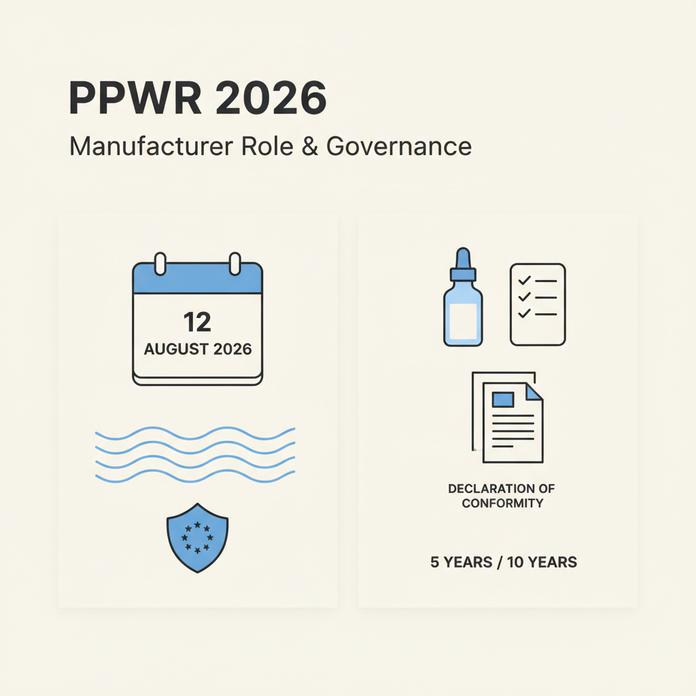
PPWR becomes generally applicable across EU Member States on 12 August 2026. Unlike a directive, the regulation is directly applicable. Even so, not every design target starts that day. Article 70 preserves several transitional provisions, while later articles set their own future dates.
The immediate job for beauty brands is governance. Under Article 15, manufacturers must place only conforming packaging on the market, perform or arrange the conformity assessment, prepare technical documentation and draw up an EU declaration of conformity. The article also sets retention periods of five years for documentation concerning single-use packaging and ten years for reusable packaging.
“Manufacturer” is a legal role, not necessarily the factory that moulds the compact or fills the serum. A company that has packaging designed or manufactured under its own name or trademark may be the manufacturer under PPWR, subject to the regulation’s definitions and the specific micro-enterprise provision. Beauty brands using private label cosmetics should map this role in writing instead of assuming the supplier carries every obligation.
What packaging information should brands collect now?
A useful PPWR data pack for each cosmetic SKU should include:
- Every packaging component, its material and its weight.
- The predominant material and applicable PPWR packaging categories.
- Colorants, coatings, inks, adhesives, sleeves, labels and metallisation.
- Evidence for post-consumer recycled content, including the calculation boundary.
- The reason each component, layer, void or headspace is necessary.
- Separation instructions and the effect of small components on sorting.
- Supplier test reports, declarations and version-controlled technical drawings.
- The party responsible for the EU declaration of conformity and technical file.
PPWR Article 16 requires packaging or material suppliers to give the manufacturer the information and documentation needed to demonstrate conformity. For a brand sourcing outside the EU, the contract should also define how quickly the supplier must provide updated evidence after a resin, decoration, closure or sub-supplier changes.
2028: labels and empty space move onto the artwork agenda
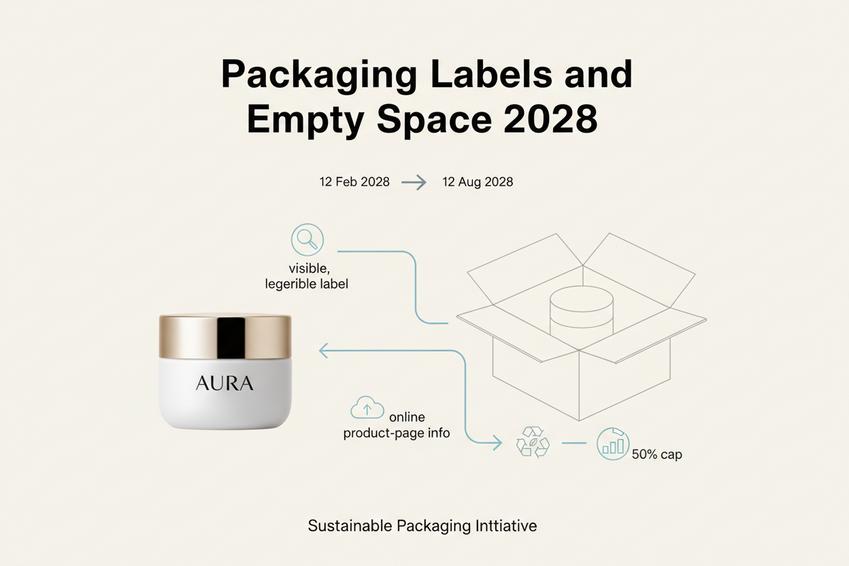
Article 12 provides for a harmonised label showing packaging material composition to help consumers sort waste. Its start date is 12 August 2028 or 24 months after the relevant implementing acts enter into force, whichever is later. This means old mock-ups circulating online should not be treated as approved symbols.
The labelling provision has two details beauty brands can prepare for today. First, the label must be visible, legible and firmly affixed, printed or engraved. If the nature or size of a pack makes that impractical, the regulation provides a sequence of alternatives. Second, the information must also be available to shoppers before an online purchase. Product-detail-page templates therefore need a packaging-information field, not just physical artwork space.
Article 24 addresses empty space. From 12 February 2028, fillers of sales packaging must reduce empty space to the minimum necessary for packaging functionality, including product protection. A premium face cream in a large false-bottom jar or a small compact held inside an oversized presentation box deserves an early review. Separately, the 50% cap covers grouped, transport and e-commerce packaging from 2030 or three years after the calculation-method implementing act enters into force, whichever is later.
2030: the main PPWR redesign checkpoint
By 1 January 2030, Article 10 requires packaging weight and volume to be reduced to the minimum necessary for functionality. Features intended only to increase perceived volume—including double walls, false bottoms and unnecessary layers—cannot be placed on the market unless a stated exception applies. A design-protected pack does not receive a blanket exemption: the article limits that route to specified rights protected before 11 February 2025 and sets further conditions.
Recyclability also becomes a market-access test. Under Article 6, packaging must achieve grade A, B or C from 1 January 2030 or 24 months after the design-for-recycling delegated acts enter into force, whichever is later. The final criteria will be category-specific. A beauty pack should therefore be assessed as a complete packaging unit, including its closure, applicator, spring, mirror, label and decoration—not just by calling the main body “recyclable plastic.”
PPWR recycled-plastic targets for cosmetic packaging
Article 7 sets the following minimum shares of post-consumer recycled plastic, calculated per packaging type and format as an average per manufacturing plant and year:
| Plastic packaging category | 2030 minimum* | 2040 minimum |
|---|---|---|
| Contact-sensitive packaging with PET as the major component | 30% | 50% |
| Contact-sensitive packaging made from plastic other than PET | 10% | 25% |
| Other plastic packaging covered by Article 7(1)(d) | 35% | 65% |
*The 2030 targets apply from 1 January 2030 or three years after the recycled-content calculation implementing act enters into force, whichever is later.
The regulation exempts any plastic part representing less than 5% of the total weight of the whole packaging unit from Article 7(1) and (2). Other exemptions exist, but brands should not assume that cosmetics receive a general exclusion: cosmetics are expressly connected to the contact-sensitive definition.
Percentages alone are not enough. Article 7 requires compliance to be demonstrated in the packaging technical information. It also sets conditions for post-consumer plastic waste collected or recycled outside the EU and calls for methods to assess third-country equivalence. That is relevant to private label cosmetics manufactured outside Europe: evidence will need to fit the EU methodology, even when the packaging is made elsewhere.
2035 and 2038: “designed for recycling” is not the end point
From 2035, subject to the later-date mechanism in Article 6, packaging must be recycled at scale. This is a practical infrastructure test as well as a design test. A component may be recyclable in a laboratory or specialist facility but still perform poorly under the PPWR assessment if it is not collected, sorted and recycled at the required scale.
Then, from 1 January 2038, only recyclability grades A and B may be placed on the market. Grade C drops out. Beauty brands with long-lived moulds should include this date in tooling decisions. A component platform commissioned for 2030 could still be in use eight years later.
2040: higher recycled content and logistics ambitions
The 2040 recycled-plastic targets are much higher: 50% for PET-majority contact-sensitive packaging, 25% for other contact-sensitive plastic packaging and 65% for the “other plastic packaging” category. Supply quality will matter as much as nominal availability, particularly where color, odour, mechanical performance and compatibility with the cosmetic formula affect pack function.
Article 29 also tells economic operators to endeavour to use at least 70% reusable packaging for specified transport formats by 2040, up from the binding 40% target in 2030. For grouped boxes other than cardboard, the comparable levels are 10% in 2030 and an endeavour to reach 25% in 2040. Cardboard boxes are excluded from the transport-packaging obligations in Article 29(1)–(3), but that does not remove other PPWR requirements such as minimisation and recyclability.
These logistics provisions are easy to miss because consumers never see most of the packaging. A beauty brand should ask how finished goods move between the filler, warehouse, distributor and retailer—not only how the retail pack looks on a shelf.
How to brief a private label cosmetics supplier for PPWR
A useful supplier brief is specific enough to produce evidence. When discussing an EU launch with Topfeel Beauty, a private label cosmetics supplier, beauty brands can ask for a component-level packaging proposal rather than a general promise of “sustainable packaging.” The brief should request:
- a material and weight breakdown for every component;
- identification of the likely PPWR packaging category;
- alternative designs that remove unnecessary layers or reduce volume;
- options that simplify material combinations and component separation;
- recycled-content evidence aligned with the final EU calculation method;
- change control for resins, colour masterbatches, coatings and decorations;
- support documents for the party preparing the technical file; and
- enough artwork space for future harmonised labels or data carriers.
Topfeel Beauty’s role should be presented accurately: a supplier can support formula, component and pack-development decisions, but the brand and other economic operators must still determine their own legal roles and EU obligations. The best project gate is simple: no packaging design is approved until performance, aesthetics, formula compatibility, supply continuity and the PPWR evidence plan have all been reviewed together.
A practical PPWR action plan for beauty brands
In 2026: appoint a PPWR owner, map legal roles, audit every packaging component and add evidence requirements to supplier contracts.
In 2027: track Member State penalty rules and the Commission’s secondary legislation. Start redesigning the highest-risk packs: mixed materials, oversized gift sets, false bottoms, complex pumps and hard-to-separate decorations.
In 2028–2029: apply the final design-for-recycling criteria, update artwork and e-commerce data for harmonised labels, and validate any refill or reuse proposition against the final labelling rules.
Before 2030: lock compliant materials, complete conformity documentation, test minimum-volume designs and verify recycled-content calculations. Check transport, grouped and e-commerce packaging as well as retail packs.
For 2035–2040: monitor recycling-at-scale results, move grade C packs toward A or B, and plan resin supply and logistics systems around the higher 2040 figures.
Frequently asked questions
Does PPWR apply to cosmetics?
Yes. PPWR applies to packaging across product categories, including cosmetics. It also defines contact-sensitive packaging by reference to the EU Cosmetics Regulation. The cosmetic formula remains regulated separately; PPWR adds requirements for the packaging and packaging-waste system.
Are all cosmetic packs required to contain 35% recycled plastic in 2030?
No. Article 7 sets different percentages by category. Contact-sensitive PET packaging has a 30% target, contact-sensitive non-PET plastic packaging has a 10% target, and the “other plastic packaging” category has a 35% target. Classification and exemptions must be assessed for the actual packaging unit. The 2030 start is also subject to a later-date clause tied to the implementing act.
Does every package need the new EU label in August 2028?
Not necessarily on that exact date. The material-composition label applies from 12 August 2028 or 24 months after the relevant implementing acts enter into force, whichever is later. Some transport packaging is outside that particular labelling obligation, while e-commerce packaging is not covered by that exception.
Does PPWR ban oversized cosmetic packaging?
PPWR does not set one universal size for a cosmetic jar or carton. It requires weight and volume to be reduced to the minimum necessary for functionality and restricts features used only to increase perceived volume. Sales-pack empty space must also be minimised from 12 February 2028.
Is refillable packaging automatically PPWR-compliant?
No. A refillable concept still has to satisfy applicable rules on recyclability, minimisation, substances, information and documentation. Where it is marketed and operated as reusable packaging, the PPWR reuse-system and labelling provisions also need to be checked.
Who is responsible when a brand uses a private label cosmetics manufacturer?
Responsibility depends on each party’s legal role. A brand placing packaging on the market under its own name or trademark may be treated as the packaging manufacturer, subject to PPWR definitions and exceptions. The supplier must provide required conformity information, but contracts do not erase statutory obligations.
References
- EU Packaging and Packaging Waste Regulation – environment.ec.europa.eu
- Regulation (EU) 2025/40 – eur-lex.europa.eu
- EU Cosmetics Regulation – single-market-economy.ec.europa.eu
- Regulation (EC) No 1223/2009 – ec.europa.eu
- design-for-recycling – recyclass.eu
- empty space – smithers.com
- harmonised label – packaginglaw.com
- Packaging minimisation – prevent-waste.net
- declaration of conformity – coolset.com
- packaging categories – wpo.org
- post-consumer recycled plastic – ellenmacarthurfoundation.org
- Contact-sensitive packaging – packagingeurope.com
- recycled at scale – plasticsrecyclers.eu
- recycled-plastic targets – circularonline.co.uk
- reusable packaging – reloopplatform.org
This article is a general compliance guide, not legal advice. PPWR secondary legislation and national enforcement rules should be checked before a packaging or market-access decision is made.
Post time: Aug-03-2026