

How to Make Lipstick Stay On: The Science Behind Long-Lasting Color and Formula Design
Everyone wants to know how to make lipstick stay on, yet most formulas quit before lunch, sliding off coffee cups and confidence alike. That gap isn’t bad luck—it’s chemistry doing a lazy job or a smart one, and the difference shows up fast.
Long wear comes from tight ingredient systems, not wishful branding—film formers, wax balance, and precise structure. Get that right, and the product sells itself; get it wrong, and customers walk.
Key Points: How to Make Lipstick Stay On
→ Prep lips with primer and liner to smooth texture and define edges
→ Leverage film-forming and cross-linking polymers for resilient, fade-resistant color
→ Balance high-melting waxes with adhesion agents to boost smudge resistance
→ Seal with a top coat or volatile emollients, then lock in moisture to prevent cracking
What Ingredients Lock Color On Lips?
Keeping lipstick in place isn’t luck. It’s chemistry. If you’ve ever searched how to make lipstick stay on, the real answer sits inside the formula—film-forming agents, wax structures, and smart silicone systems. Understanding these ingredients helps private label manufacturers like Topfeel Beauty design lip products that truly last, not just promise to.
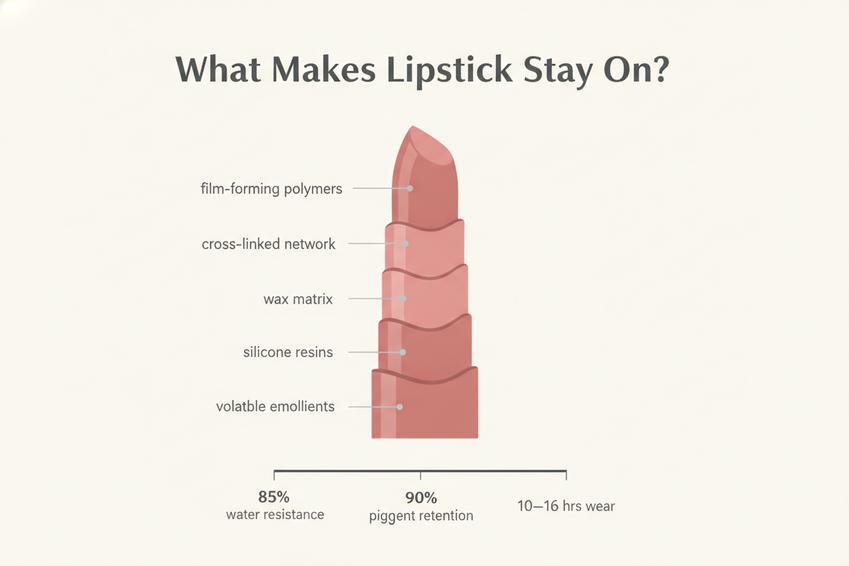
Film-forming polymers: Building a resilient color film
If you’re wondering how to make lipstick stay on all day, start with film-forming agents. These cosmetic polymers create a tight polymer matrix that wraps pigments in a flexible color film.
Here’s how it works in layers:
- Pigments disperse evenly.
- The polymer matrix forms during solvent evaporation.
- A continuous film locks in color adhesion.
- The result: improved wear resistance and stronger film integrity.
Key functional contributions include:
- Enhanced color adhesion
- Improved wear resistance
- Strengthened film integrity
From a formulation standpoint:
-
Core system
- ✅ Film-forming agents
- ✅ Plasticizers for flexibility
-
Performance outcome
- ✅ Smudge control
- ✅ Long-wear comfort
When customers ask how to make lipstick stay on without cracking, this flexible network is the answer. It bends with lip movement instead of breaking apart.
Cross-linking polymers for enhanced fade resistance
Long wear isn’t just about sticking—it’s about staying power under stress. Cross-linked polymers build a reinforced polymer network through chemical cross-linking, improving color stability and fade resistance.
Performance comparison:
| Polymer Type | Network Density | Water Resistance (%) | Pigment Retention (%) | Durability (hrs) |
|---|---|---|---|---|
| Linear polymer | Low | 45 | 60 | 4–5 |
| Branched polymer | Medium | 62 | 72 | 6–7 |
| Cross-linked polymers | High | 85 | 90 | 10–12 |
| Hybrid system | Very High | 92 | 94 | 12–16 |
Nested formulation logic:
-
Structural base
-
Polymer network formation
- Controlled cross-link density
- Balanced flexibility
-
-
Functional outcome
- Higher pigment retention
- Improved durability
According to a 2025 Euromonitor beauty durability analysis, long-wear lip products remain one of the fastest-growing subcategories, driven by consumer demand for transfer-resistant and mask-proof formulas.
So when people Google how to make lipstick stay on, this reinforced network is a big part of the real-world answer.
High melting point waxes and adhesion agents duo
Structure matters. High melting point waxes create a stable wax matrix, while adhesion promoters act as targeted binding agents to enhance lip adhesion.
Short and simple:
Heat resistant.
Shape stable.
Less feathering.
Formulation hierarchy:
-
Structural frame
-
High melting point waxes
- Maintain bullet integrity
- Improve color transfer resistance
-
-
Surface grip system
-
Adhesion promoters
- Boost pigment binding
- Support long-lasting lip adhesion
-
For brands focused on how to make lipstick stay on, pairing wax strength with smart binding agents prevents color drift beyond the lip line. Topfeel Beauty often integrates this dual approach to balance payoff and structural durability without making the formula feel stiff.
Silicone resins and volatile emollients balance
Lightweight yet locked-in—that’s the sweet spot. Silicone resins create durable, water-resistant films, while volatile emollients evaporate after application, triggering efficient film formation.
Step-by-step performance cycle:
- Apply formula rich in volatile emollients.
- Solvents flash off through emollient evaporation.
- Silicone resins condense into a flexible layer.
- A smooth surface enhances color payoff and transfer resistance.
Layered system breakdown:
-
Surface phase
- Silky glide
- Even pigment spread
-
Evaporation phase
- Rapid solvent flash-off
-
Final film
- Enhanced film flexibility
- Comfortable wear
If you’re still asking how to make lipstick stay on without that heavy, dry feeling, this balance is key. It’s also why modern long-wear formulas manufactured by Topfeel Beauty feel thin but last for hours.
Bottom line? If you truly want to master how to make lipstick stay on, the magic isn’t a trick—it’s the smart synergy of film-forming agents, cross-linked polymers, wax structure, and silicone science working together.
Types Of Long-Wear Lipstick Formulas
Long days, coffee breaks, quick selfies—everyone wants to know how to make lipstick stay on without constant touch-ups. The secret isn’t just technique. It’s formula chemistry. From bold matte looks to glossy shine, each type plays a different role in helping lipstick stay on and last all day.
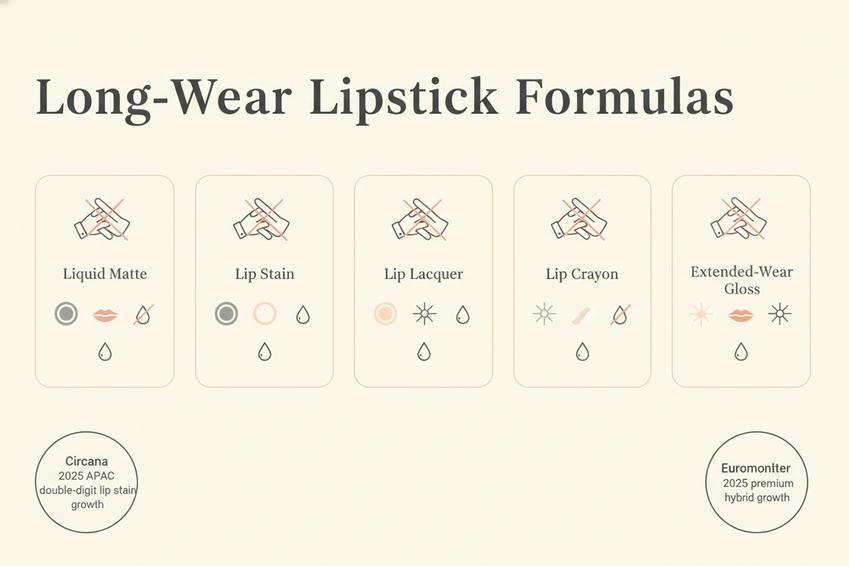
Liquid matte lipsticks
If you’re serious about how to make lipstick stay on, start with liquid matte lipsticks built for grip and dry-down power.
-
Core Composition
-
Film-Forming System
- High-density pigment load for full opaque payoff
- Flexible polymers that create a transfer-resistant layer
-
Volatile Carriers
- Fast-evaporating solvents that speed up drying
- Lightweight texture to prevent cracking
-
-
Application Mechanics
- Precision applicator shapes lip edges cleanly
- Thin layers increase adhesion
- 30–60 second set time boosts wear
-
Performance Factors
- Low oil content reduces breakdown
- Matte surface minimizes slip
- Strong bonding improves lipstick stay on under friction
Want lipstick to last all day? Keep lips lightly exfoliated, apply one thin coat, let it set, then add a second. That’s how to make lipstick stay on without heavy buildup.
Transfer-proof lip stains
Looking for that barely-there vibe that still helps make lipstick stay on?
• stain formulas sink into the lip surface
• Lightweight tint texture feels almost invisible
• transfer-proof finish handles drinks and humidity
- Apply a thin layer.
- Let absorption happen.
- Build for deeper color—yes, it’s buildable.
✦ Key edge: long lasting effect without thick layers.
Recent 2025 global beauty retail tracking from Circana notes that lip stain formats continue double-digit growth in Asia-Pacific due to demand for lightweight, long-wear color that resists transfer.
That lines up with real life—if you want to keep lipstick from fading during busy days, absorption-based color is a smart move.
Long-lasting lip lacquers
Gloss lovers still ask how to make lipstick stay on without losing shine. Here’s the play:
Step 1: Apply thin layer of lacquer for even coverage.
Step 2: Allow silicone resins to settle into a flexible film.
Step 3: Add a second swipe for high-pigment, vibrant impact.
Step 4: Press lips gently—don’t rub—to maintain glossy structure.
These hybrids balance shine and durability. A smooth, non-sticky finish keeps lips comfortable while helping lipstick last all day. It’s not fully transfer-proof, but it’s way more durable than traditional gloss.
Smudge-resistant lip crayons
For precise color and control, crayon formats quietly solve the “lipstick stay on” puzzle.
-
Structural Layers
-
Wax Base
- High melting point waxes for shape retention
- Creamy glide with controlled payoff
-
Adhesion Agents
- Improve smudge-resistant wear
- Reduce feathering
-
-
Format Advantages
- Slim pencil tip for precise edges
- Often retractable packaging
- Buildable color without heaviness
-
Wear Optimization
- Blot once after first layer
- Reapply lightly for lock-in
- Comfortable feel supports extended wear
If you’re learning how to make lipstick stay on, this format gives control plus portability. Private label suppliers like Topfeel Beauty refine wax ratios to balance creamy texture and structure, helping lipstick last all day without cracking.
Extended-wear lip glosses
Yes, gloss can help lipstick stay on—if it’s engineered right.
Here’s how formulas compare:
| Property | Traditional Gloss | Extended-Wear gloss | Matte Liquid | Lip Stain |
|---|---|---|---|---|
| Shine Level | High | High shine | Low | Sheer |
| Transfer Resistance | Low | Moderate | High | High |
| Comfort | Medium | Comfortable, non-tacky | Medium | Lightweight |
| Hydration | Light | Added hydration | Low | Minimal |
Extended-wear glosses use silicone resins to create a flexible film while keeping that juicy look. Some even add subtle plumping effects. The result? Sheer, polished color that stays longer than classic gloss.
“Hybrid lip formats combining comfort and extended wear are driving premium growth in 2025,” reported Euromonitor International in its 2025 Beauty and Personal Care update.
So if you’re still wondering how to make lipstick stay on, remember—it’s part formula, part method. Choose the right system, layer smartly, and your long lasting lipstick can last all day without feeling heavy. Topfeel Beauty continues refining these textures to make long-lasting lip formulas feel easy, not stiff.
3 Steps For How To Make Lipstick Stay On
Keeping color in place all day can feel like a full-time job. If you’ve ever searched how to make lipstick stay on before heading out, you’re not alone. Here’s the real-world, no-fuss breakdown that actually works.
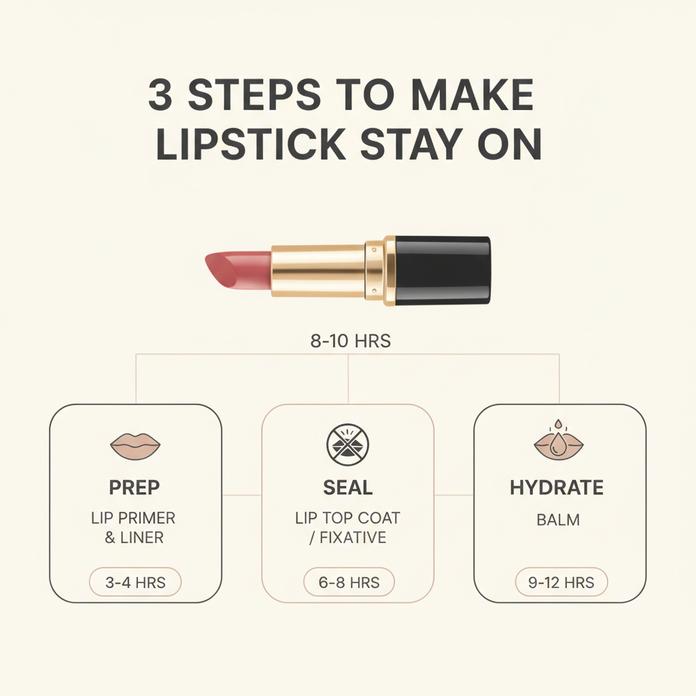
Step 1: Prep with lip primers and liners
If you’re serious about how to make lipstick stay on, prep isn’t optional—it’s the backbone.
-
Build the Base
- Apply a thin layer of lip primer to create a smooth lip base.
- Focus on dry zones to get smooth lips and better grip.
- Let it set for 30 seconds to extend wear.
-
Shape and Secure
- Outline with a lip liner to define lip shape.
- Slightly fill in corners to prevent feathering.
- Choose a shade close to your lipstick for seamless blending.
-
Adhesion Boost
- Layer lipstick over the prepped surface.
- Blot lightly once, then reapply for added hold.
This layered approach improves pigment adhesion and sets the tone for long wear. Formulators at Topfeel Beauty design private label formulas that pair smoothly with primer-based prep, making lipstick last longer without cracking.
Step 2: Seal color using top coat or lip fixatives
Locking color matters just as much as applying it. If you’re wondering how to make lipstick stay on through coffee and lunch, sealing is key.
- Add a lip top coat for a long-lasting finish.
- Use a lip sealant or lip fixative for smudge-proof and transfer-proof wear.
- Lightly mist a compatible setting spray around (not directly soaking) lips for extra color lock.
Here’s how sealing methods compare:
| Method | Avg. Wear Time (hrs) | Transfer Resistance (%) | Shine Level |
|---|---|---|---|
| No Seal | 3–4 | 40% | Natural |
| Lip Top Coat | 6–8 | 75% | Glossy |
| Lip Fixative | 8–10 | 90% | Matte |
| Seal + Blot Layer | 9–12 | 95% | Custom |
Topfeel Beauty’s seal-compatible formulas are designed to bond well with fixatives, reducing fading without that heavy feel.
Step 3: Lock in moisture for non-feathering wear
Long wear doesn’t mean dry lips. In fact, dryness ruins staying power fast.
• Apply lightweight lip balm before makeup, then blot.
• Maintain balanced lip hydration to avoid cracking.
• Choose moisturizing yet film-forming formulas for comfortable wear.
Dry lips = uneven pigment. Hydrated lips = smooth application and non-feathering edges. Smart lip care keeps color flexible, helping prevent dryness while holding shape.
If you’ve been asking how to make lipstick stay on, think prep, seal, hydrate. That’s the combo that keeps your look locked without constant mirror checks.
Matte Vs. Glossy: Which Lasts Longer?
Figuring out how to make lipstick stay on often comes down to one simple choice: matte or glossy. The finish you swipe on changes everything—longevity, comfort, even how often you need reapplication. If you want to truly make lipstick stay on, understanding formula science makes the game easier.
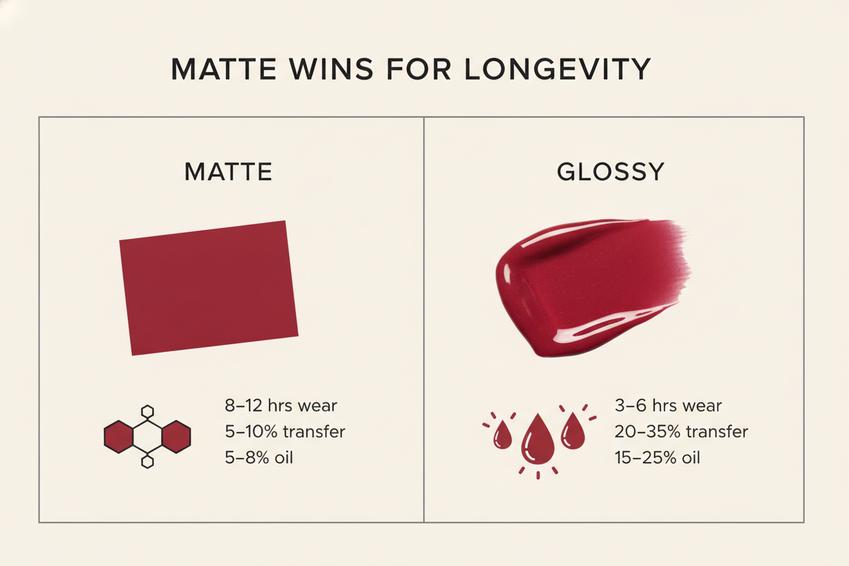
Matte
When people ask how to make lipstick stay on, pros usually point to matte. The reason sits in its pigmentation, polymers, and low oil base.
- High pigmentation
- Strong adherence
- Reduced shine, higher transfer-proof performance
- Film-forming polymers lock color in place
- Balanced waxes add structure
- Low oil ratio improves longevity
Here’s a quick lab-style comparison showing why matte helps lipstick stay on longer:
| Formula Type | Avg. Wear Time (hrs) | Transfer Rate (%) | Oil Content (%) |
|---|---|---|---|
| Classic Matte | 8–12 | 5–10 | 5–8 |
| Soft Matte | 6–10 | 8–15 | 8–12 |
| Gloss Finish | 3–6 | 20–35 | 15–25 |
Nested breakdown of why matte helps make lipstick stay on:
-
Formula Core
-
Polymers
- Create flexible film
- Improve adherence
-
Waxes
- Add grip
- Stabilize texture
-
-
Wear Behavior
- Low slip
- Minimal migration
Short truth? Matte grips. It sets. It lasts.
Recent Mintel beauty reporting (2025) noted that long-wear matte lip products remain a top purchase driver in Asia-Pacific due to demand for “mask-resistant and transfer-resistant performance,” reinforcing why consumers chasing long lasting lipstick lean matte.
Contract manufacturers like Topfeel Beauty engineer matte lines with optimized finish balance—strong hold without that cracked look. If your goal is to keep lipstick on through coffee, calls, and dinner, matte is the safe bet.
Glossy
Gloss brings glow, but shine changes physics. If you’re searching for how to make lipstick stay on all day, gloss needs strategy.
• High shine
• Increased slip
• Frequent reapplication
Because gloss relies on emollients and higher viscosity oils, it boosts hydration and comfort, yet reduces grip. Color moves faster.
Step flow of gloss wear:
- Apply for peak reflectivity
- Oils soften lip surface
- Movement breaks pigment hold
- Reapply to maintain fullness
Layer logic to help lipstick last longer:
-
Base Prep
-
Light liner
- Adds anchor
-
Thin matte stain
- Improves hold
-
-
Gloss Topcoat
-
Sheer layer
- Controls excess slip
-
Gloss feels plush. Lips look fuller. The glow is real. But to truly make lipstick stay on, gloss usually needs backup—liner, layering, blotting.
Topfeel Beauty lip gloss formulas focus on balanced viscosity so shine doesn’t instantly slide away, offering better wear than traditional high-oil gloss.
So, how to make lipstick stay on? Matte wins for pure endurance. Gloss wins for vibe. Your day decides.
References
- how to make lipstick stay on – allure.com
- film-forming agents – cosmeticsandtoiletries.com
- cosmetic polymers – fda.gov
- Euromonitor – euromonitor.com
- exfoliated – vogue.com
- Circana – circana.com
- stain – byrdie.com
- long lasting lipstick – harpersbazaar.com
- lip primer – cosmopolitan.com
- lip shape – elle.com
- setting spray – glamour.com
- lip hydration – healthline.com
- Mintel – mintel.com
Post time: Jun-21-2026