
How Long Can You Keep a Lipstick?
Everyone asks how long can you keep a lipstick, expecting a neat little date, but the real answer hits harder: shelf life is a quality signal, not a countdown.
Formulas oxidize, pigments fade, and cheap packaging lets air sneak in, quietly wrecking consistency and customer trust.
Recent reports from Mintel and Euromonitor highlight consumer scrutiny on stability and packaging integrity, pushing brands toward higher standards.
Key Points Refrain: How Long Can You Keep a Lipstick
➔ Label Limits: Expiration dates and the “Period After Opening” symbol signal tested stability, not precise failure moments.
➔ Stability Signals: Pigment fading and oxidative changes in chambers predict when formula integrity declines.
➔ Storage Tips: Store in cool, dry spots away from light to slow rancidity and microbial risks.
➔ Spoilage Signs: A sour odor, grainy or overly soft texture, and uneven color warn of degraded lipstick.
Surprising Facts: How Long Can You Keep A Lipstick?
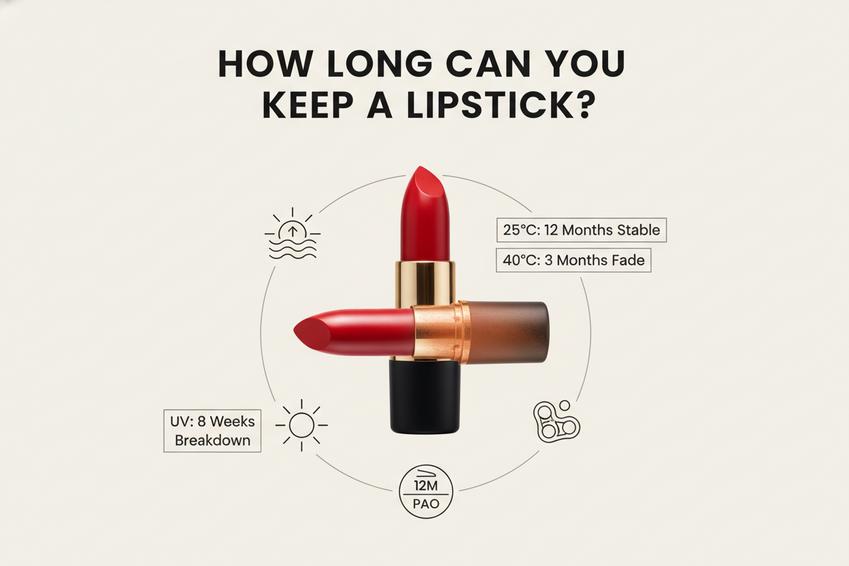
You’ve probably asked yourself, how long can you keep a lipstick before it turns weird. The label gives one date, your makeup drawer tells another story. From shelf life myths to real-world product safety, let’s break down what actually decides lipstick longevity—and how to tell when it’s time to toss it.
Beyond the Label: Lipstick Shelf Life Myths vs. Reality
So, how long can you keep a lipstick if it still smells fine? The printed expiration date reflects lab-based stability testing, not a magical midnight cutoff.
Common myths vs. reality:
- Myth: Lipstick expires exactly on the printed date.
- Reality: True shelf life depends on storage, air exposure, and hygiene.
- Myth: High-end cosmetic formulas last forever.
- Reality: Oxidation doesn’t care about price tags.
When figuring out how long does lipstick last, consider:
- Storage temperature (heat speeds chemical breakdown).
- Direct sunlight exposure.
- Frequency of use and surface contamination.
If texture turns grainy, scent shifts, or color deepens, that’s oxidation at work. Subtle changes often show up before safety risks do. When in doubt, swatch it—if payoff drops or it drags on skin, your lipstick’s usable window may be closing.
Bottom line: How long can you keep a lipstick isn’t a fixed number. It’s a mix of environment, handling, and time.
Why the “Period After Opening” Symbol Matters for 12-Month Use
That tiny jar icon—the PAO symbol—answers the real-life version of how long can you keep a lipstick after breaking the seal.
Understanding the period after opening:
- It reflects microbiological testing under standard product usage conditions.
- It assumes normal exposure to air, minor contamination, and room temperature storage.
- It evaluates preservative systems against bacterial growth and oxidation.
For typical 12-month use:
-
During testing
- A. Repeated opening simulations
- B. Controlled microbial challenges
- C. Monitoring preservative efficacy
-
Risk factors extending beyond lab assumptions
- A. Sharing products
- B. Applying over cold sores
- C. Storing in hot cars
-
Signs your 12 months may be shorter
- A. Sour or crayon-like smell
- B. Sweating beads on surface
- C. Uneven pigment glide
If you’re asking how long does lipstick last once opened, the cosmetic safety answer starts with that symbol—but ends with your habits.
Stability Testing Insights: How Color Fading Predicts Expiry
Color tells a story. In stability testing, labs track color fading, pigment degradation, and other chemical changes to estimate real expiry timelines.
Environmental Impact on Lipstick Formulation
| Condition | Time Frame | Observed Change |
|---|---|---|
| 25°C / Dark Storage | 12 months | Minimal pigment shift |
| 40°C / High Humidity | 3 months | Noticeable color fading |
| UV Exposure Cycles | 8 weeks | Accelerated pigment breakdown |
Here’s how labs interpret this:
-
Controlled chamber storage
- A. Monitor texture stability
- B. Measure oxidation markers
- C. Compare visual indicators
-
Performance evaluation
- A. Swatch consistency
- B. Payoff intensity
- C. Surface integrity
If your once-bright red now looks dull brick, that’s likely pigment degradation in action. When people ask, how long can you keep a lipstick, fading color is one of the clearest real-world clues.
In simple terms: if it looks tired, smells off, or performs badly, it probably is.
Factors Affecting Lipstick Lifespan
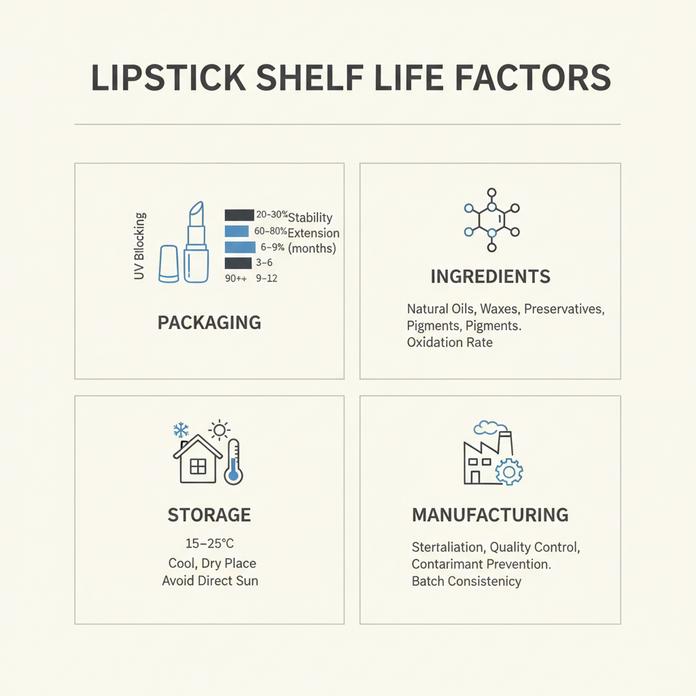
Ever stood in front of your vanity wondering how long can you keep a lipstick before it turns weird? It’s not just about the date stamped on the bottom. Packaging, ingredients, storage, and even factory hygiene quietly decide how long lipstick lasts. If you’ve asked yourself how long can you keep a lipstick or what affects lipstick shelf life, this breaks it down in plain terms.
Packaging Materials: Airtight Seals, UV Protection, and Tube Integrity
If you’re asking how long can you keep a lipstick, start with the packaging. The outer shell does more than look cute.
- Airtight seals reduce oxygen entry.
- Strong caps prevent airflow and bacteria.
- Dense material walls slow chemical breakdown.
- Oxygen exposure → oil oxidation → odor change.
- UV contact → pigment fading → color shift.
- Weak tube integrity → cracks → contamination risk.
Grouped breakdown:
-
Primary container
- Inner cup stability
- Seal tightness
-
Protective layer
- UV protection additives
- Light-blocking pigments
-
Closure system
- Snap-fit cap
- Screw-lock mechanism
| Packaging Type | Oxygen Barrier Level | UV Blocking % | Average Stability Extension (Months) |
|---|---|---|---|
| Standard Plastic Tube | Medium | 20–30% | 3–6 |
| UV-Coated Tube | High | 60–80% | 6–9 |
| Aluminum Casing | Very High | 90%+ | 9–12 |
Brands like Topfeel Beauty invest heavily in upgraded barrier systems because better packaging often answers the question: how long can you keep a lipstick without quality loss?
Key Ingredients’ Impact: Preservatives, Antioxidants, and Emollients
The real magic lives in the formula. When people ask how long lipstick lasts, it usually comes down to ingredients.
Quick hits:
- Preservatives stop microbial growth.
- Antioxidants slow oil degradation.
- Emollients affect texture and melting point.
Deep dive structure:
-
Preservation System
- Broad-spectrum preservatives
- pH compatibility
-
Oxidation Control
- Vitamin E as antioxidants
- Air-sensitive oil stabilization
-
Texture Base
- Wax-to-oil ratio
- Type of emollients
A lipstick rich in unstable oils breaks down faster. That’s when people start Googling how long can you keep a lipstick after opening.
According to a 2025 Cosmetics Europe stability review:
“Oxidative stability and preservative balance remain the two primary predictors of color cosmetic shelf life.”
Topfeel optimizes composition ratios so stability doesn’t mess with color payoff.
Short truth? Bad formula equals short lifespan.
Storage Conditions Explained: Temperature, Humidity, and Light Exposure
You can buy the best product and still ruin it with poor storage.
Keep it simple:
- High temperature = faster oil breakdown.
- High humidity = microbial risk.
- Direct light exposure = pigment fade.
Multi-step logic:
- Heat softens wax.
- Soft wax alters structure.
- Structural shift changes application feel.
Nested factors:
-
Environment
- Stable room temperature (15–25°C)
- Low humidity
-
Light control
- Avoid strong UV radiation
- Store in drawer
Leaving lipstick in a hot car? That cuts down how long you can keep a lipstick dramatically. Even cold–heat cycling causes sweating on the surface.
Tiny symbol rule:
- ✦ Cool
- ✦ Dry
- ✦ Dark
That’s how long lipstick lasts at its best.
Manufacturing Processes: Sanitation Protocols and Controlled Filling
Factory conditions quietly answer the big question: how long can you keep a lipstick before contamination creeps in?
Production chain:
-
Raw material inspection
- Microbial testing
- Oxidation baseline
-
Sanitation protocols
- Equipment sterilization
- Air filtration standards
-
Controlled filling
- Temperature-regulated pouring
- Sealed assembly lines
-
Final quality control
- Stability testing
- Batch traceability
If hygiene slips, contamination risk rises fast. That shortens how long lipstick lasts, even if the packaging looks perfect.
Manufacturers like Topfeel follow strict production monitoring to maintain batch consistency and extend usable life.
So next time someone asks, how long can you keep a lipstick, remember: it’s a mix of packaging, ingredients, environment, and factory discipline. Keep it smart, and your favorite shade stays flawless longer.
3 Signs Your Lipstick Is Spoiled
Lipstick doesn’t last forever, even if it still looks cute in your bag. Many people keep asking, how long can you keep a lipstick, and the answer depends on storage, formula, and signs of breakdown. If you’ve wondered how long does lipstick last or how long is lipstick good for, these clues make it simple.
Rancid Smell: Oxidative Rancidity from Oils and Waxes
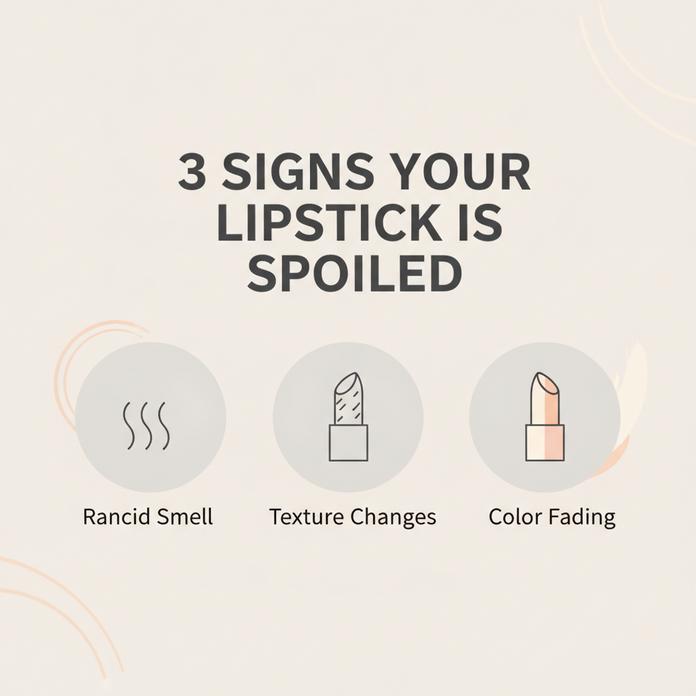
If you’re asking how long can you keep a lipstick, start with the smell. A sharp odor is your biggest red flag.
- Sour or metallic smell
- Crayon-like odor
- Noticeable shift from the original scent
- Open the cap.
- Twist up the bullet.
- Smell near (not on) the surface.
When oils and waxes undergo oxidation, rancidity develops. That’s chemical spoilage, not just aging.
-
Key causes
-
Air exposure
- Loose caps
- Frequent opening
-
Heat
- Car storage
- Sunlight
-
-
Result
- Broken-down oils
- Altered waxes
- Strong odor
If you’re still thinking, how long can you keep a lipstick, remember: once rancidity appears, it’s done.
“Oxidative instability remains a leading cause of cosmetic product degradation during consumer use,” notes a 2025 Mintel beauty packaging report.
Brands like Topfeel focus on stabilizing oils and waxes, but even premium formulas have limits.
Texture Changes: Hardening, Graininess, or Excessive Softness
Wondering again, how long can you keep a lipstick? Check the texture and overall consistency.
- Dragging on lips
- Unexpected graininess
- Sweaty surface
Changes in formula usually show up like this:
-
Hardening
-
Wax crystallization
- Temperature swings
- Cold storage
-
-
Excessive softness
-
Ingredient separation
- Overheating
- Expired stabilizers
-
If the consistency feels off, the breakdown has already started. When people ask how long does lipstick last, the real answer is: until the texture shifts.
A quick swipe test tells you everything. Smooth equals safe. Patchy or gritty equals toss.
Color Inconsistencies: Pigment Degradation and Fading Patterns
Still debating how long can you keep a lipstick? Look closely at the color and appearance.
- Uneven shade
- Surface discoloration
- Dull or faded pigment
Breakdown usually follows this path:
-
Environmental stress
-
UV exposure
- Window sunlight
-
Air contact
- Cap not sealed
-
-
Chemical change
- Pigment degradation
- Visible fading
-
Final outcome
- Altered color
- Compromised appearance
If the shade looks different from when you bought it, that’s not lighting—it’s instability.
So, how long can you keep a lipstick? As long as the smell, texture, and color stay true. The moment one shifts, it’s time to replace it. Choosing reliable manufacturing standards, like those emphasized by Topfeel, can extend wear life—but no lipstick is forever.
References
- Mintel – mintel.com/Mintel
- Euromonitor – euromonitor.com/Euromonitor
- Period After Opening – cosmeticsinfo.org/Cosmetics Info
- shelf life – fda.gov/FDA
- expiration – healthline.com/Healthline
- PAO symbol – byrdie.com/Byrdie
- bacterial growth – ncbi.nlm.nih.gov/NIH
- stability testing – allure.com/Allure
- pigment degradation – cosmeticsdesign.com/Cosmetics Design
- Oxygen exposure – webmd.com/WebMD
- Preservatives – fda.gov/FDA
- Cosmetics Europe – cosmeticseurope.eu/Cosmetics Europe
- oxidation – cosmopolitan.com/Cosmopolitan
- rancidity – harpersbazaar.com/Harper’s Bazaar
- spoilage – bustle.com/Bustle
Post time: Jun-09-2026