
What Services Should Cosmetic Contract Manufacturing Include?
Cosmetic contract manufacturing sounds simple—hand it off and watch products roll out—but reality hits fast: missed deadlines, formula hiccups, compliance headaches. Juggling labs, packaging vendors, and regulators can feel like spinning plates on a bad day, and one slip costs real money.
Topfeel Beauty’s official materials emphasize that strong internal coordination between R&D engineers, quality managers, and regulatory teams is essential to maintain consistency and speed in production, especially for private label scale-ups.
So the real question isn’t who can make your product—it’s who can handle the whole operation without chaos. That’s where the right service mix separates a smooth launch from a mess.
Rhythmic Key Points: Cosmetic Contract Manufacturing
- Define Your Path: Choose between private label, custom formulation, turnkey or bulk manufacturing partnerships to match your brand’s scale and innovation needs.
- Streamline Development: Align R&D-driven formulation, stability testing, and color matching for consistent product quality and fast market entry.
- Enforce Safety First: Integrate microbiological testing, heavy metal screening, batch consistency checks, and GMP compliance to safeguard consumers and reputation.
- Navigate Regulations: Secure FDA and EU Cosmetics Regulation compliance, accurate labeling, and complete safety assessments for seamless global distribution.
- Coordinate Supply Chain: Optimize raw material sourcing, packaging design, logistics, and inventory management to minimize lead times and production bottlenecks.
Types Of Cosmetic Contract Manufacturing Partnerships
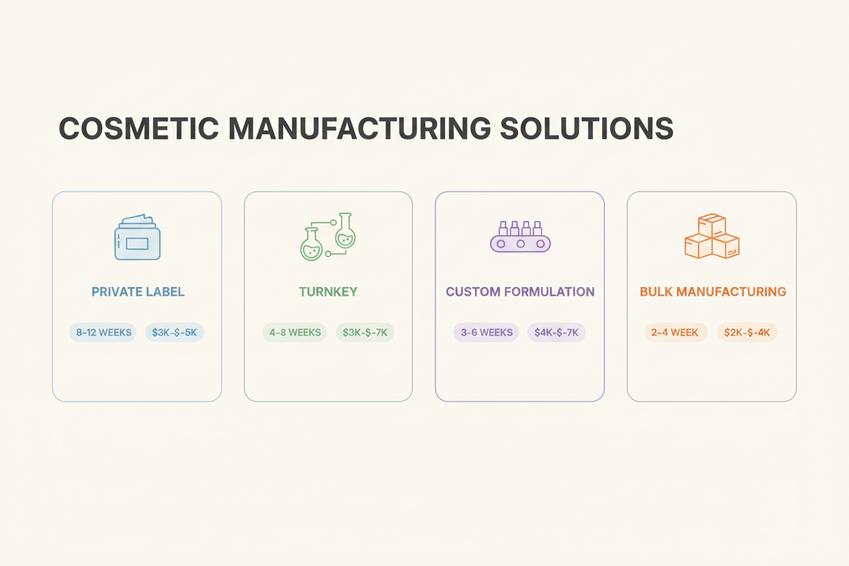
Choosing the right model in cosmetic contract manufacturing can make or break a beauty launch. From white label drops to full-scale manufacturing contracts, each partnership style shapes cost, speed, and brand control. Let’s break down how cosmetic contract manufacturing really works in everyday business terms.
Private label production agreements
In cosmetic contract manufacturing, private label deals keep things fast and simple. Brands select stock formulas that are already market ready, then customize branding and packaging design for distribution.
- Ready-to-sell foundations, lip gloss, skincare creams
- Lower R&D investment
- Faster retail rollout
- Choose from approved white label catalog
- Adjust artwork and outer box
- Confirm MOQs and compliance paperwork
Key advantages sit in three layers:
-
Product layer
- Pre-tested stock formulas
- Existing stability data
-
Brand layer
- Custom packaging design
- Flexible branding assets
-
Supply layer
- GMP production
- Global distribution readiness
For startups testing cosmetic manufacturing partnerships, this route keeps risk low and timelines tight. Topfeel Beauty often supports emerging labels with scalable private label cosmetic production options.
Turnkey solutions collaborations
Turnkey cosmetic contract manufacturing covers the full ride, from concept development to shelf delivery.
Process flow:
- Formulation briefing
- Pilot batch in manufacturing
- Component sourcing and packaging
- Safety file and regulatory compliance
- Final quality control and logistics
Core service modules include:
-
Development
- Trend research
- Shade matching
-
Production
- GMP quality control
- Batch coding
-
Delivery
- Warehousing
- Global supply chain tracking
Brands wanting minimal hands-on management usually prefer this cosmetic manufacturing model. Topfeel Beauty integrates supply chain planning to reduce launch delays.
Custom formulation partnerships
Here, bespoke formula creation defines the relationship. It’s collaborative and technical.
• R&D workshops
• Active ingredient sourcing
• Lab prototype development
Under cosmetic contract manufacturing agreements like this, intellectual property ownership is clearly defined. Ideal for brands chasing differentiation instead of speed.
Bulk manufacturing contracts
This format focuses on large volume output using a client formula.
✓ High production capacity
✓ Optimized raw materials sourcing
✓ Strict quality assurance
Operational structure:
-
Material stage
- Bulk blending
- Ingredient verification
-
Production stage
- Tank processing
- Industrial filling
-
Post-production
- Batch documentation
- Audit-ready records
For established brands managing their own packaging lines, bulk cosmetic contract manufacturing keeps costs steady while ensuring batch consistency. It’s straightforward, efficient, and built for scale.
Wow! 7 Expert Steps For Cosmetic Contract Manufacturing
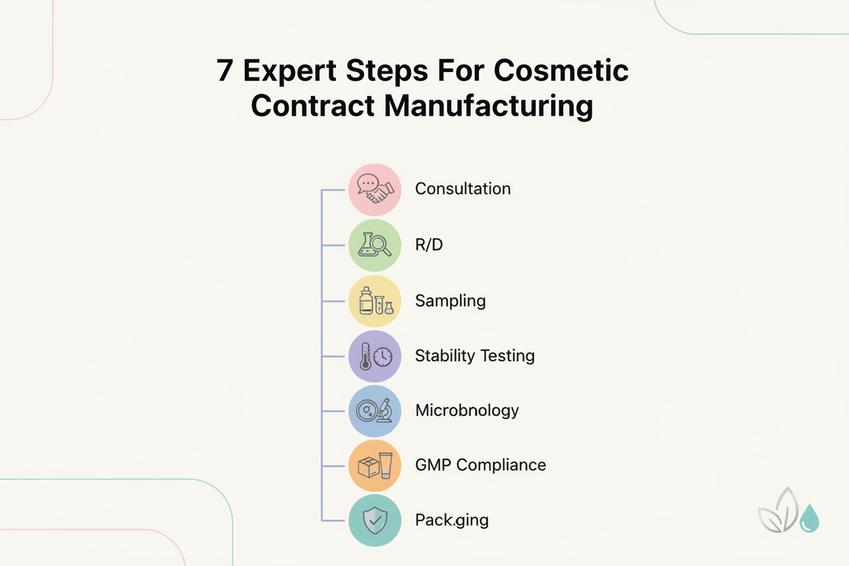
Cosmetic contract manufacturing isn’t just about mixing ingredients and filling bottles. It blends cosmetic science, supplier control, and brand vision into one tight system. When brands choose cosmetic contract manufacturing services, they expect safety, speed, and consistency. From cosmetic product manufacturing to contract cosmetic production at scale, every detail matters—and that’s where experience truly shows.
Initial consultation and ingredient selection
A strong client consultation shapes the entire cosmetic contract manufacturing journey. The conversation usually moves through layered decisions:
-
Clarifying the product concept
- Target skin type
- Finish expectations
- Pricing goals
-
Drafting a precise formulation brief
-
Reviewing regulatory requirements
Then comes technical alignment:
- Ingredient sourcing strategy
- Verification of raw materials
- Careful supplier vetting
- Smart material selection
In professional cosmetic manufacturing, skipping this groundwork is risky. Reliable cosmetic contract manufacturing partners treat ingredient review like risk control, not admin work. Even small shifts in preservative level can impact stability, safety, and compliance in global cosmetic production.
R&D-driven formulation development
In cosmetic contract manufacturing, research and development is where ideas become viable formulas.
• Structured formula creation
• Lab-based prototype development
• Measured efficacy testing
Behind the lab bench:
-
Texture refinement
- Texture development for glide
- Balanced sensory profile
-
Ingredient pairing
- Studying ingredient synergy
- Adjusting actives for safety
A strong custom formulation process blends creativity with hard data. This stage defines whether cosmetic product manufacturing will scale smoothly or stall during testing.
Sample creation and color matching
No cosmetic contract manufacturing project moves forward without solid product samples.
- Prepare prototype samples
- Conduct shade matching
- Run multiple sample iterations
- Secure client approval
For complexion products, color accuracy depends on lab lighting, pigment dispersion, and binder ratios.
Quick checkpoints:
- Texture samples under natural light
- Lab-based visual assessment
- Performance testing after 24-hour rest
In contract cosmetic production, early sampling avoids costly batch corrections later.
Step 4: Stability testing and product innovation
Stability defines real cosmetic contract manufacturing quality.
Key testing flow:
-
Accelerated stability testing
- High heat storage
- Freeze–thaw cycles
-
Long-term stability observation
-
Packaging compatibility review
Below is a typical stability assessment matrix used in cosmetic manufacturing:
| Test Condition | Temperature (°C) | Duration (Weeks) | Humidity (%) | Evaluation Focus |
|---|---|---|---|---|
| Accelerated A | 45 | 12 | 75 | Texture change |
| Room Control | 25 | 24 | 60 | Color shift |
| Refrigerated | 4 | 12 | 50 | Phase separation |
| Freeze-Thaw | -5 to 40 cycle | 6 cycles | — | Emulsion break |
| Light Exposure | 25 | 8 | 60 | Pigment fading |
Careful shelf life assessment plus ongoing product innovation keeps cosmetic contract manufacturing competitive and safe.
Microbiological testing & quality control
Safety is non-negotiable in cosmetic contract manufacturing.
Core safeguards:
- Microbial testing before filling
- Heavy metal screening
- Batch-level quality inspection
Within internal systems:
-
Quality assurance
- Contamination prevention
- Defined purity standards
-
Release protocol
- Documented safety assessment
- Formal batch release
- Verified good manufacturing practices
Professional cosmetic production facilities treat documentation like insurance. Every lot must trace back to raw material origin.
Packaging services and primary packaging design
Packaging in cosmetic contract manufacturing isn’t just about looks.
• Smart packaging design
• Durable primary packaging
• Careful container selection
Nested decisions include:
-
Compliance
- Correct labeling requirements
-
Compatibility
- Product–material interaction
- Verified material compatibility
-
Brand feel
- Strong packaging aesthetics
- Practical functional design
Reliable cosmetic contract manufacturing services also manage global packaging sourcing, ensuring bottles, pumps, and tubes align with transport and shelf demands.
Final batch consistency & GMP compliance
In cosmetic contract manufacturing, scaling up must not change performance.
Key control layers:
- Verified process validation
- Continuous quality control checks
- Strict GMP compliance
Under manufacturing oversight:
-
Production integrity
- Maintained batch consistency
- Enforced manufacturing standards
-
Growth readiness
- Tested production scalability
- Clean documentation management
- Full regulatory adherence
Brands working with Topfeel Beauty gain structured cosmetic contract manufacturing systems built for repeatability. From pilot runs to mass cosmetic product manufacturing, consistency isn’t luck—it’s controlled execution.
5 Key Services In Cosmetic Contract Manufacturing
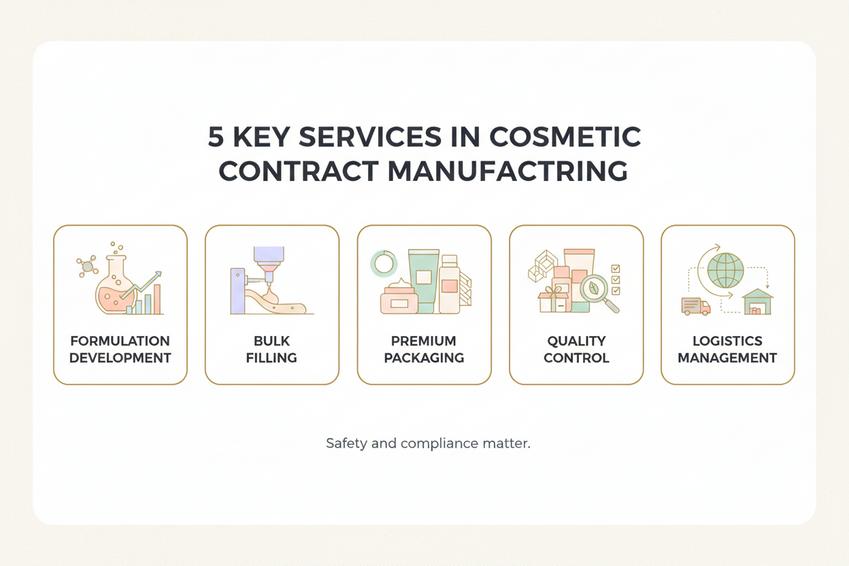
Cosmetic contract manufacturing sounds technical, but it’s really about turning bold beauty ideas into shelf-ready products. From formulation development to shipping, smart cosmetic manufacturing keeps brands fast, compliant, and ready to scale in today’s competitive beauty market.
Formulation development & custom formulation
Strong cosmetic contract manufacturing begins with smart formulation development and true custom formulation.
-
Product Concept & R&D
1.1 Define target user and price tier
1.2 Conduct lab-based R&D trials
1.3 Align with global cosmetic manufacturing standards
-
Ingredient Strategy
2.1 Ethical ingredient sourcing
2.2 Performance validation
2.3 Safety screening and stability testing
-
Testing & Validation
3.1 Prototype creation
3.2 Texture and fragrance refinement
3.3 Compatibility with packaging
Topfeel Beauty supports brands through each phase, turning cosmetic production ideas into scalable formulas that actually work.
Filling services and bulk manufacturing
When formulas are locked, bulk manufacturing kicks in.
- Large-scale blending and mixing
- Controlled manufacturing process oversight
- Precision product filling on automated production line systems
In professional cosmetic contract manufacturing, regular equipment calibration keeps output consistent. High-volume cosmetic production isn’t just about speed; it’s about hygiene, repeatability, and zero surprises.
Primary and secondary packaging services
In cosmetic contract manufacturing, packaging sells before the formula speaks.
-
Primary Packaging
1.1 Bottles, jars, tubes
1.2 Smart material selection
1.3 Functional packaging design
-
Secondary Packaging
2.1 Cartons and inserts
2.2 Retail-ready labeling
2.3 Assembly and kitting
Good cosmetic manufacturing aligns structure with brand identity. Packaging isn’t decoration—it protects, informs, and persuades.
Quality control & heavy metal screening
Safety defines serious cosmetic contract manufacturing.
Rigorous quality control includes batch-level product testing, microbiological testing, and documented safety assessment procedures. Advanced labs perform heavy metal screening to meet strict regulatory compliance demands in the US, EU, and Asia. Clean records and traceable documentation reduce risk across cosmetic production lines.
“Beauty brands are increasing investment in compliance and safety testing as regulatory scrutiny intensifies globally,” noted McKinsey’s 2025 global beauty industry update.
That’s not hype. It’s survival.
Logistics management and inventory management
Smooth cosmetic contract manufacturing doesn’t end at the factory door.
- Coordinate warehousing based on forecast demand.
- Sync inventory management systems with sales data.
- Manage global shipping and regional distribution routes.
- Track order fulfillment in real time.
- Optimize the full supply chain to cut delays.
Topfeel Beauty integrates logistics management directly into cosmetic manufacturing plans, keeping cosmetic contract manufacturing efficient from lab bench to customer doorstep.
Cosmetic Contract Manufacturing Vs. In-House Production
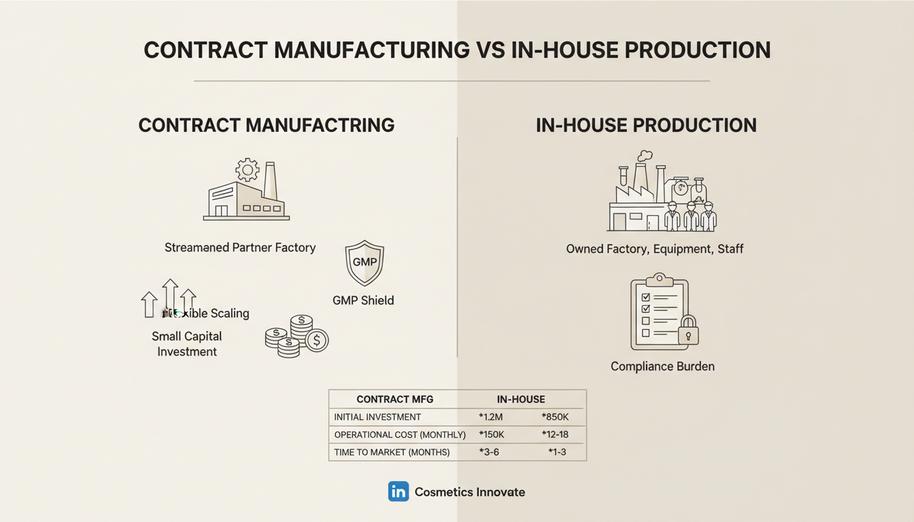
Brands today keep weighing one big question: build your own factory or partner through cosmetic contract manufacturing? The choice affects cost, speed, compliance, and product vibe. From startup indie labels to global beauty lines, the route you take shapes how fast you grow—and how smoothly you sleep at night.
Cosmetic Contract Manufacturing
Cosmetic contract manufacturing breaks into three core layers that drive modern beauty brands:
-
Strategic Development
1.1 Formulation development
- Ingredient screening
- Stability testing
- Safety validation
1.2 Product design
- Texture positioning
- Shade architecture
- Consumer testing panels
-
Operational Execution
2.1 Manufacturing processes
- Bulk compounding
- Filling and sealing
- Batch coding
2.2 Quality control
- Microbial limits
- Viscosity metrics
- Packaging integrity
-
Commercial Support
3.1 Packaging solutions
3.2 Regulatory compliance
3.3 Supply chain management
Brands using cosmetic contract manufacturing often prefer flexible MOQs and scalable output. A reliable cosmetic manufacturer can shift from 5,000 to 100,000 units without forcing a new facility build.
Partnering with specialists like Topfeel Beauty means brands tap into mature cosmetic contract manufacturing systems without burning cash upfront. It’s cosmetic production with guardrails—clean audits, GMP alignment, and fewer headaches.
In-House Production
Running beauty production internally sounds empowering. Total control. Custom workflow. Direct oversight of production facilities and equipment investment. Still, the math gets real fast.
• Heavy capital outlay
• Ongoing staffing requirements
• Dedicated raw material sourcing contracts
- Build or lease compliant space
- Install machinery and testing labs
- Recruit chemists and QA leads
- Secure certifications and audits
Then daily management kicks in:
- Inventory management must sync with production scheduling.
- Quality assurance teams track every batch.
- Downtime equals lost revenue.
Some founders love that control. Others find cosmetic contract manufacturing easier to scale. An in-house cosmetic production line may suit heritage brands with stable SKUs, while fast-moving startups often choose cosmetic contract manufacturing to stay light.
Topfeel Beauty supports hybrid paths too—brands can begin with cosmetic contract manufacturing, validate demand, then gradually invest in internal cosmetic production once volumes justify it. That flexibility keeps growth smart, not reckless.
Pain-Point: Confusing Rules? Expert Regulatory Support
Breaking into global beauty markets through cosmetic contract manufacturing sounds exciting—until the rulebook lands on your desk. From FDA checks to EU paperwork, details matter. Solid regulatory affairs support keeps your cosmetic, contract, and manufacturing workflow compliant, steady, and ready for scale.
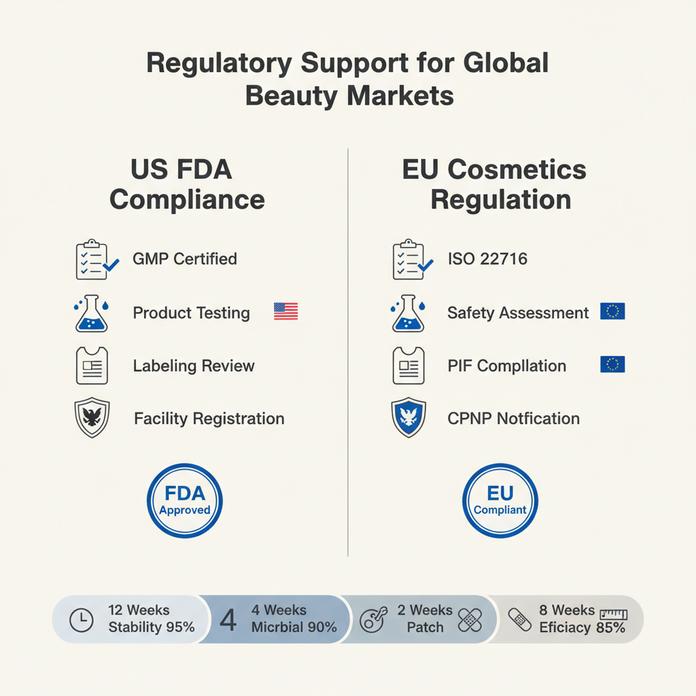
Navigating FDA compliance and EU Cosmetics Regulation
In cosmetic contract manufacturing, regulatory alignment shapes market access and long-term survival.
-
United States – FDA framework
-
Core focus
- Adherence to FDA cosmetic provisions
- Facility compliance with GMP
-
Documentation
- Ingredient substantiation
- Adverse event reporting tied to product safety
-
Market pathway
- Voluntary registration
- Clear claims review for smoother market access
-
-
European Union – EU Cosmetics Regulation
-
Legal backbone
- Full compliance with EU Cosmetics Regulation
- Designated Responsible Person
-
Safety file
- Product Information File (PIF)
- Toxicological profile review
-
Ongoing oversight
- Post-market surveillance
- Coordinated regulatory affairs management
-
For brands using cosmetic contract manufacturing or broader cosmetics manufacturing services, syncing US and EU rules early cuts reformulation costs and avoids shipment holds.
Ingredient disclosure and labeling requirements
Clear labels build trust. Sloppy ones invite penalties.
- Accurate ingredient list using correct INCI names
- Transparent labeling with required warnings
- Honest claims backed by data
- Accessible consumer information
3 compliance checkpoints matter most:
- Full disclosure of restricted substances
- Allergen declaration where thresholds apply
- Country-specific formatting rules
In beauty contract manufacturing, packaging artwork often moves faster than legal review. Smart cosmetic contract manufacturing partners slow that rush just enough to verify font size, net content, and claim wording. Small edits now prevent big recalls later.
Product registration and safety assessment
Strong cosmetic contract manufacturing relies on documented proof of safety.
-
Safety documentation flow
-
Pre-market
- Formal safety assessment
- Compiled CPSR with expert toxicology review
-
Testing layer
- Stability testing
- Efficacy testing
-
Authority filing
- Digital product notification
- Local product registration
-
Key testing benchmarks in contract manufacturing:
| Test Type | Duration (Weeks) | Sample Size | Acceptance Criteria (%) |
|---|---|---|---|
| Stability Testing | 12 | 30 units | ≥95 |
| Microbial Challenge | 4 | 20 units | ≥90 |
| Patch Safety Test | 2 | 50 subjects | ≥98 |
| Efficacy Evaluation | 8 | 40 subjects | ≥85 |
When cosmetic contract manufacturing integrates these checkpoints into daily manufacturing routines, compliance stops feeling like a headache—and starts feeling like a system that simply works. Brands working with Topfeel Beauty gain the advantage of full-scale internal validation, keeping launches swift and perfectly compliant.
References
- Cosmetics Q&A: Why are cosmetics not FDA-approved? – fda.gov/FDA
- EU Cosmetics Regulation 1223/2009 Guide – care-europe.com/Care Europe
- MoCRA: The Updated FDA Cosmetics Regulation Act – dicentra.com/Dicentra
- A Comprehensive Guide to Cosmetic Stability Testing – alfachemic.com/Alfa Chemistry
- Cosmetic Stability – scribd.com/Scribd
- Safety Assessments & Microbial Challenge Tests – oxfordbiosciences.com/Oxford Biosciences
- ISO 22716 Cosmetics GMP – sgsystemsglobal.com/SG Systems Global
- ISO 22716 Cosmetics GMP Guidelines – kiwa.com/Kiwa
- Compliance with the EU Cosmetic Regulation – cirs-group.com/CIRS Group
- Cosmetic Contract Manufacturers Directory – kokoquest.com/Kokoquest
- MoCRA in Practice – garg-law.com/Garg Law
- How FDA is Implementing Landmark Cosmetics Legislation – fda.gov/FDA
- MoCRA US Agent Services for FDA Compliance – cosmeservice.com/Cosmeservice
- How to Comply with EU Cosmetics Regulation – chemsafetypro.com/ChemSafetyPro
- Cosmetic Regulatory Requirements & Compliance Scope – annelltd.com/Annelltd
Post time: Jul-06-2026