
What Is Tinted Lip Balm? Formula, Shade and Packaging Decisions for Private Label
What is tinted lip balm? It’s the middle ground where lip care meets a sheer, buildable splash of color. For private-label buyers, though, that tiny stick can open a surprisingly big can of worms.
Cosmetic chemist Dr. Michelle Wong has explained that balms reduce moisture loss by forming an occlusive layer—useful context when oils, waxes, and pigments must share one formula.
The real job: balancing formula, shade, packaging, compliance, and production scale.
Cheat Sheet: What Is Tinted Lip Balm Unveiled
➔ Emollients: Natural oils seal in moisture for soft, supple lips and smooth application.
➔ Waxes: Key for firmness and glide—beeswax or plant-based waxes deliver non-greasy wear.
➔ Colorants: Sheer, buildable pigments must pass heavy-metal screening and regulatory checks.
➔ Humectants & Antioxidants: Ingredients like glycerin attract moisture while stabilizers guard against rancidity.
➔ UV Filters & SPF: Optional filters boost lip protection; SPF claims demand compliance testing and safety data.
5 Essential Ingredients In Private Label Tinted Lip Balm
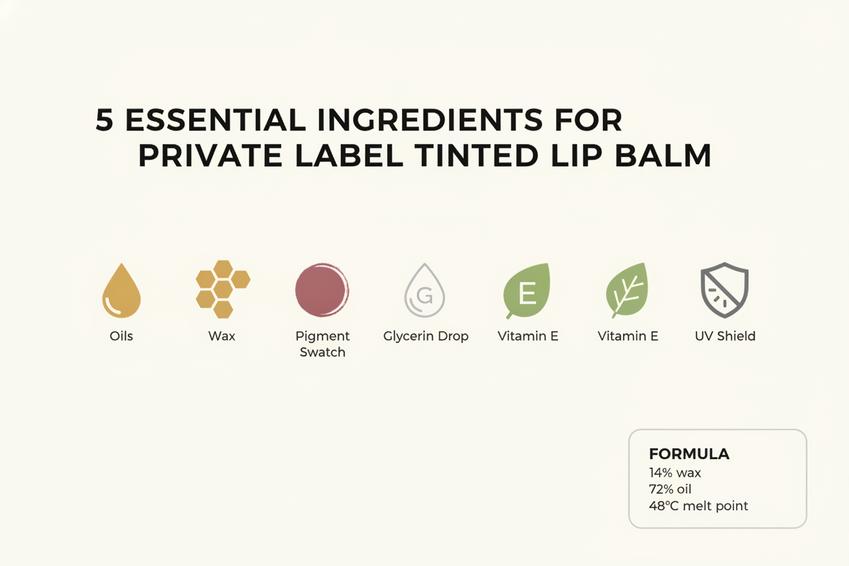
For anyone asking what is tinted lip balm, the simple answer is a moisturizing lip balm that adds soft color while improving comfort. Yet a good formula needs more than tint. For private-label buyers working with full-service cosmetic suppliers such as Topfeel Beauty, oils, waxes, pigments, moisture-supporting ingredients, and optional sun filters all shape daily performance.
Emollients – Natural Oils for Deep Hydration
-
Emollients fill rough spaces on the lip surface, improving skin conditioning and helping limit moisture loss.
- Natural oils and plant-based oils can provide deep hydration and a nourishing feel.
- A balanced oil phase supports the lipid barrier without feeling overly slick.
-
For shoppers wondering what is tinted lip balm compared with lipstick, moisturizing comfort is a key difference. Purity, vegan goals, oxidation resistance, and responsible sourcing should guide oil selection.
Waxes – Smooth Glide and Non-Greasy Finish
Good waxes turn liquid oils into a stable stick or pot with controlled texture. Simple, right? Not quite.
- Natural waxes such as beeswax can raise firmness and create a protective barrier.
- Wax ratios affect balm consistency, melting temperature, and smooth application.
- A well-tuned wax system feels non-greasy while remaining compatible with filling temperature and packaging.
| Prototype | Wax (%) | Oil (%) | Melt Point (°C) | Target Use |
|---|---|---|---|---|
| A | 14 | 72 | 48 | Soft pot |
| B | 18 | 67 | 55 | Standard stick |
| C | 22 | 62 | 61 | Firm stick |
Values are illustrative formulation targets, not universal specifications.
Colorants – Sheer Tint with Buildable Coverage
Colorants explain another part of what is tinted lip balm: a balm supplies moisture plus wearable lip color.
• Pigments and permitted natural dyes can produce a sheer tint.
• Repeated swipes increase color intensity, creating buildable coverage.
• Every cosmetic grade color system should undergo batch consistency checks and appropriate heavy-metal screening while meeting local color-additive rules.
Humectants & Antioxidants – Long-Wear Moisture Boost
-
Humectants
- Ingredients such as glycerin attract water and support hydration.
- Formula design matters because an anhydrous balm may require special handling of water-soluble materials.
-
Antioxidants
- Vitamin E can slow oil oxidation and offer free radical protection.
- Together, these ingredients support long-lasting moisture, product stability, and general skin repair support without turning cosmetic care into a medical claim.
Stability and microbiological testing remain essential.
UV Filters & SPF Factor – Lip Protection Properties
Understanding what is tinted lip balm also means separating ordinary balm from products making sunscreen claims. UV filters may add sun protection and lip protection, but an SPF factor cannot simply be assumed from the formula.
- Select locally permitted filters, potentially including titanium dioxide where allowed.
- Design for suitable UVA and UVB protection.
- Substantiate any SPF or broad-spectrum claim using the testing and regulatory procedures required in the target market.
Formula Vs. Color: Striking The Perfect Balance
Ask what is tinted lip balm and the answer starts with two jobs: caring for lips while adding wearable color. Yet a good tinted balm takes more than mixing Oils with Pigments. The base has to glide, stay comfortable, and hold its shade. As a cosmetic manufacturer, Topfeel Beauty approaches this balance with production needs in mind, offering custom color matching in professional laboratories, so a lip tint can feel good and look right batch after batch.
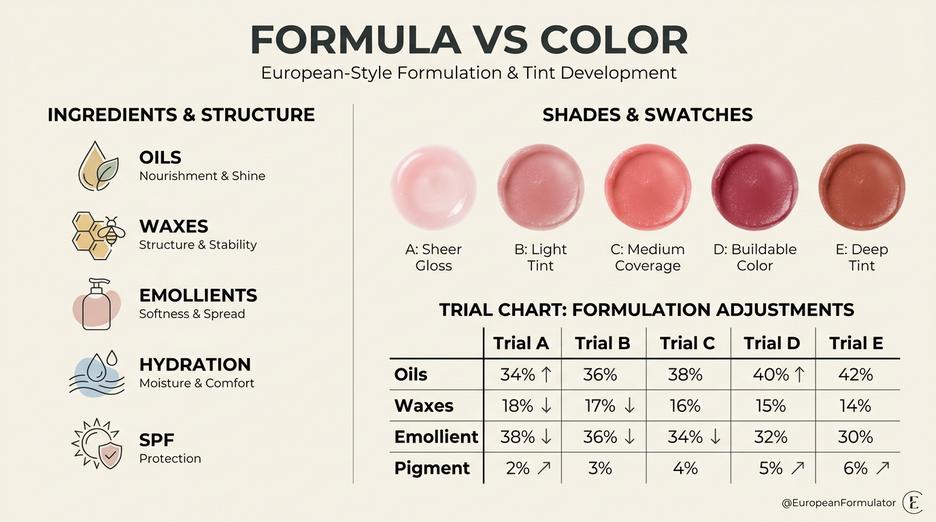
Formula
For anyone wondering what is tinted lip balm, the formula explains why it sits between plain balm and lipstick. Its Ingredients combine a conditioning base with color materials, while careful ratios control melting, payoff, and shelf stability.
-
Base system
-
Emollients help soften lips and improve slip.
-
Waxes build the stick or pot structure.
- Softer wax blends favor glide.
- Firmer blends improve heat resistance.
-
-
Care system
- Oils support spread and a smooth Texture.
- Humectants can support Hydration, while antioxidants help protect oil-based ingredients.
-
Optional protection
- SPF requires approved UV filters, suitable testing, and compliance with the rules of each sales market.
A practical development window may look like this; actual targets vary by raw materials and product format.
| Trial | Oils % | Waxes % | Emollient % | Pigment % |
|---|---|---|---|---|
| A | 34 | 18 | 38 | 2 |
| B | 36 | 17 | 36 | 3 |
| C | 38 | 16 | 34 | 4 |
| D | 40 | 15 | 32 | 5 |
| E | 42 | 14 | 30 | 6 |
Color
So, what is tinted lip balm from a color angle? Think easygoing lip color: more visible than clear balm, usually less opaque than lipstick.
- Pigments set the hue, while concentration drives Color payoff.
- Shades should remain consistent across production batches.
- Tints with a Sheer character let natural lip tone show through; adding pigment raises Opacity and buildability.
- The final Finish can look glossy, satin, or softly natural depending on the base.
When shoppers ask what is tinted lip balm, that buildable quality is a big part of the answer. Packaging, heat, light, and storage can shift color over time, so stability and compatibility testing matter. For brands developing custom tinted balm, Topfeel Beauty can coordinate custom solutions and formulation development with professional color matching laboratories rather than treating color and lip care as separate jobs.
Compact Vs. Tube: Packaging Comparison
Choosing between compact and tube packaging changes how tinted lip products are filled, carried, protected, and applied. For anyone asking what is tinted lip balm, packaging also shapes hygiene, convenience, presentation, and everyday user experience.
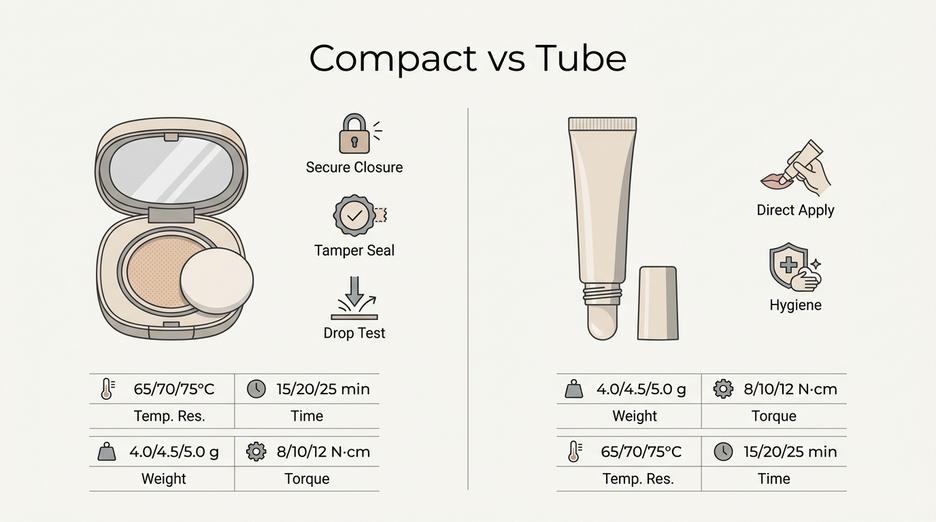
Compact
A compact works well when a tinted balm needs a wider surface, finger application, or a small brush. In practical terms, what is tinted lip balm here? It is a moisturizing lip product with visible color housed in a reusable or single-use Case.
-
Application setup
- A shallow Pan gives fingers or an Applicator easy access.
- Adding a Mirror supports quick touch-ups on the go and improves Portability.
-
Protection choices
-
Material selection affects weight, chemical compatibility, and resistance to drops.
- A firm Closure helps limit accidental opening.
- Tamper evidence can show shoppers if the balm was previously accessed.
-
Custom molds leave room for distinctive Design, but decoration should not interfere with sealing surfaces.
-
Packaging integrity tests can check hinges, seals, drops, and repeated opening cycles. That matters because a tinted lip balm may soften when warm, making secure containment a pretty big deal.
Tube
A tube favors direct Application and keeps fingers away from the balm, giving it a practical Hygiene advantage. A classic Stick format is also pocket-friendly.
| Tube test variable | Typical trial 1 | Typical trial 2 | Typical trial 3 |
|---|---|---|---|
| Fill temperature (°C) | 65 | 70 | 75 |
| Fill weight (g) | 4.0 | 4.5 | 5.0 |
| Cooling time (min) | 15 | 20 | 25 |
| Torque check (N·cm) | 8 | 10 | 12 |
These are example test settings, not universal specifications; actual values depend on formula and package supplier limits.
A Twist-up Dispenser controls product exposure, while a secure Cap helps prevent mess during travel. Tube Size, label dimensions, recycled Material, filling speed, and assembly method also affect private-label output.
For shoppers wondering what is tinted lip balm, the tube answers simply: lip care plus tint in a direct-use package. For producers, filling trials should confirm smooth movement, reliable capping, accurate dosing, and formula compatibility before scale-up. For brands exploring packaging options, Topfeel Beauty, in collaboration with its packaging division, offers related packaging solutions ranging from custom molds to diverse surface decorations.
References
- occlusive layer – byrdie.com/Byrdie
- plant-based waxes – ncbi.nlm.nih.gov/NCBI
- heavy-metal screening – cdc.gov/CDC
- lipid barrier – healthline.com/Healthline
- beeswax – cosmeticsinfo.org/CosmeticsInfo
- color-additive rules – personalcarecouncil.org/Personal Care Council
- glycerin – healthline.com/Healthline
- Vitamin E – webmd.com/WebMD
- microbiological testing – fda.gov/FDA
- titanium dioxide – skincancer.org/Skin Cancer Foundation
- UVA – skincancer.org/Skin Cancer Foundation
- UVB – who.int/WHO
- broad-spectrum – ewg.org/Environmental Working Group
- antioxidants – paulaschoice.com/Paula’s Choice
Post time: Aug-18-2026