
What Is the Base for Makeup in Product Development?
Ask what is the base for makeup in a boardroom, and you’ll get polite guesses—but profits hinge on it. Base products decide texture, loyalty, and whether customers come back or bounce.
Get the formula wrong and your line feels cheap; get it right and everything clicks, from shade to shelf appeal, like a well-oiled machine customers trust.
Key Points Unveiled: What Is the Base for Makeup
➔ Primer & Foundation Role: Smooth texture, blur pores, match skin tone, buildable coverage, natural or matte finish.
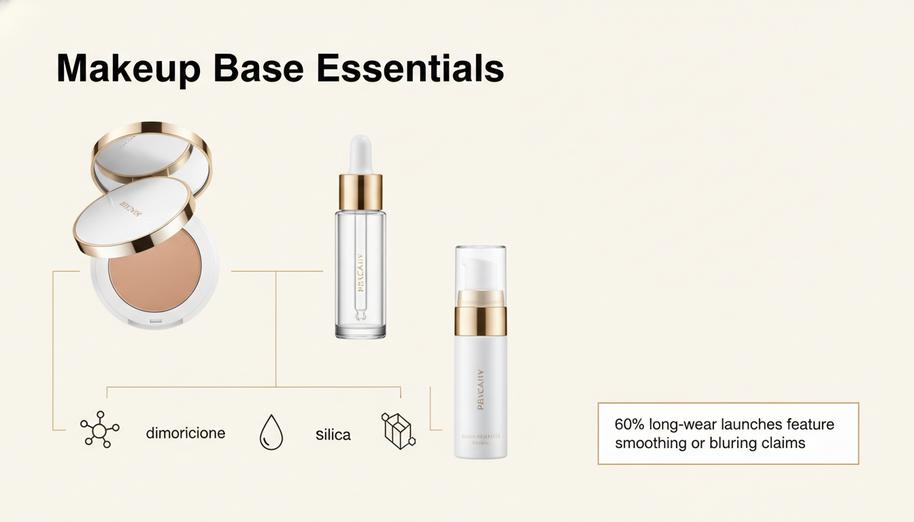
➔ Key Ingredients: Dimethicone for silky feel, glycerin for hydration, silica for oil control and matte effect.
➔ Formulation Characteristics: Oil-free for oily skin, long-wearing durability, non-comedogenic to prevent clogged pores.
➔ Packaging Solutions: Airless pumps for stability, tubes for hygiene and portability, jars for richer textures.
What Components Define A Makeup Base
A flawless look always starts with one big question: what is the base for makeup? If your skin prep feels off, everything layered on top struggles. Let’s break down the real groundwork behind a reliable makeup base in a way that actually makes sense.
Primer and Foundation: Laying the Groundwork
When people ask what is the base for makeup, the answer usually begins with two staples: primer and foundation. These are the backbone of proper skin preparation and smooth blending.
-
Primer
- Refines pores
- Improves smooth application
- Extends wear time
-
Foundation
- Creates even tone
- Offers adjustable coverage
- Sets the visible groundwork
Here’s how they function together:
- Prep skin with hydration.
- Apply primer to improve grip and blur texture.
- Layer foundation for balanced color and finish.
Think of it as building layers that lock in comfort and performance.
For brands exploring base options, Topfeel Beauty offers private label cosmetic solutions that assess primer and foundation compatibility, ensuring that the makeup base feels breathable rather than heavy.
In short bursts:
- Smooth skin.
- Balanced tone.
- Long wear.
- Confident finish.
If someone asks again, “what is the base for makeup?”—this duo is your starting line.
Key Ingredients Spotlight: Dimethicone, Glycerin, Silica
Behind every solid answer to what is the base for makeup lies smart chemistry. The right key ingredients shape how a base feels, lasts, and protects.
Core formulation components often include:
-
Dimethicone → a silicone-based emollient
- Creates a silky shield
- Fills micro-lines
- Enhances glide
-
Glycerin → a powerful humectant
- Pulls moisture into skin
- Supports hydration balance
- Prevents dry patches
-
Silica → advanced texture enhancer
- Controls oil
- Boosts matte effect
- Improves longevity
According to a 2025 Mintel Global Beauty Report:
Silicone-based base formulations continue to dominate long-wear categories, with over 60% of new complexion launches highlighting smoothing or blurring claims.
That explains why dimethicone, glycerin, and silica appear repeatedly in high-performance base products.
As a private label cosmetic supplier, Topfeel Beauty offers custom formulation development to balance these ingredients for specific texture requirements. So when someone wonders again about the base for makeup, remember—it’s not magic. It’s ingredient science.
Formulation Characteristics: Oil-free, Long-wearing, Non-comedogenic
Answering what is the base for makeup also means understanding performance claims. Not all bases behave the same.
Key formulation properties include:
-
Oil-free
- Ideal for oily skin
- Reduces shine
- Supports matte finish
-
- Resistant to sweat
- Less breakdown over time
- Maintains consistent coverage
-
Non-comedogenic
- Supports skin compatibility
- Helps reduce clogged pores
- Suitable for acne-prone users
These characteristics influence durability and comfort.
Quick reality check:
- Oily skin? Go oil-free.
- Busy day? Choose long-wearing.
- Sensitive pores? Non-comedogenic matters.
A strong makeup base isn’t only about coverage. It’s about how the product lives on your skin for hours. For brands seeking long-wearing characteristics, Topfeel Beauty provides private label and contract manufacturing options focused on stability and wear time.
So again, what is the base for makeup? It’s the blend of smart formulation and skin-aware design.
Packaging Solutions: Airless Pump, Tube, Jar Container
Even the best formula struggles if storage fails. Smart packaging solutions protect the makeup base from contamination and oxidation.
Main container design options include:
-
Airless pump
- Minimizes air exposure
- Improves product preservation
- Precise dispensing mechanism
-
Tube
- Travel-friendly
- Hygienic squeeze control
- Lightweight material
-
Jar container
- Suitable for thicker textures
- Easy access
- Requires careful handling
Symbol snapshot:
• Hygiene
• Stability
• Convenience
Steps in selecting packaging:
- Assess formula viscosity.
- Evaluate oxidation sensitivity.
- Match with proper packaging solutions.
- Confirm long-term stability tests.
Topfeel Beauty offers packaging support with color-cosmetic compatibility considerations to help maintain formula integrity.
So the next time someone asks, what is the base for makeup, you can answer confidently: it’s the synergy of primer, foundation, ingredients, formulation traits, and smart packaging—all working together for smooth, even, reliable skin results.
How Do Private Labels Choose Base
When brands ask what is the base for makeup, they’re really asking what sits under everything—coverage, comfort, and wear time. Private labels break down “what is the base for makeup” into skin feel, pigment load, and long-term stability. In simple terms, the base makeup foundation defines how the whole formula behaves.
Ingredient Sourcing & Quality Control Best Practices
Understanding what is the base for makeup starts with raw materials. A solid base relies on tight supplier vetting and crystal-clear specifications.
-
Raw Material Evaluation
1.1 Identity & Purity
- Verify purity levels against documented specifications.
- Confirm absence of restricted substances.
1.2 Documentation
- Batch-level traceability records.
- Safety data sheets aligned with global rules.
-
Supplier Qualification
2.1 Audit Process
- On-site checks of quality assurance systems.
- Review of testing protocols for microbiology and heavy metals.
2.2 Performance Monitoring
- Stability consistency across three consecutive lots.
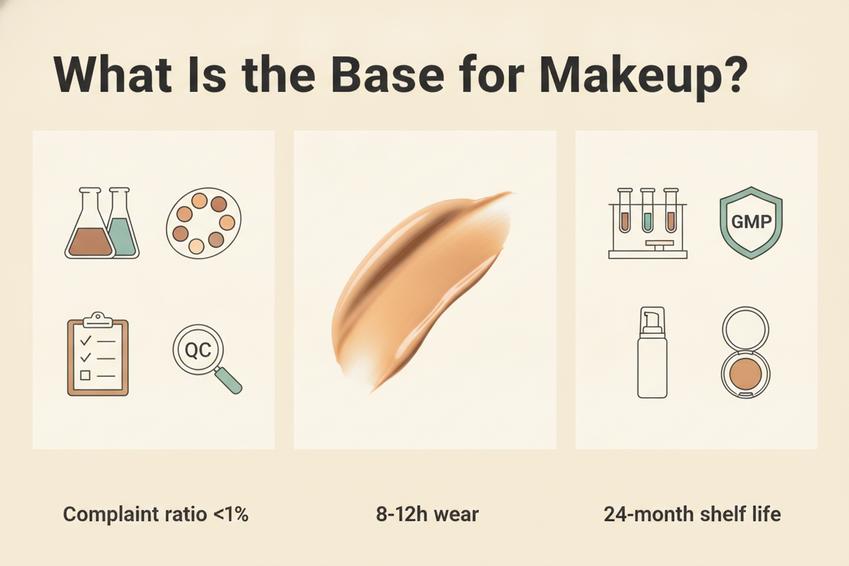
- Complaint ratio tracking below 1%.
-
Ongoing Quality Control
- Incoming inspection sampling.
- In-process viscosity and shade checks.
- Final microbial challenge testing.
Short answer? The base for makeup lives or dies by control.
Custom Formulation Development for Buildable Coverage
If someone asks what is the base for makeup in a buildable formula, the reply sits in the lab—inside formulation and sharp R&D work.
-
Core Composition
1.1 Structural Elements
- Pigments for opacity.
- Film formers for adhesion.
- Rheology modifiers shaping flow and texture.
1.2 Skin Feel Agents
- Lightweight emollients.
- Oil-balancing powders.
-
Buildability Engineering
- Adjust pigment dispersion for layer control.
- Balance viscosity so coverage stacks without caking.
- Stress-test for oxidation over 8–12 hours.
-
Consumer Fit
- Dry skin: add cushioning emollients.
- Oily skin: tweak absorbent systems.
That’s how base makeup foundation turns flexible instead of heavy.
GMP Compliance and Refillable Packaging Decisions
A clean answer to what is the base for makeup also includes manufacturing discipline.
-
Production Control
1.1 GMP Framework
- Documented quality systems.
- Equipment sanitation logs.
1.2 Regulatory compliance
- FDA/EU dossier checks.
- Stability reports for 24-month shelf life.
-
Packaging Strategy
- Material selection based on formula compatibility.
- Eco-design for refill cartridges.
- Verified recyclability claims.
-
Consumer Experience
- Airless pumps protect integrity.
- Refillable pods reduce waste without hurting performance.
So, what is the base for makeup? It’s chemistry, control, and conscious packaging—working together behind the scenes.
4 Ingredients Shaping Your Makeup Base
If you’ve ever asked what is the base for makeup, you’re really asking what makes foundation sit right, last long, and look smooth. The answer lives in four core ingredients that quietly shape your entire base routine.
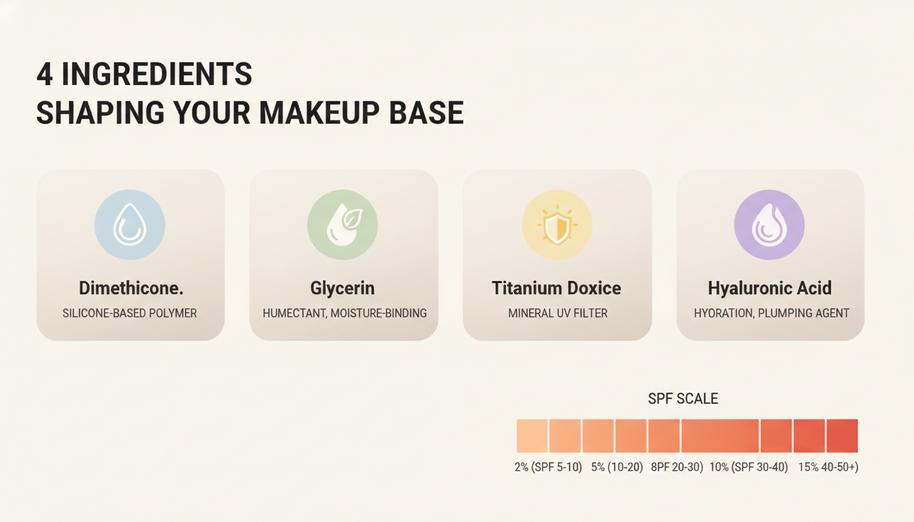
Dimethicone for Smooth, Pore-Blurring Texture
When people search what is the base for makeup, smoothness is usually the goal. Dimethicone, a type of Silicone, acts like a flexible mesh over skin.
- Enhances Smoothness
- Supports Pore-blurring
- Improves overall Skin feel
Here’s how it works in real life:
- Applied in a Primer
- Spreads evenly due to its Emollient slip
- Creates refined Texture before foundation
Now break it down deeper:
-
Surface Effect
- Fills micro-gaps visually
- Softens uneven areas
-
Performance Boost
- Helps pigment glide
- Reduces patchiness
-
Wear Comfort
- Breathable layer
- Lightweight finish
If you’re still wondering what is the base for makeup, think of dimethicone as the quiet filter under everything.
Glycerin’s Hydrating Properties and Dewy Finish
Dry skin often changes the answer to what is the base for makeup. Enter Glycerin, a classic Humectant known for Water-binding power.
- Pulls moisture into skin
- Enhances Hydration
- Creates that subtle Dewy finish
“Hydration-focused formulas are driving growth in face makeup, especially in hybrid skincare-makeup products,” noted McKinsey’s 2025 global beauty insights report.
Nested look at its impact:
-
Moisture Cycle
- Attracts water
- Reduces transepidermal loss
-
Visual Result
- Soft Skin glow
- Less flaking
-
Formula Pairing
- Works inside Moisturizer bases
- Balances with light Emollient systems
For many, what is the base for makeup equals hydration first, coverage second.
Titanium Dioxide’s SPF Protection and Even Tone
Protection matters when defining what is the base for makeup. Titanium Dioxide is a Mineral filter delivering UV protection and subtle Coverage.
Scientific Performance Snapshot
| Concentration (%) | SPF Range | UVA/UVB Coverage | Tone Effect | Particle Type |
|---|---|---|---|---|
| 2% | 5–8 | UVB-focused | Mild brightening | Pigment grade |
| 5% | 10–15 | Broad UVB | Noticeable even tone | Micronized |
| 8% | 20–25 | Partial UVA/UVB | Enhanced coverage | Coated |
| 10% | 25–30 | Broad spectrum* | Strong tone correction | Nano-treated |
| 15% | 30–50 | Broad spectrum* | High opacity | Dispersed system |
(*when combined with complementary filters)
Layered understanding:
-
Protection
- Acts as sunscreen
- Reflects UV rays
-
Cosmetic Role
- Functions as Pigment
- Improves Even tone
So when someone asks what is the base for makeup, it’s also about safe daily wear.
Hyaluronic Acid for Long-wearing Hydration
Long days demand comfort. Hyaluronic Acid, another Humectant, supports Water retention and Skin plumping.
- Boosts moisture reserve
- Reduces cracking
- Extends Long-wearing comfort
Step flow inside a formula:
- Blends into liquid base or Serum foundation
- Locks in Hydration
- Maintains flexible film
Deeper structure:
-
Immediate Effect
- Plumper look
- Smoother lines
-
Midday Stability
- Less cakiness
- Balanced shine
-
Skin Support
- Reinforces barrier
- Works with Moisturizer systems
Topfeel Beauty provides custom formulation services that incorporate these humectants and emollients for private label brands. And honestly, when you break down what is the base for makeup, it’s not just foundation—it’s the smart chemistry underneath.
Base Breakdown Issues? Improve Base Stability Now
Before answering what is the base for makeup, it helps to understand why bases fail in the first place. A solid cosmetic base keeps everything smooth, safe, and stable. When it breaks down, texture, comfort, and wear all suffer—fast.
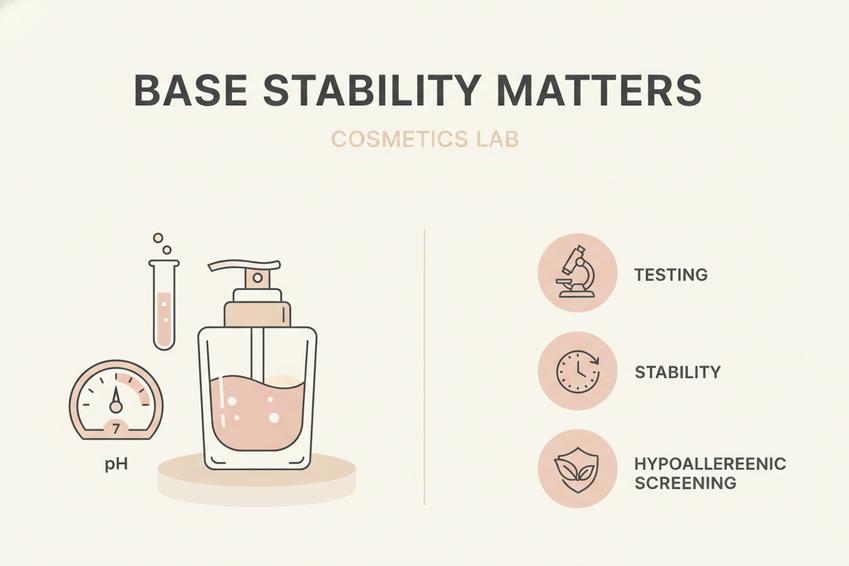
Emulsion Failures: Tackling Separation with Stabilizers
When asking what is the base for makeup, the conversation often starts with emulsion design. A cosmetic base blends oil and water, yet poor formulation leads to visible separation and reduced stability.
-
Common red flags:
- uneven texture
- oil pooling
- pigment streaking
- Weak stabilizer system
- Poor ingredient compatibility
- Inadequate mixing speed during bulk production
To fix this, labs refine the cosmetic base through layered controls:
-
Emulsion Structure
- Oil phase balance
- Water phase purity
- Emulsifier ratio
-
Stability Reinforcement
- Polymer-based stabilizer selection
- Viscosity adjustment
- Temperature cycling tests
-
Formulation Review
- Raw ingredient screening
- Small-batch validation
- Scale-up stress checks
A stable base isn’t flashy. It just works. Manufacturers evaluate formulations to prevent separation. Topfeel Beauty offers contract manufacturing services with stability assessments for custom formulas before they ever reach shelves.
pH Imbalance Causes: Zinc Oxide vs. Formula Integrity
People searching what is the base for makeup rarely think about pH. Yet imbalance can wreck formula integrity.
Key friction point: zinc oxide.
- It may shift stability
- It can trigger unwanted ingredient interaction
- It affects long-term product feel
Balanced product development requires:
-
pH Control
- Buffer systems
- Gradual neutralization
-
Ingredient Interaction Testing
- Active compatibility
- Preservative checks
-
Stability Monitoring
- Heat exposure
- Light resistance
Short version? If the pH drifts, the base drifts. When exploring what is the base for makeup, remember that even minor shifts can impact SPF performance and texture. As a cosmetics manufacturer, Topfeel Beauty implements in-process checks to support formula consistency.
Quality Control Measures: Ensuring Hypoallergenic Consistency
So, what is the base for makeup when sensitive skin is involved? It’s a balance of quality control, hypoallergenic screening, and strict testing.
Core checkpoints:
- Raw material audit
- Microbial screening
- Patch testing
Quality layers include:
-
Safety Standards
- Dermatologist review
- Allergen exclusion lists
-
Formulation Consistency
- Batch comparison
- Texture alignment
-
Product Stability
- Shelf-life simulation
- Packaging compatibility
Consistency builds trust. A well-monitored formulation protects skin and supports long-term product stability. And when brands take that seriously, irritation risks drop and performance stays steady—exactly what a real makeup base should deliver.
Silicone Vs. Water Base: Which Wins?
Before choosing products, many ask, what is the base for makeup and how does it affect skin? In simple terms, the base for makeup shapes texture, wear time, and finish. Knowing what is the base for makeup helps you avoid cakey results and wasted money.
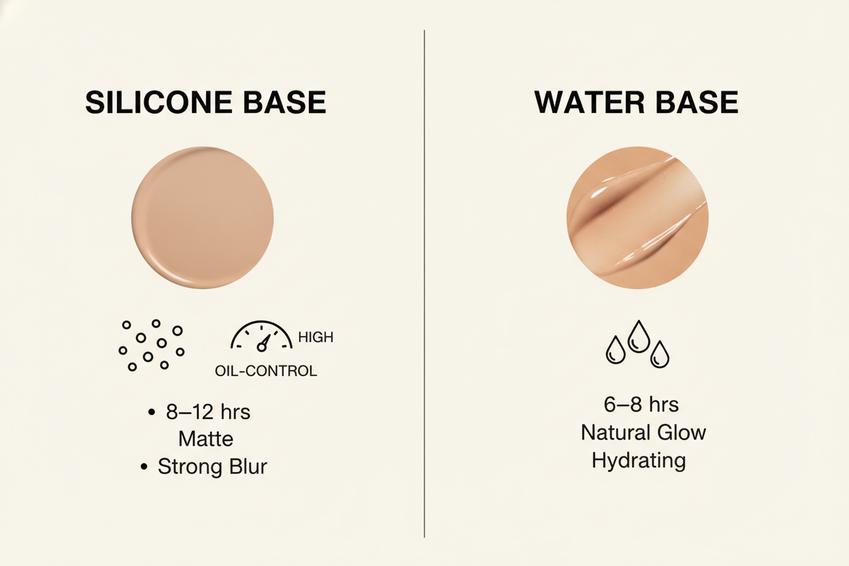
Silicone Base
When people search what is the base for makeup, silicone formulas often pop up first. Why? Because Silicone Base products are built around ingredients like Dimethicone, designed for Smooth texture and serious Pore blurring.
-
Key traits:
- Long-wear
- Water resistance
- Mattifying finish
-
Performance Breakdown
-
Texture Control
- Fills uneven areas with a silky layer
- Works well under Primer and Foundation
-
Oil Management
- Controls shine for oily skin
- Supports extended wear in humid weather
-
Finish Impact
- Creates soft-focus blur
- Reduces visible pores fast
-
Here’s a quick comparison snapshot:
| Feature | Silicone Base | Wear Time (hrs) | Finish Type |
|---|---|---|---|
| Oil Control | High | 8–12 | Matte |
| Hydration Level | Low | 6–8 | Soft Matte |
| Pore Effect | Strong blur | 10+ | Filtered Look |
“Consumers continue to prioritize long-wear and oil-control claims in facial makeup, with matte foundations leading growth in 2025,” notes Mintel’s Global Beauty Report (2025).
So if you’re still wondering what is the base for makeup that lasts all day, silicone might be your go-to.
Water Base
Now let’s flip it. If someone asks again, what is the base for makeup, but wants comfort and glow, this is it.
Water Base formulas focus on Lightweight texture and easy Absorption. Think breathable skin, not heavy layers.
-
Core benefits:
- Hydrating
- Breathable
- Ideal for Sensitive skin
-
Functional Layers
-
Skin Feel
- Quick-absorbing fluids
- No greasy film
-
Finish Style
- Natural finish
- Fresh Dewy finish
-
Product Pairing
- Works well with Tinted moisturizer
- Blends smoothly into daily routines
-
If you’ve ever typed what is the base for makeup hoping for glow instead of grip, water-based options answer that call. The base for makeup here feels barely there. It hydrates. It moves with your skin.
In short, what is the base for makeup depends on your vibe: blur and lock, or fresh and light.
Sensitive Skin Line: Soothing Base Solutions
Sensitive skin asks a real question every morning: what is the base for makeup that won’t sting, clog, or flare up redness? The answer isn’t one-size-fits-all. The base for makeup should calm, protect, and smooth—without drama.
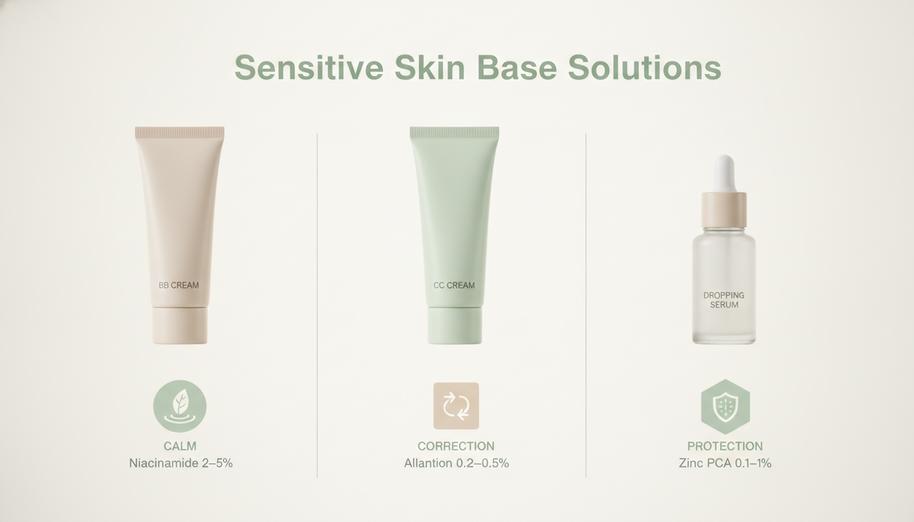
Hypoallergenic BB Cream with Niacinamide Relief
When people ask what is the base for makeup, a smart pick for reactive complexions is a Hypoallergenic BB cream with Niacinamide.
-
Core role of a makeup base
- Calm visible irritation
- Even out complexion tone
- Act as breathable skin relief
-
Barrier Support
1.1 Niacinamide helps reduce redness linked to sensitive skin.
1.2 Lightweight pigments blur uneven patches.
1.3 Non-fragrant systems lower reactivity risk.
-
Coverage Logic
2.1 Sheer-to-buildable layers prevent caking.
2.2 Flexible film formers move with facial expressions.
-
Daily Wear Performance
3.1 Works as both makeup base and light foundation.
3.2 Pairs well with mineral sunscreen.
Key ingredient comparison:
| Ingredient | Typical % Range | Skin Benefit |
|---|---|---|
| Niacinamide | 2–5% | Redness reduction, oil balance |
| Allantoin | 0.2–0.5% | Soothing support |
| Zinc PCA | 0.1–1% | Light sebum control |
Topfeel Beauty offers private label solutions, including formulas like BB creams, designed to support various skin types. It’s less about heavy coverage, more about a stable foundation base layer that keeps complexion calm.
Soothing CC Cream for Redness Correction
If redness steals the spotlight, a Soothing CC cream steps in as the color correcting makeup base.
- Green-tinted micro-pigments neutralize pink tones.
- SPF blends reduce UV-triggered flushing.
- Breathable texture suits sensitive skin.
Think of it as a smart base for makeup: part skincare, part tone-balancer. The formula focuses on redness correction, then smooths skin tone so foundation isn’t overloaded.
Quick breakdown of what makes it click:
- Correct
- Protect
- Perfect
A good CC cream doesn’t mask; it adjusts. The finish looks like real complexion, just more even. When customers wonder again what is the base for makeup, this option shows that the base can also treat color issues gently.
Dropper Bottle Serums for Acne-Prone, Sensitive Skin
For breakout-prone users, the answer to what is the base for makeup often starts before tint. A Dropper bottle serum becomes the invisible skin solution under everything.
- Precision dosing keeps application clean.
- Fast-absorbing liquids reduce pilling.
Layering logic:
-
Pre-Base Prep
1.1 Apply 2–3 drops of serum.
1.2 Focus on blemish-prone zones.
-
Treatment Focus
2.1 Mild exfoliating acids at low percentages.
2.2 Soothing agents for acne-prone yet sensitive skin.
-
Makeup Compatibility
3.1 Non-comedogenic finish supports blemish control.
3.2 Acts as a breathable base for makeup substitute on light days.
This approach reframes the whole idea of the base for makeup. Sometimes the real makeup base is skincare that steadies oil flow and reduces flare-ups.
Topfeel Beauty offers R&D support for integrating skincare actives into cosmetic bases, alongside relevant packaging solutions like dropper bottles. In simple terms, if someone asks again, what is the base for makeup, the answer might be this: calm skin first, coverage second.
References
- Dimethicone for Skin: Benefits and How to Use It – byrdie.com
- Glycerin Topical – webmd.com
- Silica – cosmeticsinfo.org
- Moisturizers for Eczema – nationaleczema.org
- What Does Noncomedogenic Mean? – allure.com
- Good Manufacturing Practice (GMP) Guidelines/Inspection Checklist – fda.gov
- Does Makeup Expire? – healthline.com
- Sunscreen – skincancer.org
- Hyaluronic Acid – clevelandclinic.org
- Emulsions – sciencedirect.com
- Sunscreen FAQs – aad.org
- Hypoallergenic cosmetics: Do they exist? – mayoclinic.org
- How Niacinamide Helps Skin – paulaschoice.com
- 15 Best CC Creams of 2024 – cosmopolitan.com
- How to Color Correct Your Face – instyle.com
Post time: Jul-09-2026