
Private Label Makeup Primer: OEM/ODM Formula Solutions
What Is Primer In Cosmetics? For brands buying primer at scale, the sharper question is whether a ready-made formula or custom OEM/ODM route fits the launch.
Ingredients, finish, testing, and packaging must work as one system. Circana’s 2025 U.S. beauty reporting shows makeup remained a prestige category, reinforcing product development.
Key Points Symphony: What Is Primer In Cosmetics
- Creates a smooth base that enhances foundation adhesion, extends wear, and resists creasing.
- Uses silicone derivatives (dimethicone, silica) to blur pores and refine skin texture instantly.
- Incorporates hydrating actives (hyaluronic acid, vitamin E) for moisture retention and comfort.
- Employs color-correcting pigments plus niacinamide for tone-evening and skin benefits.
- Available as ready-made white-label or fully custom OEM/ODM formulas—with stability testing and packaging options from airless pumps to matte jars.
This guide covers primer performance, formulation choices, and private-label manufacturing pathways.
What Is Primer In Cosmetics? 4 Facts
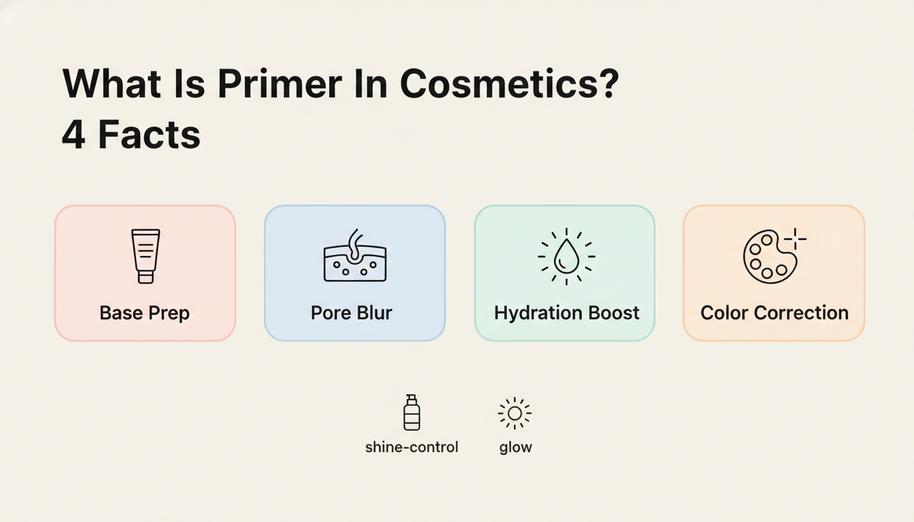
What Is Primer In Cosmetics? Put simply, primer is a prep layer worn before base makeup to help cosmetics sit more evenly. Its cosmetic formula may smooth texture, manage moisture or shine, or correct visible color.
Essential Role of Face Primer for Makeup Longevity
When asking What Is Primer In Cosmetics, wear time is a big part of the answer. A face primer creates a more uniform surface between skin and foundation.
- Wear support
- Better skin adhesion can reduce foundation movement and visible clumping.
- Improved makeup longevity helps makeup stay put through an ordinary day.
- Finish control
- Oil control can limit excess shine on oily areas.
- A light setting effect may also help resist creasing without making makeup feel heavy.
The result is simple: makeup gets a steadier base to grab onto.
Pore Minimizing Primer’s Blurring Effect Explained
A pore minimizing primer focuses on visible skin texture. Ingredients such as silicone elastomer and silica can create slip, absorb oil, and support optical blurring.
Soft-focus result: This soft focus action creates a blurring effect rather than physically changing pore size. It supports surface smoothing, while shine-control formulas can leave a mattifying finish.
How Hydrating Makeup Base Boosts Skin Moisture
A hydrating makeup base tackles dryness while preparing skin for cosmetics and should be matched to the buyer’s skin type.
- Moisture support
- Hyaluronic acid supports water retention near the skin surface.
- Glycerin also draws in water, helping improve hydration.
- Comfortable finish
- Supporting the moisture barrier can reduce a tight, dry feel.
- Added moisture often produces a softer dewy finish.
In short, improved skin moisture can keep foundation from looking dry or patchy.
Color Correcting Primer with Niacinamide for Even Tone
What Is Primer In Cosmetics when discoloration is the main concern? Color-correcting primer combines visual correction with skin-prep benefits.
- Complexion balance
- Green pigments provide redness neutralization.
- Other targeted shades support broader complexion correction and a more even tone.
- Skin care support
- Niacinamide, an active ingredient with clinical evidence also known as vitamin B3, can provide conditioning benefits.
- With a suitable formula, it may support a more even-looking tone while color correcting pigments provide the immediate visual effect.
5 Steps To Your Custom Primer Formula
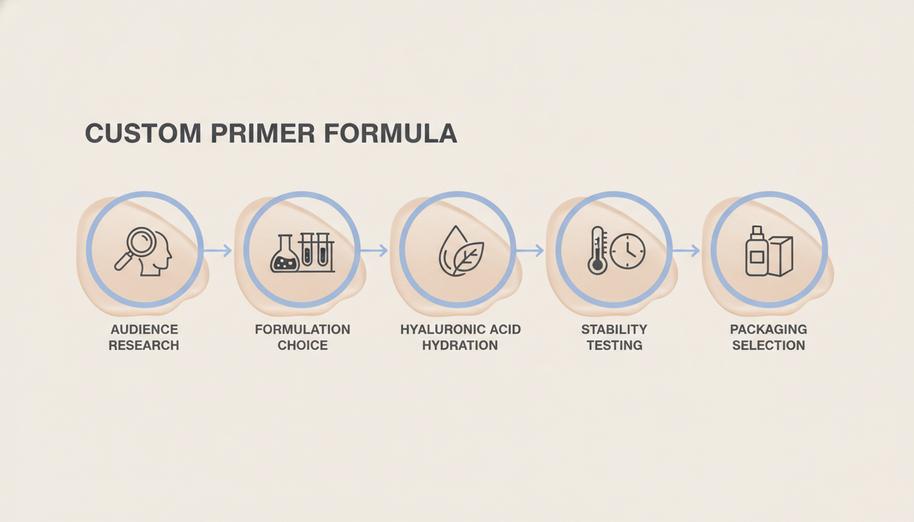
What Is Primer In Cosmetics is a useful starting question for brands planning a custom formula. Topfeel Beauty turns that purpose into texture, performance, testing, and packaging decisions.
Assessing Your Target Market’s Primer Needs
Start with target users rather than a trendy ingredient list. Customer fit explains why one primer rarely suits everyone.
- Audience profile
- Map demographics and common skin types.
- Track beauty trends and consumer preferences for the intended market.
- Performance goals
- Dry-skin buyers may favor hydration.
- Oily-skin users often seek oil control, a matte finish, and pore-blurring effects.
- Commercial fit
- Set price, clean-beauty requirements, and realistic product claims.
Selecting Ideal Formulation: Silicone-Based Gel or Oil-Free Emulsion
A silicone-based gel containing dimethicone can give primer a silky texture and smooth application; broader polymer formulation choices also affect consistency and performance.
An oil-free emulsion can feel lighter while supporting hydration. Formula development should tune slip and breathability around the target makeup experience and expected foundation interaction.
Integrating Hyaluronic Acid for Hydration Benefits
Hyaluronic acid is a humectant, meaning it attracts and holds water.
- Formula purpose
- Improve moisture retention and skin hydration.
- Support a temporary plumping effect.
- Development choices
- Adjust the active ingredient level and molecular characteristics.
- Check feel, pilling, and compatibility with the skin barrier positioning.
This connects a hydration position to measurable formula choices.
Conducting Formula Stability Tests for Quality Assurance
Stability testing supports quality assurance before scale-up. Cosmetic product testing remains the manufacturer’s responsibility. Key checks include:
• A centrifuge test for separation risk.
• Temperature variance testing for appearance and viscosity changes.
• Monitoring the pH level, odor, and color.
• Appropriate microbial testing for product safety and preservation.
Finalizing Packaging Choices from Airless Pump to Matte Finish Jar
Packaging needs to work with the cosmetic primer, not merely look sharp.
- Protection and use
- An airless pump offers controlled dosing and limits repeated product exposure.
- A matte finish jar creates different tactile and visual aesthetics.
- Production checks
- Confirm container compatibility with the formula.
- Test each dispensing mechanism for leakage and dose consistency.
- Match cosmetic packaging to brand position and OEM/ODM filling needs.
Turn five steps into one brief: Align audience, base system, hydration active, stability plan, and package around one promise. Topfeel Beauty supports lab co-creation for custom textures and actives.
Explore custom solutions and the face-primer option to compare a bespoke brief with an existing product route before sampling.
Private Label Vs. White-Label Primers
What Is Primer In Cosmetics is a useful starting point when comparing sourcing models. The route from formula to shelf shapes timing, product character, and brand control.
Private Label Primers
Private label can give the product a distinct identity. Manufacturer capabilities vary, so confirm formula, packaging, testing, and ownership choices early through a qualified cosmetic manufacturer review.
- Formula and feel
- custom formulation can adjust how the primer spreads, sets, or works with makeup.
- ingredient selection may support specific skin-feel goals or permitted claims.
- A unique texture, such as a gel, cream, or silky fluid, can strengthen differentiation.
- Commercial identity
- bespoke packaging can connect the product more closely with the wider brand identity.
- exclusive development may provide greater differentiation, with additional testing, sampling, and development.
Private label development suits brands that want more control and can accommodate a longer process.
White-Label Primers
White label follows a simpler sourcing model: select an established manufacturer formula, add branding, and prepare it for sale.
- Product choice
- Brands select ready-made formulas from a supplier’s stock catalog.
- Available shades, finishes, ingredients, and pre-designed options depend on that supplier.
- Launch preparation
- standard packaging can reduce sourcing complexity.
- Less development work can support fast market entry for demand testing.
- Scale and budget
- Existing formulas can simplify mass production planning.
- This approach may enable a cost-effective launch, although minimum orders, testing needs, and unit costs still differ by manufacturer.
White label emphasizes speed; private label emphasizes control.
Choose control or speed deliberately: private label adds formula and packaging decisions, while white label starts from a market-ready library.
Topfeel Beauty supports stock formulas and custom OEM development. Review the face-primer option and private-label routes to compare ownership, sampling, packaging, scale requirements, and commercial launch sequencing before committing resources to production.
Scenario: Launching A Matte Primer Line
What Is Primer In Cosmetics is practical when building a retail-ready matte product. A successful launch connects cosmetic design with controlled manufacturing, documented safety, and functional packaging.
Designing a Mattifying Base with Silica and Dimethicone Blend
The formula tells much of the story: a mattifying base sits between skincare and color makeup.
- Formula foundation
- Silica supports oil control by taking up surface sebum.
- A dimethicone blend works as a texture enhancer, adding smooth slip.
- User experience
- Balanced levels can improve pore blurring and help foundation spread evenly.
- During cosmetic formulation, stability and skin feel should be checked together.
Partnering for Contract Manufacturing of Oil Control Formulas
Scaling a lab sample requires controlled manufacturing.
- Start with a qualified production partner offering contract manufacturing and suitable OEM services or ODM production.
- Confirm raw-material specifications for each oil control formula.
- Use laboratory testing to check stability and compatibility.
- Move into controlled batch scaling.
- Compare pilot and production batches for viscosity, appearance, feel, and filling performance.
- Topfeel Beauty coordinates development and manufacturing through an approval process informed by cosmetics factory controls.
Ensuring GMP Certification and MSDS Documentation Compliance
Commercial launch also brings compliance requirements.
- Documentation
- Review the manufacturer’s cosmetics GMP system against ISO 22716 and current audit verification.
- Maintain ingredient records, MSDS documentation, and applicable safety data sheet information.
- Market readiness
- Quality assurance should cover incoming materials, production controls, and finished goods; U.S. brands should also understand FDA’s cosmetics authority.
- Check the EU cosmetics legislation framework and common criteria for cosmetic claims; duties differ by market.
Packaging Matte Primer in Custom Componentry for Retail Appeal
Primer packaging has to look sharp and work with the formula.
- Custom componentry
- An airless pump can limit product exposure during use.
- A flexible tube design offers simple dispensing.
- Shelf presence
- A soft-touch or matte surface finish can reinforce the product concept.
- Color, decoration, and branding visual choices strengthen retail appeal while compatibility testing checks the formula-package fit.
Reduce late-stage rework: the matte formula, scale-up controls, ISO 22716 review, documentation, and dispensing package should share one approval plan. Topfeel Beauty’s process runs from consultation and sampling through packaging design, production, QC, and delivery.
Review the custom-development workflow, then submit your primer requirements to scope formula, component, testing, and launch checkpoints.
References
- U.S. Beauty Industry Sales Grow for the Fourth Consecutive Year — Circana
- Dimethicone — Cosmetics Info
- Silica — Cosmetics Info
- Hyaluronic acid: A key molecule in skin aging — PubMed
- Niacinamide: Dermal Delivery and Clinical Evidence — PubMed
- Product Testing of Cosmetics — U.S. FDA
- FDA Authority Over Cosmetics — U.S. FDA
- Polymers in Cosmetic Formulations — Cosmetics
- ISO 22716:2007 Cosmetics GMP Guidelines — ISO
- EU Cosmetics Legislation — European Commission
- Common Criteria for Cosmetic Claims — European Commission
- Hazard Communication Standard: Safety Data Sheets — OSHA
Post time: Aug-24-2026