

What Is Mascara Made of?
Behind every bold lash lies business chemistry—mascara that builds trust, margin, and allure for private label beauty empires.
Mascara isn’t just a swipe-and-go beauty staple—it’s the quiet powerhouse of the cosmetics aisle. One coat can whisper “boardroom ready,” three coats can shout “date night.” Yet behind that tiny wand lives a chemistry set of pigments, waxes, polymers, and preservatives working in tight formation. If you’re building a beauty brand, guessing what goes inside your mascara is like baking blindfolded—messy, risky, and bad for business.
Grand View Research reports the global mascara market continues steady growth, driven by demand for long-wear and clean-label formulas. Translation? Customers read ingredient lists now. And in a product that sits inches from the eye, trust isn’t optional—it’s everything.
So what’s really in the tube—and how does it make or break your brand promise?
Why Is Mascara’s Formula So Complex?
Mascara sounds simple—swipe and go. Yet behind every tube of mascara, every lash mascara, and even that bold black lash formula, there’s serious chemistry at play. From pigment load to film strength, a good mascara makeup product balances comfort, drama, and safety without missing a beat.
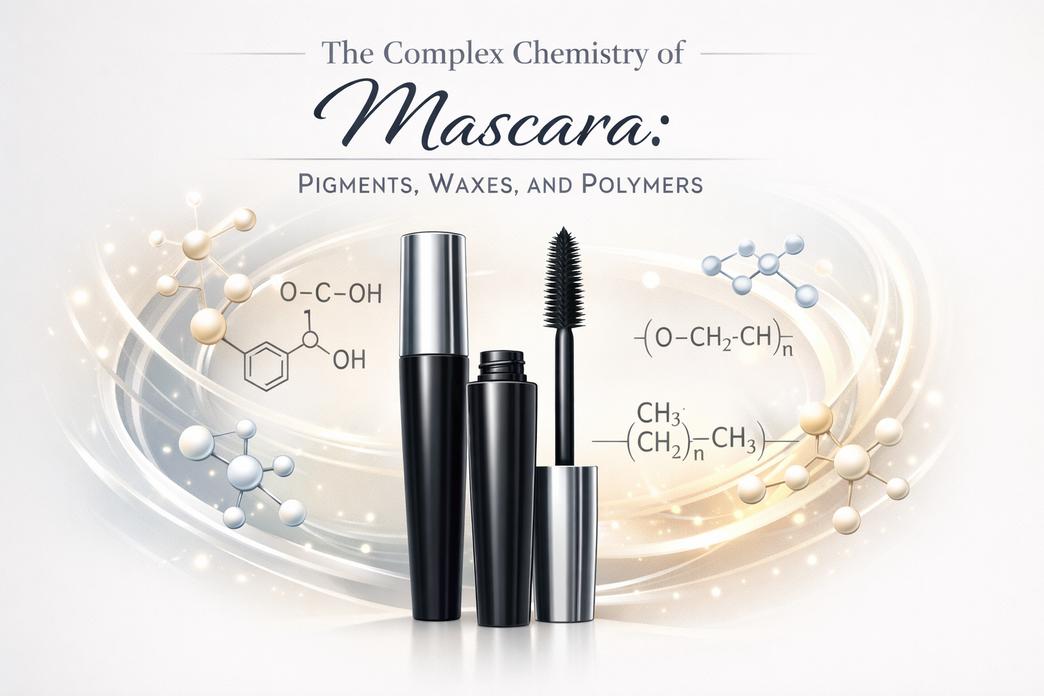
Balancing Pigments, Waxes, and Polymers
Creating a high-performance mascara starts with structure:
- Pigments
- iron oxides for deep black mascara payoff
- Even dispersion to avoid streaking
- Waxes
- Natural and synthetic waxes for body
- Control of melt point to prevent lash drop
- Polymers
- Flexible polymers as binders
- Smooth film formers supported by emulsifiers and thickeners
Inside the lab, balance is everything.
- Too much pigment? Clumps.
- Excess wax? Heavy lashes.
- Weak polymer net? Flaking.
Brands like Topfeel Beauty fine-tune ratios so mascara glides cleanly into the tube, loads evenly onto the brush, and builds without overload. That’s how modern mascara feels creamy, not chunky.
Crafting Waterproof, Smudge-Proof Performance
Long wear isn’t luck. It’s chemistry doing its thing.
- Waterproof agents lock out moisture.
- Film formers and resins wrap each lash.
- Silicones add slip, while oil-based ingredients boost flexibility.
The magic sits in the long-wear technology. A flexible shield forms around lashes, resisting sweat yet bending with every blink. Consumers want waterproof mascara that survives a long day but still removes without drama.
“Performance mascara products are increasingly judged by wear time and ease of removal in equal measure,” notes Mintel’s 2025 global color cosmetics report.
That balance keeps lash health intact while the eye makeup stays sharp.
Ensuring Safety: Quality Control & Sterilization
Eye-area products demand extra care. Every mascara batch moves through layered safeguards:
- Ingredient sourcing
- Verified suppliers
- Purity documentation
- Production control
- GMP-aligned sterilization processes
- In-line microbial testing
- Finished product checks
- Stability review
- Allergen testing
- Preservative systems with preservatives and antimicrobials
Topfeel Beauty applies strict quality control so each mascara makeup formula remains clean inside the container. Safe lashes. Happy eyes. That’s the real flex behind every swipe of mascara.
4 Key Ingredients In Most Mascaras
Mascara sounds simple, right? Swipe and go. But behind every great lash look sits a carefully balanced mascara formula. When you break down “mas-cara,” you get mas (more) and cara (face) — more impact for the eyes. From classic black mascara to waterproof lash mascara, the magic comes down to four core components working together.
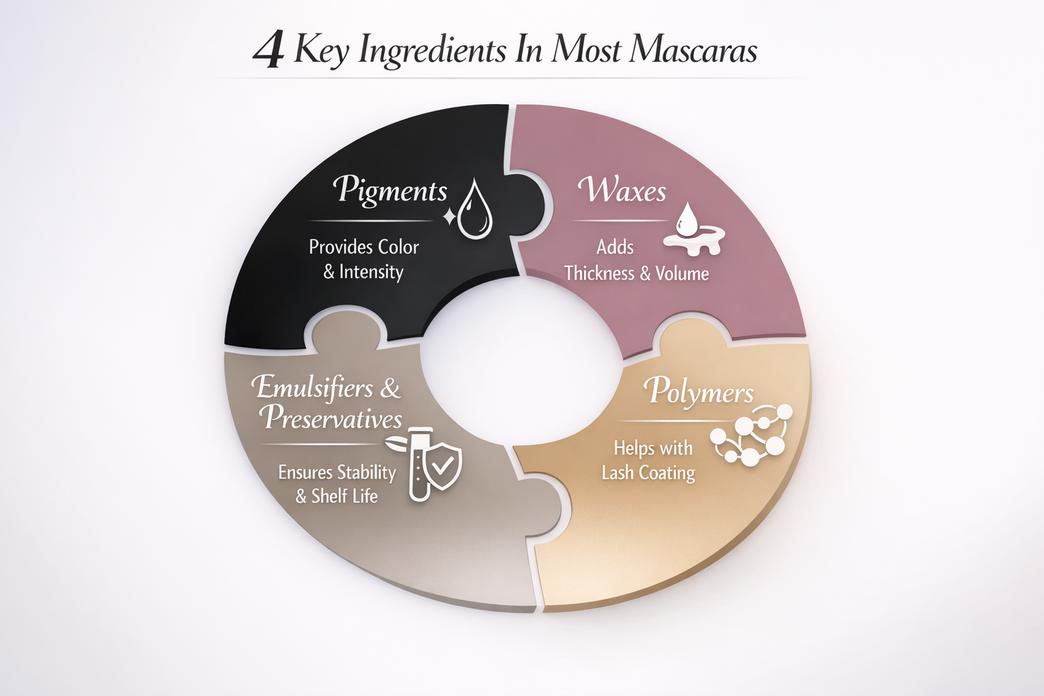
Pigments Providing Rich Color Payoff
When building a high-performing mascara, color is the heartbeat.
- Primary Pigment System
- Core Colorants
- iron oxides for deep brown and black tones
- carbon black for ultra-dark intensity
- ultramarines for blue or violet mascara shades
- titanium dioxide to adjust brightness
- Pigment Engineering
- Micronized pigment particles improve glide
- Surface-treated colorants resist clumping
- Core Colorants
- Dispersion Control in Manufacturing
- Pre-mixing pigments in oils
- High-shear blending with water phase
- Stability testing for batch consistency
For private label mascara production, uneven dispersion can ruin the vibe—streaky lashes, faded tone, or sediment at the bottom of the tube. Topfeel Beauty focuses on controlled grinding and suspension systems so every mascara brush stroke lays down smooth, even payoff. No patchy lash drama. Just bold, clean color.
Waxes for Volumizing and Lengthening
If pigments bring the color, waxes bring the body.
Here’s what shapes that thick, fluffy lash mascara effect:
- Structure Builders
- beeswax for creamy texture
- carnauba wax for lift and hold
- paraffin wax for volume boost
- synthetic waxes to fine-tune melting point
- natural waxes for smoother payoff
- Higher melting point = stronger curl hold.
- Lower melting point = softer glide.
- Balanced blends = less flaking in daily wear.
A good mascara formula balances rigidity and flexibility. Too hard? Lashes feel stiff. Too soft? Smudging city.
For lengthening mascara and volumizing mascara alike, wax ratios decide how much product loads onto the wand and how evenly it transfers.
At Topfeel Beauty, emulsifying systems often pair emulsifying wax with structural waxes to control pickup and release. The result? A lash product that builds in layers without feeling chunky.
Polymers Acting as Film Formers
Long wear is all about film formation. Once mascara dries, polymers lock everything in place.
- Film-Forming Network
- cellulose derivatives
- Improve flexibility
- Reduce cracking
- acrylates copolymers
- Deliver waterproof mascara claims
- Boost adhesion to lashes
- natural gums
- Enhance viscosity
- synthetic polymers and resins
- Increase durability
- cellulose derivatives
Below is a simplified comparison used during mascara development:
| Polymer Type | Flexibility Index (1–5) | Water Resistance (%) | Dry Time (sec) | Film Strength (MPa) |
|---|---|---|---|---|
| Cellulose Derivatives | 4 | 65 | 45 | 2.1 |
| Acrylates Copolymers | 3 | 90 | 60 | 3.8 |
| Natural Gums | 5 | 40 | 50 | 1.5 |
| Synthetic Polymers | 3 | 85 | 55 | 3.2 |
| Resins | 2 | 92 | 70 | 4.0 |
For a smudge-proof mascara, higher water resistance and film strength matter. For everyday lash makeup, flexibility wins. Getting that sweet spot keeps lashes lifted without the crunchy feel.
Emulsifiers and Preservatives for Stability
A mascara formula is basically a controlled mix of water, oils, and performance ingredients. Stability keeps it safe and smooth from factory to vanity.
- Emulsion Framework
- Water Phase
- water
- glycols for moisture balance
- Oil Phase
- oils
- Wax blends
- Bridging Agents
- emulsifiers
- stabilizers
- Water Phase
- Protection System
- preservatives to prevent microbial growth
- antioxidants to reduce oxidation
Think of it like this:
No proper emulsifier? The mascara separates.
Weak preservative system? Shelf life drops.
Poor stabilizer choice? Texture shifts over time.
From thrive liquid lash extensions mascara styles to colorful lash mascara lines, stability testing ensures the formula survives heat, transport, and daily opening and closing. That’s how modern mascara products stay safe, smooth, and ready to swipe—every single time.
Types Of Mascara Bonding Agents
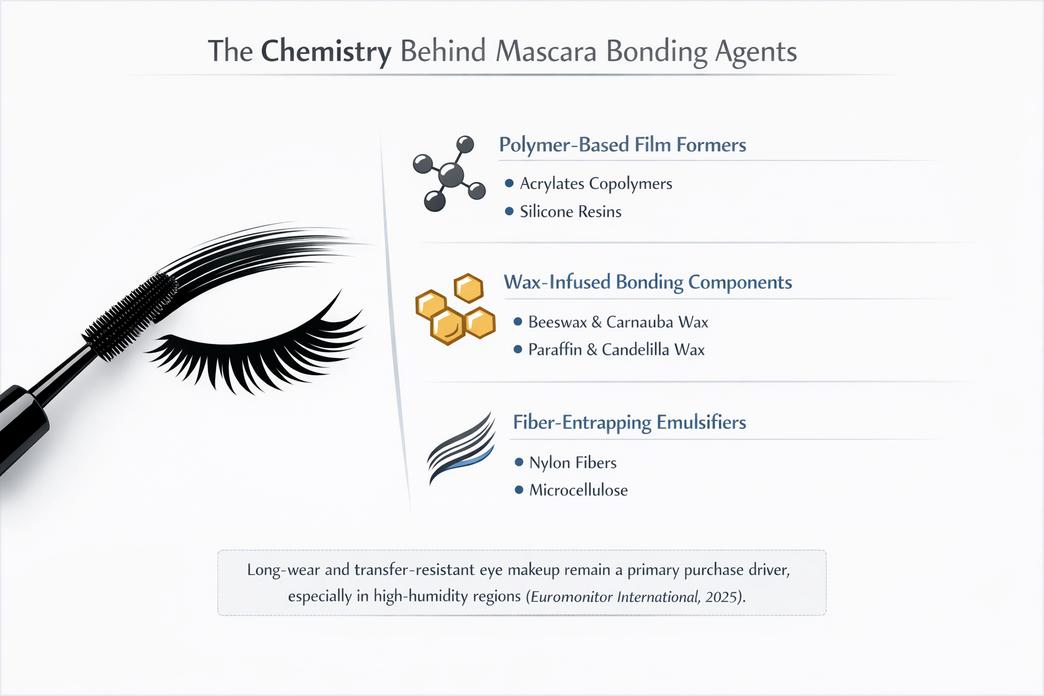
Mascara—break it down as mas, cara—sounds simple, yet every mascara formula hides serious chemistry. From classic lash mascara to modern fiber mascara, bonding agents decide if your eye makeup stays cute or turns messy by noon. Let’s unpack how mascara makeup holds on, flexes, and keeps that lash drama alive without flaking everywhere.
Polymer-Based Film Formers
When mascara hits lashes, film formers get to work.
-
Core polymers
- Polyvinylpyrrolidone
- PVP/VA copolymer
- Acrylates copolymer
- Adhesion phase
- Pigments bind to lash surface.
- Flexible net forms around each lash.
- Flex support
- Hydroxyethylcellulose adds elasticity.
- Cellulose gum improves viscosity control.
- Xanthan gum stabilizes the mascara blend.
- Wear performance
- Smudge resistance
- Flake reduction
- Comfortable hold
The global color cosmetics report by Euromonitor International (2025) noted:
“Long-wear and transfer-resistant eye makeup remain a primary purchase driver, especially in high-humidity regions.”
That’s why brands like Topfeel Beauty fine-tune polymer ratios so mascara stays put but never feels crunchy. Good lash mascara should move with you, not crack when you smile.
Wax-Infused Bonding Components
Waxes give mascara body. Not stiff, just structured.
Key wax binders include Beeswax, Carnauba wax, Candelilla wax, Paraffin wax, Microcrystalline wax, and Synthetic beeswax. Each shifts how mascara makeup grips lashes and builds volume.
| Wax Type | Melting Point (°C) | Hardness Level | Humidity Resistance | Volume Effect |
|---|---|---|---|---|
| Beeswax | 62–65 | Medium | Moderate | Natural lift |
| Carnauba wax | 82–86 | High | Strong | Dramatic volume |
| Candelilla wax | 68–73 | Medium-high | Strong | Sleek thickness |
| Paraffin wax | 47–65 | Soft | Light | Creamy bulk |
| Microcrystalline wax | 63–93 | Flexible | Strong | Dense fullness |
Blend strategy often follows this flow:
- Base softness from paraffin.
- Structure boost from carnauba.
- Flex tuning via microcrystalline wax.
Topfeel Beauty balances these so the mascara brush deposits evenly—no weird clumps, no droopy lash look.
Fiber-Entrapping Emulsifiers
Fiber mascara needs serious suspension control.
-
Fatty structure builders
- Stearic acid
- Cetyl alcohol
- Cetearyl alcohol
-
Emulsion stabilizers
- Glyceryl stearate
- Polysorbate 60
- Sorbitan oleate
- Dispersion stage
- Fibers spread evenly in the mascara base.
- Suspension lock
- Emulsifiers prevent settling.
- Brush delivery
- Even coating from root to tip.
When done right, fiber-infused mascara creates length without that spidery vibe. Smooth, extended, still soft. That’s the sweet spot every lash lover—and every serious mascara manufacturer—chases.
FAQs
What makes mascara formulas complex in private label production?
A high‑performing mascara balances art and chemistry:
- Pigments define depth and intensity.
- Waxes sculpt volume and hold curl.
- Polymers & film formers create long-wearing, smudge-proof wear.
- Precise mixing → blending → filling ensures the tube delivers smooth payoff without clumps.
During private label production, small shifts in texture affect how the wand and brush applicator load product, so strict quality control and GMP compliant standards keep every batch consistent and safe for the eye area.
How do waterproof and smudge-proof mascaras differ?
Both aim for durability, yet the bonding system changes the feel on lashes.
- Waterproof mascara
- Higher level of flexible film formers
- Stronger resistance to humidity and tears
- Requires gentle oil-based removal
- Smudge-proof mascara
- Balanced polymers + waxes
- Resists transfer from skin oils
- Feels lighter, easier to remove
In both cases, emulsifiers and conditioners prevent stiffness, keeping lashes soft rather than brittle.
Which ingredients most influence volumizing and lengthening effects?
Performance is shaped by a layered structure:
- Core base: waxes + emulsifiers for creamy glide
- Impact builders: volumizing polymers or fiber-infused elements
- Color system: iron oxide pigments for rich black or brown
- Stability shield: FDA approved preservatives for eye safety
The harmony between these ingredients defines how mascara pairs with other products like eyeliner or eye shadow without flaking throughout the day.
How is mascara safety maintained during bulk manufacturing?
Safety grows from discipline across the supply chain.
| Stage | Key Control | Purpose |
|---|---|---|
| Raw material sourcing | Supplier qualification | Consistent pigments & wax purity |
| Production | Sterilization + controlled filling | Prevent contamination inside the tube or container |
| Post-production | Microbial quality control | Eye-area safety validation |
| Distribution | Secure logistics & labeling | Traceable, compliant batches |
ISO certified, GMP compliant, and cruelty-free standards build trust in contract manufacturing and bulk purchasing, ensuring every sealed bottle, cap, and closure protects the formula until first use.
References
- Global Mascara Market Growth – grandviewresearch.com
- Eye Cosmetic Safety Guide – fda.gov
- What Are Iron Oxides? – byrdie.com
- The Chemistry of Mascara – cen.acs.org
- Carnauba Wax in Cosmetics – cosmeticsinfo.org
- Global Color Cosmetics Trends – mintel.com
- Polymers in Eye Makeup Formulation – sciencedirect.com
- Is Carbon Black Safe in Makeup? – self.com
- Beeswax Benefits for Skin and Cosmetics – healthline.com
- Understanding Cosmetic Preservatives – ewg.org
- The Importance of Microbial Testing – webmd.com
- What Cruelty-Free Really Means – allure.com
- Beauty and Personal Care Outlook – euromonitor.com
Post time: Apr-02-2026