

What Is Mascara?
Behind the perfect swipe of mascara lies big money, bold margins, and brush chemistry—your private label empire starts in the tube.
Mascara isn’t just a swipe-and-go beauty staple—it’s the little black dress of the cosmetics aisle. One coat can fake eight hours of sleep, close a deal over Zoom, or turn a bare-bones product line into a bestseller. For private label buyers, though, mascara isn’t about batting lashes. It’s about margins, manufacturing precision, and formulas that actually do what the box promises.
Here’s the catch: one smudgy batch or clumpy brush, and your brand’s reputation takes a hit. The global mascara market surpassed $10 billion in 2024, with steady growth projected through 2028 (Statista, 2025). That’s big money—but it’s crowded shelf space. Performance claims like “tubing,” “waterproof,” or “clean formula” aren’t fluff; they’re chemistry, compliance, and brush engineering working in sync.
As a Topfeel Beauty product manager put it in a 2025 industry briefing, “A mascara formula is only as strong as its compatibility with the brush and filling system.” Short sentence. Big truth.
So before you pick a shade name or sketch packaging, it pays to understand what mascara really is—inside the tube.
Key Points: Mascara Mechanics
→ Optimize Formulas: Match polymers, waxes, pigments, emulsifiers, and film-formers for durable, clump-free coating.
→ Brush Harmony: Select wand shapes and bristle designs to sculpt, separate, and volumize without tugging.
→ Performance Claims: Validate waterproof, smudge-proof, and long-wear properties through stringent GMP and QC testing.
→ Regulatory Compliance: Ensure FDA listing, EU cosmetics regulation adherence, and safe ingredient profiles for market readiness.
5 Key Ingredients In Mascara
Mascara isn’t just black goop in a tube. Great mascara makeup blends science and style so every lash looks fuller, longer, and seriously on point. From film builders to deep pigments, each part of a mascara formula matters. Let’s break down what really makes lash mascara perform like a pro.
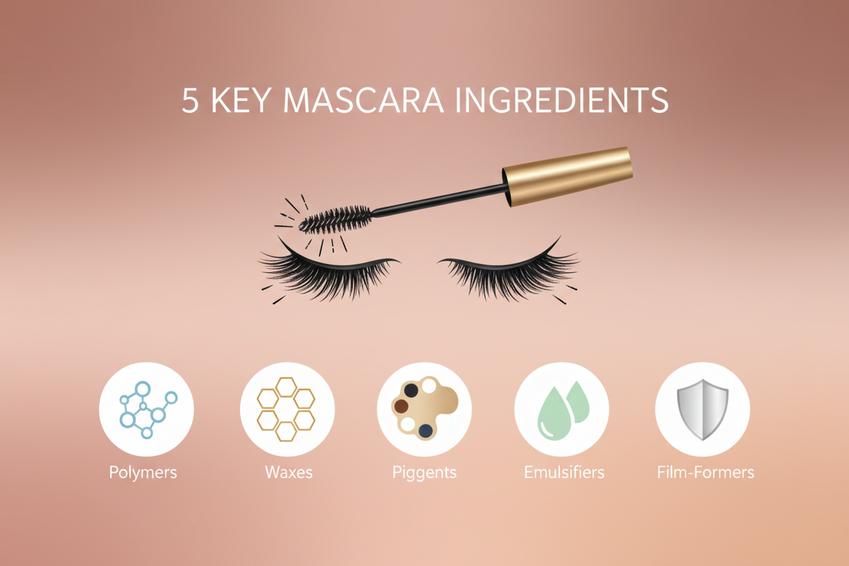
Polymers: Building Lash-Friendly Film
At the heart of many mascara formulas sit film-forming polymers. These are the quiet heroes that wrap each lash in a flexible film, giving structure without that crunchy feel.
- Functional Role
- Volumizing polymers thicken the look of sparse lashes.
- Lengthening polymers stretch the visual line of each lash.
- Lash conditioning elements help reduce brittleness.
- Material Types
- Natural polymers: plant-derived options that support softer wear.
- Synthetic polymers: engineered for stronger hold and better smudge control.
- Performance Benefits
- Improved curl retention
- Stronger adhesion to lashes
- Support for waterproof and long-wear mascara black formulas
For brands like Topfeel Beauty, balancing polymer ratios means the mascara brush glides smoothly while the lash coating stays light, not heavy. Good film structure equals better lash separation. Simple as that.
Waxes for Clump-Free Coating
If polymers build the frame, natural waxes and synthetic waxes give mascara its body. Think beeswax, carnauba wax, and paraffin wax working together for solid coating consistency.
Here’s what matters in real-world use:
- Smooth application across short and long lashes
- Reliable clump prevention during quick morning routines
- Stable texture in hot or humid storage
In production, wax melting point is key. Too soft, and the mascara smears. Too hard, and it drags. A balanced blend helps the mascara wand pick up the right amount of product, delivering even coverage from root to tip.
Topfeel Beauty focuses on wax synergy so the lash mascara feels creamy but sets with structure. No spider lashes. No flaky fallout. Just clean, defined lift.
Rich Pigments for Deep Color
Color is the vibe. Without high-quality iron oxides, carbon black, or ultramarines, a mascara won’t hit that bold, deep black payoff users expect.
- Pigment Selection
- Carbon black for maximum color intensity
- Iron oxides for softer black or brown tones
- Ultramarines for subtle blue depth in vibrant colors
- Dispersion Process
- Fine grinding
- Uniform pigment dispersion
- Stability testing for consistent color payoff
Below is a simplified comparison used during pigment evaluation:
| Pigment Type | Particle Size (µm) | Color Strength (%) | Stability Rating (1–5) |
|---|---|---|---|
| Carbon Black | 0.02–0.05 | 98 | 5 |
| Iron Oxides | 0.10–0.30 | 85 | 4 |
| Ultramarines | 0.20–0.40 | 75 | 4 |
Fine particles mean smoother mascara application and richer lash coverage. When dispersion is tight and controlled, mascara makeup looks bold in one swipe, not five.
Emulsifiers Guaranteeing Smooth Glide
Behind every creamy mascara texture is a smart system of emulsifying agents. These surfactants hold oil and water together in either oil-in-water or water-in-oil systems.
Here’s how it typically works:
- Blend water phase with selected humectants.
- Heat oil phase containing waxes and pigments.
- Introduce emulsifiers to bind both phases.
- Homogenize for even distribution and better blendability.
- Cool under controlled mixing to protect smooth texture and glide factor.
When the balance is right, the mascara brush loads evenly and deposits product with an easy sweep. No dragging. No weird patchiness. Just clean flow across the lash line.
Film-Formers That Enhance Wear Time
To keep mascara from smudging under the eyes by noon, film-forming agents step in again—this time focused on long-lasting wear.
- Adhesion Layer
- Strengthens lash grip
- Improves adhesion between pigment and lash surface
- Protection Shield
- Supports water-resistant and smudge-proof claims
- Adds transfer-resistant performance
- Comfort Factor
- Maintains a flexible coating
- Enhances durability without stiffness
When durability meets comfort, users stick with the brand. That’s why Topfeel Beauty fine-tunes film networks for all-day mascara performance that feels light but holds strong. From daily office wear to late-night events, good film structure keeps lashes lifted and defined.
How Does Mascara Increase Lash Volume?
Mascara feels simple, yet every swipe hides serious cosmetic science. From classic black mascara to waterproof mascara and lengthening mascara, each mascara formula plays with texture and hold. Let’s break down how this lash makeup turns tiny hairs into bold, fuller fringe without feeling heavy.
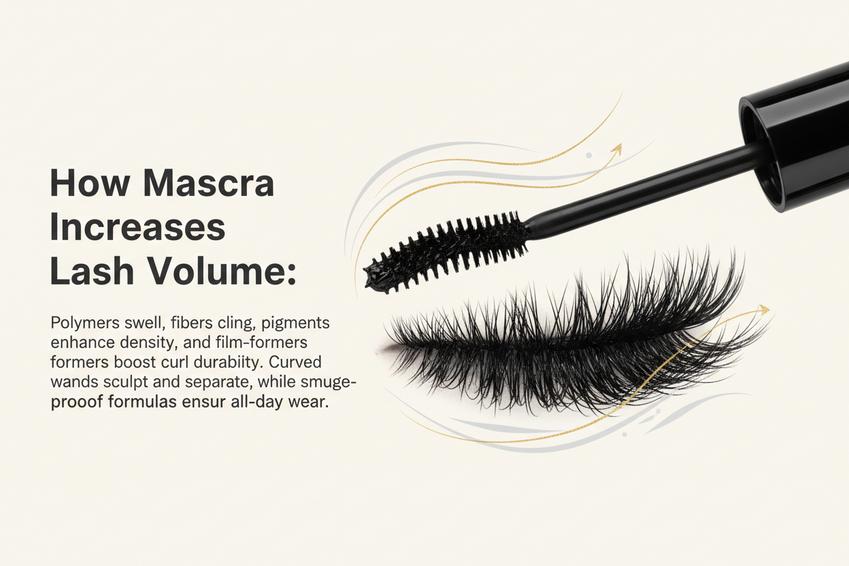
Volumizing Polymers: How They Bulk Up
When mascara touches lashes, polymers get to work.
- Core performance
- Film expansion
- polymers swell slightly as solvents evaporate
- Boost visible lash thickness
- Surface grip
- Attach to natural keratin
- Improve even coating
- Film expansion
- Texture builders
- Micro fibers cling between lashes
- Deep black pigments enhance density
The result? Each mascara layer wraps lashes in flexible bulk, creating thicker-looking fringe without stiff crunch. Topfeel Beauty fine-tunes polymer ratios so volume builds smoothly, not clumpy.
Curved Wands Sculpt and Separate
Great mascara isn’t just formula; it’s engineering.
- Wand shape hugs the lash line for better reach.
- Curved bristles lift from root, boosting lash lifting.
- Spacing supports clean separation and sharp definition.
A good brush means fewer passes, less mess, and better control. That’s why Topfeel Beauty pairs every mascara formula with beauty tools designed for real-life application.
Smudge-Proof Formulas for All-Day Wear
Nobody likes raccoon eyes. A solid eye mascara handles heat, long workdays, and late nights.
- waterproof blends resist tears
- transfer-resistant systems fight smears
- Balanced oil-based components lock in color
- Flexible wax matrix boosts long-lasting wear in humidity
Topfeel Beauty designs vibely mascara for daily hustle, keeping volume intact from coffee to commute.
Film-Formers Ensuring Lash Longevity
Inside modern mascara, film-formers create a light shell around each lash.
- Adhesion system
- Strong adhesion without stiffness
- Reduced clumping
- Flex performance
- Maintains flexibility
- Limits flakes
- Wear strength
- Boosts curl durability
This coating keeps mascara, lash makeup, and even waterproof mascara looking fresh for hours. Volume stays bold. Lashes stay soft. That’s the sweet spot Topfeel Beauty aims for every time.
Traditional Vs. Tubing Mascara Formulas
Mascara seems simple, yet the formula behind every lash mascara makes a huge difference in wear, removal, and vibe. From classic eye mascara to modern tube mascara styles, the way a mascara formula wraps your lashes changes your whole lash makeup game. Here’s how traditional and tubing mascara really stack up.
Traditional Mascara
Traditional mascara relies on a classic blend designed to coat and build.
- Core Base
- Wax-based structure built from waxes and oils
- Rich pigments for bold eye definition
- Balanced with emulsifiers and light film-formers
- Performance on Lashes
- Thick coating can increase volume fast
- Higher risk of clumping if layered heavily
- May lead to smudging, especially in humid weather
- Removal & Wear
- Standard versions wash off with cleanser
- Waterproof lash mascara needs dedicated remover
For brands like Topfeel Beauty, bulk production of traditional mascara focuses on texture control, smooth brush glide, and stable pigment payoff. It’s the go-to mascara formula for dramatic, high-impact lash makeup that lasts through long days.
Tubing Mascara
Tubing mascara takes a different route, wrapping lashes instead of painting them.
- Formula Technology
- Polymer-based system forms flexible tubes
- Tiny microspheres and advanced film tech lock around each lash
- Naturally water-resistant without heavy wax load
- Lash Effect
- Defines without bulk
- Promotes no smudging during daily wear
- Supports no flaking through movement
- Removal Experience
- Warm water loosens tubes
- Tubes gently flakes off in soft pieces
- Leaves a clean removal finish, no dark residue
Topfeel Beauty develops oem eyes makeup options that balance comfort and durability, giving modern consumers easy removal with zero raccoon eyes. For anyone switching from classic mascara to tube mascara, the difference feels instantly noticeable.
FAQs about Mascara
What makes a mascara formula truly high‑performing in bulk production?
A high‑performing mascara lives or dies by its formula discipline:
Core Structure
- Polymers + film-formers → flexible, waterproof, smudge-proof lash coating
- Waxes → volumizing body and clump-free glide
- Pigments → deep black payoff under FDA compliance
Stability Under Pressure
- Balanced emulsifiers prevent phase separation during inventory management
- Controlled preservatives protect long-wearing safety in bulk production
Manufacturing Control
- Precise formulation and mixing
- Monitored filling into tubes
- Final quality control aligned with GMP and ISO certification
When the chemistry holds, lashes stay bold from morning coffee to late-night lights.
How do traditional and tubing mascara formulas differ for brand positioning?
The difference shapes user loyalty—and return rates.
Traditional (Wax-Based) Mascara
- Rich in waxes and pigments
- Delivers volumizing, lengthening drama
- Removed with cleanser
- Ideal for bold looks alongside eyebrow pencil or eyeshadow palettes
Tubing (Polymer Film) Mascara
- Powered by film-formers
- Forms water-resistant tubes around each lash
- Slides off with warm water
- Appeals to sensitive or hypoallergenic-focused users
In contract manufacturing, the choice affects raw material sourcing, brush compatibility, and even packaging assembly. One speaks to glamour; the other whispers everyday ease.
Which quality and packaging factors matter most in private label mascara manufacturing?
Performance is only half the story—trust completes it.
A. Regulatory Grounding
- GMP-controlled manufacturing practices
- FDA compliance and verified ingredient listing
- EU cosmetics regulation with documented safety assessment
B. Packaging That Protects the Formula
| Component | Why It Matters |
|---|---|
| Wands & brushes | Define separation, lift, volumizing impact |
| Tubes & caps | Airtight seal for long-wearing stability |
| Cartons | Support logistics and brand presentation |
From sterilization to final assembly, each step guards the product’s integrity. A mascara that survives filling, shipping, and retail shelves without drying or separating earns more than sales—it earns repeat devotion.
References
- Safety of Eye Cosmetics – FDA
- Global Mascara Market Size 2024-2028 – Statista
- The Chemistry of Mascara: Polymers and Waxes – Royal Society of Chemistry
- Film-Forming Polymers in Cosmetics – PubMed Central
- Regulations on Carbon Black in Cosmetics – SCCS Opinion
- Emulsification Technology in Personal Care – ScienceDirect
- Carnauba Wax: Properties and Cosmetic Uses – Cosmetics Info
- Tubing Mascara vs Traditional Formulas – Healthline
- Preservatives and Microbial Safety in Mascara – Journal of Cosmetic Science
- Pigment Dispersion and Color Strength in Cosmetics – American Chemical Society
- FDA Guide to Cosmetic Labeling – FDA
- Polymer Swelling and Film Formation in Mascara – ResearchGate
- Ophthalmic Evaluation of Cosmetic Eye Products – AAO Journal
- Synthesis and Application of Synthetic Waxes – SpringerLink
- Consumer Trends in Waterproof and Smudge-Proof Beauty – Euromonitor
Post time: Mar-17-2026