
What Is a Complexion Brush Used For?
What is a complexion brush used for? It applies, buffs, blends, sculpts, and lightly dusts foundation, contour, or highlighter. For bulk orders, head shape, fiber, density, ferrule, handle, and shed resistance all matter.
For brands, distributors, and salons, those details affect control and consistency. A clear brief connects formula, finish, user, and packaging before sampling.
Topfeel Beauty supports cosmetics tools, private-label branding, and packaging for color-cosmetics programs.
Quick Insights: What Is Complexion Brush Used For
➔ Foundation Application: Synthetic bristles distribute and buff cream or liquid formulas for smooth, even coverage.
➔ Contour Sculpting: Angled or tapered brush heads place and blend contour for defined cheekbones, jawlines, and facial structure.
➔ Highlight Blending: Soft polyester or taklon tips dust powder highlighters onto high points for precise, buildable luminosity.
➔ Buff & Blend: Circular motions create a seamless, airbrushed finish with controlled product use and light pressure.
Wow! What Is Complexion Brush Used For?
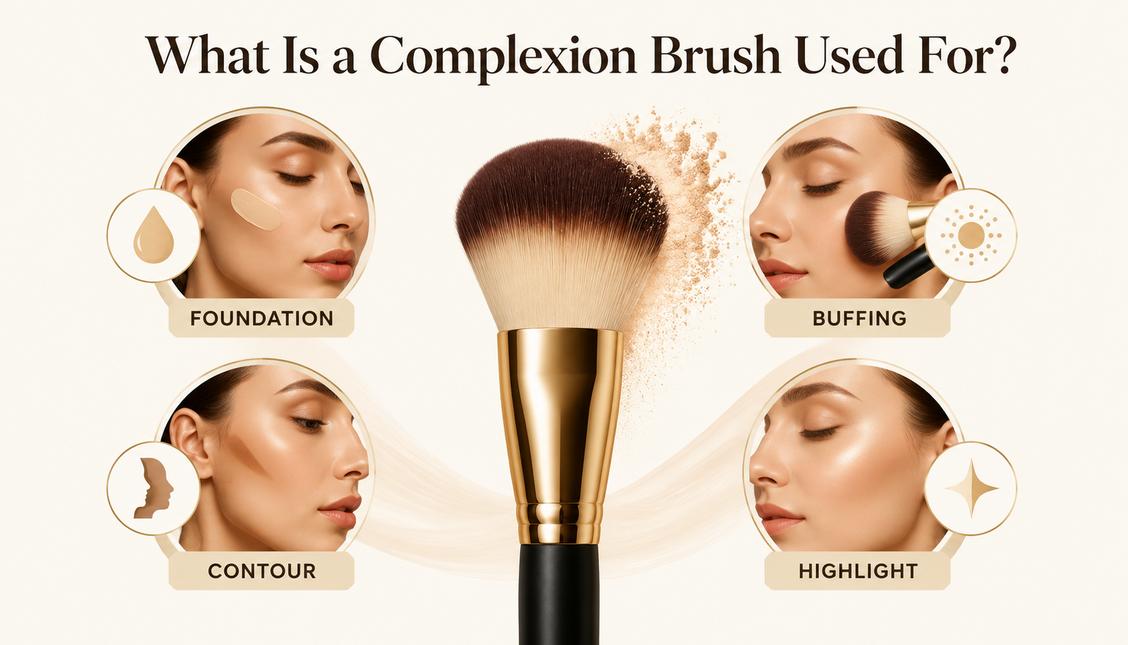
Wondering what is complexion brush used for in an everyday routine? This tool applies, blends, shapes, and brightens the face.
Foundation Application with Synthetic Fiber Bristles
For foundation, a complexion brush with synthetic fibers can support controlled, buildable liquid or cream coverage.
- For lighter coverage
- Dot foundation across the face.
- Sweep the bristles outward in thin layers.
- For fuller coverage
- Add another light layer where needed.
- Press gently rather than loading on product.
Topfeel Beauty’s base-makeup planning guide helps buyers compare face-tool formats.
Blender Buffing for Liquid Smoothing Effects
A blender technique softens liquid makeup. Use small circular buffing motions and light pressure around the nose and hairline.
For a more seamless finish, keep pressure light around the nose and hairline. Topfeel Beauty’s foundation-clumping guide supports that technique.
Contour Sculpting using Vegan Bristles Precision
Contour work uses an angled or tapered profile to place color below the cheekbones and soften the edge.
- Cheeks
- Place color just beneath the cheekbones.
- Blend upward for clean definition.
- Jaw and temples
- Use vegan bristles when the brief requires them.
- Keep sculpting soft so lines do not look harsh.
The makeup-brush guide connects head shape to task.
Highlight Dusting via Polyester Fiber Tips
Highlight application calls for a lighter touch. Soft polyester fibers and flexible tips help with gentle dusting across high points.
- Pick up a small amount.
- Tap away excess powder.
- Sweep over cheekbones for luminosity and a natural glow.
Keep shimmer targeted. Eye-makeup safety guidance advises keeping glitter and sparkle particles away from the eye margin.
A cleaner base brief: Foundation coverage, contour placement, and highlight control all depend on matching fiber, density, and head shape before sampling. Topfeel Beauty’s cosmetics tools and gift sets can be customized with branding and packaging, helping buyers avoid an inconsistent face-tool line.
Compare tools and brushes and the brush-use guide to select the needed shapes.
3 Key Benefits Of Using Complexion Brush
The benefit is smoother, more controlled makeup application for foundation and blending.
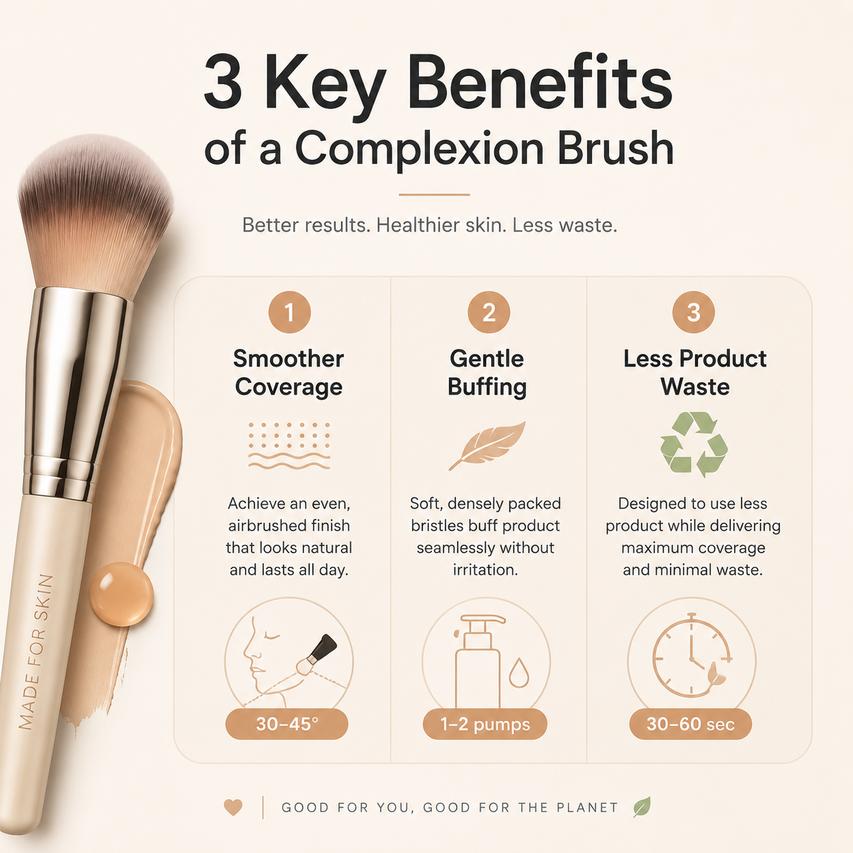
Seamless Foundation Application: Nylon Filament Advantage
Nylon filament gives synthetic bristles a flexible surface for controlled liquid-makeup pickup.
- For everyday foundation application:
- Dot on a small amount.
- Blend outward with the makeup tool.
- Light strokes build smooth coverage.
- Soft circular motions help create a streak-free finish.
For a base routine, it supports spreading, blending, and layering. Formula, fiber geometry, and care instructions should be reviewed together; Topfeel Beauty’s foundation development resource is a relevant reference.
| Application factor | Typical target | Practical effect |
|---|---|---|
| Brush angle | 30–45° | Softer blending |
| Foundation dose | 1–2 pumps | Less excess |
| Buffing time | 30–60 sec | More even coverage |
Dermatologist Approved Design for Gentle Blender Buffing
Soft fibers and a stable ferrule can support gentler buffing around the nose, cheeks, and facial contour. “Dermatologist approved” and “irritation-free” claims require product-specific evidence.
- Choose soft fibers suited to sensitive skin.
- Use gentle buffing rather than hard scrubbing.
- Clean the makeup blender regularly to limit residue.
The American Academy of Dermatology recommends washing makeup brushes every 7 to 10 days; its cleaning guidance supports user instructions.
Eco Friendly Craftsmanship Reduces Product Waste
Eco-friendly craftsmanship is most useful when material choice supports care and service life.
- Better control
- lowers makeup absorption
- supports efficient application
- Longer service life
- favors sustainable materials
- makes the brush a reusable tool
- reducing product waste
- supporting everyday green beauty
The brief should cover care, drying, and replacement without promising a fixed lifespan. Topfeel Beauty’s makeup-brush cleaning guide can inform that checklist.
Will users feel the difference? Foundation application, gentle blender buffing, and eco-friendly reuse belong in the same specification.
The makeup-brush cleaning guide turns that choice into a care checklist. Review beauty tools to compare a format against the planned formula and maintenance routine.
Types Of Complexion Brush Shapes Explained
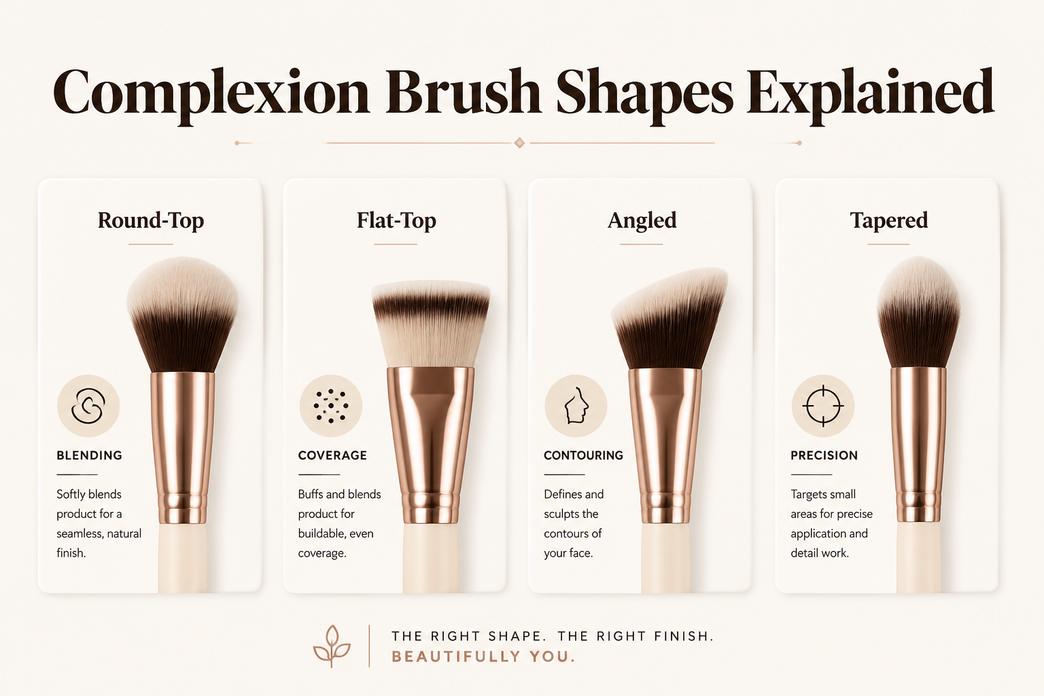
Match head shape, handle, and bristle placement to the job, from foundation to contour.
Round-Top Complexion Brush with Wooden Handle
A round-top brush suits small circular buffing across cheeks and the forehead.
- For base makeup: A balanced wooden handle can also make control feel natural. So, what is complexion brush used for here? Mainly an even base without obvious streaks.
- Liquid foundation spreads smoothly with light circular motions.
- Cream application benefits from gentle pressure, followed by soft blending around edges.
Flat-Top Stippling Brush and Aluminum Ferrule Fit
A flat-top brush creates broad contact, while a stippling brush can tap on liquid formula before light buffing.
- Press on a thin layer.
- Use short taps for an airbrush finish.
- Add gentle circles for powder blending.
- Check the hardware.
- A snug aluminum ferrule limits bristle movement during repeated use.
This shape suits fast, even foundation work; specify ferrule and handle with the head.
Angled Beauty Accessory Featuring Bamboo Shaft
An angled brush follows cheekbones and jawlines for contouring and blush placement.
- Placement:
- use the higher edge for highlighting;
- sweep the fuller edge across cheeks.
- Handling:
- a bamboo shaft keeps this makeup tool relatively light.
That angled profile offers useful control without much fuss.
Tapered Cosmetic Applicator in Copper Crimp Style
A tapered brush narrows toward its tip, helping with precise application where a broad complexion brush feels clumsy. Smaller spaces are its sweet spot.
- Face setting:
- Sweep setting powder where needed.
- Use the tip for under-eye setting.
- Detail work:
- A highlight brush shape can target cheekbones and the nose.
- A firm copper crimp secures this cosmetic tool at the handle connection.
In practical terms, complexion brush use here centers on accuracy rather than broad coverage.
Why Are Complexion Brushes Worth It?
Beyond application, buyers should consider construction, volume planning, and documented materials.
Private Label Custom Manufacturing for Premium Quality
A complexion brush can be built around a chosen finish. Topfeel Beauty supports synthetic bristles, branding, packaging, and cosmetics tools.
- A softer finishing brush can create light, blended coverage.
- Custom packaging design helps brands keep a consistent shelf identity.
- Detailed quality control can check shape, assembly, and fiber performance, while cruelty-free materials support defined sourcing requirements.
That is a useful application outcome: a custom brush can support controlled face-makeup coverage. The FDA cosmetic product information and color-additives fact sheet support product and claim planning.
Bulk Assembly and Wholesale Supply Cost Benefits
- Higher manufacturing capacity can support cost-effective production across larger orders.
- Better supply chain efficiency may reduce repeated purchasing costs.
- Coordinated inventory management helps keep popular brush formats available.
- Wholesale makeup tool sets simplify commercial purchasing.
- Planned logistics distribution can serve salons, retailers, and beauty brands.
- Global shipping gives growing businesses wider delivery options.
For bulk orders, the qualified cosmetic manufacturer guide can help teams structure supplier questions before sampling.
Contract Manufacturing Ensures Hypoallergenic Tested Standards
- Safety specifications
- raw material safety requirements can cover fiber and component selection.
- sensitive skin safety may include dermatologist tested claims only when supported by suitable testing.
- Production controls
- sterile production procedures and quality assurance can be documented where applicable.
- antibacterial fibers require substantiated material specifications.
- Compliance
- regulatory compliance and shed-resistant standards should be written into the contract.
Skin-contact products need defined material and testing terms. ISO 22716 and EU cosmetic safety assessment guidance support a broader quality-system review.
Avoid a fragmented brief: Private-label customization, volume planning, and contract quality terms should be decided together before a bulk brush program proceeds. Topfeel Beauty’s documented customization process runs from consultation through sampling, packaging, production, QC, and delivery; initial samples take 3-7 days.
Use OEM face makeup and custom solutions to submit the specification.
Complexion Brush Vs. Sponge: Which Wins?
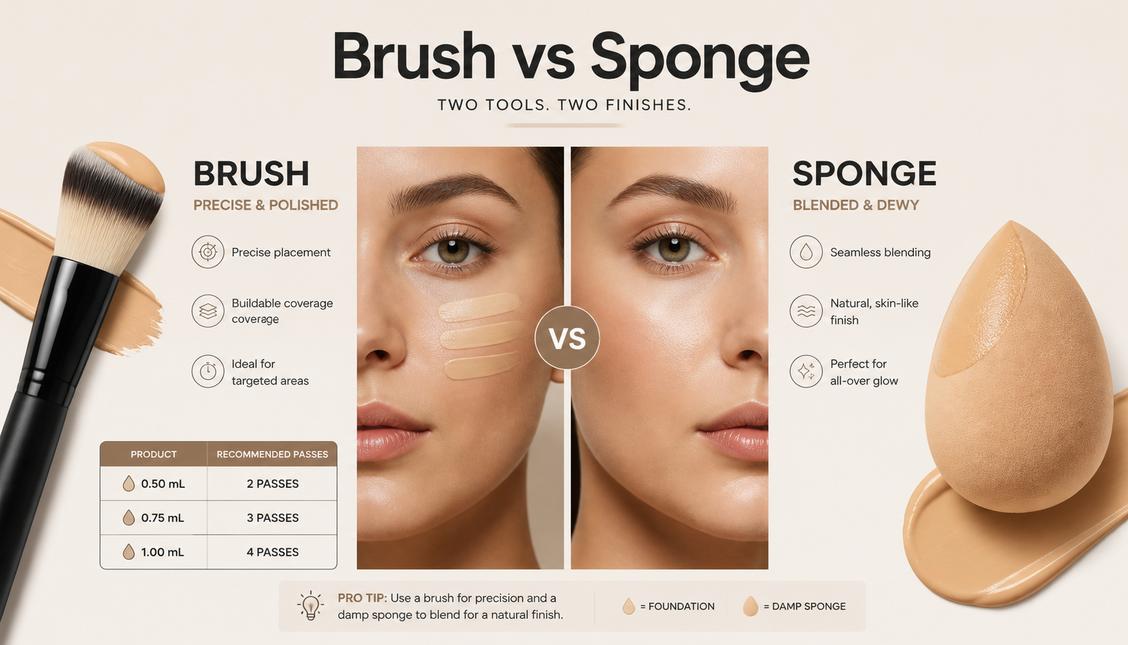
Brushes favor targeted coverage; sponges soften edges. The better choice depends on formula, finish, and use case.
Complexion Brush
A complexion brush gives coverage control with synthetic bristles that spread liquid foundation precisely.
- For everyday foundation:
- Use a small buffing motion for an even layer.
- Add a stippling technique where redness needs extra coverage.
- Keep pressure light for an airbrushed finish.
- For other face products:
- Try powder application with less pressure.
- Sculpt contour using the brush edge.
- Use a small buffing motion for an even layer.
Beyond foundation, it can place, build, and polish products without a damp tool.
| Controlled test form | Foundation dose (mL) | Tool prep (mL water) | Application passes |
|---|---|---|---|
| Brush trial A | 0.50 | 0.00 | 2 |
| Brush trial B | 0.75 | 0.00 | 3 |
| Brush trial C | 1.00 | 0.00 | 4 |
Sponge
A beauty blender suits soft edges and a dewy finish when used damp.
For creamy products, tap rather than drag and adjust hydration before use.
The brush favors precision and buildable coverage; the sponge favors quick diffusion. A PubMed study of used cosmetic products and Topfeel Beauty’s makeup-brush cleaning guide support cleaning and storage instructions for reusable applicators.
Scenario: Bridal Makeup With Complexion Brush
For bridal work, the tool brief should coordinate a smooth base, face shaping, and controlled glow.
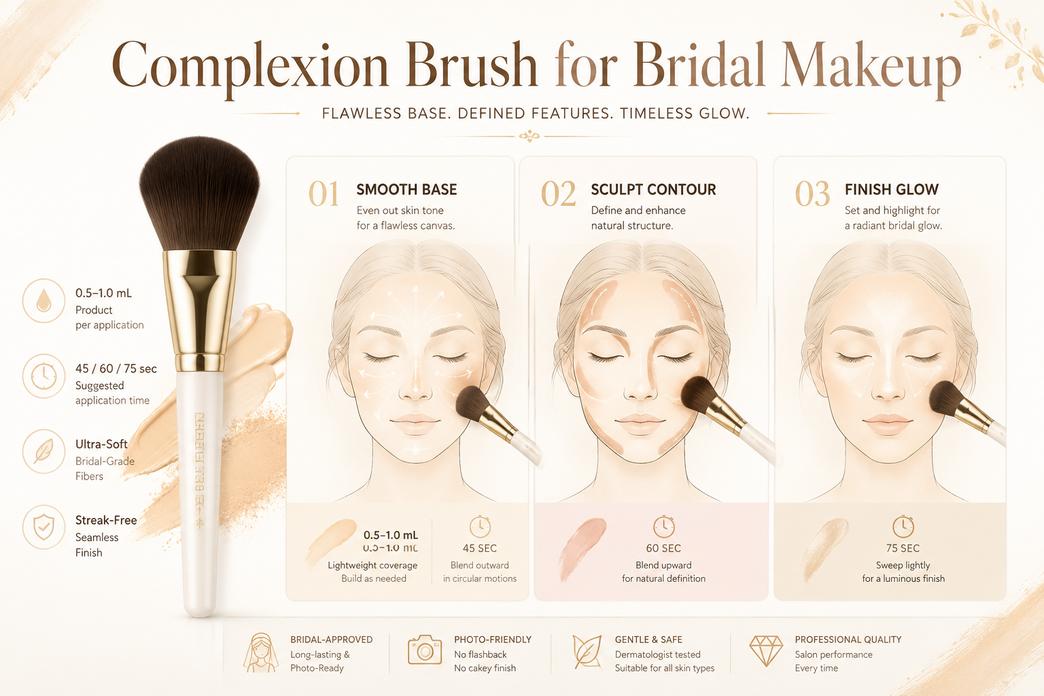
Liquid Smoothing Base Layer with Vegan Bristles
Dense vegan bristles support controlled liquid-foundation pickup and a smooth base.
- Base control
- Start with about 0.5–1.0 mL of foundation.
- Buff the synthetic fibers in small circles, keeping pressure light.
- Coverage check
- Add thin layers where redness shows.
- Keep edges soft around the jaw and hairline.
| Application target | Typical amount (mL) | Buffing time (sec) |
|---|---|---|
| Light coverage | 0.5 | 45 |
| Medium coverage | 0.75 | 60 |
| Fuller coverage | 1.0 | 75 |
Precise Contour Sculpting on Cheekbones via Plastic Grip
Contour sculpting needs control, not a heavy hand.
- Hold the plastic grip near its center.
- This steadies the makeup tool.
- Adjust the application angle toward the hollow below the cheekbones.
- Blend upward.
- Short strokes support natural definition.
- Avoid dragging color too low, which can change the look of facial structure.
So, what is complexion brush used for beyond foundation? Controlled shaping is a big part of the answer.
Highlight Dusting Finale Using Shed Resistant Fibers
For the finishing pass, shed-resistant fibers help keep powder application cleaner.
- Glow placement
- Sweep highlight dusting across upper cheekbones for soft luminosity.
- Use less product along the nose and brow bone.
- Final check
- A light finishing touch keeps the radiant glow camera-friendly.
- Topfeel Beauty brush fibers support a neat wedding day look without overloading highlighter.
For professional use, specify cleaning, storage, packaging, and destination-market documentation. Great Britain cosmetic-product guidance and Health Canada’s cosmetics guidance support the related makeup-product review.
A complete artist workflow: Bridal tools need a coordinated base, contour, and glow.
Review Topfeel Beauty’s 12-piece professional face brush set for a multi-tool route. Then contact Topfeel Beauty with fiber, handle, packaging, sampling, and market requirements for validation.
References
- How to clean your makeup brushes
- Cosmetic Products
- How To Use Cosmetics Safely Around Your Eyes
- Microbiological study of used cosmetic products
- ISO 22716:2007 – Cosmetics – Good Manufacturing Practices (GMP)
- Scientific and technical assessment
- Making cosmetic products available to consumers in Great Britain
- Guidance on Heavy Metal Impurities in Cosmetics
- Color Additives and Cosmetics Fact Sheet
Post time: Sep-02-2026