
What Is MOQ in Cosmetic Manufacturing?
Ready to scale private label makeup? See what is an MOQ in manufacturing and how formulas, packaging, and costs shape your bulk order.
“what is an moq in manufacturing?” It’s the minimum production run a factory accepts, shaped by formula, filling, packaging, and quality work.
In private label makeup, custom formulas and branding can raise minimums. This guide balances cost, inventory, and sales.
Key Points: What Is an MOQ in Manufacturing
➔ Definition Clarity: What is an MOQ in manufacturing—minimum batch size shaped by formula, setup, labor, QA, and packaging.
➔ Calculation Essentials: Estimate run size from formulation, pigment processing, packaging, lead times, and unit economics.
➔ Negotiation Strategy: Balance customization, demand planning, GMP expectations, and private-label or OEM routes.
What Is an MOQ in Manufacturing—Defined
What is an MOQ in manufacturing? MOQ means minimum order quantity: the smallest production run a factory accepts. In cosmetics, it informs purchasing, packaging, stock planning, and brand decisions.
Why Batch Production Threshold Matters in Cosmetics
When founders ask what is an MOQ in manufacturing, the answer starts with batch production economics. A cosmetic factory must turn ingredients and factory time into a repeatable, saleable batch.
- Cost drivers
- Raw material purchases may have supplier minimums.
- Equipment setup and cleaning create cost before usable product.
- Product controls
- Formulation stability helps confirm consistent texture, color, and performance. For plant controls, review qualified cosmetic manufacturers.
- Production efficiency improves as fixed tasks are spread across more units.
- Stock concerns
- Larger MOQs can lower unit manufacturing cost, but increase inventory management and shelf life risk.
MOQ vs. Fabrication Scale: Understanding Assembly Requirement
Production scale describes efficient operating size, while MOQ defines the smallest order a supplier will accept.
Factory operations
- Manufacturing capacity
- Available mixers and filling equipment shape factory output.
- Batch size also affects processing yield, meaning usable output after normal production losses.
- Assembly line
- Filling, labeling, casing, and packing need dedicated labor allocation.
- Small runs can still require nearly the same setup work, so minimum quantities may apply separately to packaging.
Production scale shows what a plant can make efficiently; assembly requirements show what it makes sense to run. Compare cosmetics factory operations.
How Output Volume Limit Shapes Your Private Label Strategy
For private label planning, what is an MOQ in manufacturing becomes a commercial question too.
- Market launch
- A lower MOQ can ease market entry and limit unsold stock.
- Growth plan
- Higher quantities may reduce per-unit costs as volume rises.
- Custom formulas and packaging add supply chain commitments.
- Brand choices
- Brand development with white-label stock can keep early orders manageable.
- Contract manufacturing offers greater customization, but its minimum production quantity may be higher.
MOQ is both a factory threshold and a commercial strategy constraint.
Make the whole launch plan workable: MOQ decisions connect batch cost drivers, assembly capacity, and private-label inventory choices. Topfeel Beauty combines formulation R&D with final color-cosmetics production.
Review its OEM/ODM workflow and custom solutions to compare routes before choosing a first order.
How to Calculate MOQ for Cosmetics
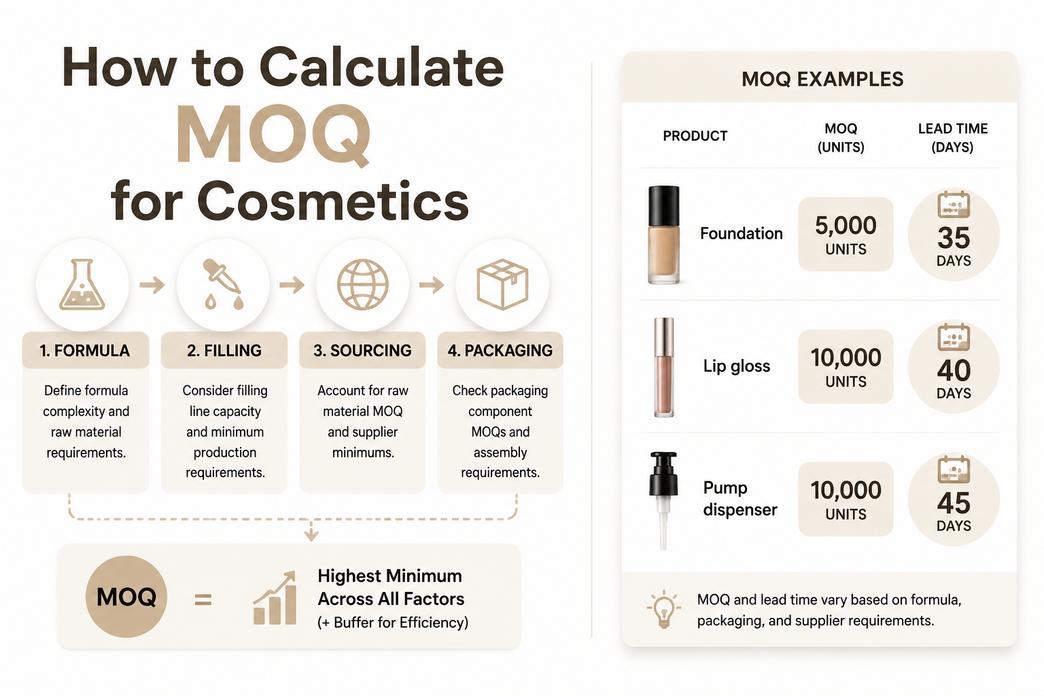
MOQ connects factory limits with the number of finished products a brand can order. The practical answer depends on formula, filling, packaging, and purchasing limits.
Estimating Manufacturing Run Size Based on Cosmetic Formulation
A workable batch size starts with the cosmetic formulation, not a random unit target.
- Formula factors
- Active ingredients may have supplier minimums.
- Viscosity can limit mixing and filling choices.
- Output factors
- Expected production yield should account for residue and filling loss.
- Preservative efficacy and stability testing may require samples.
Here, it is the smallest technically practical run after normal losses. For ingredient context, see this cosmetic ingredients guide.
Factoring in Pigment Dispersion and Emulsion Base Costs
Color cosmetics add another wrinkle. Pigment dispersion needs controlled homogenization, while color matching may require trials. An emulsion base also depends on the right surfactant and rheology modifier.
Cost: Specialized processing raises raw material cost and setup expense.
MOQ: Longer setup makes tiny batches pricey, so minimum order quantity in manufacturing often rises.
Topfeel Beauty can assess these costs before production. See this formulation development resource.
Packaging Materials Impact: From Foundation Bottles to Lip Gloss Tubes
Packaging MOQ can outrun formula MOQ. Compare component minimums before locking the order quantity.
| Component | Example MOQ | Lead time |
|---|---|---|
| Foundation bottle | 5,000 units | 35 days |
| Lip gloss tube | 10,000 units | 40 days |
| Pump dispenser | 10,000 units | 45 days |
These are planning examples, not supplier quotes. Secondary packaging, custom tooling, and material compatibility testing can shift final numbers.
Incorporating Raw Material Sourcing and Component Lead Time
- Purchasing
- Raw material sourcing considers vendor minimums and supplier audit results. Check market requirements before committing materials; the EU cosmetics regulation is one example.
- Regulatory compliance can narrow approved material choices.
- Timing
- Component lead time affects production scheduling. A GMP inspection checklist can shape the quality portion of a production brief.
- Supply chain delays and logistics can move purchasing earlier.
- Cash flow
- Higher stock can reduce inventory turnover and add storage cost.
The practical MOQ is the highest workable minimum across formula, packaging, sourcing, and production.
Turn variables into a usable brief: Formula behavior, pigment processing, packaging components, lead times, and cash flow should be reviewed together.
Topfeel Beauty’s color-cosmetics support includes formulation and packaging coordination. Explore custom solutions to decide which specifications belong in your first brief, then use the foundation range as a product reference.
3 Steps to Negotiate Your First MOQ
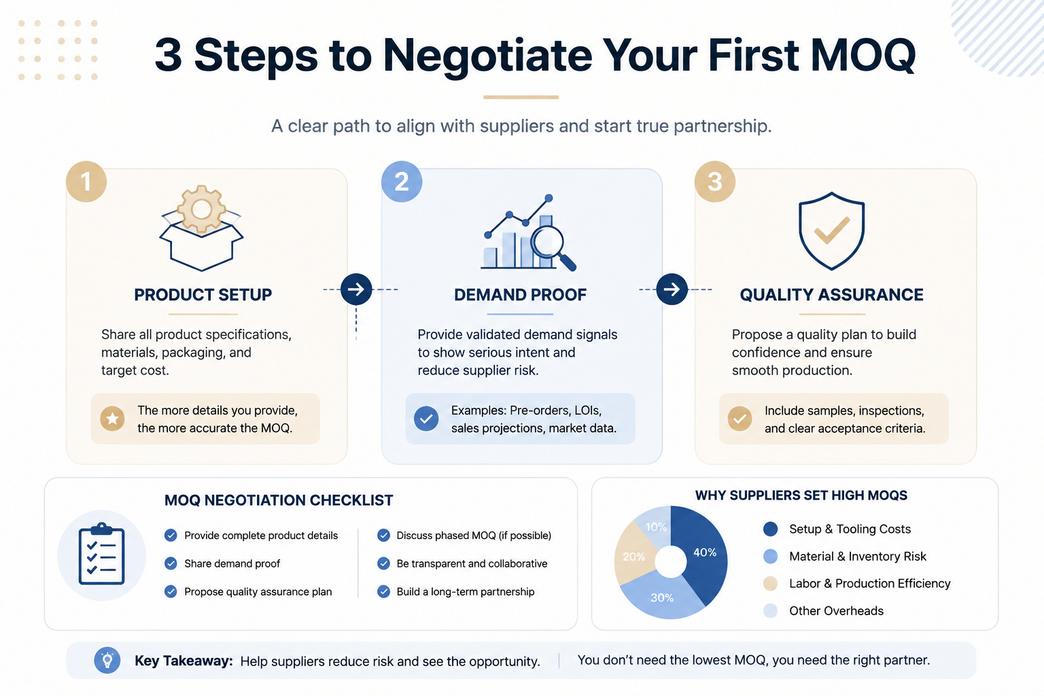
Negotiating a first order gets easier when both sides know the product, demand plan, and non-negotiable quality checks.
Establishing Custom Branding Needs and Formula Adaptation
A low MOQ often depends on practical customization. Separate must-have product features from nice-to-have extras.
- Product setup
- Confirm whether cosmetic formulation needs adaptation or an existing private label base will work.
- Review ingredient sourcing and prototype testing before production.
- Brand setup
- Settle packaging design, sizes, labels, and components early.
- Keep product development changes limited; fewer custom parts can cut setup costs.
- Check regulatory compliance before artwork is locked.
Demonstrating Volume Potential to Improve Inventory Holding
MOQ negotiation is not just about today’s order. Credible future demand makes the supply chain easier to plan.
- Show demand evidence.
- Share a grounded sales projection linked to real market demand.
- Map repeat orders.
- Provide a likely production schedule for purchasing and stock management.
- Discuss operations.
- Explain warehouse storage needs and logistics planning. Before selling in another market, check UK cosmetic product requirements and Canadian cosmetic requirements.
Minimum order quantities reflect production economics, not simply a factory rule.
Aligning Quality Assurance Expectations with GMP Certification
Quality requirements can move a negotiated MOQ because testing adds time and cost.
- Certification and oversight
- Verify Good Manufacturing Practice status and relevant ISO standards. The ISO 22716 overview covers cosmetics GMP.
- Ask how the audit process and factory inspection are handled.
- Testing and records
- Agree on quality control, stability testing, microbial analysis, and required safety standards.
- Confirm batch traceability and regulatory compliance documentation.
Put these expectations in the manufacturing agreement early. For an additional checkpoint, consult Australia’s cosmetics guidance.
Negotiate from a complete decision brief: Customization choices, repeat-order volume, and quality records all affect a workable first order.
Topfeel Beauty uses a 100,000-level purification workshop and a process covering consultation through delivery. Share your formula, packaging, target markets, forecast, and testing needs through contact us to discuss an MOQ and production path.
References
- Good Manufacturing Practice Guidelines/Inspection Checklist
- Cosmetics Regulation (EC) No 1223/2009
- ISO 22716:2007 Cosmetics — Good Manufacturing Practices
- Making cosmetic products available to consumers in Great Britain
- Regulatory information for cosmetics
- Cosmetics
Post time: Sep-02-2026