
What Is a Lip Combo? A Product Guide for Beauty Brands
“what is a lip combo? It’s a coordinated pairing of lip products—liner and lipstick, or velvet color and gloss.
For brands, formulas, packaging, and testing matter.”
Key Points: What Is a Lip Combo Unpacked
→ Core Concept: Lip liner plus lipstick, or velvet liquid lipstick plus gloss.
→ Brand Appeal: Duo kits coordinate shades and retail positioning.
→ Packaging Edge: Dual-ended wands, magnetic closures, custom logos.
→ Formulation Focus: Balance finish, stability, pigment dispersion, and claims.
What Is A Lip Combo, Really?
So, what is a lip combo? It’s lip products worn together to shape color, texture, and shine. Formula and packaging choices coordinate the routine.
Lip Combo Essentials: Velvet Finish Liquid Lipstick + Transparent Gloss Topper
The classic pairing makes the concept clear.
- Base layer
- Liquid lipstick supplies strong pigmentation and a soft velvet finish.
- A thin coat helps avoid heavy texture layering.
- Top layer
- Transparent gloss works as a gloss topper, adding shine without changing the core shade.
- Gloss can improve the feeling of hydration, too.
Wear either finish alone or layer both.
Why Brands Love Duo Lip Combo Kits
For product planning, the combination is also a retail concept.
- Duo kits create simple product bundling.
- For beauty brands, coordinated shades reduce guesswork in a makeup routine.
- That convenience can strengthen consumer appeal.
- Commercially, one pairing supports:
- cross-selling between product types;
- a clearer sales strategy built around one complete look.
The result feels purposeful. Guidance on matching lip liner and lipstick can inform the shade story.
Key Packaging Features in Lip Combos – Dual-Ended Applicator Wand & Magnetic Closure Lipstick Barrel
Packaging choices: A dual-ended applicator and wand can carry two formulas in one compact format, improving portability without clutter.
Closure details: A magnetic closure on a lipstick barrel gives a satisfying snap while helping keep the pack shut.
Daily use: Smart cosmetic packaging can make use quicker and cleaner.
From Matte Liquid Lipstick Base to High-Shine Lip Gloss Polymer
Technically, the pairing depends heavily on formula contrast.
- Color foundation
- Matte liquid lipstick acts as the lip base.
- Pigments and film-forming ingredients support long-wear color.
- Shine layer
- Lip gloss uses polymer systems to create slip and a high-shine surface.
- Applied on top, it shifts matte color toward a glossy finish without requiring a new shade.
Build one coherent lip story: Coordinate shade, finish, retail logic, and packaging around a single buyer decision. Topfeel Beauty’s 12-color lipstick and gloss set gives brands a concrete format for comparing the complete duo.
Review the set route to define the combination before sampling.
Ingredients Breakdown For Lip Combos
If you’re asking what is a lip combo, it’s a layered pairing chosen to work together in color and feel. Films, waxes, pigments, and conditioning ingredients shape wear.
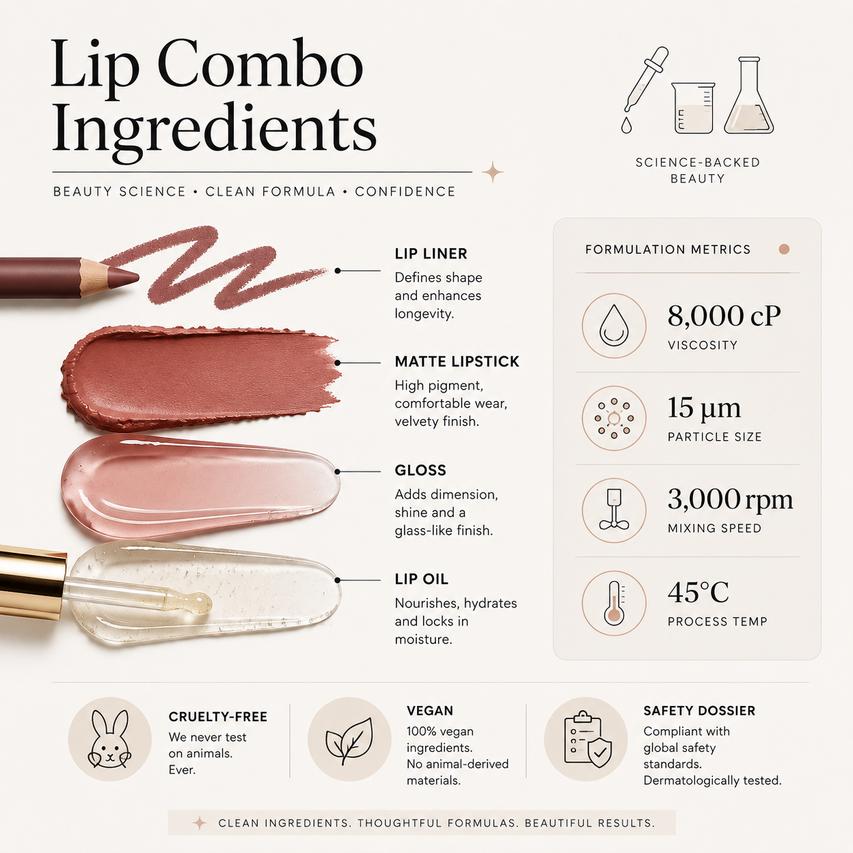
Matte Liquid Lipstick Base and Moisturizing Lip Liner Wax
- The color layer
- A matte liquid lipstick combines a pigment base with a film former or long-wear polymer for coverage and set.
- The contour layer
- Lip liner wax, an emollient, and a moisturizing agent help pencils glide instead of dragging.
That pairing supports crisp definition. Brands can compare the contour format through the private label lip liner guide.
High-Shine Lip Gloss Polymer with Hyaluronic Acid Plump Serum
A high-shine polymer creates a reflective glossy finish. Hyaluronic acid can support surface hydration.
For a plump lip combination, a plumping serum may complement that hydrated look. “Collagen booster” claims need suitable evidence.
Vitamin E Lip Oil Infusion in Transparent Gloss Toppers
- Shine
- Transparent gloss and a gloss topper add sparkle without changing the base color much.
- Comfort
- A lip oil infusion can carry vitamin E, a familiar antioxidant.
- Nourishing oil supports emollience and a softer feel associated with hydration.
That’s a pairing for shine. The lip serum guide adds comfort context.
Emulsion Stability Metric & Pigment Dispersion Rate Explained
- Formula controlExample development checks
- Emulsion stability tracks separation resistance.
- Pigment dispersion tracks how evenly color particles spread.
| Formulation test | Numerical target | Why it matters |
|---|---|---|
| Viscosity metric | 8,000 cP | Flow |
| Particle size | 15 µm | Smooth color |
| Centrifuge test | 3,000 rpm | Separation |
| Heat hold | 45°C | Stability |
A rheology modifier controls flow within a colloidal system; actual acceptance limits depend on the formula.
Cruelty-Free Certification, Vegan Formulation Standard, and Cosmetic Safety Dossier
When explaining retail claims, keep each term tied to evidence and market requirements.
- Verify cruelty-free certification and its specific criteria through the applicable program.
- Check the vegan formulation against supplier documentation and the chosen ethical standard.
- Build a safety dossier covering ingredient safety, cosmetic testing, and applicable regulatory compliance.
For tolerance planning, compare skin-tolerance guidance with CIR ingredient safety reports.
Turn claims into a workable brief.
Topfeel Beauty’s custom formulation support covers color matching, finish development, and compatibility, stability, and safety assessments. Review lip gloss options to compare the shine layer, then use custom solutions to define the evidence and documentation required for the complete formula pairing.
4 Steps To Create Your Lip Combo
What is a lip combo in production terms? It connects formula, application, packaging, and product checks.
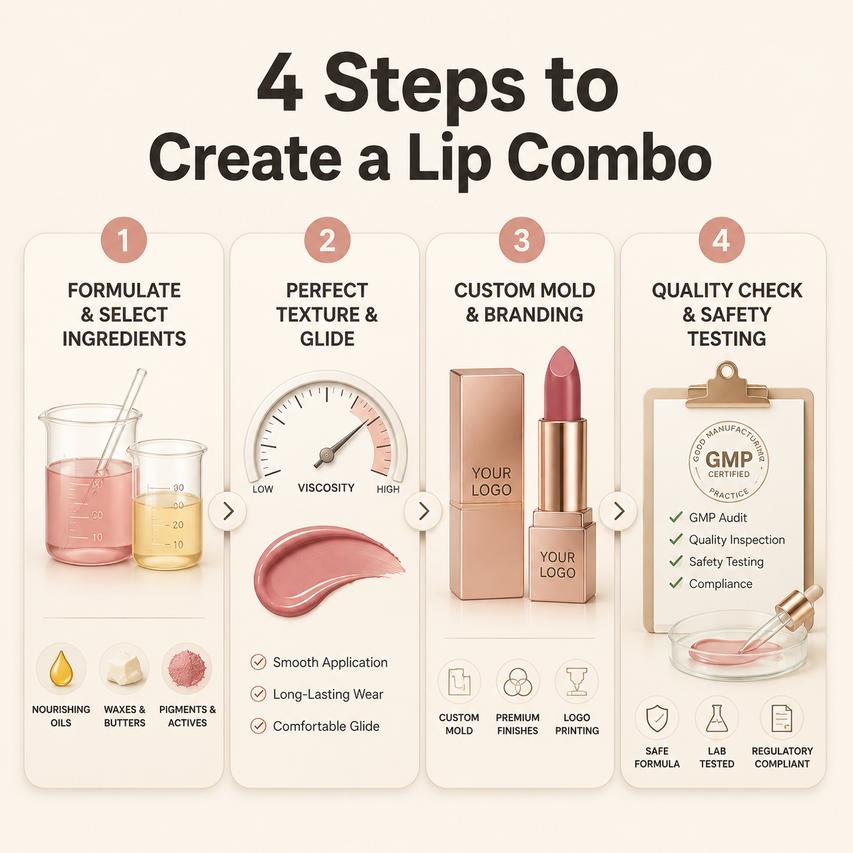
Step 1: Custom Formula Development & Bulk Raw Material Sourcing
Start with compatible formulas.
- Formula targets
- A lip liner needs controlled payoff and clean definition.
- The lipstick base combines emollients, waxes, and pigment dispersion to set color and comfort.
- Production supply
- Approved bulk raw materials and cosmetic ingredients help keep batches consistent.
A strong custom formula makes the pairing feel intentional.
Step 2: Balancing Bulk Viscosity Index for Creamy Glide Application
The viscosity index indicates how readily the lip product flows under set conditions.
- Adjust the rheology modifier within the texture formulation.
- Check applicator pickup.
- Compare drag and payoff.
- Fine-tune the creamy texture.
- Confirm easy glide application.
- Assess sensory feel on lips.
The goal is smooth, controlled application without messy dripping.
Step 3: Private Label Silkscreen Printing on Custom Molded Plastic Casing
The visual side extends beyond shade matching.
- Private label presentation
- Silkscreen printing places the brand logo directly onto a custom molded casing.
- Surface decoration should align with carton graphics.
- Packaging fit
- Plastic packaging dimensions must suit each cosmetic container and filling format.
That keeps the pair retail-ready. The matte lipstick guide can inform finish positioning.
Step 4: GMP Manufacturing Audit and Heavy Metal Test Report
Final checks connect manufacturing discipline with product safety.
- GMP compliance
- A manufacturing audit reviews hygiene, records, and production controls.
- Quality assurance tracks identified issues and corrective actions.
- Product testing
- Heavy metal testing measures specified contaminants against applicable regulatory standards.
- A safety report may document results alongside relevant toxicology analysis.
These checks support release decisions based on documented evidence. A brand evaluating suppliers can review how to find a qualified cosmetic manufacturer.
Create your lip combo with clear gates: Topfeel Beauty’s workflow connects formula, application, packaging, and quality control, moving from consultation and 3-7 days of initial sampling through verification, production, QC, and delivery.
Use the OEM lip makeup route to prepare the specification, then submit your requirements for review.
References
- Cosmetic Ingredients — FDA
- ISO 22716:2007 — ISO
- Cosmetic Products Regulation — EUR-Lex
- Testing of chemicals — OECD
- CIR Reports — CIR
- Skin Tolerance Guidance — Cosmetics Europe
Post time: Aug-31-2026