
What Are Spray on Cosmetics and How Do They Work in Makeup Application?
Spray on cosmetics are crashing the party, fixing messy routines and slow glam with a quick mist that feels almost too easy, yet sells like crazy.
Brands chasing speed, hygiene, and that airbrushed finish keep circling back to sprays because customers want results without the fuss or fingerprints.
insights from Mintel and Euromonitor highlight demand for spray formats in beauty, pointing to convenience-led purchasing and private label expansion across North America.
Quick Insights: Spray On Cosmetics
➔ Atomization through fine-mist applicators ensures ultra-even coverage for foundation, setting sprays, and sunscreens.
➔ Film-forming polymers lock pigments and emollients in place, delivering long-wear, transfer-proof finishes.
➔ Glycerin and humectants maintain skin hydration, while botanical extracts soothe and refresh the complexion.
➔ Compact aerosol containers and white-label solutions streamline professional kit customization and high-volume filling operations.
How Do Spray On Cosmetics Work?
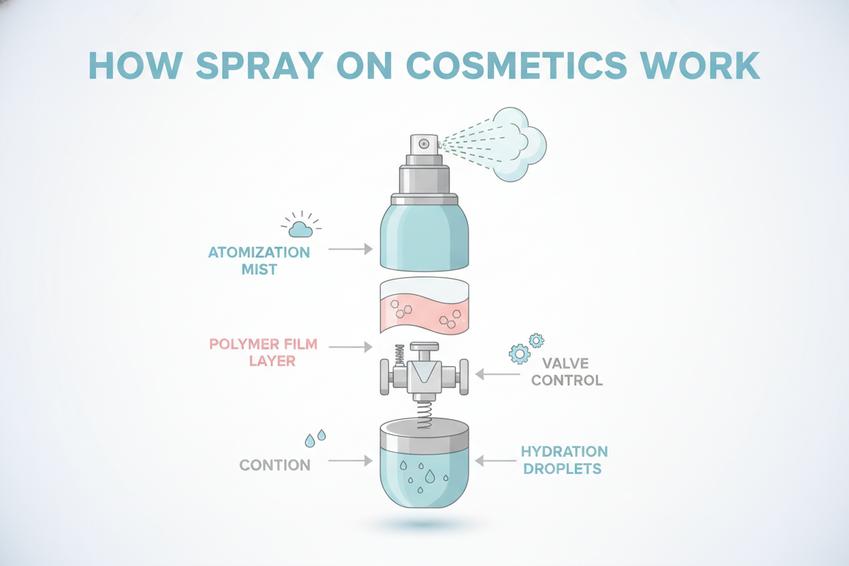
Spray on cosmetics look simple—press, mist, glow—but there’s clever science inside every bottle. From atomization to film formation, each cosmetic spray relies on tight engineering and skin-friendly chemistry. As spray on cosmetics keep trending in fast beauty routines, brands like Topfeel refine formulas so spray-on makeup feels light, even, and easy to love.
Atomization through Fine Mist Applicator
When spray on cosmetics leave the bottle, performance starts with atomization.
- Fine mist
- Precision applicator
- Micro-sized spray droplets
- Liquid moves toward the nozzle.
- Pressure forces rapid dispersion.
- The aerosol or pump breaks liquid into uniform particles.
This matters because droplet size controls coverage. Too large, and foundation spray streaks. Too small, and pigment floats away.
Grouped flow inside the applicator:
-
Spray Head System
- Orifice diameter control
- Air–liquid mixing chamber
-
Droplet Formation
- Shear force split
- Velocity adjustment
-
Skin Contact
- Even radial spread
- Quick settling layer
Good spray on cosmetics feel weightless. A balanced fine mist lands softly, building thin layers instead of thick patches. That’s why cosmetic spray products for primer or setting mist look smooth under daylight—and even smoother on camera.
Film Formation via Film-Forming Polymers
After the mist settles, chemistry takes over. Film formation begins as solvents evaporate and film-forming polymers knit together, creating a breathable cosmetic layer.
Key performance elements:
- Strong adhesion
- Flexible barrier
- Smooth coating
Below is a simplified technical comparison used in spray on cosmetics formulations:
| Polymer Type | Avg. Molecular Weight (kDa) | Dry Time (sec) | Adhesion Strength (MPa) | Flexibility (%) |
|---|---|---|---|---|
| PVP | 40 | 45 | 1.2 | 18 |
| Acrylates Copolymer | 85 | 60 | 1.8 | 25 |
| Polyurethane Dispersion | 120 | 75 | 2.1 | 32 |
| Silicone Resin | 60 | 50 | 1.5 | 22 |
| Pullulan Blend | 20 | 40 | 0.9 | 15 |
How the layer forms in spray-on makeup:
-
Solvent evaporation
- Alcohol or water flashes off
-
Polymer alignment
- Chains interlock
-
Surface bonding
- Pigment anchors to skin
The result? Transfer-resistant spray cosmetics that move with facial expressions instead of cracking. Spray on cosmetics designed this way keep foundation spray fresh for hours without that tight feeling.
Dispensing Control with Valve System
Inside every can or bottle sits the quiet hero: the valve system.
Core components:
- Actuator
- Internal propellant
- Flow regulation channel
Multi-level function breakdown:
-
Dispensing Core
- Stem opening diameter
- Spring compression tension
-
Pressure Management
- Propellant expansion rate
- Internal chamber balance
-
Delivery Pattern
- Cone angle control
- Output consistency
In aerosol spray on cosmetics, the propellant pushes formula upward. In pump versions, mechanical compression handles delivery. Either way, accurate control prevents waste and keeps coverage even.
A well-tuned valve means each press releases nearly identical volume. That consistency matters for sunscreen spray and spray foundation alike. Topfeel fine-tunes actuator response so cosmetic spray feels predictable—no sudden splashes, no clog drama.
Hydration Delivery using Glycerin and Humectant
Spray on cosmetics are not just about color. Skin comfort counts.
Main hydration players:
- Glycerin
- Humectant blends
- Purified water
Hydration pathway:
-
Moisture attraction
- Glycerin binds external water
-
Surface retention
- Forms light moisture net
-
Long-term balance
- Supports water retention within skin
Nested ingredient roles:
-
Hydration Base
- Distilled water
- Aloe extract
-
Moisture Lock
-
Skin Feel Modifiers
- Lightweight emollients
- Soft-focus agents
Short bursts. Quick refresh. That’s the charm of spray on cosmetics in daily life. A makeup refresher mist can cool skin at noon, while spray-on makeup primers help foundation grip better. With balanced hydration delivery, spray cosmetics stay comfortable instead of chalky.
Spray on cosmetics may look effortless, but behind every fine mist sits careful engineering, smart polymers, steady dispensing, and real moisture science.
3 Benefits Of Spray On Cosmetics
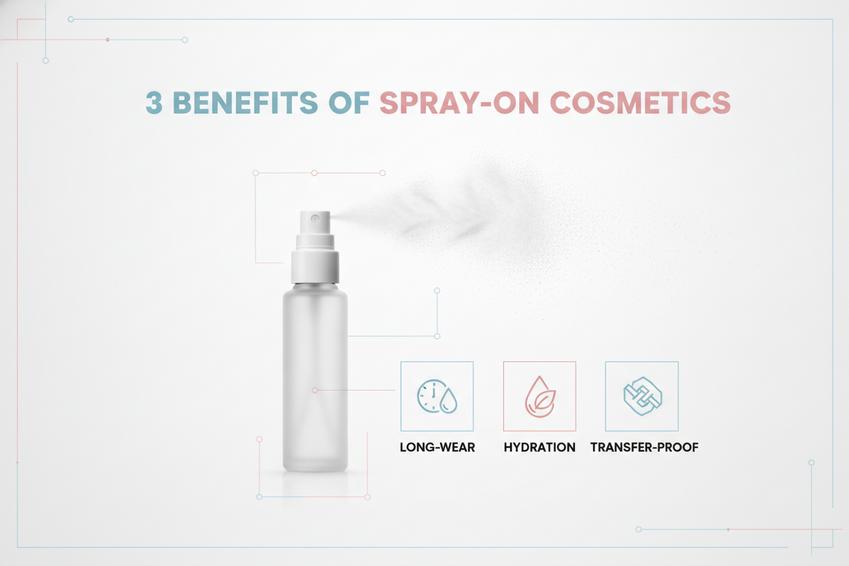
Spray on cosmetics are changing daily beauty routines. From quick foundation spray touch-ups to full-face makeup mist, this fine-spray format feels light, fast, and seriously practical for modern, on-the-go lifestyles.
Long-wear Formula for All-Day Confidence
Spray on cosmetics stand out for their long-lasting performance and real staying power. The secret sits inside smart film technology and precise mist diffusion.
-
Formulation Core
-
Film-forming polymers
- Create a flexible mesh over foundation spray.
- Improve smudge-resistant and fade-proof results.
-
Silicone derivatives
- Boost durable makeup adhesion.
- Enhance extended wear under heat and humidity.
-
-
Performance in Daily Life
-
During commuting
- Controls shine without cracking.
- Maintains all-day coverage even in crowded spaces.
-
During events
- Keeps makeup mist intact under bright lighting.
- Minimizes patchiness in high-definition photos.
-
-
Application Advantage
-
Ultra-fine spray on makeup particles
- Distribute evenly.
- Reduce product buildup.
-
Lightweight layers
- Feel breathable.
- Prevent heaviness common in traditional creams.
-
According to a 2025 Euromonitor beauty update:
Long-wear and transfer-resistant claims remain among the top drivers of global color cosmetics growth, especially in hybrid spray formats.
Brands like Topfeel refine spray on cosmetics with lab-tested adhesion standards, helping users feel secure from morning coffee to late-night plans.
Hydrating Effect Locks in Moisture
Dry, tight skin can ruin even the best makeup spray. That’s where skin-friendly spray on cosmetics shine.
- Hydrating ingredients such as glycerin support skin hydration.
- Fine mists help with steady moisture retention.
- Light emollients protect the skin barrier.
A quick breakdown of how spray on makeup supports comfort:
-
Humectants
- Attract water.
- Support a subtle plumping effect.
-
Conditioning agents
- Improve skin nourishment.
- Encourage a soft dewy finish.
In daily use:
- Morning: primer mist preps and smooths.
- Midday: makeup refresher revives glow.
- Night events: foundation spray keeps radiance from turning dull.
Topfeel develops spray on cosmetics that balance coverage with breathable moisture, so skin feels fresh instead of sticky. It’s makeup that works with your face, not against it.
Transfer-proof Finish for Flawless Looks
No one likes foundation stains on collars. Spray on cosmetics address that with transfer-resistant technology built for real movement.
-
Polymer Network Design
-
Cross-linking agents
- Improve non-transferring performance.
- Strengthen rub-off protection.
-
Flexible resins
- Maintain a flawless complexion.
- Prevent cracking around expression lines.
-
-
Daily Friction Scenarios
-
Mask wear
- Support mask-friendly makeup spray results.
- Reduce cheek residue.
-
Clothing contact
- Offer stain-free wear.
- Preserve an impeccable finish.
-
-
User Experience
-
Lightweight spray on makeup
- Feels smooth, never stiff.
-
Even atomization
- Minimizes buildup in high-contact areas.
-
With advanced testing for heat, humidity, and friction, Topfeel ensures spray on cosmetics deliver a clean, polished look that holds up in real life.
Why Spray On Cosmetics Are Revolutionizing Pro Makeup Kits
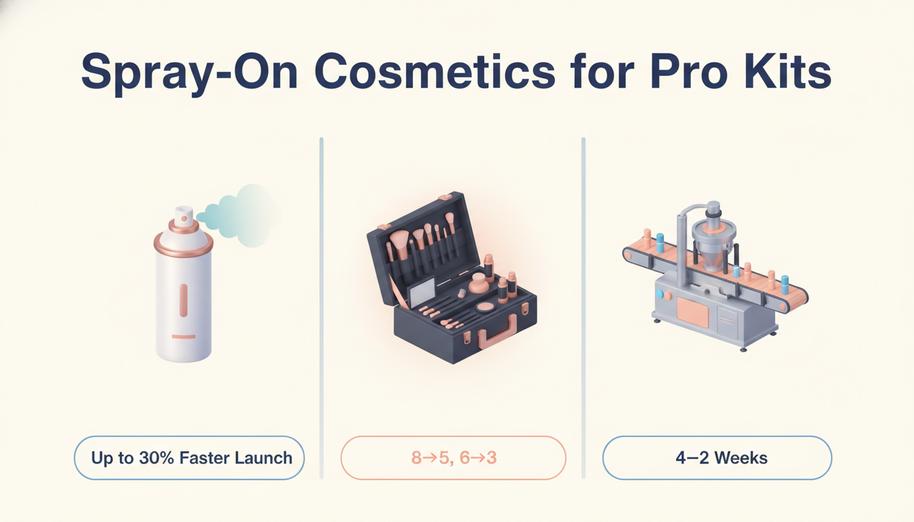
Spray on cosmetics are changing how artists pack, move, and work. From quick-fix touchups to full glam applications, spray cosmetics cut time and boost precision. As pro kits shrink and expectations rise, smart brands like Topfeel are reshaping makeup spray solutions for speed, durability, and scale.
Compact Aerosol Container for On-the-Go Artists
Makeup artists live out of their kits, so portability isn’t optional—it’s survival.
- lightweight packaging
- portable design
- travel-friendly formats
- compact caps with secure overfits
These details power modern aerosol technology built for professional use.
- Faster quick application backstage
- Cleaner storage in tight kit layouts
- Better artist mobility between locations
When it comes to spray on cosmetics, container engineering matters just as much as formula.
-
Key priorities:
- Size optimization
- Pressure balance
- Controlled mist output
For makeup spray systems used daily, the structure often looks like this:
-
Container Architecture
- Aluminum mono-wall
- PET plastic variant
-
Valve System
- Fine-mist actuator
- Lockable nozzle
-
User Impact
- Reduced fatigue
- Smooth spray cosmetics finish
The result? Spray on cosmetics that feel light in hand yet deliver pro-level performance.
White Label Production Speeds Kit Customization
Private label and product customization services allow fast shifts in shade ranges and finishes.
According to McKinsey’s 2025 global beauty outlook:
“Agile product development and rapid prototyping are now central to beauty growth, cutting launch timelines by up to 30%.”
That speed directly supports spray on cosmetics expansion.
Manufacturing typically flows through:
-
Concept Development
- Shade targeting
- Bespoke formulations
-
Technical Validation
- Stability screening
- Compatibility checks
-
Scaling
- Rapid prototyping
- Supply chain efficiency alignment
Here’s how timelines compare:
| Stage | Traditional Model (Weeks) | OEM Model (Weeks) | Efficiency Gain (%) |
|---|---|---|---|
| Formula Finalization | 8 | 5 | 37% |
| Packaging Sourcing | 6 | 3 | 50% |
| Pilot Run | 4 | 2 | 50% |
With spray cosmetics under manufacturing process refinement, brands gain sharper market differentiation. Topfeel supports this shift through integrated white label spray makeup production built for speed and consistency.
Water-Resistant, Transfer-Proof Performance in Action
Performance claims must hold up under heat, lights, and long days.
Spray on cosmetics designed with long-wear formula chemistry are tested for:
- smudge-proof endurance
- humidity resistance
- sweat-proof stability
- extended cosmetic longevity
Testing layers often include:
-
Laboratory Validation
- Microbial safety
- Stability cycling
-
Wear Trials
- 8-hour evaluation
- 12-hour evaluation
-
Environmental Stress
- High humidity chamber
- Elevated temperature exposure
A durable finish isn’t hype; it’s measured. For pro artists using spray makeup in real time, transfer-proof reliability saves touchups and keeps clients camera-ready.
Spray on cosmetics that pass these checks earn their place in serious kits.
Streamlined Filling Operations for High-Volume Supply
Behind every sleek can sits disciplined production.
Automated filling systems improve production efficiency, especially for large-scale spray cosmetics orders.
Typical operational workflow:
-
Raw Material Handling
- Batch weighing
- Controlled mixing
-
Filling Line
- Pressure calibration
- Valve crimping
- Leak detection
-
Quality Control
- Weight verification
- Spray pattern testing
- Batch coding
This large-scale manufacturing structure supports rapid production without skipping compliance.
At the supply level:
-
Inventory Planning
- Forecast alignment
- Safety stock logic
-
Supply chain optimization
- Supply chain optimization
- Export documentation
Spray on cosmetics demand keeps climbing, and scalable systems make sure stock doesn’t run dry. With tight quality control and streamlined operations, Topfeel keeps makeup spray supply steady for global partners who can’t afford delays.
References
- Mintel – mintel.com/Mintel
- Euromonitor – euromonitor.com/Euromonitor
- aerosol – wikipedia.org/Wikipedia
- film-forming polymers – wikipedia.org/Wikipedia
- PVP – pubchem.ncbi.nlm.nih.gov/PubChem
- Polyurethane Dispersion – wikipedia.org/Wikipedia
- propellant – wikipedia.org/Wikipedia
- Glycerin – pubchem.ncbi.nlm.nih.gov/PubChem
- Sorbitol humectant – pubchem.ncbi.nlm.nih.gov/PubChem
- Sodium PCA – incidecoder.com/INCIdecoder
- skin barrier – wikipedia.org/Wikipedia
- McKinsey – mckinsey.com/McKinsey
- Microbial safety – wikipedia.org/Wikipedia
- compliance – fda.gov/FDA
- Supply chain optimization – wikipedia.org/Wikipedia
Post time: Jun-26-2026