
7 Factors to Define Before Developing a Skin Care Formula
Skin care formulation isn’t some lab-side afterthought; it’s the make-or-break move that decides if your product flies off shelves or flops hard.
Skip the groundwork and you’re stuck with returns, cranky reviews, and inventory that just sits there gathering dust.
Recent Mintel and McKinsey reports show demand rising for compliant, targeted formulas, pushing brands to prioritize performance, safety, clarity.
Quick Answers: Skin Care Formulation
➔ Define Your Audience: pinpoint age, skin condition, texture preference, ethical claims and distribution channels.
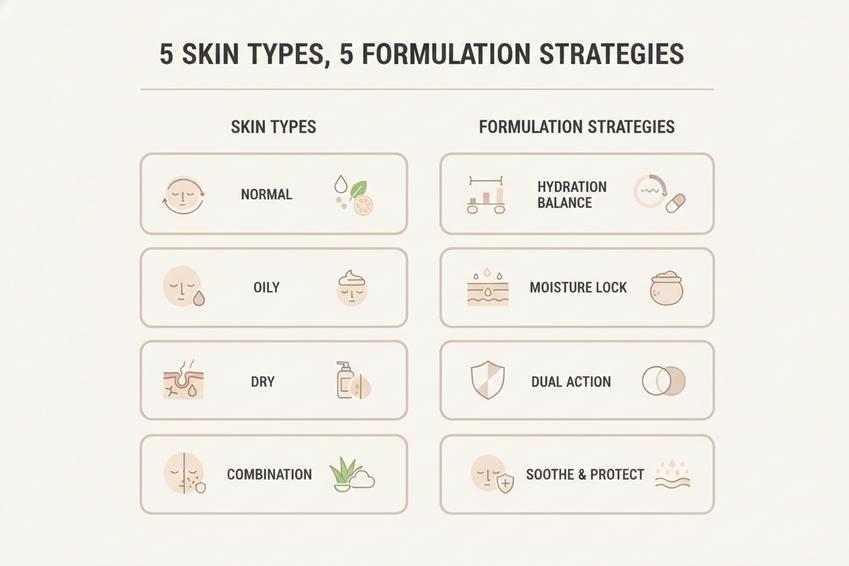
➔ Tailor by Skin Type: use balanced humectants for normal, mattifying film formers for oily, rich emollients for dry, dual-phase systems for combination, hypoallergenic preservatives for sensitive.
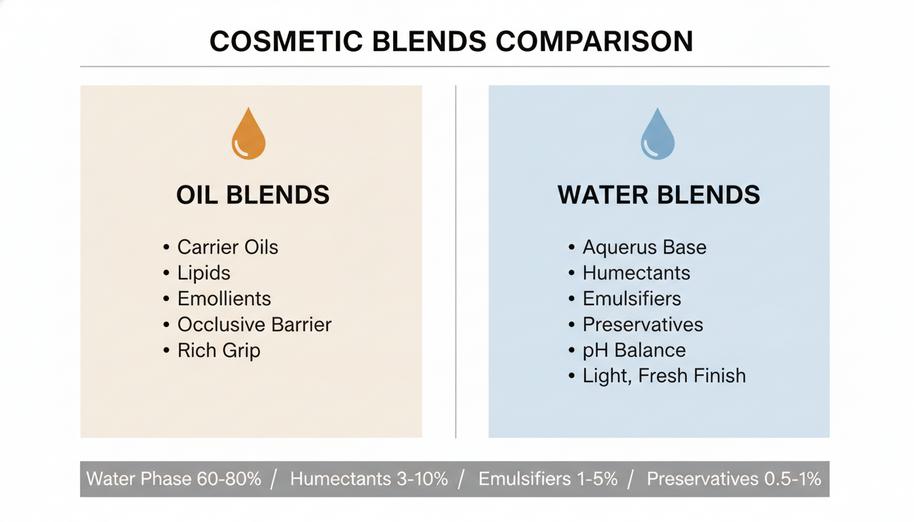
➔ Select the Base: oil blends for rich coverage and water resistance; water blends for breathable, lightweight finishes.
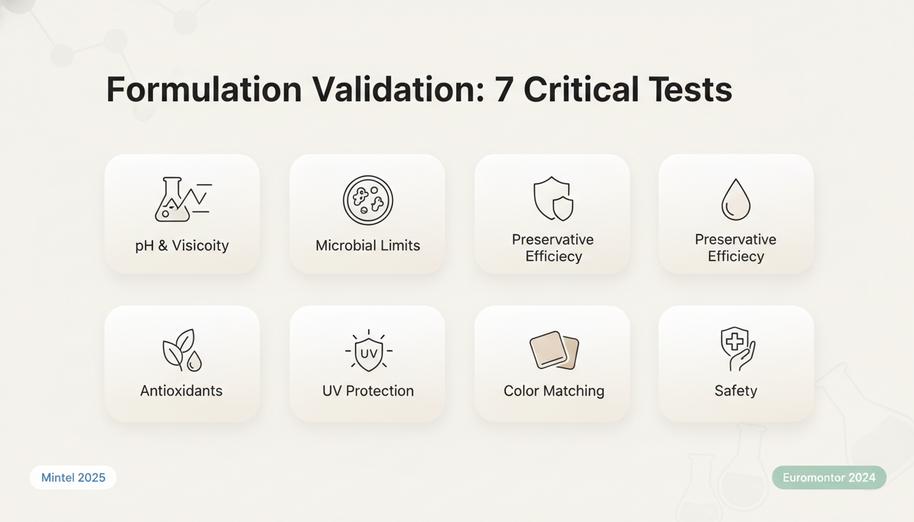
➔ Validate & Stabilize: perform pH/viscosity checks, microbial limits, preservative efficacy, antioxidant and UV filter tests, plus real-time and accelerated stability trials.
Who Is Your Target Consumer? Define First.
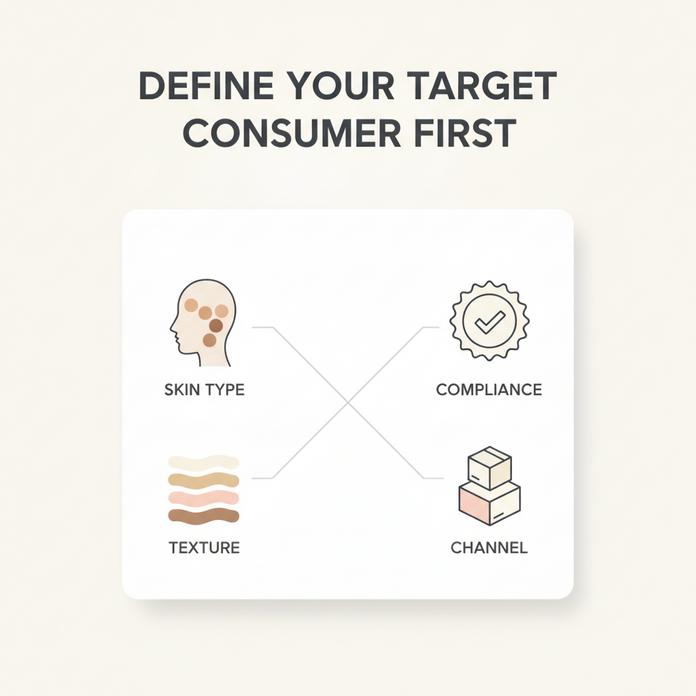
Getting real about your audience saves time and money. A sharp skin care formulation plan starts with people, not products. Know habits, skin issues, and buying behavior before mixing anything.
Age and Skin Condition: Catering to Sensitive, Acne-Prone, and Mature Types
Understanding sensitive skin, acne-prone skin, and mature skin shapes every skin care formulation decision. Different ages carry different skin concerns, so your formula can’t be one-size-fits-all.
-
Core needs:
- Hydration for mature skin
- Oil balance for acne-prone skin
- Barrier repair for sensitive skin
-
Ingredient mapping
- Gentle preservatives for sensitive skin
- Non-pore-clogging agents for acne-prone skin
- Antioxidants for anti-aging and long-term hydration
Short take: good skin care formulation respects biology, not trends. As a cosmetics formulation and manufacturing partner, Topfeel Beauty offers custom solutions tailored to specific demographic needs.
Texture & Finish Preferences: Non-Comedogenic Creams vs. Lightweight Gels
Texture sells before results do. People feel it first.
- Cream lovers want comfort and glow
- Gel fans want fast absorption and zero weight
-
Build the base
- Choose non-comedogenic oils
- Balance water-to-oil ratio
-
Adjust finish
- Matte → oil control powders
- Dewy → humectants and light reflectors
A smart skin care formulation keeps the texture breathable while dialing in the final finish. For brands exploring texture innovation, Topfeel Beauty provides R&D support for a foundation or base with finishes ranging from matte to radiant.
Ethical & Regulatory Appeal: Cruelty-Free, Vegan Certification, and FDA Regulations
Modern buyers scan labels fast. Words like cruelty-free, vegan, and FDA compliance matter. Global movements toward banning animal testing and trade in cosmetics make these certifications a priority.
-
Key checkpoints:
- Ingredient safety
- Clear regulatory labeling
- Verified certification
• Ethical sourcing isn’t optional anymore
A reliable skin care formulation balances clean claims with actual compliance. Transparency builds trust quicker than marketing buzz.
Distribution Channels: E-Commerce Fulfillment Centers vs. Brick-and-Mortar Retail
Where you sell shapes how you build.
-
E-commerce flow
- Durable packaging for fulfillment
- Efficient logistics for online sales
-
Retail flow
- Shelf appeal in physical stores
- Tester-friendly formats
Short bursts:
- Pumps reduce leaks
- Tubes travel better
- Cartons boost branding
A flexible skin care formulation pairs with smart distribution planning. For brands exploring packaging options, Topfeel Beauty offers products and packaging support ranging from stock components to custom molds.
5 Skin Types Guiding Your Formulation Strategy
Skin behaves differently day to day, so smart skin care formulation keeps things flexible, not rigid. This guide breaks down how each skin type responds to ingredients, textures, and finish—so your skin care formulation strategy actually works in real life, not just on paper.
Normal Skin: Balanced Humectants and Antioxidants Blend
-
Core balance
-
Hydration layer
- Glycerin + Hyaluronic Acid keep water levels steady
-
Protection layer
- Vitamin E, Green Tea Extract defend against stress
-
-
Barrier harmony
- Ceramides + Niacinamide help maintain pH balance
-
Texture goal
- Lightweight, breathable, no buildup
A well-built skin care formulation here avoids extremes. Think of it as maintenance mode—steady hydration, mild antioxidant support, and a finish that feels like nothing’s there. As a manufacturing partner, Topfeel Beauty supports brands developing what is clean beauty products with paraben-free and vegan-friendly formulation choices.
Oily Skin: Oil-Control Emulsification with Mattifying Film Formers
-
Sebum control core
- Salicylic Acid clears buildup
- Zinc PCA supports Sebum regulation
-
Surface management
- Kaolin Clay, Silica absorb excess oil
-
Structure design
- Stable Emulsifiers + flexible Polymer film
-
Safety
- Strictly Non-comedogenic
Short notes: shine drops, pores look tighter, wear lasts longer. A good skin care formulation here feels dry-touch but not tight.
Dry Skin: Rich Emollients, Binders, and Deep-Hydration Humectants
• Moisture sealing
- Shea Butter, Squalane lock softness
• Deep hydration
- Urea, Glycerin pull water inward
• Barrier rebuild
- Lipids, Ceramides support Barrier repair
Rich textures matter, but spreadability matters more. Skin care formulation for dryness should glide, not drag. Topfeel Beauty offers lab co-creation on textures and skincare actives to help balance occlusives with fast-absorbing layers.
Combination Skin: Dual-Phase UV Filters and Texture Evaluation
Here’s where things get tricky—two needs, one formula.
| Component | Function | Ingredient Example | Skin Zone Effect |
|---|---|---|---|
| UV Shield | Broad protection | Zinc Oxide | Even coverage |
| Light Filter | Smooth finish | Titanium Dioxide | T-zone control |
| Base System | Texture balance | Emulsion | Adaptive feel |
| Finish Layer | Comfort | Gel-cream | Hydrates dry areas |
A hybrid skin care formulation blends facial sunscreen elements, UVA, UVB defense with smart Sensory analysis so it feels right across the face.
Sensitive Skin: Hypoallergenic Preservatives and Safety Assessments
-
Calm-first approach
- Allantoin, Bisabolol, Centella Asiatica reduce Irritation
-
Safety system
- Phenoxyethanol in low, controlled levels
-
Testing flow
- Patch test
- Stability check
- User validation
Short segments: no fragrance, low risk, skin stays quiet. Dermatologist-backed and Fragrance-free claims matter more than trends. For brands requiring stringent safety profiles, Topfeel Beauty provides oemodm formulations documented to comply with EU and FDA regulations.
Oil Vs. Water Blends: Selecting The Base
A smart skin care formulation starts with choosing the right base. Oil or water shifts texture, wear, and vibe. In skincare formulation work, this choice quietly shapes how every ingredient behaves and feels on skin.
Oil Blends
“Oil-rich cosmetic formats continue to rise in long-wear categories due to improved adhesion and barrier support,” notes a 2025 Mintel beauty report.
-
Core build of an oil-based skin care formulation:
-
Base layer
- Carrier oils set glide and spread
- Lipids and fatty acids reinforce barrier feel
-
Performance layer
- Emollients soften and fill micro-gaps
- Occlusive elements lock in moisture
-
Finish tuning
- Adjust viscosity for drag vs slip
- Select non-comedogenic options for acne-prone users
-
Short notes that matter:
- richer payoff, stronger grip
- great for pigments and long-wear looks
- can feel heavy if balance slips
In formulation labs, pairing lighter carrier oils with structured lipids avoids that greasy afterfeel while keeping payoff high. For brands developing oem lips makeup or a custom lipstick, Topfeel Beauty provides formulation development targeting specific wear properties.
Water Blends
Water-based skin care formulation feels easy, fast, breathable—perfect for daily wear and fresh finishes.
-
Key build:
- Aqueous solutions form the base
- Humectants pull in hydration
- Emulsifiers keep oil and water from fighting
- Preservatives maintain safety
- pH balance keeps skin calm
-
Texture path in a skincare formulation
- Start with hydrosols or purified water
- Add solvents for actives
- Blend in humectants for bounce
- Stabilize with emulsifiers
Tiny breakdown:
- light feel
- quick absorption
- natural finish
Table snapshot for a clean skin care formulation:
| Component | Typical % | Function |
|---|---|---|
| Water phase | 60–80% | Base solvent |
| Humectants | 3–10% | Hydration retention |
| Emulsifiers | 1–5% | Stability |
| Preservatives | 0.5–1% | Safety & shelf life |
Refining a skincare formulation balance involves adjusting pH balance and humectants. As a cosmetics supplier, Topfeel Beauty assists with stability and compatibility assessments during this process for a base for lip gloss and other water-based formats.
Formulation Validation: 7 Critical Analytical Tests
Getting a solid skin care formulation right isn’t just lab talk—it’s how texture, safety, and performance come together. Each test keeps your skin care, skincare formula, and cosmetic formulation feeling consistent and reliable.
pH and Viscosity Measurements for Texture Evaluation
-
pH, Viscosity, and Texture define how a formulation behaves on real skin.
-
Measurement flow:
- Check pH range → match skin comfort
- Adjust Rheology → refine spread
- Confirm Evaluation → batch consistency
-
Small tweaks here can totally change a skin care formulation feel from greasy to silky.
Microbial Limits Assessment and Stability Testing
Keeping a skin care formulation clean matters.
- Watch Microbial limits and Contamination risks
- Track Shelf life and Product integrity
“Stability testing is now a key driver of consumer trust in personal care,” notes a 2025 Mintel beauty report.
Healthy control of Microorganisms keeps formulas fresh longer.
Preservative Efficacy Testing under GMP Standards
A reliable preservation system isn’t optional.
- Challenge test → simulate real use
- Monitor Microbial growth
- Align with GMP standards and Quality control
Under GMP and ISO 22716 standards, Topfeel Beauty implements multi-step inspection processes to monitor product integrity.
Antioxidant Activity Evaluation and Ingredient Purity
Oxidation kills vibe fast.
- Check Antioxidant activity
- Verify Ingredient purity
- Protect against Free radicals
Clean inputs keep skincare formula potency stable and color intact.
UV Filter Protection Analysis and Performance Testing
-
UV filter balance = real protection
- SPF accuracy
- UVA + UVB coverage
- Photostability
A good skin care formulation with SPF should feel light but still deliver Efficacy.
Color Matching Trials in Compact Cases and Jars
Consistency is everything in makeup-based skin care formulation.
- Test Pigments across Packaging
- Match Shade in Compact cases and Jars
For brands seeking consistent cosmetic shades like pigmented eye shadow, Topfeel Beauty features professional laboratories to match specific color samples.
Safety Assessments and ISO Certification Checks
Safety builds trust.
- Toxicology review
- Dermatological testing
- Regulatory compliance
Euromonitor (2024) highlights safety validation as a top purchase factor in global beauty.
Every skin care formulation should pass strict Product safety checks before reaching users.
Formulation Stability: Results From A 30-Day Trial
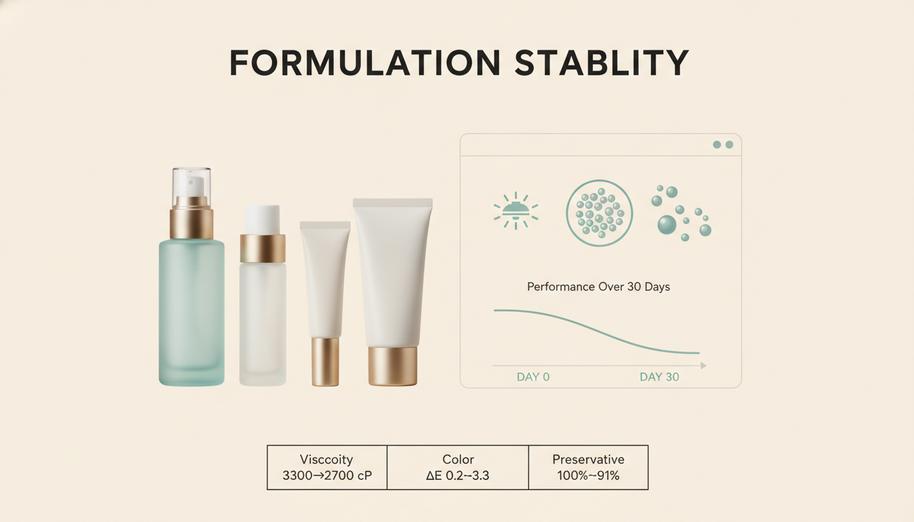
A 30-day window can reveal a lot about a skin care formulation—from subtle texture drift to full-on instability. Here’s a grounded, lab-to-shelf look at how skin, care, and formulation choices behave in real use, with practical checks that manufacturers run to keep products steady and user-friendly.
Real-Time Shelf Life Tracking in Bottles and Tubes
-
Track shelf life through real-time monitoring across bottles and tubes.
-
Packaging
- packaging materials compatibility → watch for leaching, odor pickup
- closure integrity → micro-leaks, evaporation loss
-
Performance over storage duration
- texture drift → viscosity creep, graininess
- efficacy signals → SPF shift, color fade (degradation)
-
Stability readouts
- product stability index (weekly)
- user-feel checks (spread, drag)
-
Short notes: small changes add up. A skin care formulation that feels plush on day 1 can feel waxy by day 20 if the emollient system isn’t balanced.
Accelerated Stability Testing under UV Exposure
- Set stress conditions: UV + heat cycles
- Measure photostability of pigments and filters
- Record light degradation and preservative drop-off
- Conclude stability assessment for formulation integrity
| Day | UV Dose (mJ/cm²) | Viscosity (cP) | Color ΔE | Preservative (%) |
|---|---|---|---|---|
| 0 | 0 | 3200 | 0.2 | 100 |
| 7 | 500 | 3150 | 0.8 | 98 |
| 14 | 900 | 3010 | 1.6 | 96 |
| 21 | 1300 | 2890 | 2.4 | 94 |
| 30 | 1700 | 2700 | 3.3 | 91 |
Industry standard quality control often flags ΔE > 2 as noticeable. That’s when a skin care formulation needs pigment or antioxidant tuning.
Impact of Emulsification & Homogenization on Longevity
-
Core flow
-
emulsification process
- oil phase build → emulsifier choice
- water phase → humectant load
-
homogenization technique
- pressure range → particle size distribution
- passes count → uniformity
-
-
Outputs
- emulsion stability ↑ when droplets are tight
- viscosity curve stays smooth
- less phase separation under heat
Quick takes: tweak manufacturing parameters by small margins; the skin care formulation often rewards precision.
Batch Consistency, Defect Detection, and Texture Evaluation
-
Quality loop
-
batch consistency
- incoming checks → raw variance
- in-process → pH, torque
-
defect identification
- air pockets, specking, odor shifts
-
texture analysis
- rheological properties (yield stress, thixotropy)
- panel + sensory evaluation
-
Finish line
- product appearance and uniformity
-
Multiple quick reads: smooth glide, even color, no grit. If any slip, the skin care formulation gets reworked. Through first article verification and process control, Topfeel Beauty supports manufacturing workflows designed so each batch lands the same feel users expect.
References
- Mintel – mintel.com
- The beauty market in 2023 – mckinsey.com
- FDA compliance – fda.gov
- Hyaluronic Acid – healthline.com
- Vitamin E – allure.com
- Ceramides – webmd.com
- Niacinamide – byrdie.com
- Salicylic Acid – medicalnewstoday.com
- Zinc PCA – incidecoder.com
- Squalane – paulaschoice.com
- Titanium Dioxide – safecosmetics.org
- Bisabolol – byrdie.com
- GMP standards – iso.org
- Free radicals – medicalnewstoday.com
- Euromonitor – euromonitor.com
Post time: Jul-28-2026