
Custom Silicone-Based Foundation for Beauty Brands
“A silicone based foundation list is only the starting point. Beauty brands still need finish, coverage, shade, viscosity, packaging, and wear to remain consistent at factory scale.
A strong prototype must translate into repeatable bulk batches. This guide covers formulation, testing, scale-up, packaging, and OEM/ODM sourcing.”
Key Harmonies: Silicone Based Foundation List Overview
→ Diverse Formulations: oil-free bases, waterproof polymers, dimethicone blends, and pore-minimizing emulsions for tailored textures.
→ Signature Shade Steps: traceable silicone and pigments, ISO-certified trials, stability review, container selection, and glass jar prototyping.
→ Skin-Type Solutions: oil-free and matte-finish formulas plus pore-smoothing emulsions perfect for oily complexions.
→ Scale-Up Essentials: GMP-compliant partners, OEM/ODM agreements, and controlled factory mixing for consistent bulk batches.
→ Quality Safeguards: adjust emulsion ratios, conduct microbial limit tests, and enforce GMP process controls throughout production.
What Are Silicone Based Foundation List Categories?
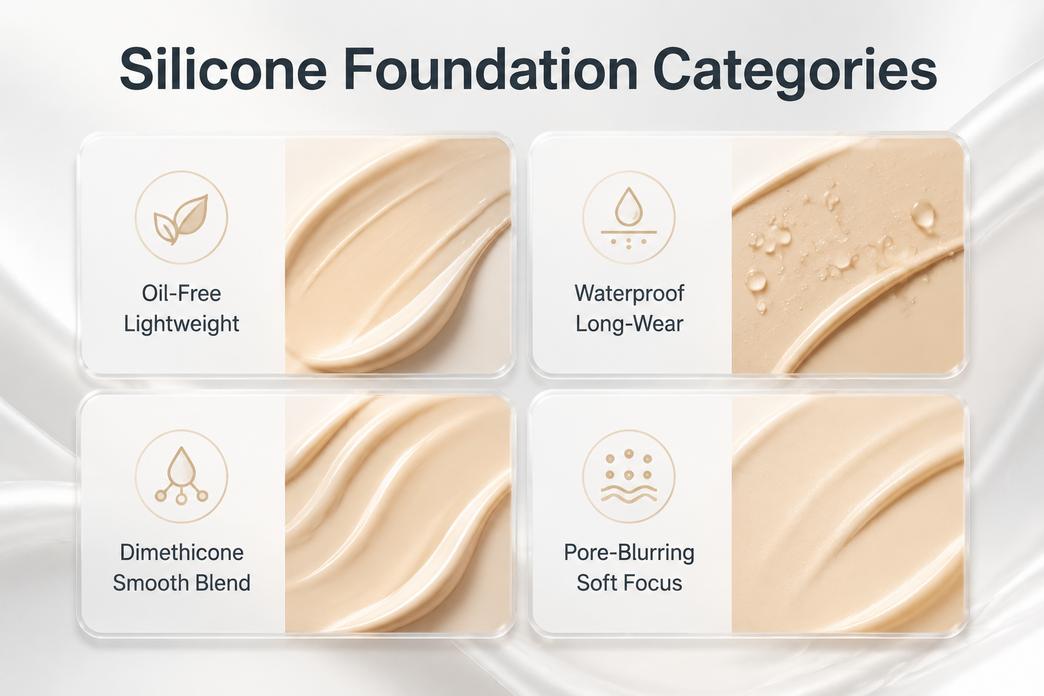
A practical silicone based foundation list sorts formulas by feel, wear, coverage, and finish. Brands can then match foundation development and the wider base-makeup routine to product goals.
Oil Free Silicone Base Variants
Oil-free choices keep things light without giving up slip.
- Daily feel
- oil-free formula supports a lightweight texture and breathable wear.
- volatile silicones help foundation spread, then evaporate from the film.
- Skin goals
- sebum control can support a matte finish.
- A non-comedogenic design requires substantiation for the finished formula.
Waterproof Liquid Polymer Formulations
For long days, waterproof silicone foundation focuses on staying put.
- Wear system
- A film former and long-wear polymer can build a flexible barrier.
- hydrophobic agents can support humidity defense and sweat-resistant performance after testing.
- Finish
- transfer-proof wear helps preserve high coverage with fewer touch-ups.
Dimethicone Heavy Blend Options
This silicone based foundation list category goes richer and smoother.
- Texture
- Dimethicone gives a velvety texture and smooth application.
- cyclomethicone improves glide.
- Wear
- silicone elastomer supports crease resistance.
- hydration lock helps reduce a dry, tight feel.
Pore Minimizing Emulsion Types
Pore-focused formulas are all about visual smoothing, not changing pore size.
- Optical finish
- Silica and optical diffusers can create a soft focus finish.
- Surface feel
- filling polymers provide a blurring effect.
- A pore refiner approach adds skin smoothing for a more even-looking finish with less visible clumping.
5 Steps to Create Your Signature Shade
Building a silicone based foundation list takes more than choosing color. Ingredients, testing, and packaging shape wear, safety, feel, and customer experience.
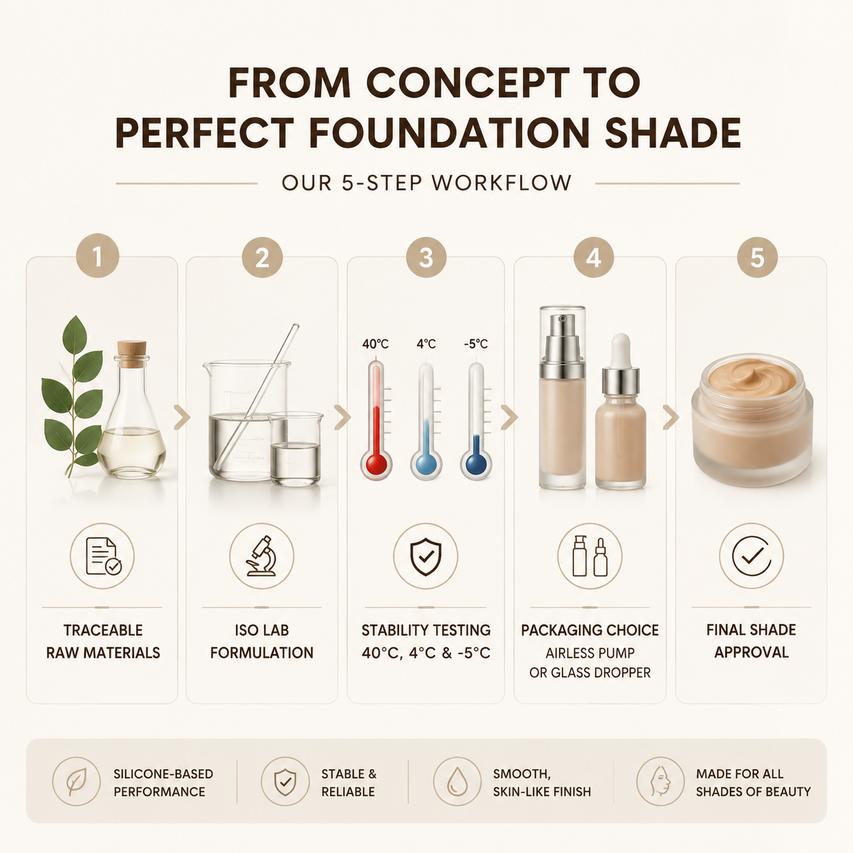
Raw Material Sourcing for Cosmetic Grade Silicone
- Start with traceable cosmetic grade materials.
- Check supplier records for dimethicone, cyclomethicone, and each ingredient.
- Screen every raw material, including emulsifier choices, against brand and regulatory needs.
Topfeel Beauty can source cruelty-free options within an approved product brief.
Custom Formulation Run in an ISO Certified Facility
- Trial production starts under ISO 22716 GMP guidance.
- A cosmetic chemist manages each batch.
- Mixing tests refine pigment ratios and coverage.
- Rheology checks how easily the foundation flows and spreads.
- A cosmetic chemist manages each batch.
This custom formulation work helps control undertone, viscosity, and blending.
Reviewing Stability Testing Report and Safety Data Sheet
A stability testing report and safety data sheet (SDS) give quality control teams practical documentation. Cosmetic product testing remains the manufacturer’s responsibility.
| Check | Measure | Goal |
|---|---|---|
| Heat | 40°C | Stable |
| Cold | 4°C | Stable |
| Freeze | -5°C | Recover |
| Viscosity | cP | Consistent |
| Shelf life | Months | Supported |
These checks flag separation or compatibility issues before scale-up.
Selecting Airless Pump Container or Glass Dropper Bottle
Airless pump: controlled dosing and reduced repeated exposure during use; packaging research also evaluates protection against microbial contamination.
Glass dropper: premium aesthetic, but better suited to formulas that dispense cleanly.
Compare packaging, dispenser performance, viscosity, and material compatibility. Match the container to real use, not appearance alone.
Finalizing Shade in a Frosted Glass Jar Prototype
- Review the frosted glass jar prototype under varied lighting.
- Confirm shade matching and undertone.
- Inspect pigment dispersion.
- Use colorimetry where tighter color control matters.
- Approve the final sample before labeling and bulk manufacture.
Convert shade intent into controls: Raw-material traceability, lab color matching, stability review, dispensing, and prototype approval should produce one reproducible shade brief. Topfeel Beauty uses professional laboratories to match brand color samples.
Explore custom solutions and the foundation route to compare formula, shade, and package decisions before sampling.
Which Silicone Variants Suit Oily Skin?
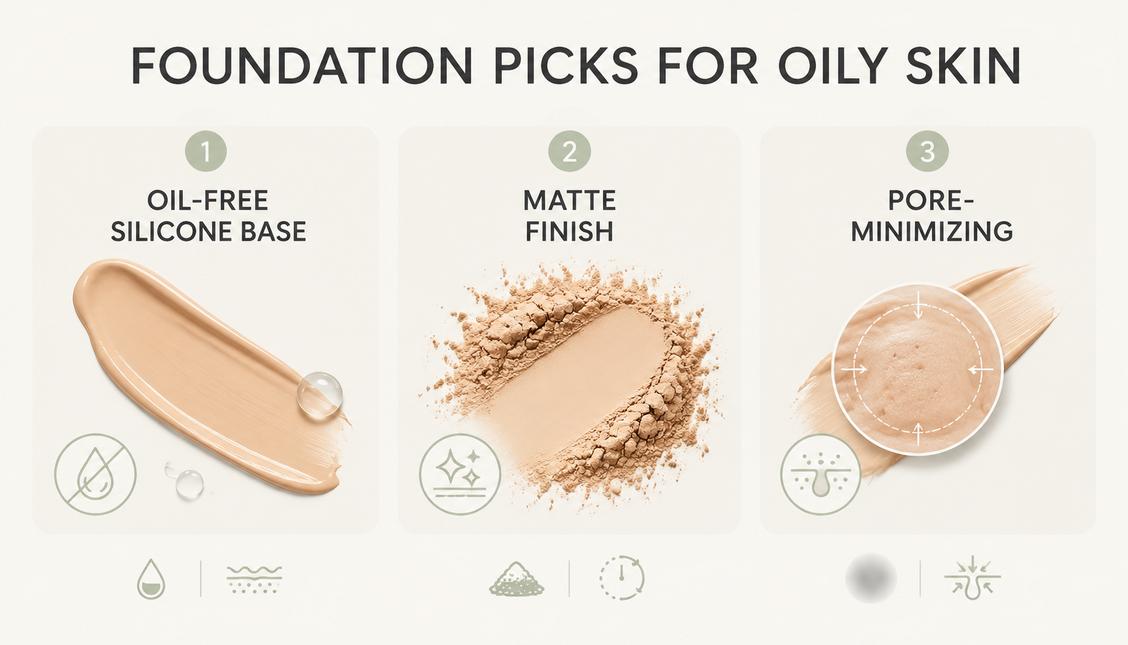
Picking from a silicone based foundation list gets easier when oily-skin needs come first. Some bases manage shine, while others blur texture. Brands should define finish and skin feel through a skin-type brief.
Oil Free Silicone Base
An oil-free silicone based foundation list often starts with cyclomethicone and dimethicone, giving foundation slip without added cosmetic oils.
- Base performance
- volatile silicone evaporates after spreading, supporting a lightweight texture.
- non-comedogenic design principles require finished-product evaluation.
- Oily-skin goals
- Good sebum control keeps the feel less greasy.
- A formula brief should guide choices for comfortable everyday wear.
Matte Finish Formula
Matte formulas have one big job: keep shine from stealing the show. Phenyl trimethicone supports a velvety texture, while porous silica aids excess sebum absorption.
- Build shine control into the base.
- Balance it with a blurring effect so the finish stays smooth, not flat.
- Test for long-wearing coverage.
This creates a clearer comparison of matte bases for oil-prone complexions.
Pore Minimizing Emulsion
For visible pores, silicone foundation ingredients can do some clever smoothing.
- Texture refinement
- An elastomer blend, including dimethicone crosspolymer, creates a soft filling effect.
- This supports skin smoothing without a heavy finish.
- Visual finish
- optical diffusers scatter light around uneven areas.
- The result is a refined texture with easier blending.
Balance oil control with comfort: Oil-free wear, matte shine control, and pore blurring still need a wearable finish for the target user.
Topfeel Beauty develops matte textures and long-wear properties through custom formulation. Compare a long-wear foundation product with the OEM face-makeup route to prepare a finish, wear, and oily-skin test brief before approving samples.
Streamlining Production: Silicone Base Selection
Moving a silicone formula from bench work to production requires a qualified partner, clear commercial terms, and managed equipment to preserve shade, texture, safety, and output.
Choosing GMP Compliant Process Partners
A practical supplier review checks documented Good Manufacturing Practice controls:
- Quality system
- auditing protocol and quality assurance records
- regulatory compliance and third-party certification
- Factory controls
- facility hygiene
- repeatable production standards
Traceable raw materials and recorded batch controls support repeatability.
Leveraging OEM/ODM Service Agreements
An original design manufacturer agreement should pin down responsibilities early.
- Product ownership
- Define intellectual property and formulation rights.
- Commercial terms
- Confirm minimum service terms and production capacity.
- Delivery
- Set the customization scope, packaging, labeling, procurement, and contract manufacturing duties.
This creates a clearer path from foundation concepts to private-label goods.
Scaling Up on the Factory Production Line
Lab success needs measurable factory targets. Batch processing, equipment calibration, and quality control turn a promising silicone base into repeatable output.
| Control | Trial | Pilot | Factory |
|---|---|---|---|
| Batch size, kg | 5 | 50 | 500 |
| Mix speed, rpm | 900 | 700 | 500 |
| Temperature, °C | 25 | 25 | 25 |
| Fill rate, units/min | 5 | 20 | 60 |
| Target yield, % | 95 | 97 | 98 |
- Scale-up controls
- Tune automated mixing for pigment dispersion.
- Track manufacturing throughput and yield optimization.
- Align filling schedules with supply chain efficiency.
Define ownership before scale-up: GMP controls, formulation rights, commercial terms, and factory targets need one signed production brief. Topfeel Beauty’s customization process moves from consultation and sampling through production, QC, and delivery.
Review OEM/ODM services. Then submit your requirements to align formula ownership, approvals, packaging, and factory controls.
Instability Issues? Optimize Emulsion Stability
A stable foundation starts with controlled ratios, hygiene, and production records. Repeatable processing helps keep texture and color consistent while checks catch separation or contamination before filling.
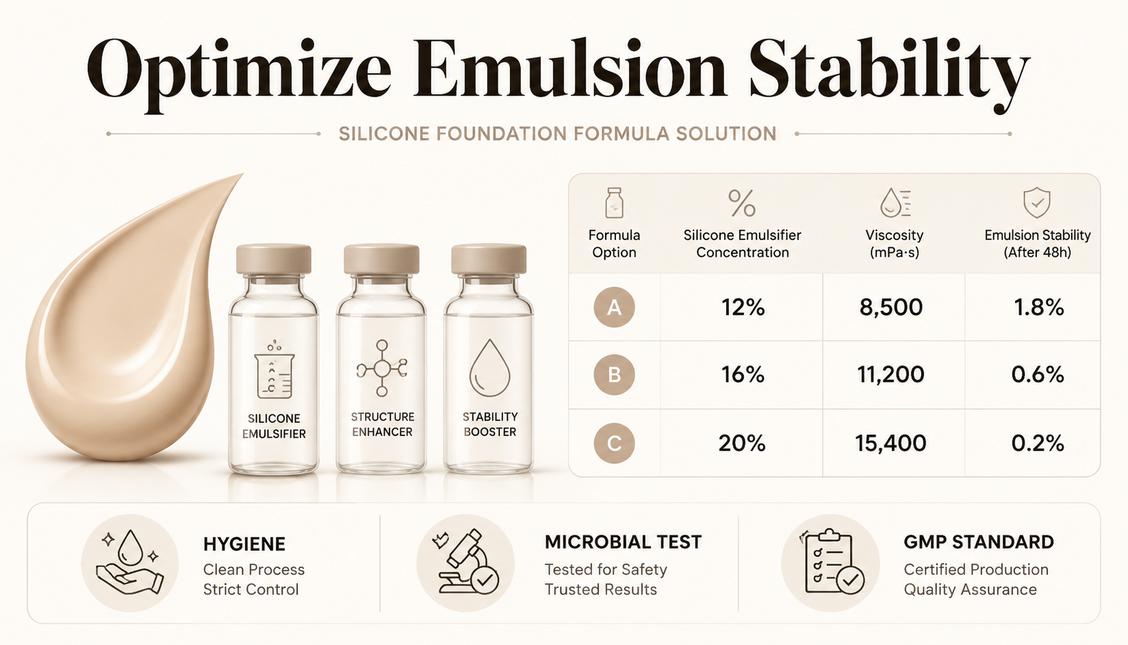
Adjusting Dimethicone Heavy Blend Ratios
A silicone based foundation list needs the right dimethicone balance; too much can feel heavy, while too little may weaken emulsion stability.
- Formula trials
- Track viscosity and pigment settling after each adjustment.
- Balance silicone elastomer and rheology modifier so spreading stays smooth.
- Stability checks
- Watch for phase separation after storage.
- Adjust cyclopentasiloxane carefully when a lighter feel is needed. Small changes can go a long way.
| Trial | Dimethicone % | Viscosity (mPa·s) | 24 h Separation % |
|---|---|---|---|
| A | 12 | 8,500 | 1.8 |
| B | 16 | 11,200 | 0.6 |
| C | 20 | 15,400 | 0.2 |
Values are illustrative development targets, not universal specifications.
Implementing Microbial Limit Test Protocols
Routine microbial limit testing keeps quality checks practical.
- Check starting bioburden and possible contamination.
- Use validated pathogen testing methods.
- Set acceptance limits through quality control.Confirm preservative efficacy separately, since a passing microbial count does not prove preservation performance.
- Align methods with applicable USP standards.
- This testing adds an important safeguard to the range.
Ensuring GMP Compliant Process Controls
Good manufacturing practices turn a promising formula into a repeatable batch.
- Production control
- Follow approved standard operating procedures for weighing and mixing.
- Verify equipment validation and documented sanitation.
- Release control
- Maintain batch records for full traceability.
- Review filling checks and regulatory compliance before release.
That discipline supports reproducible batches.
Scalable Production: From Lab to Factory
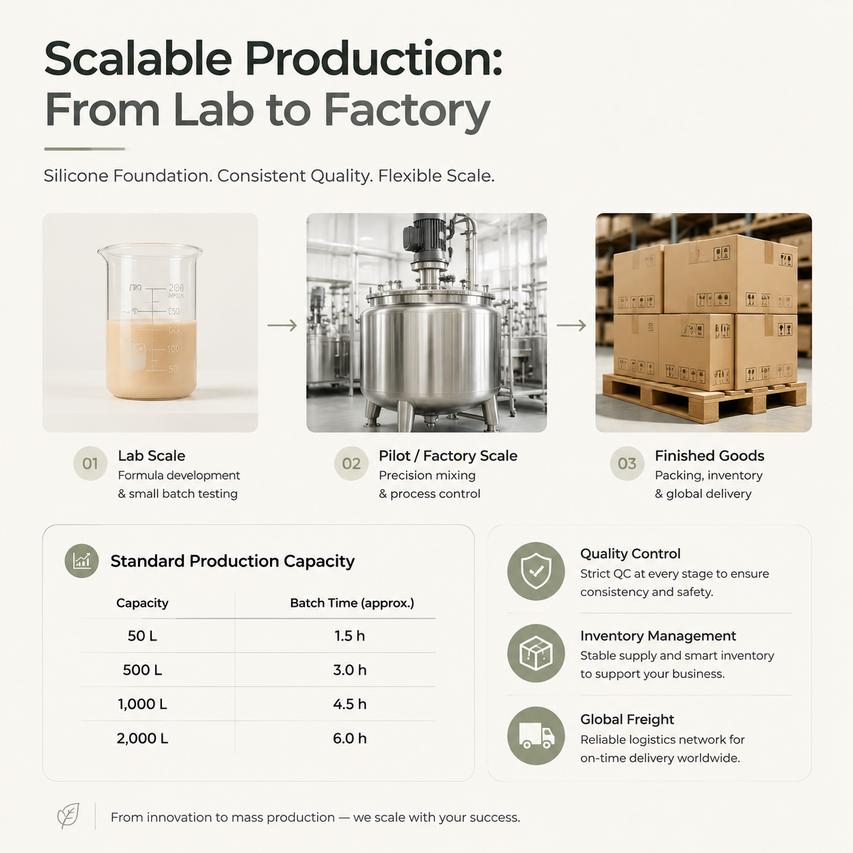
Taking a formula from bench samples to factory output means keeping its behavior familiar as volume increases. Pigments, filling, mixing, inventory, and freight must align through factory controls.
Custom Formulation Run Scale-Up
- Lock the laboratory protocol around the approved pilot formula.
- Compare each pilot batch through rheology testing and shade checks.
- Protect silicone elastomer dispersion and emulsion stability during scale-up.
- Confirm batch reproducibility before release.
- Use controlled viscosity adjustment rather than fixing texture by guesswork.
That discipline helps retain slip, coverage, and shade consistency at scale.
Industrial Mixing Capacity Planning
Capacity gets practical fast: the high-shear mixer must suit both batch size and homogenization needs.
| Batch | Mixer capacity | Typical cycle time |
|---|---|---|
| Pilot | 50 L | 1.5 h |
| Small | 500 L | 3.0 h |
| Medium | 1,000 L | 4.5 h |
| Large | 2,000 L | 6.0 h |
Check equipment throughput, utility requirements, and facility footprint against production scheduling. Then run bottleneck analysis so one long cycle time does not jam silicone foundation output.
Contract Manufacturing Output Forecast
- Start with sales demand and target inventory.
- Convert forecasts into required production yield.
- Account for MOQ, packaging stock, and lead time.
- Test the manufacturing schedule against factory utilization.
- Adjust resource allocation when launches overlap.
- Track operational efficiency across the supply chain.
This ties the product plan to realistic factory capacity.
Global Freight Shipping Coordination
Production completion triggers the shipping clock. Match freight forwarding bookings with packaging strength and pallettization, then confirm destination-specific customs clearance paperwork.
For foundation shipments, verify hazardous material classification rather than assuming standard treatment and review applicable dangerous-goods requirements. Where climate exposure matters, assess temperature-controlled logistics and destination documentation.
Plan factory output around approvals: Pilot comparison, mixer capacity, demand forecasting, and freight timing should share one release schedule. Topfeel Beauty states formulation engineers prepare initial samples in 3-7 days, creating an early checkpoint before production commitments.
Review the custom-development workflow, then contact the team to scope pilot approval, capacity, filling, and delivery milestones.
References
- Polymers in Cosmetic Formulations — Cosmetics
- Dimethicone — Cosmetics Info
- Silica — Cosmetics Info
- EU Cosmetics Legislation — European Commission
- ISO 22716 Cosmetics GMP Guidelines — ISO
- Hazard Communication Standard: Safety Data Sheets — OSHA
- Product Testing of Cosmetics — U.S. FDA
- Protective Efficiency of Cosmetic Packaging — PubMed
- FDA Authority Over Cosmetics — U.S. FDA
- Dangerous Goods Regulations — IATA
Post time: Aug-25-2026