
Private Labeling for Cosmetics: A Guide for Beauty Brands
Scaling beauty gets messy fast: private labeling for cosmetics can unite formulas, packaging, customization, compliance, production, and freight under one manufacturing plan.
That means fewer handoffs.
A launch brief connects the product concept, market, documentation, order planning, and repeat production.
Key Insights on Private Labeling for Cosmetics
→ Lower Costs: Consolidate production and freight planning.
→ Custom Shades: Use color matching for a recognizable range.
→ Quality Assurance: Review controls, testing, safety, and documentation.
→ Streamlined Supply: Connect sourcing, production, inventory, and shipping.
→ Branded Packaging: Coordinate materials, decoration, and artwork.
Why Choose Private Labeling For Cosmetics?
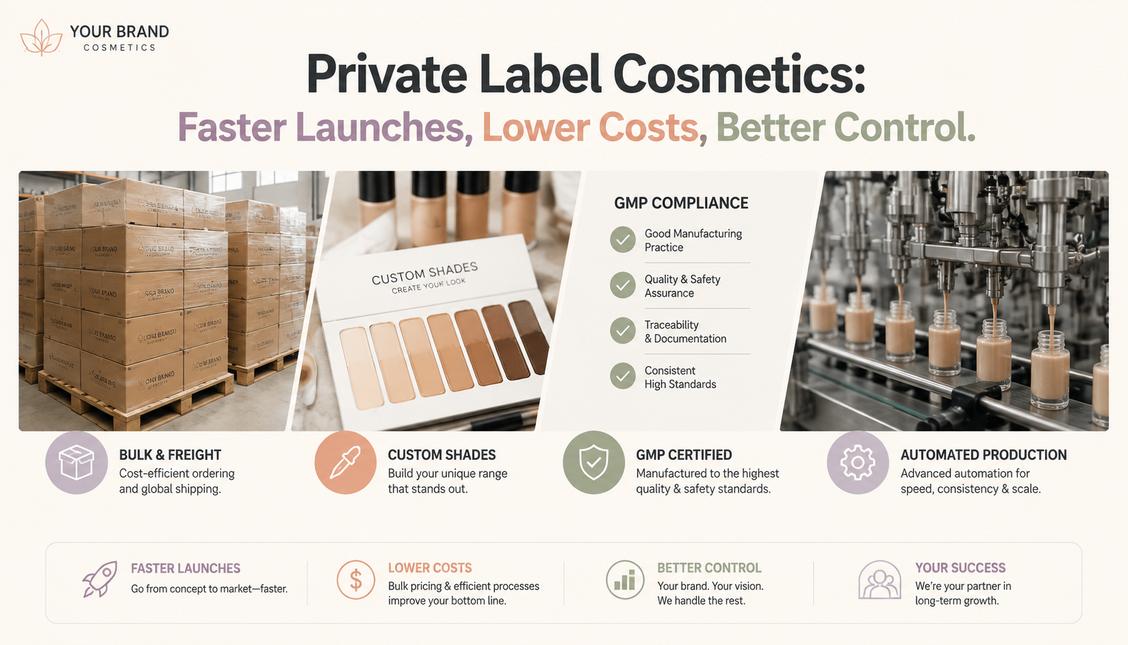
Choosing private labeling for cosmetics connects formula, packaging, production, and quality control without building a factory. Learn how to evaluate a qualified cosmetic manufacturer.
Lower Production Costs with Bulk Freight Transport
Bulk orders can improve logistics efficiency when supply chain logistics match order volume and replenishment timing.
- Freight planning
- Larger loads can spread handling costs across more units.
- Coordinated freight forwarding improves shipping efficiency between factory and warehouse.
- Stock planning
- Better inventory management keeps the distribution network moving.
Stand Out with Custom Color Matching
With private labeling for cosmetics, color does not have to feel off the shelf. Pigment formulation and shade matching can adjust foundation, lipstick, powder, and eyeshadow around a defined buyer and finish.
Topfeel Beauty uses laboratory color matching and supports custom texture and finish development. Review foundation formula development.
Ensure Quality via GMP Certification
GMP, or good manufacturing practices, establishes documented controls for cosmetic production.
- Batch controls
- Quality assurance checks incoming materials and records.
- Hygiene protocols guide equipment and packaging handling.
- Finished-product controls
- Quality control verifies net content, color, texture, and approved specifications.
- Regulatory compliance and safety standards shape market records.
That makes private label cosmetics easier to manage consistently.
Accelerate Manufacturing through Automated Filling
Automated packaging machinery can improve production speed while controlling dispensing.
- Containers enter the assembly line.
- Industrial automation controls dosing according to the approved setup.
- Equipment precision helps reduce filling variation.
- Higher output capacity supports manufacturing efficiency after validation.
Unify the launch path: Cost control, shade development, GMP discipline, and filling efficiency work better as one decision system. Topfeel Beauty’s integrated service connects raw-material sourcing, formula development, packaging design, manufacturing, and quality control, reducing coordination gaps that can slow a growing brand.
Review custom solutions with the OEM face makeup route to compare the manufacturing scope and category fit your launch needs.
5 Steps To Launch Private Label Cosmetics
Launching private labeling for cosmetics balances product, packaging, production, legal duties, and supply. Treat the steps as one specification.
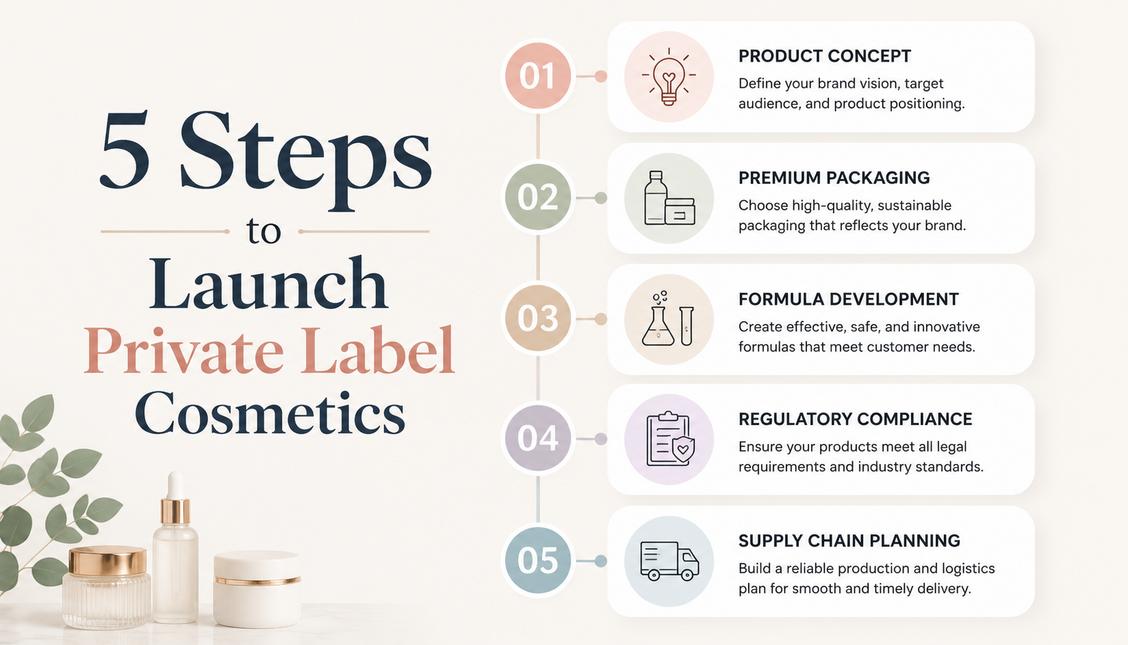
Define Your Product Category: Facial Makeup to Contour Kits
Build the product line around its buyer and range role.
- Face: facial makeup and contour kits can anchor color cosmetics.Expansion: add eye, lip, or setting beauty products when demand supports them.
- Match shade range and cosmetic formulation to the buyer.
This keeps the product line focused.
Choose Premium Packaging Materials from Glass Dropper Bottles to Aluminum Compact Cases
Packaging must suit the formula, filling method, transport, and brand presentation.
- Liquids: glass dropper bottles or airless pumps require compatibility and leakage review.Powders: aluminum compact cases can create a polished presentation while protecting the pan.
- Check the component with the formula before production.
- Premium lines: explore luxury containers and sustainable materials after confirming function.
Topfeel Beauty can align cosmetic packaging with private-label positioning through stock components, custom molds, DFM, and compatibility review.
Develop Your Formula with Vacuum Emulsification Techniques
Formula work turns the concept into a sample.
- vacuum emulsification can limit trapped air while compatible phases are blended.
- Adjust texture development for foundation or skin care creams.
- Verify ingredient safety assessments alongside laboratory and stability work.
For private labeling for cosmetics, review formula, packaging, and claims together. Use this guide to cosmetic ingredients to prepare formulation questions.
Secure Regulatory Compliance through FDA Registration and Safety Assessment
Compliance depends on market requirements, company role, product, labeling, and claims.
- U.S. sales: review applicable cosmetic regulations before launch.Documentation: maintain a safety assessment, ingredient and specification records, and quality assurance documentation appropriate to the market.
- Confirm registration and listing, labeling, and safety-substantiation responsibilities.
Do not treat “FDA registration” as FDA product approval. Topfeel Beauty describes documentation support aligned with EU and U.S. requirements.
Optimize Your Supply Chain for Raw Material Sourcing and Inventory Management
Keep the supply chain practical by connecting demand, purchasing, production, storage, and replenishment.
- Purchasing: qualify ingredient suppliers and plan raw material sourcing around approved specifications.
- Manufacturing: connect forecasts with production planning.
- Stock: use inventory management to balance availability and storage cost.
That discipline limits unnecessary cash tied up in stock.
Five steps, one brief: A clear specification keeps product and production decisions aligned.
Topfeel Beauty’s initial sampling stage is described as 3-7 days. Submit one launch brief covering category, packaging, formula, compliance, supply decisions, and the sample outcome your team expects.
Complex Logistics? Simplify With Private Label
Beauty logistics become easier when sourcing, production, freight, and storage share one plan with clear ownership.
Struggling with Raw Material Sourcing? Let Experts Handle It
Private labeling shifts ingredient sourcing to a manufacturer with an established supplier process.
- Procurement
- Teams source raw materials and cosmetic ingredients for pigments, mascara, and other formulas.
- Supplier checks support quality control and consistent formulation.
- Planning
- Availability is tracked across the supply chain before production.
Understanding what cosmetic factories manage helps assign sourcing responsibilities.
Bulk Freight Transport Made Easy through Contract Manufacturing
With contract manufacturing, production and shipment preparation can follow one schedule. Private labeling brings packaging and finished goods together before shipping.
- Goods are prepared for bulk freight.
- Freight forwarding supports transportation.
- Coordinated logistics management moves orders toward distribution points.
That makes private label cosmetics simpler to ship at scale.
Streamline Warehouse Storage and Inventory Management
Private labeling can connect production with warehouse storage and inventory management.
- Stock operations
- Stock control shows what is available.
- Storage facilities keep cosmetics organized by batch and product.
- Order flow
- Fulfillment turns stored stock into outgoing orders.
- Supply chain optimization helps align replenishment with demand.
Better logistics can reduce stockouts and excess inventory.
Make logistics decisions visible: Topfeel Beauty’s workflow connects sourcing, freight, storage, and inventory decisions through purchasing, production, quality control, and delivery. Review the service scope to map supplier ownership and shipping handoffs before placing an order.
Online Store: White-Label Cosmetics Setup
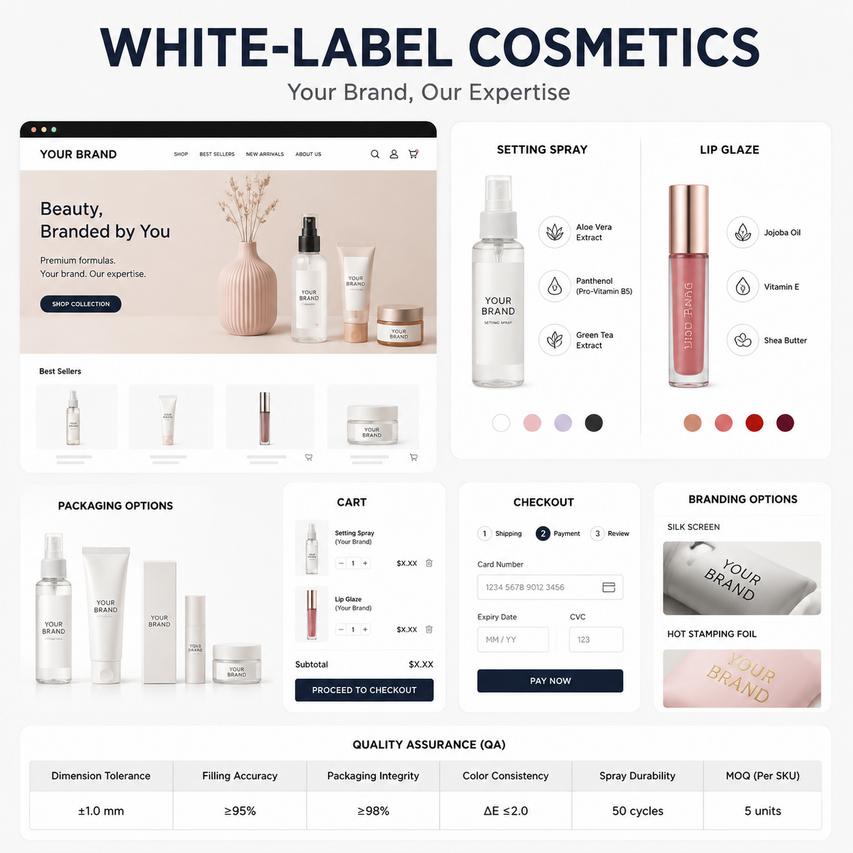
A polished eCommerce website makes cosmetic private labeling easier to understand. Page and packaging records should align on shade, finish, warnings, and delivery.
Building an eCommerce Platform for Setting Spray and Lip Product Sales
Private labeling works best online when the digital catalog answers questions about lip product planning before checkout.
- Product setup
- Setting spray: show cosmetic ingredients, directions, packaging, and required labeling details.
- Lip products: organize shades, finish, directions, and product photography.
- Buying flow
- Keep the shopping cart easy to edit.
- Make the checkout process display delivery methods, costs, and totals clearly.
Clear product information supports purchase decisions.
Integrating Silk Screen Printing and Hot Stamping Logo for Brand Consistency
Silk screen printing applies ink to packaging, while hot stamping transfers foil with heat and pressure. Both can turn a logo design into repeatable packaging decoration after artwork and material approval.
| QA check | Typical target | Test quantity |
|---|---|---|
| Logo position tolerance | ±1.0 mm | 5 units |
| Print adhesion | ≥95% | 5 units |
| Foil coverage | ≥98% | 5 units |
| Color difference ΔE | ≤2.0 | 5 units |
| Rub test | 50 cycles | 5 units |
Brands should approve custom artwork, decoration samples, and visual elements before production.
Offering Fragrance Infusion and Matte Surface Finish Options
- Fragrance infusion
- Review scent formulation alongside cosmetic ingredients and market.
- Check compatibility, safety assessment, labeling, and fragrance restrictions.
- Matte surface
- Select finish options that suit the packaging material.
- Compare appearance and texture customization using physical samples.
These sensory attributes can give a product line extra character. Review clean beauty concepts before finalizing claims.
Will the online promise match the sample?
Topfeel Beauty’s 3D prototyping supports eCommerce setting-spray and lip-product packaging decisions. A customization checklist aligns silk-screen or hot-stamp decoration with fragrance and matte finish; send the brief for packaging review.
References
- Registration & Listing of Cosmetic Product Facilities and Products
- Summary of Cosmetics Labeling Requirements
- ISO 22716:2007 — Cosmetics — Good Manufacturing Practices
- Regulation (EC) No 1223/2009 on Cosmetic Products
- IFRA Standards
- Guidelines for Cosmetic Product Claim Substantiation
- How Does CIR Work?
Post time: Aug-27-2026