
Primer for Long-Lasting Makeup: A Private Label Product Guide
When shine, sweat, texture, and transfer affect wear, a primer for long lasting makeup becomes a sourcing decision. This base makeup guide helps frame the user routine.
Buyers should define oil control, adhesion, skin-type fit, packaging, testing, order planning, and lead times.
Circana reported 5% growth in U.S. prestige makeup dollar sales, supporting continued product development.
Key Notes for Primer for Long Lasting Makeup
- Fill and assess slip with a silicone elastomer blend
- Control shine and sebum for the target skin type
- Create and test a film for the intended wear conditions
- Blur pores and assess transfer resistance
- Match hydration, oil management, and sensitive-skin claims to the user
- Choose private label or retail-branded based on customization and volume needs
- Follow five launch steps: sampling, blending, testing, printing, and airless bottle design
What Makes A Primer Last All Day?
A primer for long lasting makeup combines texture, oil management, film, and pore-blurring goals that require finished-formula testing.
Silicone Elastomer Blend for Smoothing Texture Enhancement
A silicone elastomer can be evaluated as a texture enhancer through sensory testing.
- For smoother application:
- Skin smoothing should create an even base.
- A slip agent should aid glide; foundation-clumping guidance defines the user problem.
- For appearance:
- Pore filler performance should be assessed for soft-focus and velvety results.
That makes the primer feel polished while giving teams sensory criteria for samples.
Oil-Control Polymer Delivering a Shine Control Effect
An oil-control polymer should be tested against the user’s oil-management goal.
- During wear:
- A sebum absorber can be screened for surface oil.
- Shine control should be assessed on high-oil areas.
- The mattifying agent should support a matte finish without buildup.
Film-Forming Agent That Creates a Sweat-Resistant Barrier
A film-forming agent creates a continuous layer. A 2020 review of polymers in cosmetic formulations identifies film-forming and fixative functions among their cosmetic uses; the finished formula still needs testing.
- A long-wear polymer should be evaluated for grip.Lock-in technology needs measurable wear criteria.
- The humidity barrier needs relevant-condition testing.
- Sweat-resistant performance should be confirmed in the formula.
Pore-Blurring Powder with Transfer-Proof Formula
Topfeel Beauty can develop long-wear and transfer-proof properties from a custom texture brief. A face-primer direction can start the sample discussion.
- Optical diffuser
- Visually assess the intended pore-softening effect.
- Micro-powder
- Supports checking smudge-resistant wear.
- Adds a wear-extension variable for system testing.
Define durable wear: Topfeel Beauty develops texture and long-wear properties for color cosmetics. Review its face-primer direction and OEM face makeup route to compare the smoothing, oil-control, film, and powder requirements your sample brief should test.
Primer Classification By Skin Type
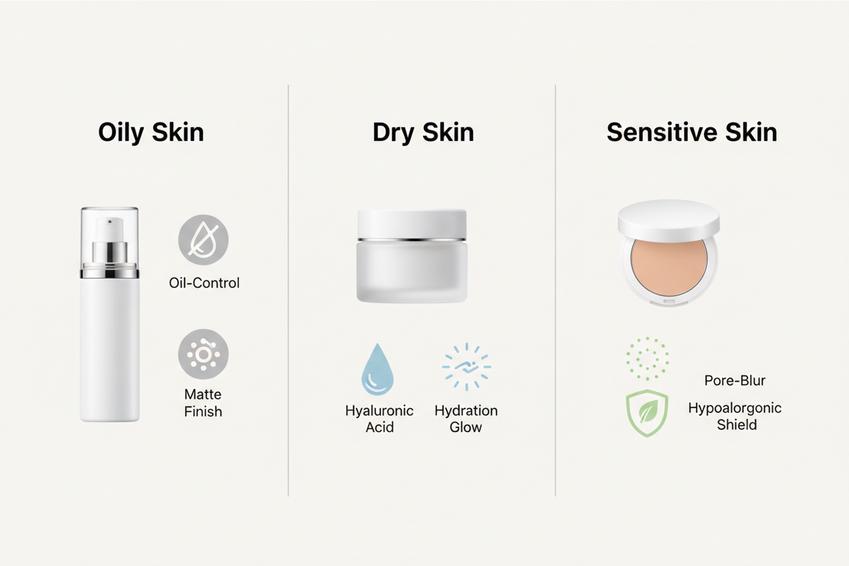
Choosing the right primer for long lasting makeup starts with skin needs. This skin-type overview helps buyers define user profiles.
Oily Skin: Oil-Control Polymer in Airless Pump Bottle
Assess an oil-control polymer for sebum absorption and finish.
- Daily performance
- Shine control should focus on high-oil areas.
- A pore minimizer should be evaluated for a smoother-looking base.
- Formula and pack
- A long-wear formula needs compatibility testing.
- An airless pump bottle needs formula-mechanism compatibility.
Target a clean matte finish without excessive application.
Dry Skin: Hydrating Hyaluronic Acid in Matte Finish Jar
A 2018 review covers clinical investigations of hyaluronic acid formulations used in cosmetics for skin rejuvenation. A hydrating primer brief should separately define texture, comfort, and makeup compatibility.
- Prep with light moisture.
- Apply nourishing ingredients where needed.
- Use dewy hydration for the intended finish.
A matte finish jar still needs hygiene and compatibility review.
Sensitive Skin: Pore-Blurring Powder with Hypoallergenic Testing
A sensitive-skin primer needs a simple formula and defined claims.
- Formula priorities
- Pore-blurring powder should support smooth texture without heaviness.
- A fragrance-free, gentle formula still needs review because fragrance ingredients can be cosmetic allergens. A clean-beauty overview can organize exclusions.
- Product support
- Hypoallergenic testing should match the claim and market.
- Non-comedogenic claims need evidence; EU cosmetic-claim criteria require adequate, verifiable support.
Together, these choices clarify the formula and claim brief.
Which user comes first?
Topfeel Beauty uses lab co-creation to translate oily, hyaluronic-focused dry-skin, and sensitive-skin priorities into one formula-and-claim matrix. Explore custom solutions alongside its OEM face makeup service to define the packaging and evidence needed before samples.
Private Label Vs. Retail-Branded Primers
Formula ownership, positioning, sales channels, timing, and volume shape the primer route. This guide to evaluating cosmetic manufacturers helps compare supplier support.
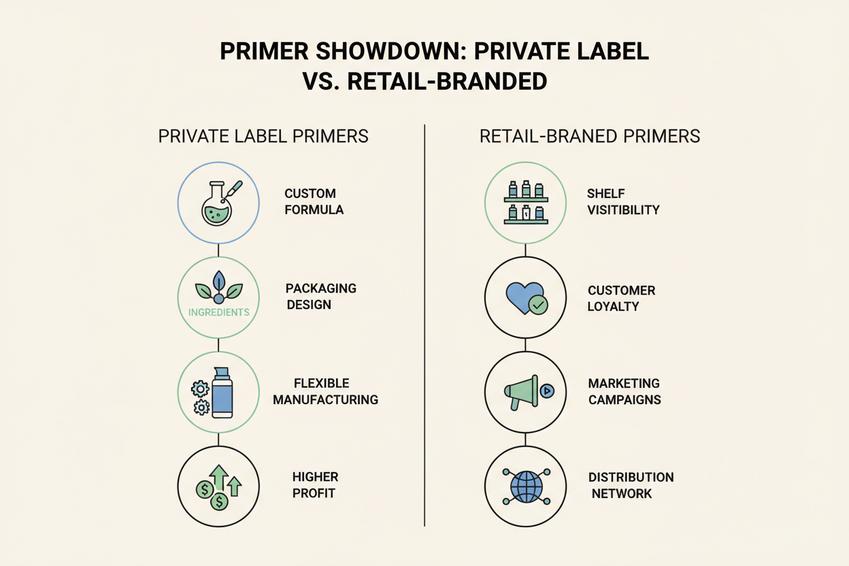
Private Label Primers
Private label lets a brand build around a customer need.
- Product creation
- Custom formulation and ingredient selection can target oil, hydration, grip, or texture.
- Packaging design supports product differentiation within the brand system.
- Business planning
- Flexible manufacturing requires early volume and timing alignment.
- A white label route uses a market-ready formula; customization changes scope and ownership.
Topfeel Beauty distinguishes stock private label formulas from custom OEM development.
Retail-Branded Primers
Retail-branded products use established positioning and shelf recognition.
- Market recognition can encourage trial.
- Consumer loyalty can support repeat purchase.
- Marketing campaigns and advertising build awareness.
- Strong retail distribution increases access, while trend forecasting informs updates.
Buyers gain reach but less formula and packaging influence.
Turn trade-offs into a brief: Retail-branded primers bring recognition and distribution but less formula control; private label aligns formula and branding, while OEM expands custom scope. Topfeel Beauty’s formulation engineers prepare initial samples in 3-7 days, creating an early checkpoint for pack, positioning, timing, and ownership decisions.
Compare the private label route, then submit your requirements for a scoped recommendation.
5 Steps To Launch A Private Label Primer
Launching a primer for long lasting makeup coordinates trials, production, decoration, packaging, and shipping. This factory overview helps prepare supplier questions.
Custom Formulation Sampling & Palletized Storage
- Custom formulation starts with sample testing and prototype development.
- A raw material review supports scale-up.
- Palletized storage, inventory management, and warehouse logistics organize bulk goods.
Emulsification Blending and Vacuum Homogenization
Emulsification blending joins phases; vacuum homogenization can reduce trapped air.
- Ingredient mixing controls cosmetic texture.
- Viscosity control supports processing with suitable manufacturing equipment.
Batch Testing alongside GMP Certification
- Batch testing should cover relevant safety and quality questions; the FDA describes manufacturer responsibility for cosmetic product testing.
- GMP certification supports controls. ISO 22716 covers cosmetic production, control, storage, and shipment.
| Check | Typical Target | Review Point |
|---|---|---|
| pH | 5.0–7.0 | Each batch |
| Viscosity | 5,000–30,000 cP | Each batch |
| Stability | 3+ temperatures | Trial stage |
Actual specifications depend on the formula.
Silk Screen Printing with Custom Color Matching
- Silk screen printing
- supports logo printing and packaging decoration.
- Custom color matching
- uses standardized color references, graphic design, and the chosen surface finish to keep branding consistent.
Airless Pump Bottle Design & Lead Time Schedule
A primer for long lasting makeup needs suitable cosmetic packaging. Topfeel Beauty supports packaging design and compatibility review; an airless pump bottle is one container structure to evaluate.
Timing: Check the dispenser mechanism for compatibility, then align decoration, filling, and freight in the lead time schedule.
Plan backward from launch: Topfeel Beauty publishes a consultation-to-delivery workflow that connects sampling, production and testing, decoration, packaging, and QC. Mass production is listed at 45 days after deposit and final product approval, so approvals must be built into the calendar rather than treated as a final step.
Review the custom-development route and share your launch requirements to build a milestone schedule.
References
- US Beauty Industry Sales Grow for the Fourth Consecutive Year — circana.com
- Applications of Natural, Semi-Synthetic, and Synthetic Polymers in Cosmetic Formulations — mdpi.com
- Hyaluronic Acid, a Promising Skin Rejuvenating Biomedicine — nih.gov
- Allergens in Cosmetics — fda.gov
- Commission Regulation (EU) No 655/2013 — europa.eu
- Product Testing of Cosmetics — fda.gov
- ISO 22716:2007 Cosmetics — Good Manufacturing Practices — iso.org
Post time: Aug-21-2026