
Pancake Base Makeup vs. Liquid Foundation: Which One Wins?
Pressed formats and liquids give brands different development routes. Their finishes depend on the complete formula, not the format name alone.
Start with the intended customer and the way they apply foundation.
Key Points for Pancake Base Makeup Mastery
→ Evaluate pressed powder density alongside pickup and application.
→ Review moisture content and film-formers together during development.
→ Compare particle distribution and talc-pigment ratios in samples.
→ Compare cost-per-use: refillable pancake pans vs. flexible liquid doses.
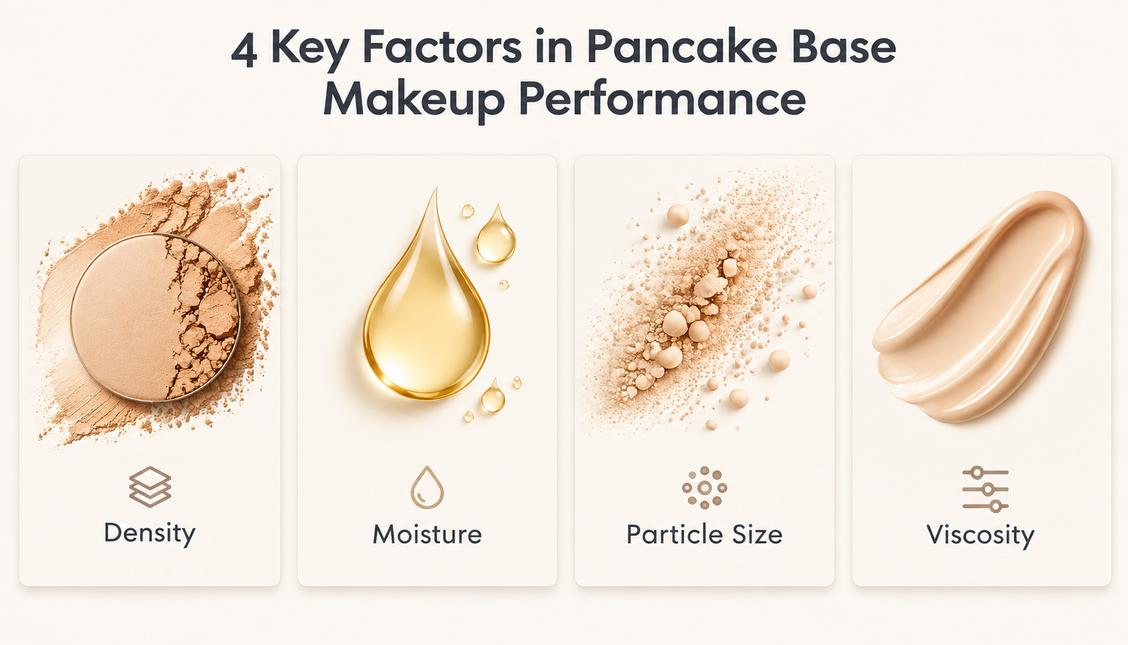
4 Key Factors In Pancake Base Makeup Performance
Developing pancake base makeup involves powder density, moisture balance, particle size, and binder consistency. Assess these factors together rather than selecting one specification in isolation. A sample comparison should cover product pickup, blending, finish, and the way the compact behaves during handling.
Oil-Control Cake Foundation and Pressed Powder Density
Pressed powder density is one part of the development brief for pressed rather than loose powders.
- Compression and oil management
- Balanced powder compaction belongs in the trial-production review.
- A suitable porosity rate must be considered alongside compact integrity.
- Everyday makeup performance
- Proper talc formulation requires ingredient and application evaluation.
- Controlled density should be checked against the desired matte complexion.
Compare pickup and compact handling before approving pressing conditions.
Waterproof Pancake Makeup with Moisture Content Limit
Waterproof pancake base makeup needs a finished-product evaluation, not simply a moisture specification.
- Moisture stability
- A controlled hydration threshold belongs in the storage assessment.
- Monitoring the dryness index provides a production comparison point.
- Waterproof protection
- A suitable film former should be evaluated in the complete formula.
- Effective formulations need evidence for sweat resistance and humidity endurance.
Moisture content and wear claims need separate acceptance criteria.
Matte Finish Compact Powder’s Micronized Particle Size
Fine particles belong in the compact foundation blending assessment for matte makeup.
- Particle refinement
- Consistent mill grind is a useful production parameter.
- Smaller particles should be assessed within the full powder blend.
- Visible skin finish
- Controlled light diffusion requires evaluation of the finished sample.
- Balanced particle sizes belong alongside pore blurring and velvet texture targets.
Review smoother matte coverage during sample application, alongside particle distribution.
High-Coverage Dry Powder under Viscosity Testing Standard
Viscosity describes a fluid’s resistance to flow; define the measurement conditions for liquid binders used in processing.
- Formulation consistency
- The rheology index needs a defined measurement method.
- A balanced binder ratio belongs in the formula specification.
- Coverage performance
- Higher pigment load should be assessed against the intended opacity level.
- Controlled binding needs an application check for layering capacity.
Topfeel Beauty checks color and texture during first article inspection before mass production.
Compare the complete compact: Four performance factors—density, moisture, particle distribution, and binder behavior—need a shared acceptance brief. Topfeel Beauty includes drop testing for pressed powders in its inspection process, giving brands a concrete handling checkpoint alongside their application review.
Review pressed foundation options to prepare a sample comparison covering pickup, finish, and compact integrity.
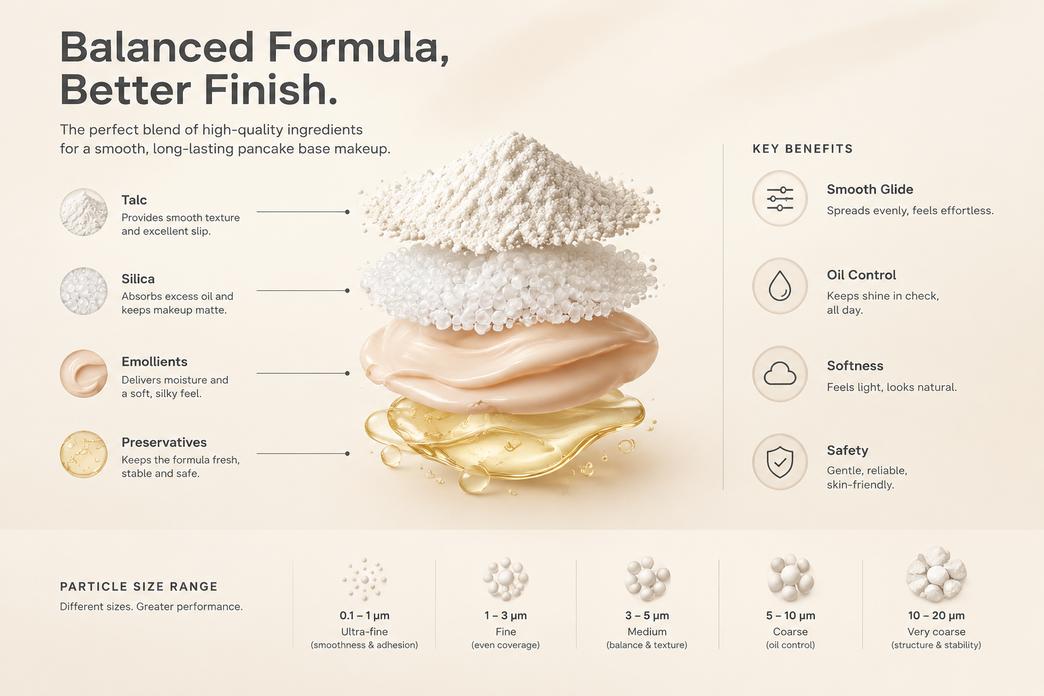
Ingredients Layer: Talc, Silica, Emollients, Preservatives
Ingredient selection connects texture, preservation, and the intended market. Review fillers, emollients, and preservatives as a complete formula, including their interaction with packaging. Topfeel Beauty’s custom formulation work includes compatibility, stability, and safety assessments.
Talc’s Role in Custom Pigment Ratio
Talc is a naturally occurring mineral used in cosmetics to absorb moisture, prevent caking, and improve product feel.
Its oil-absorbing role in color cosmetics belongs alongside pigment and filler selection in the formulation brief.
- Pigment balance and coverage
- Higher pigment load requires comparison of color and coverage.
- Talc, a soft magnesium silicate, belongs in the color dispersion review.
- Adjusting fillers is part of evaluating shade matching.
- Texture and application
- Controlled particle density belongs in the blending assessment.
- Balanced talc ratios require sample evaluation for dragging and feel.
Getting the balance right requires pressed powder foundation samples; brands considering talc-free directions should compare reformulated textures.
Silica and Micronized Particle Size Control
Porous silica is one ingredient to consider when defining a powder’s texture; cosmetic silica functions include absorbency, anticaking, and bulking.
Its surface area is a material property rather than a finished-product wear result.
Particle size belongs in the texture modification, feel, and appearance assessment.
| Particle Size (µm) | General Classification | Formulation Consideration |
|---|---|---|
| 0.1–1 | Ultrafine | High surface area |
| 1–3 | Fine | Smooth application |
| 3–5 | Fine | Soft powder texture |
| 5–10 | Medium | Balanced powder feel |
| 10–20 | Coarse | Greater texture visibility |
Note: These are illustrative size ranges, not universal cosmetic specifications.
Review the full particle distribution alongside the intended matte finish.
Nanoparticles need market-specific assessment: in the EU, certain products containing nanomaterials require additional notification six months before market placement, with exceptions for specified uses and restricted substances.
Emollients Meeting Moisture Content Limits
Emollients belong in the review of powder feel, spreadability, and adhesion.
Compare ester oils and other moisturizing agents in finished samples.
Their formulation review includes:
- Maintain suitable emollient concentrations in the development brief.
- Monitor water activity in the microbial risk assessment.
- Evaluate emulsion stability for water-containing systems.
- Support skin comfort with appropriately tested hydration or skin barrier claims.
Review liquid-binder levels alongside product pickup and application.
Preservatives & ISO Cosmetic Standard Compliance
Microbiological safety involves preservation, packaging, storage, and contamination during use.
Anhydrous cosmetics and water-containing products need their own risk assessments.
- Preservation controls
- Select suitable antimicrobial agents according to the formula’s risks.
- Evaluate permitted preservatives, including parabens, for the target market.
- Conduct microbial testing with defined acceptance criteria; ISO 11930 addresses interpretation of preservative-efficacy and microbial-risk data for antimicrobial protection.
- Manufacturing and documentation
- Follow ISO 22716 guidance for cosmetic production, control, storage, and shipment.
- Complete appropriate safety assessment and market-specific checks.
- Maintain SDS documentation and stability records supporting formulation integrity.
Topfeel Beauty provides MSDS and COA documentation for its formulations.
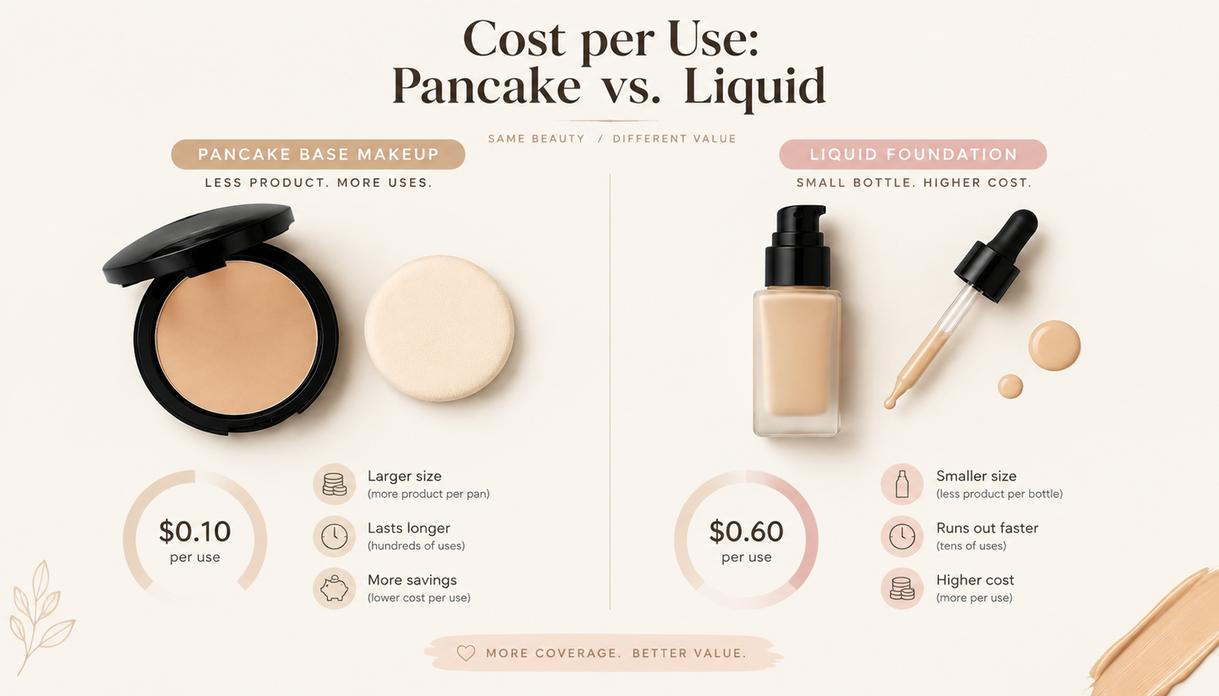
Cost Per Use: Pancake Vs. Liquid
Price alone does not establish value per application. Compare actual product usage, pack cost, and application habits when evaluating pancake base makeup and liquid foundation. Use equivalent coverage targets so the comparison reflects the product customers intend to use.
Pancake Base Makeup
Evaluate a cake formulation by weighing the amount used for a typical application.
- Product Efficiency and Application
- Controlled Pickup: Include sponge application in the usage comparison.
- Coverage Performance: Compare the amount needed for high coverage.
- Daily Wear: Assess the desired matte finish and touch-up routine.
- Packaging and Long-Term Savings
- Compact Design: Include the compact container in the finished-product cost.
- Refill Options: Compare refill and replacement-pack quotations.
- Professional Value: Include theatrical makeup applications when relevant to the audience.
For frequent users, compare makeup costs using the same application assumptions across both formats.
Liquid Foundation
Liquid foundation’s fluid texture gives brands another application route. Review dispensing alongside coverage in base-makeup development.
What affects everyday expenses?
- Dispensing Control: Compare portions from a pump dispenser and dropper bottle.
- Formula Performance: Assess blendability and the quantity needed for buildable coverage.
- Skin Benefits: Evaluate proposed hydration claims separately from the skin finish.
Measure usage rather than assuming one format costs more.
Compare product quantity, residual product, and packaging quotations with the same coverage brief.
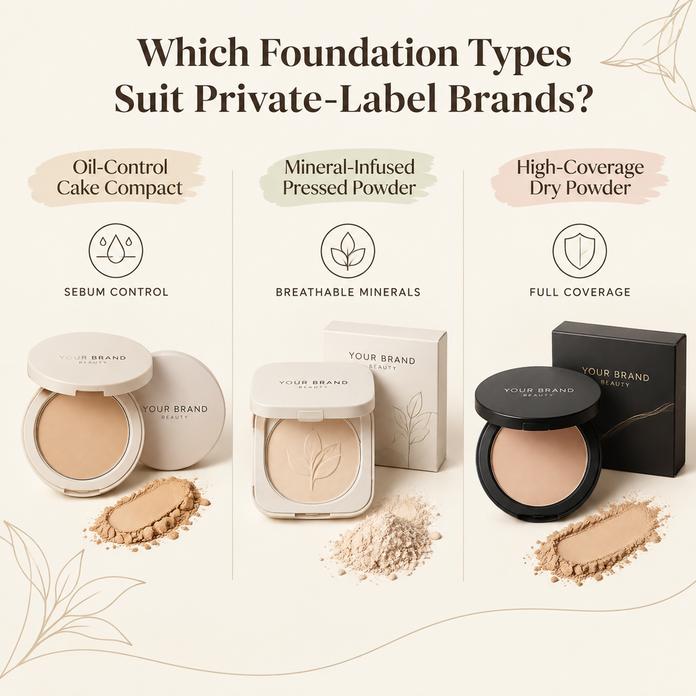
Which Foundation Types Suit Private-Label Brands?
Define the customer’s preferred coverage, texture, and application before choosing a foundation type. For pancake base makeup, this brief should also include the compact and shade direction. Topfeel Beauty distinguishes stock-formula private label from custom OEM development.
Oil-Control Cake Foundation for Private Label Production
Oil-control cake foundations give brands a pressed-format direction to evaluate for customers concerned about shine.
For private-label cosmetics, define these features:
- Formula Performance
- Matte finish: Specify the desired visible finish.
- Long-wear formula: Establish an application and wear-test brief.
- Shine control: Define the intended claim and assessment method.
- Product Customization
- Pressed powder: Compare pickup and coverage in samples.
- Compact casing: Specify colors, logos, and finishes.
Topfeel Beauty develops color cosmetics with customizable textures and finishes.
Mineral-Infused Base Formula from Custom Formulation Lab
For mineral-based foundation briefs, fragrance and preservative selection matter because either can trigger contact reactions.
Through custom formulation, brands can define natural minerals and proposed active botanical ingredients.
Development options include:
- Talc-free formulas for customers avoiding talc.
- Lightweight coverage as a sample-evaluation target.
- Skin-soothing ingredients with claims assessed for the finished formula.
Brands can request dermatologist tested claims with appropriate supporting studies.
Compare mineral-based samples against the intended coverage and application brief.
High-Coverage Dry Powder via Contract Manufacturing Service
High-coverage powder foundation is another route for brands defining fuller coverage.
Professional contract manufacturing should connect the formula specification with production and quality checks.
Key considerations include:
- Pigment concentration: Define color intensity and the full coverage target.
- Blemish concealing: Assess appearance at the intended application amount.
- Production scaling: Confirm the order plan and approval stages.
- Custom packaging: Match the retail presentation to brand positioning.
Topfeel Beauty uses laboratory color matching for brand-supplied samples.
For brands expanding their makeup collections, compare the proposed high-coverage powder foundation shades, finish, and packaging before approving production.
Build a distinctive foundation brief: Which route fits your oil-control, mineral, or high-coverage concept?
Topfeel Beauty’s custom OEM service develops formulas around texture, color, and finish rather than requiring a stock formula. Compare customizable liquid foundation with your pressed-format reference to prepare a coordinated oil-control, mineral, or high-coverage formula brief for your chosen market.
High-Humidity Days: Pancake Or Liquid Choice?
Choose between pancake base makeup and liquid foundation using skin needs, coverage preferences, and application habits. For a climate-specific launch, compare finished samples under the intended use conditions rather than choosing by format alone.
Waterproof Pancake Makeup
For waterproof pancake makeup, define coverage and wear claims separately.
Here’s what to consider:
- Protection Against Humidity
- Sweat resistance: Set a test brief reflecting intended use.
- Oil control: Define the finish customers expect.
- Long-lasting wear: Set a duration and application protocol for assessment.
- Coverage and Application
- Pressed powder: Assess compact pickup for touch-ups.
- Cake-free results: Compare thin-layer application with the intended sponge.
- Humid weather comfort: Include user feedback in the sample review.
Skin type belongs in the product brief: dermatologists recommend oil-free, water-based makeup for oily skin, with matte products to reduce visible shine.
Topfeel Beauty co-creates textures and product claims during formulation development.
Matte Finish Liquid Foundation
Matte liquid foundation gives brands a fluid-format alternative to compare.
Assess coverage adjustments and application with fingers, brushes, or sponges.
Why liquid foundation works in humidity:
- Shine control: Specify the intended visible finish.
- Blendability: Compare application with the intended tools.
- Pore-blurring: Assess the proposed appearance claim.
- Lightweight texture: Review feel at the recommended dose.
- Humidity-proof performance: Require a defined finished-product assessment.
- Natural finish: Compare finish across the intended shade range.
- Sebum regulation: Distinguish a surface-finish claim from a physiological claim.
Use skin-type considerations alongside sample testing.
The takeaway? Compare pressed and liquid samples against the same coverage, wear, and application brief.
Can your pressed and liquid samples meet the same humid-weather brief? Topfeel Beauty’s formulation engineers prepare initial samples in 3-7 days within its customization workflow. That stage gives your team a comparison point for finish, application, and the wear assessment needed before choosing a launch format.
Submit your foundation requirements with the target climate, coverage, and packaging brief to discuss sample development.
References
- Talc
- Microbiological Safety and Cosmetics
- ISO 22716:2007 — Good Manufacturing Practices
- ISO 11930:2019 — Antimicrobial Protection
- Nanomaterials
- Silica
- Talc
- Cosmetics Allergy
- How to Control Oily Skin
- Talc: Definition, Uses, and Facts
- Viscosity
Post time: Oct-22-2026