
10 Questions to Ask an OEM Beauty Products Supplier
Choosing an oem beauty products supplier can wreck your launch or carry it—no middle ground. One bad batch, one missed regulation, and your brand eats the fallout.
Smart buyers ask sharp questions early, digging past glossy samples into capabilities, timelines, and limits, so surprises stay off the production line.
Melodic Notes: Quick Answers on OEM Beauty Products
➔ Formulation Clarity: Outline custom blends—paraben-free, vegan, hypoallergenic—for foundations, lipsticks, and eyeshadows.
➔ Certified Compliance: Verify GMP, ISO 22716, FDA/EU and REACH standards to ensure safe mixing, filling, and labeling.
➔ Operational Expertise: Confirm capabilities in pressing powders, mixing liquids, and precise filling for matte, satin, and shimmer finishes.
➔ Logistics Assurance: Insist on clear lead-time schedules, milestone roadmaps, and freight-forwarding buffers to prevent launch delays.
Why Trust This OEM Beauty Products Partner?
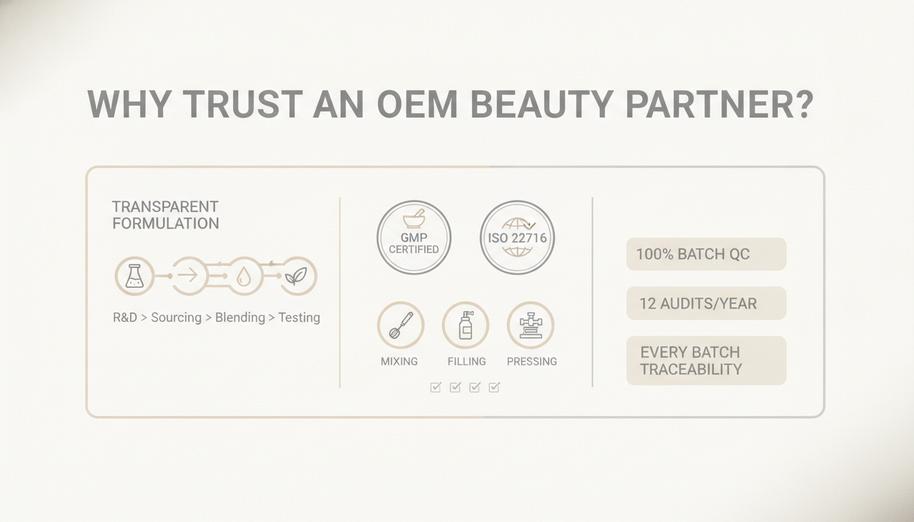
Choosing a partner for oem beauty products is not just about production volume. It comes down to visibility, process control, and repeatable quality. From beauty OEM development to cosmetic manufacturing and private label cosmetics support, the right factory shows its work clearly. That practical approach is one reason brands turn to Topfeel Beauty.
Transparent Custom Formulation Processes
For oem beauty products, transparency starts long before production.
-
Planning
- Define Product specifications for foundation, lipstick, or eyeshadow.
- Review target texture, coverage, and finish.
-
Development
- Conduct Formulation development through joint R&D collaboration.
- Confirm Ingredient sourcing and disclose key raw materials.
-
Customization
-
Adjust formulas through Recipe customization:
- Vegan options
- Paraben-free options
- Hypoallergenic options
-
-
Documentation
- Maintain detailed Process documentation.
- Clarify Formula ownership before scale-up.
This workflow helps brands buying oem beauty products understand exactly how a formula evolves rather than receiving a finished product with limited visibility.
Verified GMP Certified & ISO 22716 Compliance
Quality systems support consistent beauty OEM production.
| Control Area | Standard | Review Frequency | Target |
|---|---|---|---|
| Raw materials | GMP certification | Every batch | 100% |
| Production rooms | ISO 22716 standard | Monthly | 12 audits/year |
| Documentation | Regulatory compliance | Per project | 100% records |
| Finished goods | Quality control | Every batch | 100% inspection |
Key compliance elements include:
-
Quality assurance
- Incoming material checks
- Batch traceability
-
Audit procedures
- Internal reviews
- Corrective action tracking
-
Facility standards
- Controlled environments
- Safe handling practices
These measures help oem beauty products meet FDA-aligned expectations and relevant EU cosmetic requirements.
Track Record in Filling, Mixing, Pressing Operations
Strong Manufacturing experience shows up on the production floor.
-
Production capabilities
- Advanced Mixing technology for liquids and creams
- Reliable Filling processes for mascara and concealer
- Precision Pressing equipment for powder products
-
Operational flow
- Batch preparation through controlled Batch production
- Formula blending using validated systems
- Filling and packaging via integrated Packaging lines
- Final inspection and release
A proven Operational history helps maintain consistency across matte, satin, and shimmer finishes. For brands seeking cosmetic OEM support, that repeatability often matters just as much as formula innovation. For companies navigating these production requirements, working with a partner equipped for custom solutions combines these capabilities to support dependable scale and product quality.
3 Supplier Capabilities to Always Verify
Choosing a supplier for oem beauty products goes beyond price. A reliable partner helps shape product quality, brand perception, and delivery performance. For beauty OEM projects, these three capabilities deserve close attention before any large order moves ahead.
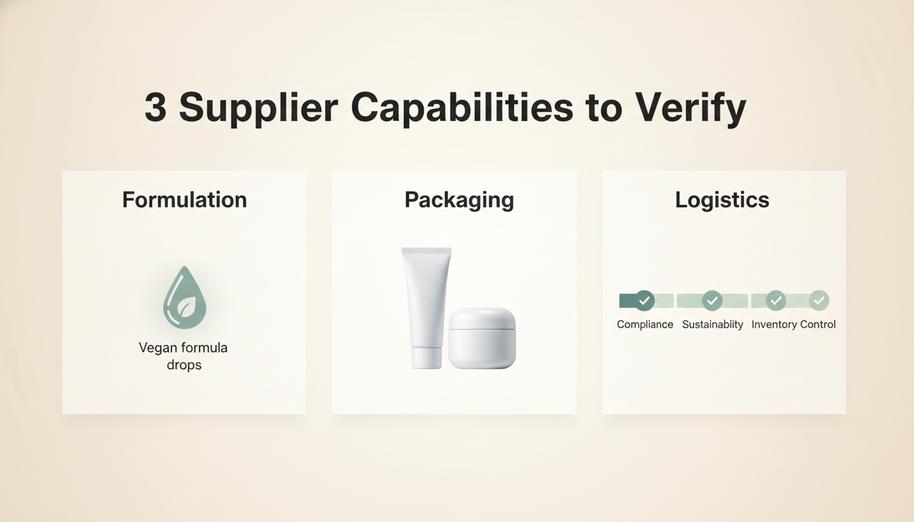
Formulation Expertise: Paraben-Free & Vegan Blends
When evaluating oem beauty products suppliers, start with formulation strength.
-
Formulation development
- Review experience with vegan lipstick, mineral foundation, and clean-label cosmetics.
- Check how Custom blends are adjusted for target markets.
-
Ingredient sourcing
- Verify supplier access to stable raw materials.
- Confirm Ingredient certifications supporting vegan and cruelty-free claims.
-
Product safety
- Examine testing procedures.
- Assess documentation supporting Regulatory compliance.
-
R&D capabilities
- Look for active innovation pipelines.
- Ask how trends are translated into commercial formulas.
For beauty products OEM programs, strong technical teams can shorten development cycles while helping brands meet changing consumer expectations.
Packaging Options: Airless Packaging, Tubes, Jars
Packaging affects usability, shelf appeal, and product stability.
-
Packaging design
- Brand-matching graphics.
- Custom labeling options.
-
Material selection
- Plastic, glass, and hybrid solutions.
- Available Sustainability options.
-
Container types
- Airless bottles.
- Tubes.
- Jars.
-
Dispensing mechanisms
- Pumps.
- Applicators.
- Precision dispensers.
-
Product protection
- Reduced contamination risks.
- Better formula preservation.
Many oem beauty products brands prefer suppliers that can manage both manufacturing and packaging under one roof. For brands exploring packaging options, Topfeel Beauty is often evaluated on this point because coordinated packaging decisions, often through a dedicated packaging division, can simplify product launches.
Supply Chain Logistics: Lead Time & Inventory Management
Even excellent oem beauty products can struggle if delivery systems are weak.
-
Review the Production schedule
- Check manufacturing capacity.
- Compare seasonal demand readiness.
-
Assess Delivery timelines
- Confirm forecasting methods.
- Track historical performance.
-
Examine Warehouse management
- Storage controls.
- Inventory accuracy.
-
Evaluate the Logistics network
- Shipping partners.
- Regional coverage.
-
Verify operational visibility
- Demand forecasting
- Order fulfillment
- supply chain visibility
Topfeel Beauty and other beauty OEM providers are judged by how consistently they balance inventory, shipping, and replenishment. That consistency helps reduce stock shortages and supports long-term growth for oem beauty products and cosmetic manufacturing projects.
What Are Your OEM Product Testing Standards?
For buyers sourcing OEM beauty, trust starts with testing. The industry standard requires layered checks that cover safety, regulations, and real-world wear. Across OEM beauty products, custom beauty products, and private label makeup lines, testing helps confirm that formulas perform as expected while meeting market requirements and customer expectations.
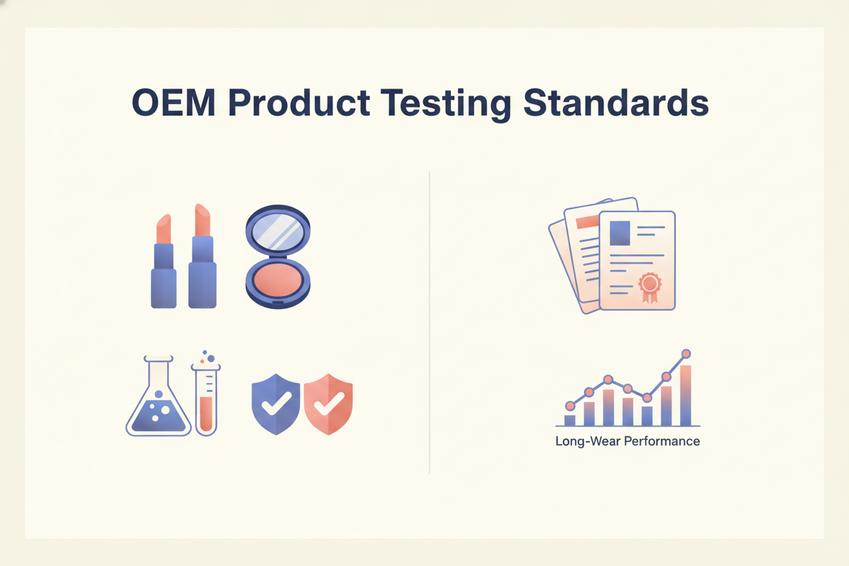
Stability & Safety: Hypoallergenic, Fragrance-Free Trials
When developing OEM beauty products, product safety is reviewed through several connected stages:
-
Safety Verification
-
safety assessment
- Raw materials are screened before formulation.
- Ingredient compatibility is reviewed under different storage conditions.
-
hypoallergenic testing
- Skin compatibility studies help reduce irritation risks.
- Sensitive-skin considerations are evaluated during development.
-
- Controlled application checks support claim validation.
-
-
Formula Stability
-
stability testing
- Samples are exposed to varying temperatures and humidity levels.
- Appearance, texture, and odor are monitored over time.
-
shelf life
- Aging studies help estimate product durability during storage.
-
fragrance-free validation
- Formula reviews confirm fragrance-free positioning when applicable.
-
-
Product Protection
-
microbiological testing
- Microbial limits are assessed throughout development.
-
preservative efficacy
- Preservation systems are challenged to verify ongoing protection.
-
For OEM beauty and beauty products intended for global distribution, these checks help support consistent quality from production through consumer use.
Regulatory Compliance: FDA, EU Cosmetic Regulations, REACH
The formulation process supports regulatory preparation through a structured review process.
-
Ingredient Review
-
ingredient restrictions
- Formula components are compared against applicable market requirements.
-
- Substance-related obligations are evaluated where relevant.
-
-
Documentation Management
-
documentation
- Technical records are organized for product registration support.
-
safety data sheets
- Ingredient information is maintained and updated when needed.
-
-
Market Entry Preparation
-
FDA regulations
- Product information is aligned with applicable cosmetic expectations.
-
EU cosmetic regulations
- Formula and product file considerations are reviewed.
-
labeling requirements
- Claims, ingredient declarations, and packaging details receive verification.
-
• Clear records help reduce delays.
• Consistent review supports smoother product launches.
• OEM beauty products entering multiple regions benefit from early compliance planning.
Performance Testing: Buildable Coverage & Long-Wear Formula
Performance evaluation focuses on how products behave in everyday use.
-
Complexion Products
-
coverage assessment
- Foundation and concealer formulas are checked for buildable results.
- Layering performance is reviewed without excessive heaviness.
-
consumer trials
- User feedback helps identify practical wear characteristics.
-
-
Wear Characteristics
-
long-wear testing
- Extended-use observations measure appearance retention.
-
transfer resistance
- Contact testing helps assess product movement during wear.
-
adhesion testing
- Formula attachment to skin is examined under typical conditions.
-
-
User Experience
-
application properties
- Spreadability, blendability, and finish are reviewed.
-
sensory evaluation
- Comfort, feel, and overall perception are recorded.
-
★ Additional checks may include oil-control behavior, SPF-related performance reviews where applicable, and highlighter wear observations.
Through these testing stages, the process helps ensure OEM beauty products and related beauty products meet practical expectations before reaching the market.
In-House vs OEM Beauty Products Sourcing
Choosing between internal manufacturing and external production can shape cost, speed, product quality, and brand flexibility. For beauty brands entering competitive markets, the decision often comes down to balancing control against efficiency while keeping customer expectations and compliance requirements in check.
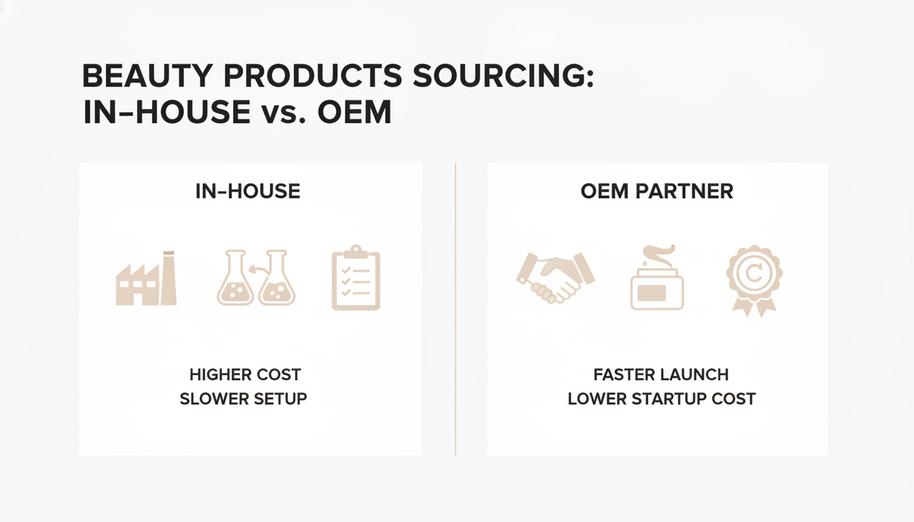
In-House Production
An in-house model gives a brand direct oversight of every stage, from Formulation development to finished packaging. That control can be valuable when unique textures, shades, or performance claims are central to positioning.
-
Product creation
- Research and testing depend on strong Staffing expertise.
- New concepts move through Quality control checks before launch.
-
Operations
- Dedicated Manufacturing facilities support daily production.
- Significant Equipment investment is needed to maintain consistency.
- Available Production capacity influences how quickly demand can be met.
-
Business management
- Effective Supply chain management keeps ingredients and packaging flowing.
- Ongoing Regulatory compliance work supports market access and product safety.
For brands seeking complete ownership of processes, this route can feel like a good fit. The trade-off is higher capital commitment and longer setup timelines.
OEM Sourcing
Many beauty companies prefer OEM beauty products because experienced partners already possess advanced manufacturing systems and established compliance practices. As an OEM/ODM manufacturer, Topfeel Beauty is one example of a supplier supporting custom development and private labeling.
-
Partner evaluation
- Review Supplier selection criteria carefully.
- Verify relevant Certifications.
- Assess available Manufacturing capabilities.
-
Project planning
- Define Product customization requirements.
- Establish clear Communication protocols.
- Confirm expected Lead times.
-
Execution and protection
- Use detailed Contractual agreements to clarify responsibilities.
- Monitor ongoing Quality assurance standards.
A typical path may include:
- Product concept approval
- Sample development
- Formula refinement
- Production scheduling
- Final delivery
For brands looking to launch OEM beauty products efficiently, this approach often reduces risk and startup costs. Reputable suppliers can help streamline development while supporting custom OEM beauty products, OEM beauty programs, and beauty products OEM solutions without the burden of building a factory from scratch.
Timeline Delays? Insist on Clear Production Schedules
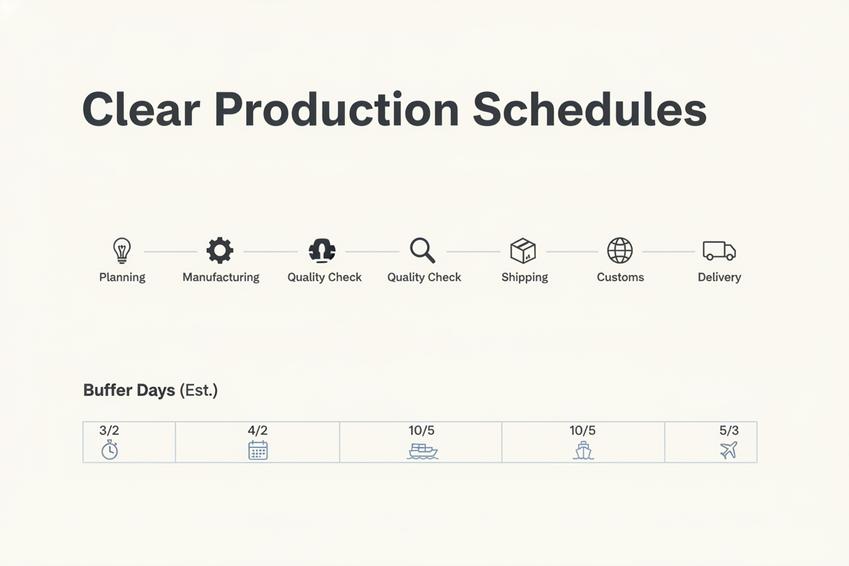
Clear schedules reduce surprises and help buyers of oem beauty products track progress with confidence. A practical timeline connects factory work, shipping plans, and communication, making OEM beauty and beauty products sourcing much easier to manage.
Milestone-Based Production Roadmap
-
Planning stage
- Define development stages for oem beauty products.
- Confirm formula targets and required approval points.
- Record expected completion dates.
-
Production preparation
- Review production phases with suppliers.
- Align the project timeline with purchasing goals.
- Schedule material arrival windows.
-
Manufacturing control
- Filling, pressing, and packaging move through set key deliverables.
- Required quality checks are completed before the next task begins.
- Progress is logged and shared.
-
Release readiness
- Final sign-off at designated approval points.
- Packaging verification and shipment booking.
- Confirmation of completion dates for customer planning.
Short updates at each milestone keep OEM beauty projects from drifting off schedule.
Freight Forwarding & Customs Clearance Buffer
A realistic buffer helps beauty products move across borders without turning minor delays into major headaches. For oem beauty products, timing should account for paperwork, transport, and port activity.
| Activity | Typical Days | Buffer Days |
|---|---|---|
| Booking freight | 3 | 2 |
| Customs documentation review | 4 | 2 |
| Export processing | 3 | 2 |
| Ocean or air transit time | 10 | 5 |
| Destination clearance | 5 | 3 |
Key checks include:
- Compliance with import regulations
- Coordination with logistics partners
- Monitoring port operations
- Backup contingency planning for schedule changes
Regular Logistics Coordination Updates
-
Communication flow
- Share tracking information after dispatch.
- Provide shipment notifications when status changes.
- Maintain clear communication channels.
-
Inventory visibility
- Review stock levels and delivery status.
- Match forecasts with production output.
- Improve supply chain visibility.
-
Reporting routine
- Set an agreed update frequency.
- Use consistent reporting methods.
- Escalate risks before lead times are affected.
Regular coordination keeps oem beauty products moving smoothly while giving buyers reliable information instead of last-minute surprises. If you are ready to discuss your specific logistics and formulation needs, you can contact us directly to explore available options.
References
- GMP certification – who.int/World Health Organization
- ISO 22716 standard – iso.org/International Organization for Standardization
- FDA-aligned expectations – fda.gov/U.S. Food and Drug Administration
- EU cosmetic requirements – europa.eu/European Commission
- vegan and cruelty-free claims – vegansociety.com/The Vegan Society
- Airless bottles – packagingdigest.com/Packaging Digest
- supply chain visibility – gartner.com/Gartner
- patch testing – aad.org/American Academy of Dermatology
- shelf life – cosmeticsinfo.org/Cosmetics Info
- microbiological testing – personalcarecouncil.org/Personal Care Products Council
- REACH compliance – echa.europa.eu/European Chemicals Agency
- safety data sheets – osha.gov/Occupational Safety and Health Administration
- FDA regulations – fdli.org/Food and Drug Law Institute
- JIT manufacturing – investopedia.com/Investopedia
- import regulations – cbp.gov/U.S. Customs and Border Protection
Post time: Jul-13-2026