
Makeup With Skincare Benefits: Ingredients, Claims, and Formulation
Hybrid makeup must balance pigments, actives, texture, stability, and claims. For private-label buyers, a trendy ingredient alone won’t cut it.
Serum foundations and tinted moisturizers must deliver consistent shades and defensible claims. This guide covers ingredients, formulation, testing, and supplier discussions.
Lyrical Key Points for Makeup with Skincare Benefits
- Choose hybrid textures that blend pigments with actives (e.g., hyaluronic acid, niacinamide) for smooth coverage and skin support.
- Embrace cold-process blending or vacuum emulsification to preserve temperature-sensitive ingredients and ensure consistent shade dispersion.
- Verify stability, SPF and non-comedogenic claims through rigorous testing; seek cruelty-free and dermatologist-tested certifications.
- Offer customization options—shade matching, active concentrations, finish tuning—in airless or dual-chamber packaging for optimal protection and performance.
What Makes Makeup With Skincare Benefits Unique?
Hybrid makeup combines coverage with skin-care positioning. Topfeel Beauty develops these formulas around performance and comfort through custom face makeup development.
Hybrid Product Category: Serum Foundation Meets Skincare
Serum foundation pairs pigments with active ingredients in a lighter-feeling base.
- Skin support
- Hydration: Hyaluronic acid can help hold water at the skin surface.
- Skin barrier: Niacinamide may support barrier function with regular use.
- Wear experience
- Lightweight coverage can be layered without a heavy feel.
- Botanical extracts and antioxidants add options for skin-focused positioning.
The result keeps complexion performance central.
Innovative Manufacturing Process: Cold Process Blending for Enhanced Actives
Ingredient handling matters. A cold process limits unnecessary heat for suitable potent actives.
- Build the emulsion under controlled conditions.
- Disperse pigments evenly for reliable shade and texture.
- Use suitable formulation technology to maintain stability and nutrient preservation.
Cold processing does not automatically increase bioavailability, so the formula still needs testing.
Certified Formulation: Cruelty-Free & Dermatologist-Tested Fusion
Proof separates supported formulas from catchy packaging. Great Britain guidance covers product-safety responsibilities.
- Product assurance
- Cruelty-free certification can support ethical positioning.
- Dermatologist-tested claims need a documented skin-tolerance evaluation method.
- Skin-focused evidence
- Non-comedogenic testing assesses the formula’s tendency to clog pores.
- Hypoallergenic positioning requires suitable evidence rather than a blanket promise.
- A formal safety assessment is especially useful when products target sensitive skin.
Topfeel Beauty can pair these checks with claim documentation. Its guide to developing foundation close to skin care is a useful starting point.
Build the hybrid brief: A skincare-makeup launch has to coordinate serum-foundation texture, cold-process handling, and cruelty-free or dermatologist-tested evidence. Topfeel Beauty’s OEM work covers custom formula development with compatibility, stability, and safety assessment considerations.
Review the liquid foundation route to compare the format, testing checklist, and claim package before sampling.
3 Key Ingredients In Makeup With Skincare Benefits
The formulation task is pairing useful actives with textures that wear well.
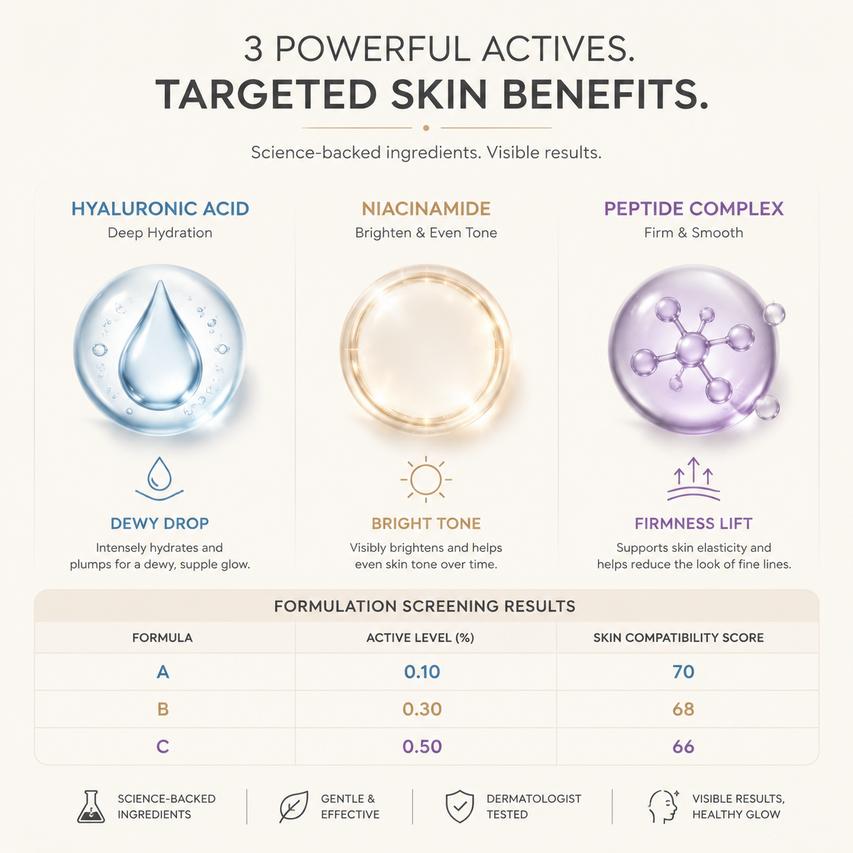
Hyaluronic Acid: Gel Cream for Instant Plumping
Hyaluronic acid is water-binding, and its hydration role suits a dewy finish.
- Formula fit
- Gel texture spreads easily and feels cooling.
- Sodium hyaluronate supports moisture retention at the skin surface.
- Wear considerations
- Balanced water levels help the skin barrier feel comfortable.
- Too much thickener can make layering feel tacky, so formulation trials matter.
| Screening batch | HA level (%) | Water phase (%) |
|---|---|---|
| A | 0.10 | 70 |
| B | 0.30 | 68 |
| C | 0.50 | 66 |
These are screening examples, not efficacy thresholds.
Niacinamide: Lightweight Emulsion to Even Tone
Niacinamide, or vitamin B3, suits lightweight formulas targeting radiance and smooth texture. CIR reports provide ingredient-level safety information.
Tone: Regular use may help reduce the appearance of uneven pigmentation.
Finish: Its compatibility with light emulsions suits formulas designed around oil control and the appearance of pore minimization.
That combination suits breathable daily coverage.
Peptide Complex: Silky Mousse for Firming Effects
Peptides are short chains of amino acids used in firming-focused products.
- Texture and performance
- A whipped texture keeps mousse makeup airy.
- Soft-focus coverage can visually soften fine lines.
- Skincare connection
- Certain peptides are studied for signaling related to collagen synthesis.
- Formula-dependent peptide care may support the appearance of elasticity, fitting an anti-aging routine without making instant lifting promises.
Brands can review cosmetic ingredient categories before fixing an active-led brief.
Which Antioxidants Fortify Cosmetic Formulas?
Vitamin C supplies antioxidant care, while squalane and ceramides address comfort and moisture. Their stability and sensory needs must fit the color formula.
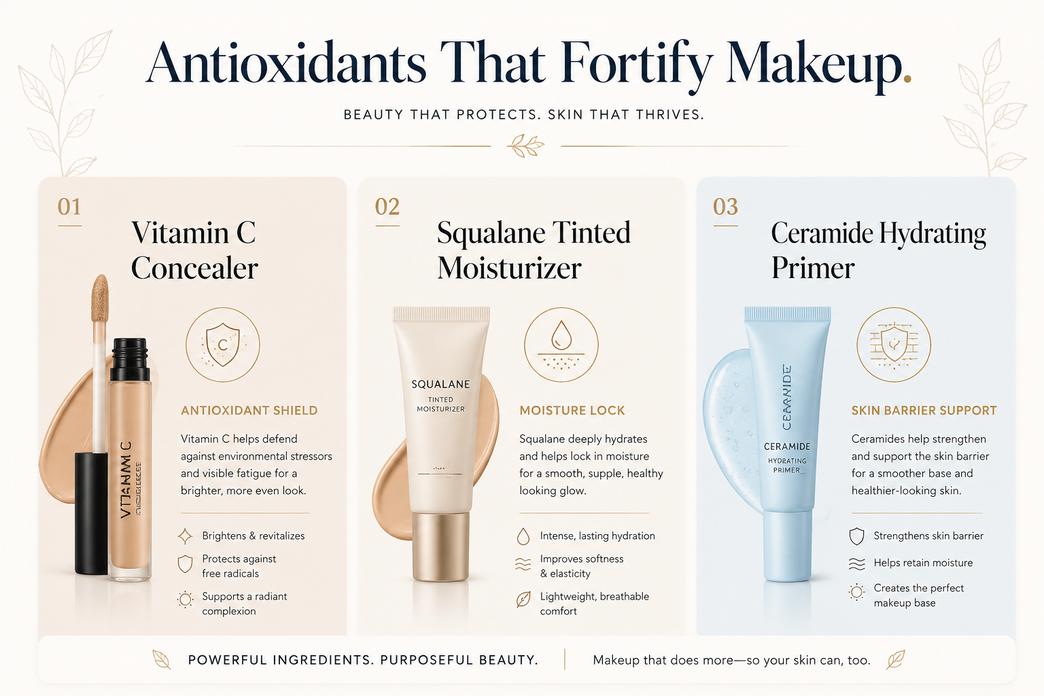
Vitamin C Concealer for Brightness and Protection
Vitamin C brings an antioxidant role to hybrid complexion products, helping limit oxidative stress caused by everyday environmental exposure. Its formula needs careful handling.
- Brightening care
- Ascorbic acid and stable derivatives can support radiance.
- Around dark circles, that effect can complement a brightening pigment rather than replace coverage.
- Formula protection
- Light, air, water, and pH can affect vitamin C stability.
- Smart packaging and compatible ingredients help preserve performance and skin protection. Pretty handy for a concealer doing double duty.
Squalane-Infused Tinted Moisturizer for Barrier Support
Squalane is an emollient that softens the surface and helps lightweight coverage feel comfortable.
In formulas with botanical lipids, squalane can improve slip without feeling overly heavy.
Ceramides in Hydrating Primer to Lock in Moisture
Ceramides naturally belong to the skin’s lipid matrix, so primer is a neat place to add them.
- Skin barrier repair support helps reinforce depleted surface lipids.
- Better moisture retention can help reduce water loss from the skin surface.
- A hydrating primer can consequently create a softer smoothing base for makeup while supporting skincare benefits underneath.
Protect the ingredient story: Coordinate vitamin C, squalane, and ceramides before sampling.
Topfeel Beauty can co-develop texture and claims while checking compatibility. Its documented workflow prepares initial samples in 3-7 days. Compare the custom solutions workflow to decide which active, package, and validation questions belong in the brief.
Conventional Vs. Skin-Care-Infused Foundations
Conventional formulas prioritize coverage and wear; infused formulas add a targeted skin-care story.
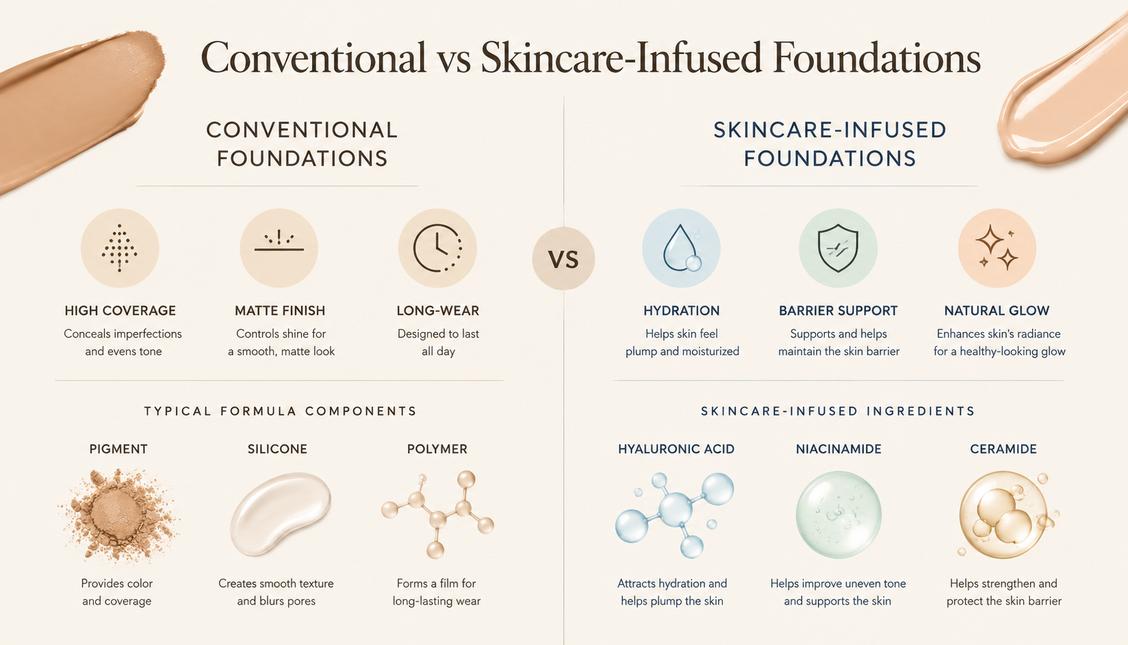
Conventional Foundations
Conventional foundation puts reliable color, wear, and finish first.
- Coverage and appearance
- Pigments create color and help hide uneven tone.
- Talc can absorb oil and support a smooth matte finish, while formulas designed for full coverage use pigment levels and texture carefully to avoid a heavy feel.
- Wear and texture
- Silicones can improve slip and softness.
- Synthetic polymers may help foundation form an even, longer-lasting film.
- Good formulation also matters when consumers worry about a pore-clogging feel.
- Silicones can improve slip and softness.
For brands developing hybrid complexion products, Topfeel Beauty can pair these familiar performance goals with skin-friendly positioning. The makeup still has to look good. Simple as that. Compare the foundation category when setting coverage and finish priorities.
Skin-Care-Infused Foundations
Skin-care-infused foundation combines coverage with familiar care ingredients.
- Hyaluronic acid supports hydration, helping dry skin feel more comfortable.
- Niacinamide and ceramides can support the skin barrier, depending on concentration and formula design.
- Antioxidants or botanical extracts can add targeted care claims when backed by suitable evidence.
Topfeel Beauty can develop skincare makeup around these ingredient stories while considering stability, packaging, and claim support. If SPF protection is intended, applicable sunscreen testing and regulatory rules become especially important; simply adding an SPF-related ingredient doesn’t automatically make a valid protection claim. This distinction keeps ingredient selection, finished-product testing, and consumer-facing language aligned before a brand commits to a complexion format system.
Office Glow: Lightweight SPF Foundations
Office makeup can pair comfortable coverage with tested SPF claims. ISO 24443 covers UVA testing; WHO guidance explains UV risk.
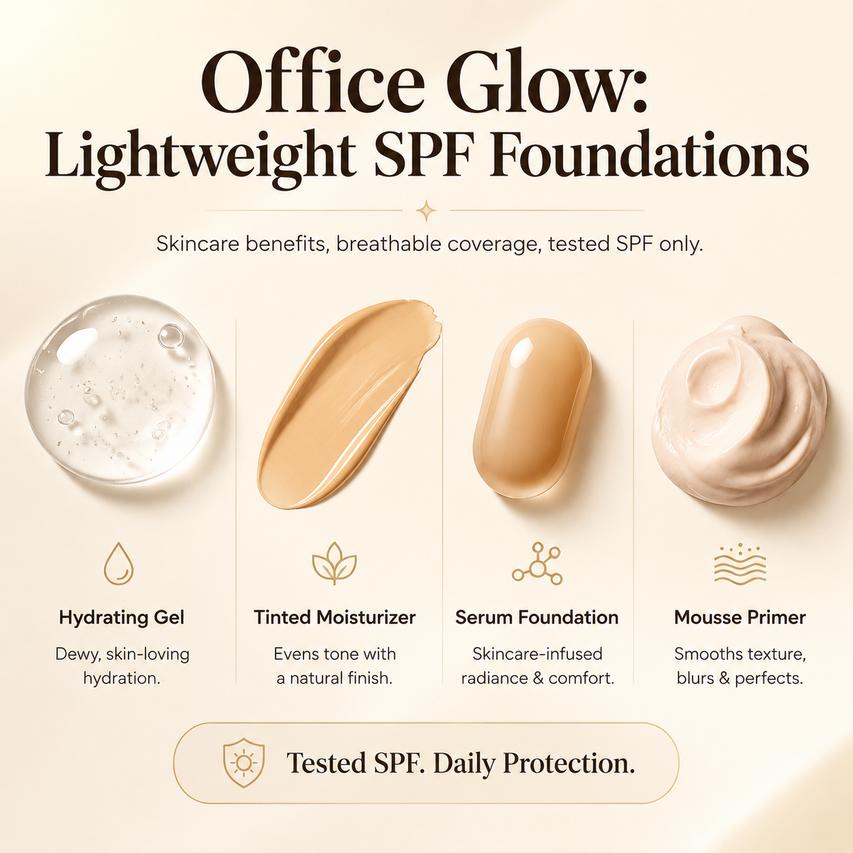
SPF Gel Cream Tinted Moisturizer for All-Day Sheen
A gel cream tinted moisturizer suits sheer, fresh-looking coverage.
- For an easy office glow:
- Choose a lightweight formulation offering hydration and sheer pigment.
- A soft sheen finish keeps skin lively rather than flat.
- Skincare-infused formulas make makeup with skincare benefits practical for daily routines.
- Treat labeled SPF protection as sun protection only at the tested application amount.
- Don’t count a thin cosmetic layer as a free pass for all-day UV exposure.
- Choose a lightweight formulation offering hydration and sheer pigment.
Topfeel Beauty can develop this kind of skin-friendly complexion format around sensory feel, shade needs, and tested SPF goals. Its article on foundation with SPF helps frame the buyer discussion.
SPF Lightweight Emulsion Serum Foundation
A serum foundation built as a lightweight emulsion spreads easily.
- Look for radiant coverage with a breathable texture.
- Pair useful active ingredients with a skin-nourishing base where formula compatibility permits.
- For makeup with skincare benefits carrying broad-spectrum SPF, rely on finished-product testing rather than simply adding sunscreen filters.
The result combines coverage with a testable protection claim; FDA guidance distinguishes labeled protection from ingredient assumptions.
Silky Mousse Hydrating Primer with Broad-Spectrum Protection
A silky mousse hydrating primer smooths before makeup.
- Texture and care:
- Pore-blurring ingredients can create a smooth finish.
- Hydrating components help support the moisture barrier.
- Pore-blurring ingredients can create a smooth finish.
- Sun care:
- A suitable UV filter system may provide broad-spectrum protection.
- The finished product still needs required SPF and UVA testing to substantiate that claim.
- A suitable UV filter system may provide broad-spectrum protection.
It’s a soft-focus format. ISO 24444 specifies in vivo SPF determination. Review Topfeel Beauty’s facial sunscreen category when defining the claim route.
Make SPF defensible: A tinted moisturizer, serum foundation, or primer must connect filters, application, finished-product testing, and the label claim. Topfeel Beauty can develop the complexion texture while your brief defines the market and protection target.
Send the format, shade range, finish, and SPF goal through contact us to plan samples and the required testing path.
Hydration Meets Coverage
Color products increasingly combine familiar skin-care ingredients with coverage. Topfeel Beauty connects moisture-focused formulas with practical textures.
Nourishing Lip Balm with Ceramides for Dewy Finish
- Ceramides give a nourishing lip balm a skin-care-minded edge.
- They support barrier repair and hydration, useful when lips feel dry.
- A twist-up stick keeps lip care quick.
- The payoff can be a comfortable dewy finish.
That makes a care-led color product easy to swipe on and go.
Vitamin C Concealer Liquid Fluid for Radiant Concealment
A vitamin c concealer can combine radiant concealment with a fresher look.
- A liquid fluid texture spreads easily around dark circles.
- Flexible pigment supplies coverage without feeling too heavy.
- Brightening ingredients need thoughtful protection from air and light, so airless packaging or stabilized vitamin C forms can make sense.
It’s a coverage-plus-care format, not just camouflage.
Serum Foundation Silky Mousse with Hyaluronic Acid
- Serum foundation pairs complexion color with moisture-focused care.
- Hyaluronic acid supports moisture retention.
- That can encourage skin smoothing and a dewy complexion.
- A silky mousse needs balanced viscosity.
- Good flow supports even pigment and lightweight coverage.
- Hyaluronic acid supports moisture retention.
The result feels less cakey and more comfortable.
Hydrating Primer Gel Cream Infused with Squalane
- Hydrating primer handles skin prep before foundation.
- Squalane adds emollient softness.
- It supports the moisture barrier without a heavy feel.
- A gel cream texture can create a smooth base.
- A non-greasy finish helps makeup sit evenly.
- Squalane adds emollient softness.
This skin-loving makeup approach keeps prep simple and practical. Buyers can compare lightweight liquid foundation formats when balancing hydration, coverage, and a non-greasy finish.
Turn hydration into a range: Lip balm, concealer, serum foundation, and primer need different pigment, flow, barrier-support, and package decisions. Topfeel Beauty’s consultation-to-sampling process can convert those connected requirements into a coordinated face-and-lip development brief.
Share the formats, target textures, shades, and claim priorities through contact us to start sampling and packaging review.
References
- Hypoallergenic Cosmetics — fda.gov
- Sunscreen: How to Help Protect Your Skin from the Sun — fda.gov
- ISO 24443:2021 — iso.org
- ISO 24444:2019 — iso.org
- Making cosmetic products available to consumers in Great Britain — gov.uk
- Hyaluronic Acid: What It Is, Benefits, How To Use & Side Effects — clevelandclinic.org
- Ultraviolet radiation — who.int
- Guidelines for Assessment of Skin Tolerance of Potentially Irritant Cosmetic Ingredients, 1997 — cosmeticseurope.eu
- CIR Reports — cir-safety.org
Post time: Aug-31-2026