
Luxury Private Label Cosmetics: How to Choose the Right Manufacturer
Scaling luxury private label cosmetics sounds glamorous until batches slip, launches stall, and suppliers ghost when pressure hits hard.
McKinsey and Euromonitor report sustained premium beauty demand, with buyers prioritizing consistent quality, compliant manufacturing, and partners who protect brand equity.
The manufacturer isn’t a vendor; it’s your growth engine, aligning R&D, packaging, timelines, and logistics so launches land.
Key Notes on Scaling Luxury Private Label Cosmetics
➔ Vet production partners for GMP certified lines, robust R&D support, and full regulatory compliance.
➔ Balance MOQs with inventory systems and negotiate flexible thresholds to optimize cost and stock levels.
➔ Align lead times by leveraging in-house or outsourced testing, expedited logistics, and synchronized marketing schedules.
➔ Ensure scalable warehousing, global shipping, and fulfillment services to protect brand equity and support growth.
3 Steps To Vet Production Facilities
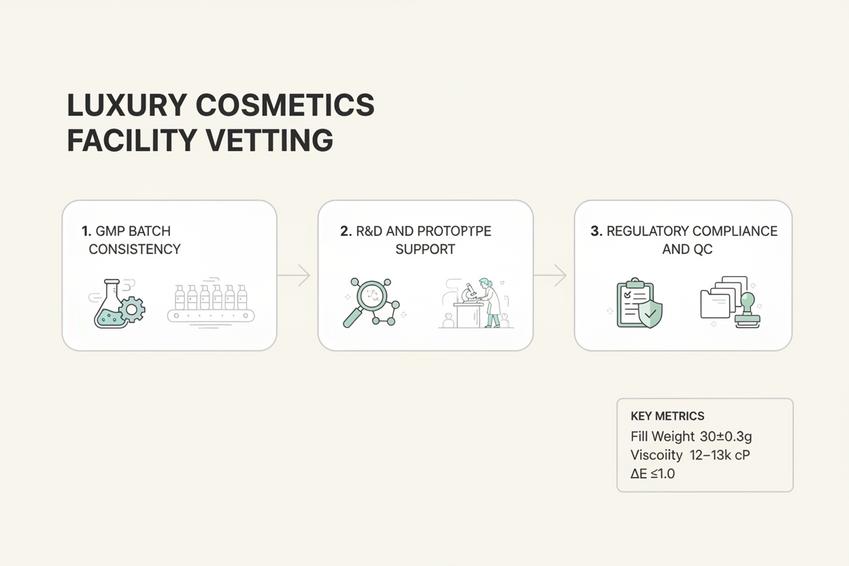
Getting into luxury private label cosmetics isn’t just about pretty packaging; it’s about who’s behind the lab doors. If you’re building private label cosmetics or scaling a luxury cosmetics line, the right facility can make or break consistency, safety, and speed. Here’s how to vet smart without overthinking it.
Evaluate GMP certified lines for batch consistency
-
Audit flow of production lines under GMP certification
-
Incoming materials
- Check supplier COAs
- Verify quarantine and release logs
-
In-process controls
- Track weight checks, fill volumes, viscosity
- Confirm process control checkpoints are recorded per batch
-
Finished goods
- Review stability reports (3, 6, 12 months)
- Confirm shade and texture repeatability for foundation, lipstick, mascara
-
-
Validate batch consistency with data, not promises
-
Compare 3 recent batches
- Color ΔE values
- Micro limits
- Fill weight variance
-
Ask for deviation reports and CAPA actions
-
-
Facility audit essentials
- Cleanroom zoning, line clearance, line changeover time
- Quality assurance sign-offs and electronic batch records
| Metric | Batch A | Batch B | Batch C | Spec Range |
|---|---|---|---|---|
| Fill Weight (g) | 29.9 | 30.1 | 30.0 | 30 ± 0.3 |
| Viscosity (cP) | 12,500 | 12,700 | 12,600 | 12–13k |
| Micro (CFU/g) | <10 | <10 | <10 | <100 |
| ΔE Color | 0.6 | 0.7 | 0.5 | ≤1.0 |
| Stability @40°C (wk) | Pass | Pass | Pass | Pass |
Topfeel Beauty typically shares this level of documentation for luxury private label runs, which keeps surprises low when you scale.
Assess formulation development and R&D support capabilities
You want a lab that can actually create, not just copy. In private label beauty, speed matters, but so does originality.
-
Quick checks:
- Custom shade matching across skin tones
- Claims testing for long-wear, transfer-proof
- Vegan and non-comedogenic options
- Formulation development depth
- R&D capabilities tied to ingredient selection (actives, sensorials)
- Prototype development speed (first sample in 3–7 days is solid)
- Technical support for scale-up and troubleshooting
Short notes that matter:
- Texture feel beats ingredient hype.
- Stability beats speed.
- Documentation beats memory.
“Brands that invest early in lab collaboration reduce reformulation cycles by up to 30%,” noted a 2025 McKinsey beauty manufacturing brief.
If you’re building luxury private label cosmetics, Topfeel Beauty offers hands-on iteration loops—feedback, tweak, re-sample—until your concealer or eyeshadow palette lands exactly right.
Verify regulatory compliance and quality control processes
-
Regulatory compliance stack
- FDA registration, ISO alignment
- EU Cosmetics Regulation files (PIF, CPSR)
- Clear documentation trails for every SKU
-
Quality control layers
- Raw material testing → in-process checks → finished goods release
- Routine product testing: micro, heavy metals, preservative efficacy
- Retention samples and recall readiness
-
Auditing procedures and safety regulations
- Internal audits quarterly
- Third-party audits annually
- Training logs for operators and lab techs
Nested view of control flow:
-
Intake
- ID testing
- Supplier verification
-
Manufacturing
- Line clearance
- Environmental monitoring
-
Release
- COA approval
- Batch record closure
For luxury cosmetics and private label cosmetics, clean paperwork is as critical as clean formulas. Topfeel Beauty aligns industry standards with practical workflows, so your luxury private label cosmetics line stays compliant in the US and EU without slowing launches.
Can You Handle Minimum Order Quantities?
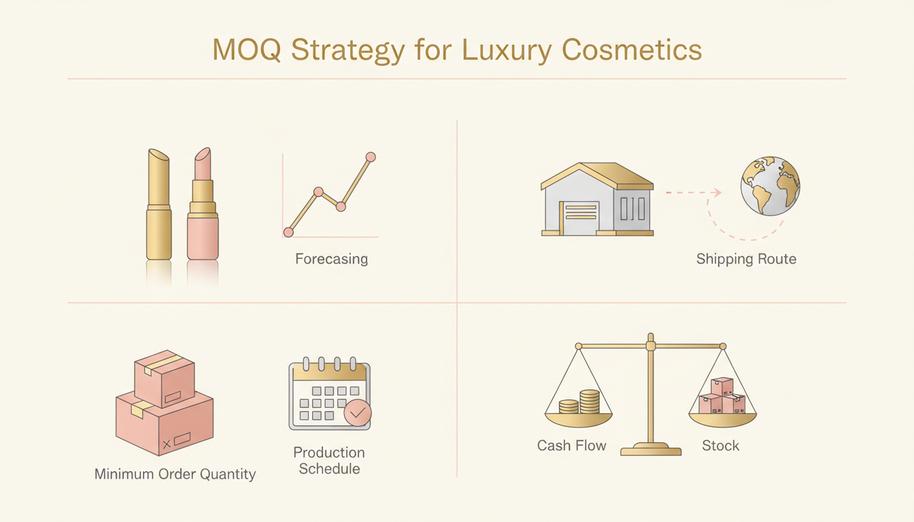
Keeping luxury private label cosmetics moving without drowning in stock is a real balancing act. When you’re building a luxury cosmetics line or scaling private label makeup, MOQ decisions ripple through cash flow, storage, and speed to market. Let’s keep it practical and sharp.
Balancing MOQs with inventory management
-
Core alignment
-
Demand side
- Use demand forecasting to map sales for luxury private label cosmetics drops
- Track stock levels weekly to avoid dead stock
-
Supply side
- Sync production planning with seasonal spikes
- Shorten lead time management windows where possible
-
-
System tuning
-
Inventory layer
- Apply inventory control rules per SKU (lipstick vs foundation behave differently)
- Push storage optimization to reduce holding costs
-
Flow layer
- Improve supply chain efficiency via tighter reorder points
- Refine warehousing strategies to keep luxury cosmetics fresh and ready
-
-
Brand fit
- A luxury private label cosmetics brand like Topfeel Beauty keeps runs tight, not bloated
Negotiating bulk production thresholds for Lipstick and Foundation
You don’t just accept MOQs—you shape them.
- Prep
- Lock product specifications and cosmetic formulation early
- Understand supplier capacity planning and real production volume
- Negotiate
- Use clear negotiation tactics: split runs, stagger deliveries
- Build long-term supplier relationships to unlock flexibility
- Protect
- Embed quality assurance checks in manufacturing agreements
“Brands that align MOQ strategy with real-time demand signals outperform peers on inventory turns and margin stability.” — McKinsey, 2025
Short takeaways:
- Smaller initial runs for new luxury private label cosmetics
- Scale only when sell-through proves it
- Keep options open for reformulation in private label makeup
Scaling warehousing and global shipping logistics
-
Network build-out
-
Warehousing
- Choose warehousing solutions near key markets
- Standardize fulfillment operations for luxury cosmetics
-
Distribution
- Expand global distribution lanes gradually
- Partner with strong shipping networks
-
-
Compliance and flow
-
Cross-border
- Nail customs compliance for each region
- Use reliable freight forwarding partners
-
Integration
- Connect systems for supply chain integration and visibility
- Tighten logistics management to cut delays
-
-
Growth rhythm
- Start lean, then scale with demand for luxury private label cosmetics
- Topfeel Beauty shows how steady expansion beats overextension
Lead Times Explained: Speed Vs. Cost
Kicking off a luxury private label cosmetics line sounds exciting, but timing can make or break it. From product development to shipping choices, every move affects cost and speed. If you’re building private label luxury cosmetics or scaling luxury cosmetics lines, getting this balance right keeps launches smooth and shelves stocked without burning your budget.
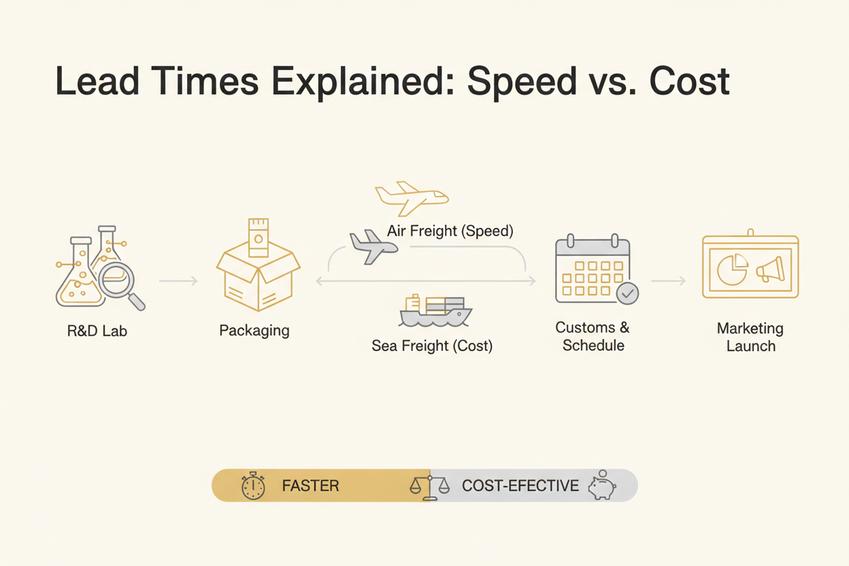
Impact of R&D support on turnaround time
-
Core flow of product development in luxury private label cosmetics:
-
Ideation → formulation → testing → prototyping
- Each stage benefits from tight innovation cycles
- Faster design tweaks reduce delays
-
Compliance track:
- regulatory compliance checks run parallel
- Early validation avoids rework
-
-
Strong internal labs or partners like Topfeel Beauty speed up efficiency, cutting weeks off private label luxury cosmetics timelines while keeping quality tight.
Faster shipping methods for urgent launches
When a luxury cosmetics private label launch is breathing down your neck, speed wins—but it stings your wallet a bit.
-
Air options:
- air cargo for bulk urgency
- express shipping for smaller urgent orders
-
Logistics layer:
- Tight supply chain coordination
- Real-time transportation tracking boosts delivery speed
Topfeel Beauty often pairs fast logistics with flexible batching so luxury private label cosmetics hit shelves right on cue.
Cost implications of air freight vs. sea freight
-
Define shipment size within your luxury cosmetics line
-
Compare transportation modes:
- Air = fast, higher shipping expenses
- Sea = slower, better budget control
-
Evaluate transit time vs campaign deadlines
-
Optimize freight options for supply chain efficiency
Balancing delivery methods keeps margins healthy in private label luxury cosmetics.
Aligning production schedules with marketing plans
-
Sync framework for luxury private label cosmetics:
-
Planning layer:
- production planning aligns with launch strategy
- Match manufacturing timeline to campaign timing
-
Execution layer:
- Monitor inventory management
- Ensure product availability during promotional activities
-
Clean alignment means no awkward “coming soon” gaps—just a smooth luxury cosmetics private label rollout.
In-House Vs. Outsourced Lab Testing
Kicking off, brands juggling luxury private label cosmetics often face a real fork in the road: keep testing inside or send it out. Each path shapes speed, trust, and how polished those luxury cosmetics feel when they finally hit shelves.
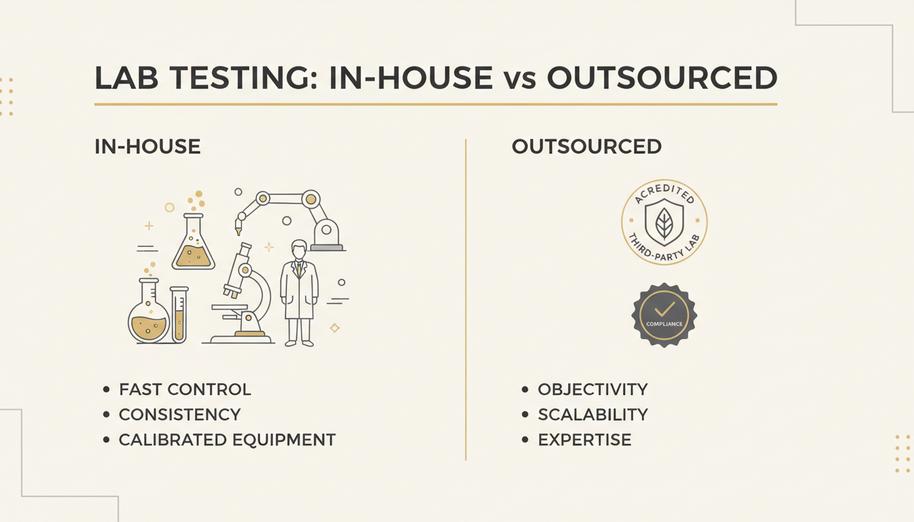
In-House Lab Testing
Running tests internally keeps Control tight and decisions quick. For luxury private label cosmetics, that kind of immediacy can seriously sharpen product consistency.
-
Core setup
- Equipment calibrated for stability and microbial checks
- Skilled Personnel trained in cosmetic chemistry
- Clear Protocols guiding every batch
-
Workflow rhythm
- Sample prep tied to private label cosmetics specs
- Real-time Data management for fast tweaks
- Continuous Quality assurance before scale-up
• Custom edge: formulas evolve faster, especially for luxury label cosmetics needing quick trend pivots
Short bursts of insight:
Speed matters. Control feels reassuring. Costs stack early. Flexibility wins long term.
A nested look at advantages:
-
Internal mastery
-
Process depth
- Customization for luxury private label cosmetics
- Immediate corrections
-
Risk handling
- Fewer delays
- Stronger batch consistency
-
Topfeel Beauty leans on this model when tight turnaround defines a launch window, especially in luxury cosmetics lines that can’t wait around.
Outsourced Lab Testing
Outsourcing flips the script by bringing in Specialized expertise and recognized Accreditation, which can boost credibility for luxury private label cosmetics entering stricter markets.
“Independent lab validation is increasingly tied to consumer trust and regulatory acceptance in premium beauty categories.” — McKinsey Beauty Insights, 2025
-
External strengths
- Certified Regulatory compliance support
- Proven Certifications for claims like dermatologist-tested
-
Operational flow
- Submit samples aligned with private label cosmetics specs
- Third-party validation ensures Objectivity
- Reports returned with Turnaround efficiency benchmarks
• Scaling upside: easier expansion without heavy capital spend
Layered benefits:
-
Market readiness
- Faster entry into global regions
- Trusted validation for luxury private label cosmetics
-
Resource balance
- No internal lab overhead
- Built-in Scalability
Topfeel Beauty often pairs outsourcing with internal checks, blending independence with brand control—something many luxury cosmetics brands quietly adopt to stay competitive.
References
- The Beauty Market in 2023: A Special State of Fashion Report – mckinsey.com
- Premium Beauty and Personal Care: Resilience and Reinvention – euromonitor.com
- ISO 22716:2007 Cosmetics — Good Manufacturing Practices (GMP) – iso.org
- Modernization of Cosmetics Regulation Act of 2022 (MoCRA) – fda.gov
- Cosmetics Legislation – europa.eu
- What You Need to Know About Demand Forecasting – hbr.org
- Inventory Control: Definition, Techniques, and Examples – investopedia.com
- How to Build a More Efficient Supply Chain – mit.edu
- Choosing the Right 3PL – inboundlogistics.com
- E-commerce Fulfillment: What Is It? – forbes.com
- Basic Importing and Exporting – cbp.gov
- Supply Chain Integration – ibm.com
- Just-In-Time (JIT) Inventory System – investopedia.com
- Air Freight vs Ocean Freight: What’s the Difference? – freightos.com
- ISO/IEC 17025 Testing and calibration laboratories – iso.org
Post time: Jul-30-2026