
Custom Lip Liner and Gloss Sets for Beauty Brands
Custom lip liner and gloss sets work best as one coordinated private-label offer. Bulk sourcing still requires clear shade standards, compatible formulas, consistent branding, compliance records, and realistic freight planning. A structured private-label lip liner plan helps connect these decisions before production begins.
This guide follows approved shades through formulation, testing, packaging, and delivery. For U.S. launches, the FDA cosmetics overview summarizes safety responsibilities.
Harmony Highlights for Lip Liner and Gloss
→ Define Your Shades: Use an approved physical reference for pencils, stains, and gloss.
→ Optimize Production: Confirm mixing, filling, cooling, and inspection checkpoints for each format.
→ Secure Compliance: Build safety, labeling, and documentation requirements into the launch brief.
5 Key Benefits Of Private Label Lip Liners
A coordinated range gives brands control over identity, color, wear, and documentation. Label planning should follow the FDA cosmetics labeling guide.
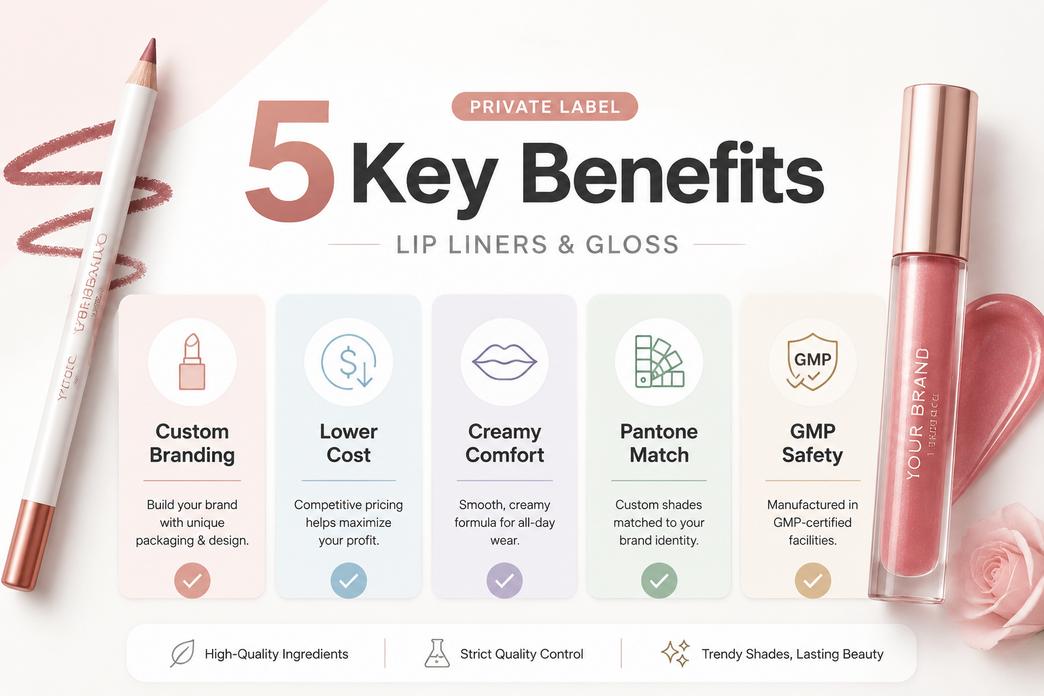
Unique Brand Identity with Custom Logo Printing
A custom logo turns separate cosmetics into recognizable private label products.
- Brand details
- Print logos on wooden pencils or twist-up casings.
- Match packaging design across outer boxes and gloss tubes to reinforce brand recognition and a consistent brand identity.
Reduced Production Costs via Bulk Mixing & Automatic Filling
Repeatable manufacturing can make larger orders easier to plan.
- Formula preparation
- Bulk mixing creates a shared batch for controlled production.
- Filling
- Automatic filling supports repeatable output and manufacturing efficiency.
- A defined process also simplifies the supply chain for gloss and liquid lip stains.
Luxurious Wear: Creamy Texture and Non-Sticky Finish
Comfort depends on balancing payoff, glide, and after-feel.
- Liner feel
- A creamy texture supports smooth application without excessive dragging.
- Gloss feel
- A non-sticky finish can make a high-shine lip gloss formulation more comfortable.
- Hyaluronic acid can support long-lasting moisture; compare lip gloss base options against the applicator and finish.
Standout Shades through Pantone Color Matching
A shared color reference gives shade teams a practical target.
- Color creation
- Refine pigment formulation for the approved custom shades.
- Apply color precision separately to lip liner colors, glosses, and tinted balms.
- Final coordination
- Connect shade development with packaging, and review guidance on matching liner depth to lipstick.
Guaranteed Safety: GMP Certified & Heavy Metal Testing
Safety and compliance need documented controls rather than broad guarantees.
- Production controls
- Choose GMP certified manufacturing with documented quality assurance and a qualified supplier.
- Testing controls
- Use heavy metal testing and microbial limit tests to verify product safety.
- Support cosmetic compliance with suitable documentation and toxicological assessment before market release.
Coordinate the set: Align formula, shade, and presentation before committing to production.
Topfeel Beauty’s turnkey workflow connects formulation with packaging design and quality control. Review the lipstick and gloss set route and custom solutions to compare the specification and presentation choices your launch brief should settle.
Step-By-Step: Formulating Velvet Liners
Consistent velvet liners depend on hygienic equipment, formula balance, filling, and safety records. ISO 22716 addresses cosmetic production, control, storage, and shipment.
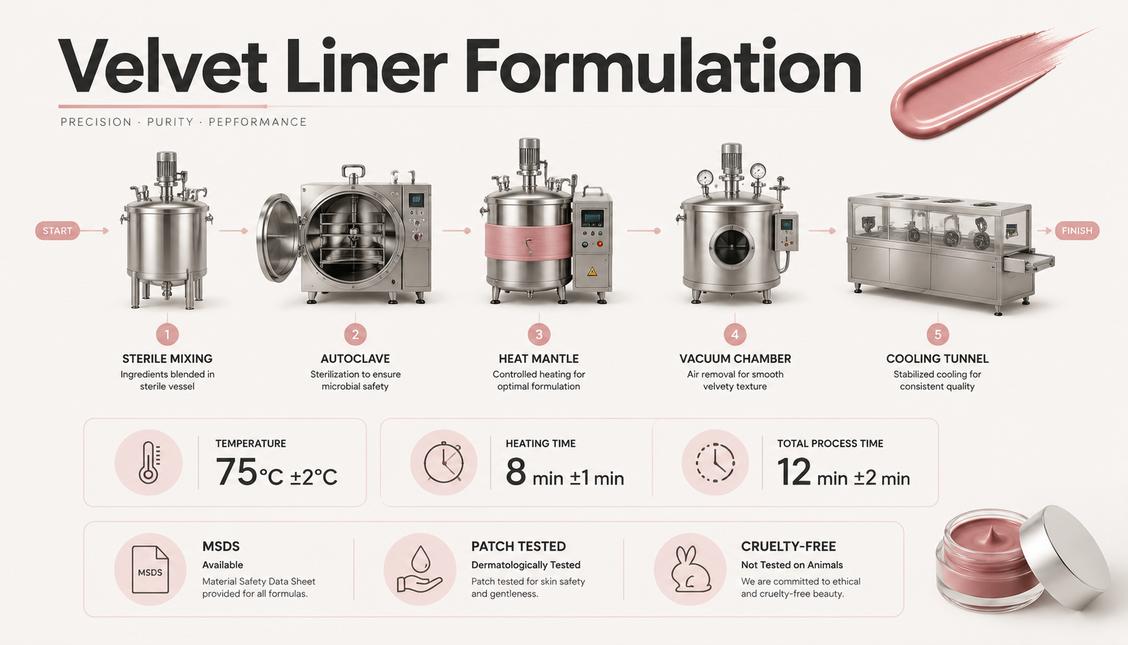
Preparing Equipment for Batch Sterilization
Clean processing starts before ingredients enter the line.
- Pre-production controls
- Stainless steel vessels receive validated sanitization suited to the equipment.
- An autoclave can sterilize compatible removable tools with controlled heat and pressure.
- Environmental checks
- Temperature control and cleanroom practices reduce process variation.
- Routine microbial testing verifies hygiene. A review of how cosmetics factories manage production can help buyers frame supplier questions.
Balancing Hyaluronic Acid, Waterproof Formula & Creamy Texture
A velvet liner needs glide without becoming overly soft.
- Build the base
- Select a compatible polymer blend and wax system for water resistance.
- Add hyaluronic acid in a form suited to the formula as a moisturizing agent.
- Tune performance
- Control viscosity and pigment dispersion for even payoff.
- Check emulsion stability when water-containing phases are used.
| Control | Trial target | Check |
|---|---|---|
| Pour temperature | 75°C | ±2°C |
| Vacuum time | 8 min | ±1 min |
| Cooling time | 12 min | ±2 min |
These are example process targets, not universal specifications.
Implementing Hot Pouring and Vacuum Sealing Processes
For liner production, a heating mantle supports steady temperature regulation.
- Filling
- Use controlled hot molding while the mass flows evenly.
- Move material through a vacuum chamber for deaeration.
- Setting
- A cooling tunnel helps the liner solidify consistently and reduces voids or surface defects.
Completing MSDS Documentation and Cruelty-Free Assay
Documentation keeps a program traceable. OSHA’s hazard communication standard covers labels, safety data sheets, and training, while the EU’s Scientific Committee on Consumer Safety evaluates risks from cosmetics and ingredients.
- Safety records
- Maintain the current safety data sheet, ingredient disclosure, and applicable toxicological assessment.
- Verification
- Document regulatory compliance and evidence supporting cruelty-free certification claims.
- Use appropriate microbial limits and, where justified, human patch testing under suitable ethical and safety controls.
Reduce scale-up surprises: A liner brief should connect hygiene, formula balance, filling, and documentation. Topfeel Beauty’s published workflow includes initial samples in 3–7 days, giving teams an early point to review texture and packaging before mass production.
Compare the OEM lip makeup route and a retractable liner format to prepare a focused sample checklist.
Orders: Ensuring Color Matching
Bulk orders are easier to manage when color approval, packing, and shipping follow one schedule. The European Commission cosmetics overview links EU rules and notification resources.
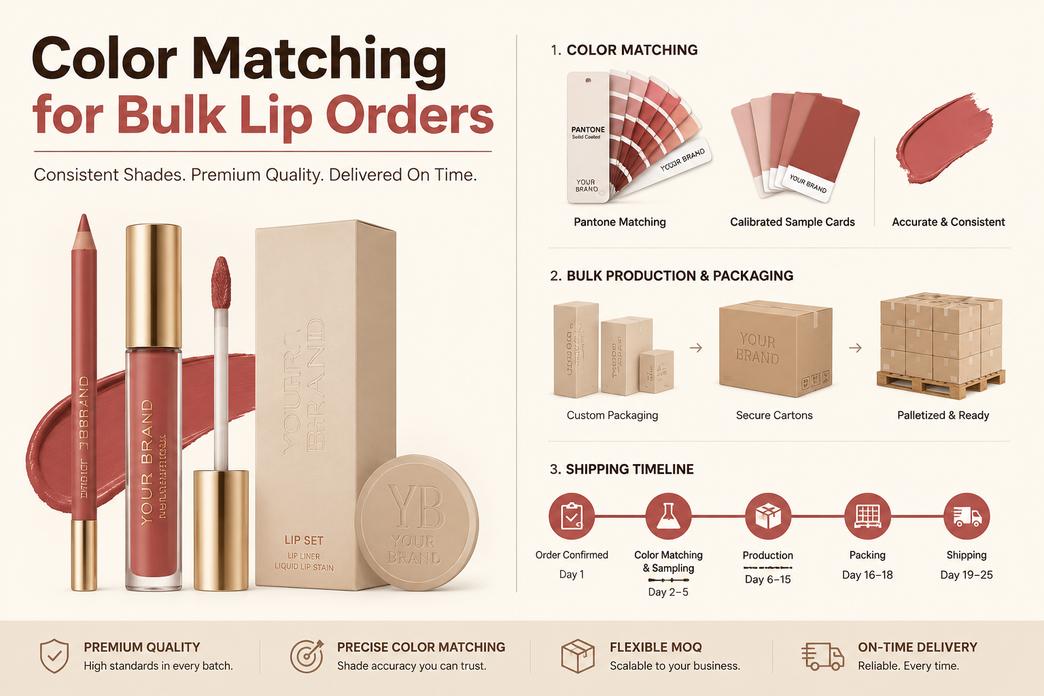
Pantone Color Matching across Matte Lip Pencil and Liquid Lip Stain
A shared color target helps suppliers compare products, but different formulas can still appear different.
- Shade development
- A Matte lip pencil has its own Pigment formulation, affecting depth and finish.
- A Liquid lip stain may dry darker or lighter.
- Shade calibration compares both products against the approved reference.
- Visual inspection under controlled lighting confirms practical Color consistency.
Physical samples remain important because screens cannot replace an approved production reference.
Coordinating Lead Time Schedule with Pallet Stacking Logistics
A workable Lead time schedule connects manufacturing dates with the Shipping timeline.
- Confirm production and packing dates.
- Plan Pallet stacking around carton size and safe Cargo configuration.
- Match Warehouse storage space with pickup timing.
Good Logistics planning keeps the wider Supply chain aligned and reduces last-minute warehouse changes.
Streamlining Freight Forwarding and Private Label Embossing
For coordinated sets:
- Branding comes before packing.
- Complete Logo embossing for the Private label components.
- Check finished marks before Custom packaging is sealed.
- Shipping follows approved goods.
- Book Freight forwarding around the final Manufacturing process and review the broader OEM lip makeup route.
- Prepare accurate documents for Customs clearance.
- Use carton and route planning for better Transport optimization.
This sequence keeps branded components together and clarifies shipment handoff.
Protect the launch date: Topfeel Beauty states mass production takes 45 days after deposit and final approval. That timeline covers packaging.
Turn color matching, pallet planning, and private-label embossing into one release gate. Review the customization workflow to prepare it, then submit your requirements to confirm the bulk schedule.
References
- ISO 22716:2007 — ISO
- Cosmetics — FDA
- Cosmetics Labeling Guide — FDA
- Hazard Communication — OSHA
- Scientific Committee on Consumer Safety — European Commission
- Cosmetics Overview — European Commission
Post time: Aug-28-2026