
Lip Gloss Recipe Development Guide for Beauty Brands
Get this right and shelves stay stocked; get it wrong and customers ghost you fast. Guide cuts lab talk and shows how formulas hold up at scale.
Quick Answers: Lip Gloss Recipe Essentials
- Balance stabilizers: Hydrogenated Polyisobutene, Caprylic/Capric Triglyceride and Polybutene ensure viscosity, shine and non-stick comfort.
- Choose your base: Mineral Oil for shelf stability or Castor Oil for natural gloss and pigment dispersion—test for consistency.
- Plan packaging: Select tube material, tamper seal and label design; validate filling process and GMP compliance for seasonal launches.
- Verify quality & compliance: Conduct stability, heavy-metal and microbiological testing; follow FDA guidelines, EU regulations and cruelty-free policies.
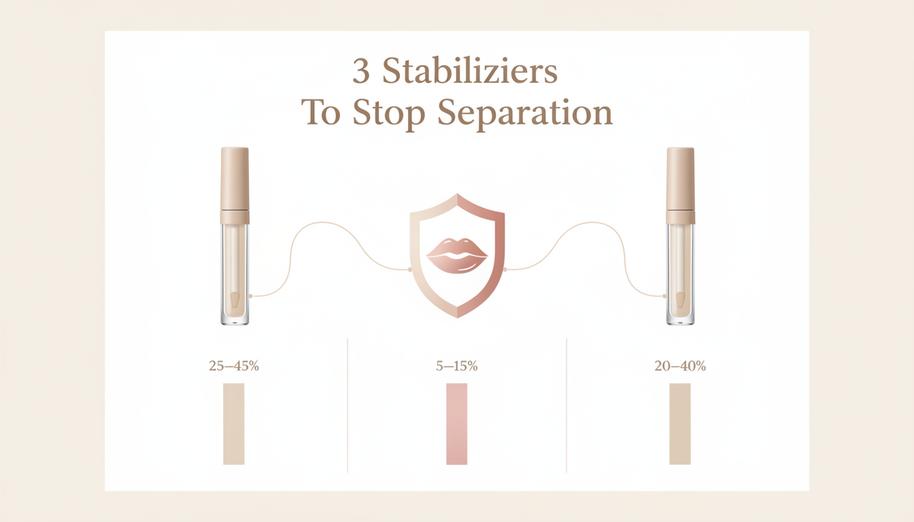
3 Stabilizers To Stop Separation
A smooth lip gloss recipe lives or dies by stability. No one wants separation halfway through wear. These three picks keep your lip gloss formula steady, shiny, and easy to work with.
Hydrogenated Polyisobutene for Enhanced Formula Viscosity
Building a reliable lip gloss recipe starts with control over flow and hold. Hydrogenated Polyisobutene acts as a viscosity enhancer, a quiet polymer that keeps phases from drifting.
-
Core roles:
- Texture modifier that thickens without drag
- Stabilizer that locks oils and pigments in place
- Formula thickener supporting consistent fill during production
- During mixing
- During cooling
- During filling
• Keeps gloss uniform
• Reduces oil bleed
A solid lip gloss base needs balance. In many lip gloss recipes, this ingredient helps match viscosity targets so batches feel identical. Short and sweet: smoother glide, longer wear, less mess.
Caprylic/Capric Triglyceride as an Emulsifying Stabilizer
For a clean lip gloss recipe, dispersion matters. Caprylic/Capric Triglyceride works as a gentle emulsifier and carrier oil, keeping mica and flavor evenly suspended.
- Light feel, zero heaviness
- Supports skin conditioning and soft shine
- Aids separation prevention in warm storage
In lip gloss making, uneven pigment ruins payoff. This emollient keeps color sheer but consistent, ideal for modern lip gloss formulation trends. Many labs, including Topfeel Beauty, favor it for stable yet breathable textures.
Polybutene: Non-sticky High-shine Stabilizer
A glossy lip gloss recipe should shine, not stick. Here’s how Polybutene handles that, step by step:
-
Base performance
-
Film behavior
- Film former creates a flexible layer
- Adhesion promoter improves wear time
-
Finish quality
- High-shine reflection boosts gloss payoff
- Non-sticky feel keeps lips comfortable
-
-
Production flow
-
Mixing stage
- Blends smoothly into a lip gloss base
-
Filling stage
- Maintains consistency across units
-
Data snapshot for a typical lip gloss formula using these stabilizers:
| Ingredient | % Range | Function | Stability Impact |
|---|---|---|---|
| Hydrogenated Polyisobutene | 25–45% | Viscosity enhancer | High |
| Caprylic/Capric Triglyceride | 5–15% | Emollient/Emulsifier | Medium–High |
| Polybutene | 20–40% | Gloss agent/Film former | High |
| Pigment & Additives | 1–10% | Color/Flavor | Variable |
In real-world lip gloss recipes, this trio keeps texture smooth from batch to shelf. Topfeel Beauty often builds around this combo to ensure shine, stability, and that easy swipe users expect from a modern lip gloss recipe.
Mineral Oil Vs. Castor Oil Base
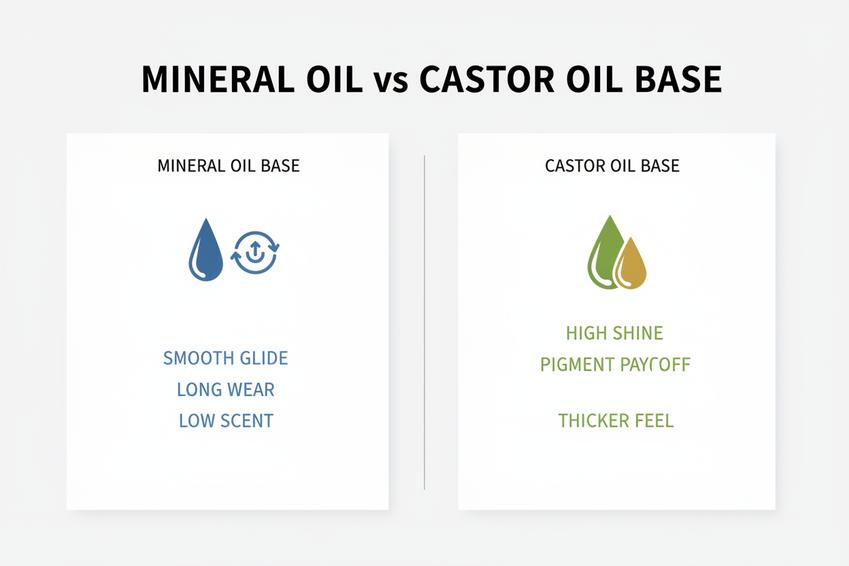
A good lip gloss recipe starts with the base, and this choice shapes shine, feel, and shelf life. Here’s a clean, real-world take on mineral oil and castor oil base for anyone refining a lip gloss formula.
Mineral Oil
-
Core identity
- Petroleum derivative refined to cosmetic grade
- Functions as occlusive agent and emollient
- Acts like a smooth lubricant in a lip gloss recipe
-
Performance stack
-
Slip & spread
- Ultra-even glide; great for quick-fill lines
- Keeps pigments moving without drag in a lip gloss formulation
-
Stability
- Low odor, oxidation-resistant; a reliable synthetic base
- Extends shelf life for bulk batches
-
Skin feel
- Forms a light barrier; typically non-comedogenic
- Reduces water loss without heavy tack
-
-
Production logic
- Batch consistency stays tight across temperature swings
- Easier scaling for contract manufacturing (Topfeel Beauty uses it for stable SKUs)
- Predictable viscosity helps dial a repeatable lip gloss recipe
-
When to pick it
- You want long wear, minimal scent, and fewer surprises
- You’re building a budget-friendly lip gloss formula that still feels smooth
Castor Oil Base
-
Quick hits
- Vegetable oil, plant-derived, rich in ricinoleic acid
- Natural emollient with humectant behavior
- Strong gloss agent and viscosity enhancer / thickener
- What it brings to a lip gloss recipe
- High shine that looks plush, not plastic
- Better pigment wetting, so color pops in a lip gloss formulation
- Cushiony feel with a mild plumping vibe
- Watch-outs (and fixes)
- Can separate if rushed → mix warm, then slow-cool while stirring
- Batch drift → add a co-emollient to steady viscosity
- Needs testing → small pilot runs before scaling with Topfeel Beauty
- Simple blend path
- Heat phase: castor oil + wax (low)
- Disperse pigments until glossy
- Cool, add flavor, check flow; tweak until your lip gloss recipe lands just right
Short take: mineral oil = consistent workhorse; castor oil base = shine-forward natural feel. Topfeel Beauty balances both depending on target finish and price.
Launching A Holiday Lip Gloss Line
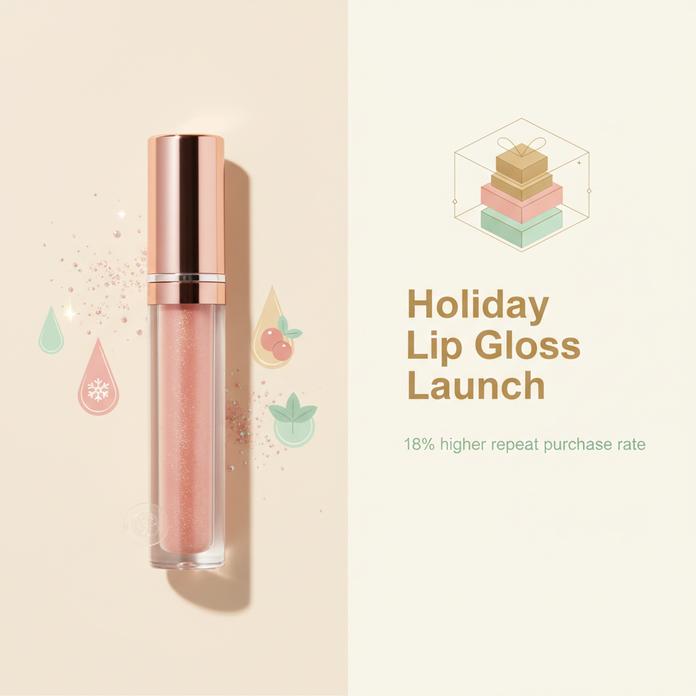
Holiday gloss drops hit different—people want shine, scent, and a vibe that feels giftable but still wearable every day. Building a solid lip gloss recipe isn’t just mixing oils; it’s dialing in flavor, texture, and packaging so the whole thing feels intentional, not rushed.
Festive Flavor Oil Blends for Holiday Appeal
-
Core blend logic for a winning lip gloss recipe:
-
Flavor base:
- flavor oils tuned to cozy holiday scents like vanilla spice or peppermint bark
- Light aroma compounds to keep the scent noticeable but not overpowering
-
Support layer:
- Add natural extracts for subtle depth
- Balance with tocopheryl acetate for skin feel and stability
-
Refinement:
- Adjust blend ratios to control sweetness vs freshness
- Test multiple taste profiles across batches
-
-
Quick mix flow:
- Warm base oils
- Add flavor phase slowly
- Stabilize and rest
- Sensory test for final lip gloss recipe
Mintel (2025) notes that seasonal lip products with recognizable dessert-like flavor cues saw a 18% higher repeat purchase rate, especially in limited holiday runs.
Topfeel Beauty keeps blends tight, avoiding that artificial aftertaste while still making each swipe feel festive.
Tube Material and Tamper Seal for Seasonal Packaging
-
Packaging stack decisions:
-
Tube body:
- tube plastics like PETG for clarity and shine
- Focus on material durability during cold shipping
-
Application system:
- Choose between doe-foot or brush in applicator types
- Match viscosity from your lip gloss recipe
-
Safety + finish:
- Add tamper-evident seals
- Refine closure mechanisms to prevent leaks
- Align seasonal aesthetics with gift-ready packaging design
-
Small tweaks here seriously affect how premium the gloss feels in hand.
Mica-driven Shades with Cruelty-free Certification
-
Shade building workflow:
-
Pigment selection:
- High-quality mica pigments for controlled shimmer effects
- Blend with approved colorants
-
Safety checks:
- Heavy metal screening
- Batch consistency in shade development
-
Ethics + compliance:
- Follow cruelty-free standards
- Verify ethical sourcing
- Document through trusted certification bodies
- Share full ingredient transparency
-
Short version? Sparkle sells, but trust keeps people coming back.
Bulk Shipping and Inventory Management for Peak Demand
-
Operations map:
-
Demand prep:
- Use demand forecasting tied to past holiday spikes
- Align output with each lip gloss recipe variant
-
Storage + flow:
- Organize warehouse storage by SKU and scent
- Track real-time stock levels with tight inventory control
-
Distribution:
- Load optimized shipping containers
- Sync distribution channels with retail launch dates
- Maintain flexible supply chain backups
-
Topfeel Beauty handles peak season by keeping production and logistics talking constantly—no last-minute chaos, no empty shelves.
References
- Polyisobutene – Cosmetics Info – cosmeticsinfo.org
- Safety Assessment of Caprylic/Capric Triglyceride – cir-safety.org
- Cosmetics Labeling Guide – fda.gov
- In-situ oligomerization of lactic acid within broiler skin extracted elastin/collagen matrix for the efficacy of ointment base – pmc.ncbi.nlm.nih.gov
- Evaluation of alkenones, a renewably sourced, plant‐derived wax as a structuring agent for lipsticks – pmc.ncbi.nlm.nih.gov
- Glyceryl triricinoleate – pubchem.ncbi.nlm.nih.gov
- Probing the effect of aroma compounds on the hydrodynamic properties of mucin glycoproteins – pmc.ncbi.nlm.nih.gov
- Fabrication of Ethosomes Containing Tocopherol Acetate to Enhance Transdermal Permeation: In Vitro and Ex Vivo Characterizations – pmc.ncbi.nlm.nih.gov
- Beauty and Personal Care Trends for 2025 and beyond – mintel.com
- SKYGREEN PN100 – specialchem.com
- Evaluating the Chemical Resistance and Performance of Thermochromic Polymers for Food Packaging – pmc.ncbi.nlm.nih.gov
- Mica-group minerals – pubchem.ncbi.nlm.nih.gov
- LIB 4662 extraction of light and heavy filth from lipstick – fda.gov
- About Leaping Bunny – leapingbunny.org
- Operations and Supply Chain Management News – supplychaindive.com
Post time: Aug-07-2026