
How Is Makeup Manufactured?
You’re not asking how is makeup manufactured out of curiosity—you’re trying to avoid costly mistakes and flaky suppliers before your brand launches.
Behind every polished palette sits a process that either makes your margins sing or quietly drains your budget dry.
Industry research from Statista and McKinsey shows private label beauty demand rising steadily, with brands prioritizing compliant manufacturers that ensure consistency, speed, and scalable customization.
Key Notes: How Is Makeup Manufactured from Palette to Package
➔ Ingredient Selection: Source high-purity pigments, waxes, and oils; test for contaminants and compliance.
➔ Precision Blending: Mill powders to uniform particle size, ensuring smooth texture and consistent color payoff.
➔ Emulsification & Mixing: Heat and combine oil and water phases under controlled conditions for stable formulas.
➔ Quality Assurance: Conduct microbial, stability, and heavy‐metal tests before filling, molding, and labeling.
5 Key Steps: How Is Makeup Manufactured From Scratch
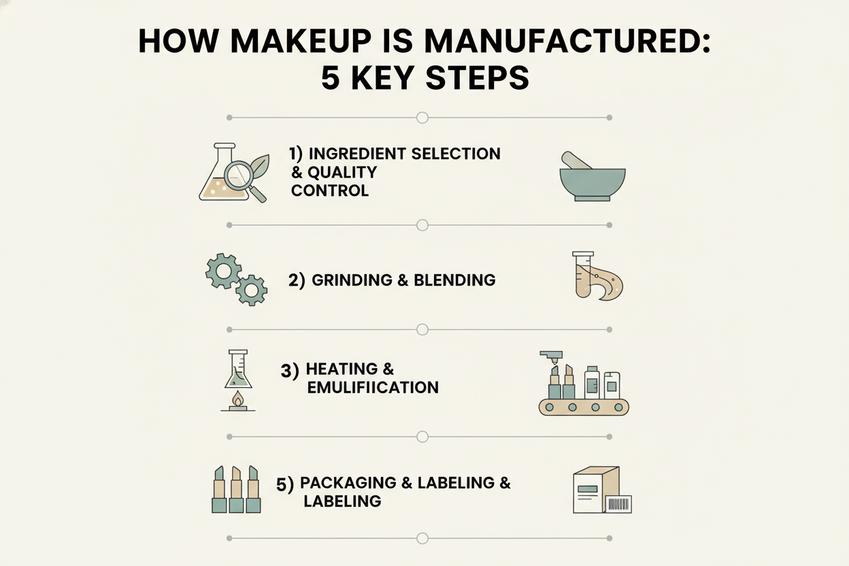
Ever wondered how is makeup manufactured from raw powders to polished palettes? This guide breaks down how makeup is made, showing exactly how makeup is produced inside modern factories without the fluff.
Ingredient Selection and Quality Checks
Understanding how is makeup manufactured starts with smart sourcing. The process begins long before mixing.
- raw materials
- active ingredients
- pigments
- binders
- preservatives
Behind the scenes, quality teams verify:
- Ingredient purity against strict specifications
- Stability under light and heat
- Compliance with cosmetic regulations
Inside production labs, quality control works in layered checks:
-
Raw Material Stage
- Identity testing of pigments
- Microbial screening of active ingredients
-
Pre‑Batch Approval
- Texture validation
- Color consistency
-
Production Release
- Documentation review
- Safety clearance
When people ask how makeup is made safely, this is the backbone. Brands like Topfeel prioritize controlled sourcing so every formula begins clean and compliant. That’s the real starting point of how makeup is manufactured at scale.
Precision Grinding and Powder Blending
To answer how is makeup manufactured for silky textures, look at grinding and milling. Fine powders go through pulverization until particle size becomes ultra-uniform.
Key performance factors include:
- Controlled blending
- Equipment-calibrated mixers
- Strict homogeneity targets
Inside blending rooms:
-
Particle Refinement
- High-speed milling
- Micron-level reduction
-
Color Development
- Layered pigments integration
- Shade calibration
-
Stability Testing
- Flow behavior checks
- Press performance review
A 2025 report from Grand View Research notes that demand for finely milled cosmetic powders is rising due to consumer preference for smoother finishes and longer wear.
That trend explains why how makeup is produced today depends heavily on precision engineering. Smooth payoff isn’t luck. It’s calculated.
Heating, Mixing, and Emulsification
Creams and liquids answer the creamy side of how is makeup manufactured. Here, heating meets chemistry.
Core elements:
- mixing tanks
- balanced oil phase
- stabilized water phase
- powerful emulsifiers
- controlled temperature control
Inside the tanks:
-
Phase Preparation
- Melt waxes in the oil phase
- Heat purified water phase separately
-
Integration
- Timed combination
- Mechanical homogenization
-
Texture Lock
- Cooling curves
- Viscosity checks
When people ask how makeup is made into foundation or concealers, emulsification is the magic. Proper formulations prevent separation and keep texture smooth from factory line to bathroom shelf.
Filling, Molding, and Solidifying
Now comes the physical transformation in how is makeup manufactured.
Equipment involved:
- Automated filling machines
- Precision molds
- Cooling systems for solidification
Production flow looks like this:
- Liquid or molten batch transfer
- Measured dispensing into containers, lipstick tubes, or trays
- Cooling and structural setting
- Surface polishing or compacting
- Pump or cap attachment
For pressed powders:
- Metered filling
- Hydraulic compacting
- Pan insertion
For liquids:
- Pump calibration
- Airless pumps testing
- Seal integrity checks
Uniform weight and clean edges define professional manufacturing. This is how makeup is produced consistently, batch after batch.
Packaging and Labeling for Retail
The final answer to how is makeup manufactured sits in presentation. Strong packaging protects formulas and builds brand trust.
Packaging layers include:
- Inner jars, bottles, or applicators
- Printed cartons
- Tamper seals
Compliance checklist:
- Ingredient list accuracy
- Verified batch codes
- Regional regulatory compliance approval
Operational structure:
-
Primary Packing
- Container filling verification
- Leak testing
-
Secondary Packing
- Carton assembly
- Barcode printing
-
Distribution Prep
- Pallet organization
- Shipment logging
When shoppers ask how makeup is made ready for stores, labeling is part of the science too. Clear traceability protects brands and buyers alike.
Topfeel aligns packaging precision with formulation quality, closing the loop on how makeup is manufactured from lab bench to retail shelf.
How Is Makeup Manufactured At Scale For Private Labels
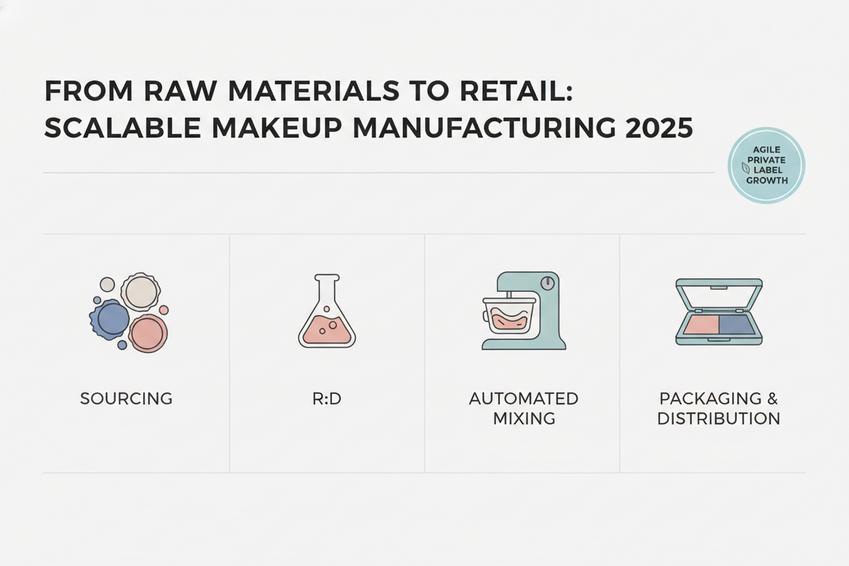
Understanding how is makeup manufactured at scale isn’t just factory talk—it’s about smart sourcing, tight process control, and brand-focused design. From raw powders to polished palettes, every move shapes quality, cost, and speed to market.
Optimizing Ingredient Sourcing for Bulk Orders
When people ask how is makeup manufactured, the answer often starts with raw materials. Bulk buying isn’t random shopping; it’s layered procurement built on long-term suppliers and tight quality control.
- Vet certified pigment and emollient vendors
- Lock annual pricing for cost stability
- Audit sustainability claims
In real production flow:
- Forecast demand through inventory management tools.
- Align contracts across the supply chain.
- Test incoming batches for purity and safety.
At scale, cost efficiency matters, but so does traceability.
Small inconsistency? Huge ripple effect.
“private label beauty is accelerating as brands seek agile manufacturing partners with integrated supply networks,” noted McKinsey’s 2025 global beauty market update.
Brands partnering with Topfeel often streamline supplier audits and compliance checks under one roof. That’s how makeup products are made without chaos—clear sourcing lanes, stable inputs, predictable output.
Custom Formulation with Brand-Specific Requirements
So, how is makeup manufactured when every brand wants its own twist? Through serious product development and lab-heavy R&D.
The flow usually looks like this:
- Define texture, shade, and claims.
- Select safe chemical compounds and active ingredients.
- Run stability testing under heat, light, and humidity.
- Validate regulatory compliance in target markets.
Under each stage:
-
Sensory review
- Blend slip
- Pigment payoff
-
Safety screen
- Micro testing
- Preservative balance
This is where intellectual property lives. Shade ratios, emulsifier balance, even scent levels become guarded formulas.
How makeup is made in private label settings depends on how well labs translate brand vibe into measurable data. Topfeel supports custom matrices while protecting intellectual property, so scaling doesn’t dilute identity.
Automated Mixing: Ensuring Consistency Across Batches
Ask again, how is makeup manufactured consistently? The answer: controlled manufacturing process driven by calibrated mixing equipment.
Industrial kettles regulate:
- Temperature curves
- Shear speed
- Mixing duration
Behind the scenes:
- Sensors track viscosity.
- Systems log every adjustment through data logging software.
- QA teams verify batch uniformity before filling.
If a foundation shade shifts slightly, customers notice. That’s why process control and quality assurance are baked into daily operations.
How cosmetics are manufactured at volume relies on repeatable settings, not guesswork. Production efficiency improves when machinery and software speak the same language.
Packaging Solutions for Private Label Brands
Packaging answers the final piece of how is makeup manufactured for retail shelves. After formulation and filling, it’s about smart packaging materials and scalable container types.
A practical breakdown:
-
Primary containers
- Bottles
- Compacts
-
Secondary solutions
- Cartons
- Protective inserts
Then comes:
- Automated labeling lines.
- Coordinated warehousing.
- Timed distribution routes.
Strong packaging design balances shelf appeal and sustainability goals. Lightweight tubes reduce freight cost. Recyclable materials support eco claims.
How is makeup manufactured for global launch? It ends with logistics done right. Topfeel integrates packaging and fulfillment so brands move from lab bench to retail dock without missing a beat.
4 Safety Tests Before Shipping Finished Cosmetics
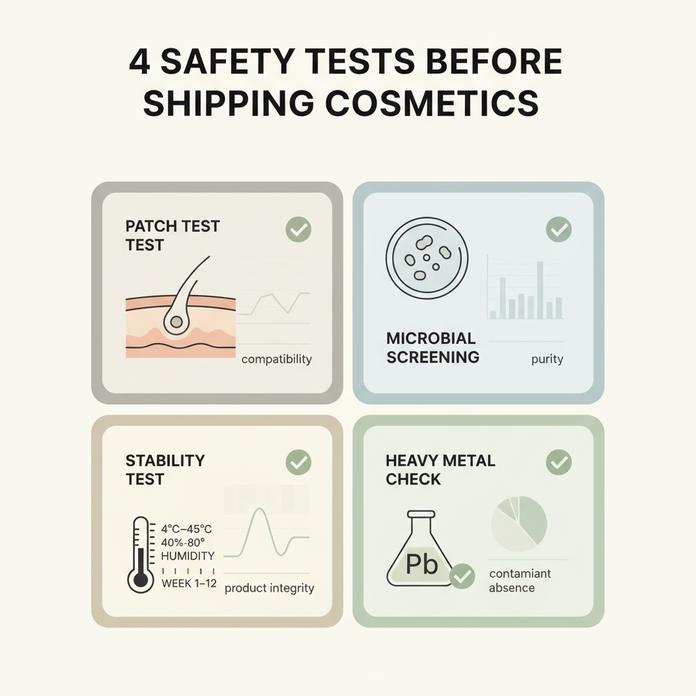
Before a lipstick or serum reaches your vanity, people often ask, how is makeup manufactured in a way that keeps skin safe? The answer isn’t just about color mixing. It’s about testing—real checks on skin irritation, bacteria, and even lead traces. If you’ve ever wondered how is makeup manufactured at scale without cutting corners, here’s the inside scoop.
Patch Test for Skin Compatibility
When someone asks how is makeup manufactured safely for the epidermis, patch testing is a big part of the answer.
- Checks for skin irritation
- Screens for allergic reaction
- Confirms hypoallergenic claims
- Apply formula to human volunteers or lab models.
- Observe redness, swelling, or sensitivity.
- Record results under controlled dermatological testing standards.
At labs like Topfeel, testing flows in layers:
-
Application Phase
- Small dose placed on upper arm
- 24–48 hour monitoring window
-
Evaluation Phase
- Visual scoring
- Participant feedback
-
Safety Review
- Data logging
- Reformulation if irritation appears
No drama. Just careful science to protect real faces.
Microbial Contamination Screening
So, how is makeup manufactured without turning into a petri dish? Through tight sterility controls.
Key risks include:
- bacteria
- fungi
- mold and yeast
Testing usually runs like this:
- Sample dilution
- Incubation
- Colony counting
- Pathogen identification
Nested control measures matter:
-
Raw Material Check
- Water purity
- Preservative strength
-
Production Environment
- Air sampling
- Equipment sanitation
-
Finished Product Audit
- Pathogens scan
- Stability under use
If counts exceed limits, the batch doesn’t ship. Simple as that.
Stability and Shelf-Life Analysis
People asking how is makeup manufactured for long shelf life are really asking about product integrity.
Testing tracks how formulation, packaging, and storage affect degradation and oxidation.
Accelerated Stability Data Example
| Test Cycle | Temperature (°C) | Humidity (%) | Observed Change | Result |
|---|---|---|---|---|
| Week 1 | 4 | 40 | None | Pass |
| Week 2 | 25 | 60 | Slight color shift | Monitor |
| Week 4 | 40 | 75 | Texture thickening | Adjust formula |
| Week 8 | 45 | 80 | Mild oxidation | Reformulate |
| Week 12 | 25 | 60 | Stable | Approved |
Process breakdown:
-
Environmental Stress
- temperature cycling
- High humidity exposure
-
Performance Check
- Texture
- Pigment stability
-
Final Decision
- Set expiration date
- Define storage rules
This is how makeup production protects quality over time.
Heavy Metal and Toxin Assessment
Safety isn’t just about germs. It’s also about hidden impurities.
Labs screen for:
- lead
- mercury
- arsenic
- cadmium
Testing flow:
- Sample digestion
- Instrument calibration
- Trace element detection
- Comparison to regulatory limits
Under toxicology review:
-
Detection Stage
- Measure contaminants in ppm
-
Compliance Stage
- Compare with EU, FDA standards
-
Release Stage
- Approve only compliant lots
Brands like Topfeel align production with global safety benchmarks, ensuring toxicology data backs every shipment.
So next time someone wonders how is makeup manufactured safely, the real answer is layered testing—on skin, in labs, and under strict global standards.
References
- Statista Private Label Cosmetics Data – statista.com
- The Beauty Market in 2023 – mckinsey.com
- Cosmetics Laws & Regulations – fda.gov
- Cosmetics Market Size & Trends – grandviewresearch.com
- Ingredient Safety Information – cosmeticsinfo.org
- EU Cosmetics Legislation – single-market-economy.ec.europa.eu
- ISO 22716 Cosmetics GMP – iso.org
- Shelf Life and Expiration Dating of Cosmetics – fda.gov
- Plastics and Packaging Materials Overview – ellenmacarthurfoundation.org
- Patch Testing for Dermatitis – aad.org
- Microbiological Safety of Cosmetics – fda.gov
- FDA Testing of Cosmetics for Heavy Metals – fda.gov
- International Activities for Cosmetics – fda.gov
- Vegan Cosmetics Market Growth – mintel.com
- Global Barcodes and Batch Codes Standards – gs1.org
Post time: Jun-05-2026