
What Is the Lipstick Manufacturing Process for Beauty Brands?
In beauty, speed and consistency make or break a launch, and how is lipstick manufactured decides both. Behind every shade sits a process that can either stall your brand or keep shelves stocked and customers coming back.
See the machinery, formulas, and quality checks that turn raw materials into reliable product, so your next batch hits right on time.
Key Highlights: How Is Lipstick Manufactured
➔ Pigment & Wax Selection: Choose high-quality pigments, waxes, oils and emollients, plus antioxidants and preservatives for shade accuracy and shelf stability.
➔ Homogenization & Mixing: Melt raw materials in tanks, blend and homogenize to disperse pigments evenly and ensure smooth, uniform batches.
➔ Automated Molding & Filling: Use precision molds and filling machines to shape sticks, fill tubes, then cool in tunnels for consistent size, weight and finish.
➔ Quality & Compliance Checks: Conduct viscosity, melting-point and stability tests, microbiological screening, and adhere to FDA, GMP and ISO standards.
4 Key Steps In How Lipstick Is Manufactured
Curious about how is lipstick manufactured in real factories? It’s not magic—it’s smart material science, tight process control, and well-tuned machines. Below breaks down how lipstick is made, from raw ingredients to finished tubes, in a way that actually makes sense.
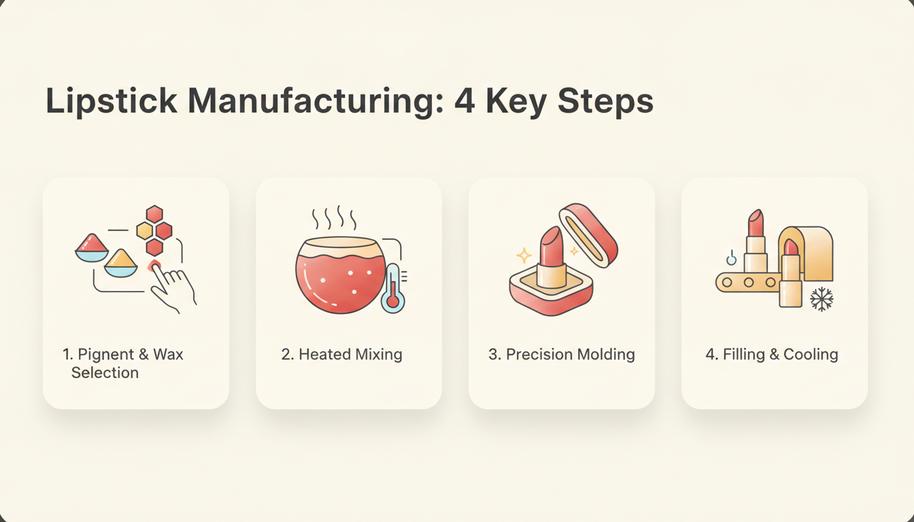
Pigment and Wax Selection: Raw Material Precision
Understanding how is lipstick manufactured starts with the right raw material lineup. No solid base, no perfect bullet. It’s that simple.
At this stage, chemists fine-tune the selection process:
- pigment for shade accuracy
- wax for structure and payoff
- conditioning ingredient blends for glide
Inside professional labs, the formulation work flows like this:
- Define target shade and undertone.
- Match colorant dispersion to base oils.
- Test melt point balance between soft and hard wax types.
Manufacturers break materials into functional tiers:
-
Base Structure
- Natural and synthetic wax blends
- Stabilizing ingredient systems
-
Color System
- Iron oxide pigment
- Organic colorant lakes
-
Protection Layer
- Antioxidants
- Preservation ingredient controls
According to a 2025 Cosmetics Europe market update:
“Shade precision and ingredient transparency are now central to consumer purchasing decisions in global color cosmetics.”
That shift shapes how modern factories answer the question: how is lipstick manufactured for both beauty and safety? Top-tier cosmetic manufacturers invest heavily in precision sourcing to keep batch color stable and skin-friendly.
Melting and Homogenization in Mixing Vessels
Now the transformation begins. Solid raw material turns fluid.
Inside a heated mixing vessel, controlled heating gradually melts oils and wax. Timing matters. Too fast, and texture suffers.
Core operations include:
- Controlled melting at defined temperature ranges
- Continuous stirring for dispersion
- High-shear homogenization for color uniformity
The internal workflow often looks like this:
-
Thermal Phase
- Raise mixture to full liquid state
- Maintain even heat distribution
-
Pigment Integration
- Add pre-dispersed pigment
- Initiate mechanical blending
-
Refinement
- Extended homogenization cycle
- Micron-level dispersion checks
When people ask, how is lipstick manufactured with smooth texture and zero streaking, this is the answer. The science of uniformity makes the swipe look effortless.
Modern manufacturing facilities emphasize closed-system mixing vessel control to reduce contamination and maintain shade consistency across production runs.
Molding with Automated Molding Machines
The molten formula now moves toward shaping. This is where liquid becomes a recognizable lipstick bullet.
The shaping system relies on:
- Precision mold cavities
- Temperature-controlled automated machine systems
- Timed solidification cycles
Inside the molding line:
-
Mold Preparation
- Clean cavity inspection
- Surface polishing for gloss finish
-
Pouring Phase
- Accurate fill into each form
- Vibration to remove air pockets
-
Controlled Cooling
- Gradual solidification within the mold
- Release of formed lipstick bullet
Small miscalculations here affect weight, angle, even break resistance. When someone searches how is lipstick manufactured, they rarely realize how exact the shaping tolerances must be.
Top-tier manufacturing facilities calibrate each automated machine to maintain uniform geometry batch after batch.
Filling and Cooling Through Filling Machines and Tunnels
After molding, bullets meet their final home—the casing.
This stage answers the last part of how is lipstick manufactured at scale.
Key elements include:
- High-speed filling machine alignment
- Secure insertion into cosmetic packaging containers bases
- Controlled cooling tunnel stabilization
The process unfolds in coordinated layers:
-
Assembly Line Integration
- Insert bullet into metal lipstick container
- Lock mechanism placement
-
Thermal Stabilization
- Pass through cooling tunnel
- Stabilize internal structure
-
Final Handling
- Quality inspection
- Transfer to packaging and outer assembly
A few essentials keep it running smoothly:
• Accurate centering
• Even cooling
• Clean transfer
By the time units exit the cooling tunnel, the answer to how is lipstick manufactured is sitting right there—finished, polished, ready for shelves. As a cosmetic packaging supplier, Topfeelpack offers related lipstick packaging solutions for brands exploring packaging options to house these finished products.
From pigment to polished tube, that’s how lipstick is made in today’s precision-driven beauty industry.
Can Automating How Lipsticks Are Manufactured Improve Efficiency?
When brands ask how is lipstick manufactured, the real question is about speed, control, and staying profitable. Automation reshapes how lipstick is produced—from raw wax melting to final labeling. Here’s how smart systems make the whole lipstick manufacturing process smoother and more scalable.
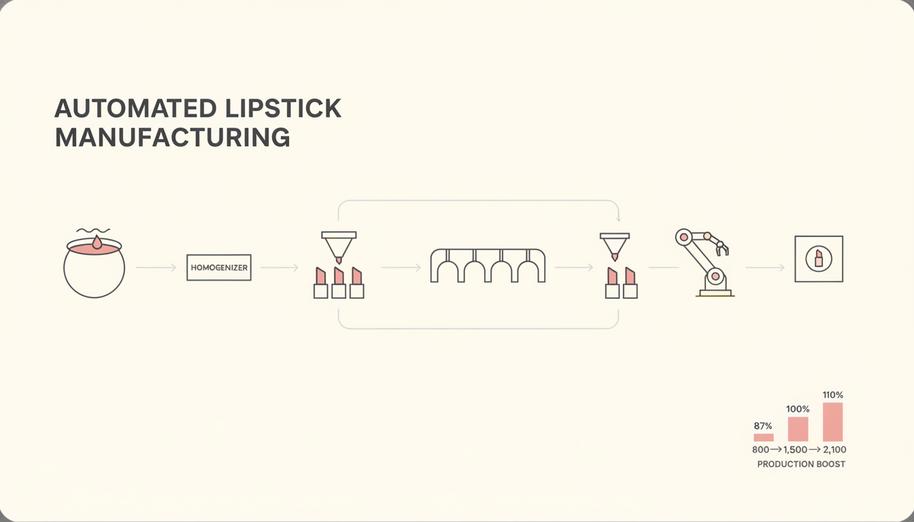
Boosting Production Capacity with Turnkey Solutions
Scaling lipstick production isn’t just adding machines. It’s building integrated systems that connect every part of the manufacturing line.
-
Core automation framework
-
Raw material handling
- Automated wax and oil feeding improves production volume stability
- Controlled heating reduces material waste
-
Mixing and melting units
- Centralized temperature panels optimize process optimization
- Linked kettles increase operational efficiency
-
Molding and cooling tunnels
- Synchronized belt speeds maintain consistent output
- Smart sensors prevent downtime
-
-
Installation and scalability
- Site evaluation before equipment installation
- Modular line expansion for growing scalability
- Data-linked PLC systems for performance tracking
| System Component | Manual Output (units/hr) | Automated Output (units/hr) | Efficiency Gain (%) |
|---|---|---|---|
| Melting Tank | 800 | 1,500 | 87% |
| Molding Line | 1,200 | 2,400 | 100% |
| Cooling Tunnel | 1,000 | 2,100 | 110% |
For brands asking how is lipstick manufactured at scale, turnkey automated machinery connects melting, molding, and filling into one coordinated flow. That means higher production volume without chaos on the shop floor.
Reducing Batch Variability via Homogenizers
Consistency matters. When someone searches how is lipstick manufactured, texture and shade uniformity usually sit at the top of the list.
Advanced mixing equipment plays a big role:
- Fine-tuned ingredient dispersion improves product consistency
- High-shear action supports particle size reduction
- Stable blending enhances emulsion stability
According to a 2025 Cosmetics Europe industry outlook:
“Automated homogenization and precision blending systems have reduced batch deviation rates in color cosmetics manufacturing by over 30% compared to conventional mixing setups.”
That drop in deviation directly impacts quality control. Fewer rejected batches. Lower raw material waste. Better batch uniformity.
In practical terms, how lipstick is made today involves: controlled heating, timed agitation, vacuum homogenizing, and digital monitoring. Small tweaks in RPM speed can shift pigment payoff dramatically. Advanced production managers integrate real-time viscosity tracking, helping labs lock in repeatable formulas across runs.
If you’re still wondering how is lipstick manufactured with zero surprises, homogenizers are the quiet heroes behind stable shades and smooth glide.
Streamlining Filling and Labeling Automation
Once the bulk is ready, the lipstick manufacturing process moves fast.
- Heated bulk transfers into hoppers for automated filling.
- Servo-driven nozzles control volume with high accuracy.
- Cooling racks solidify sticks before casing.
- Robotic arms place bullets into plastic cosmetic tubes using synchronized robotic systems.
- High-speed labeling machines apply batch codes and branding across eco friendly packaging solutions.
Short bursts of automation create big wins:
- Faster production speed
- Noticeable waste reduction
- Cleaner sealing and assembly
Modern lipstick production lines answer the question how is lipstick manufactured with one word: precision. Automated filling avoids air pockets. Label sensors reject off-center prints instantly. Secondary cartons are folded and sealed without slowing the belt.
For growing brands, modern automated packaging lines merge filling and labeling into one seamless system. For brands exploring packaging options to use on these high-speed lines, Topfeelpack provides a variety of customizable airless bottles and compatible cosmetic packaging solutions. That’s how lipstick is produced today—smart, synchronized, and ready for volume.
Struggling With Shelf Stability In Manufacturing?
Ever wondered how is lipstick manufactured so it survives heat, shipping, and months on shelves? The answer blends science, strict controls, and smart formulation. Here’s how modern factories keep every tube fresh, safe, and consistent.
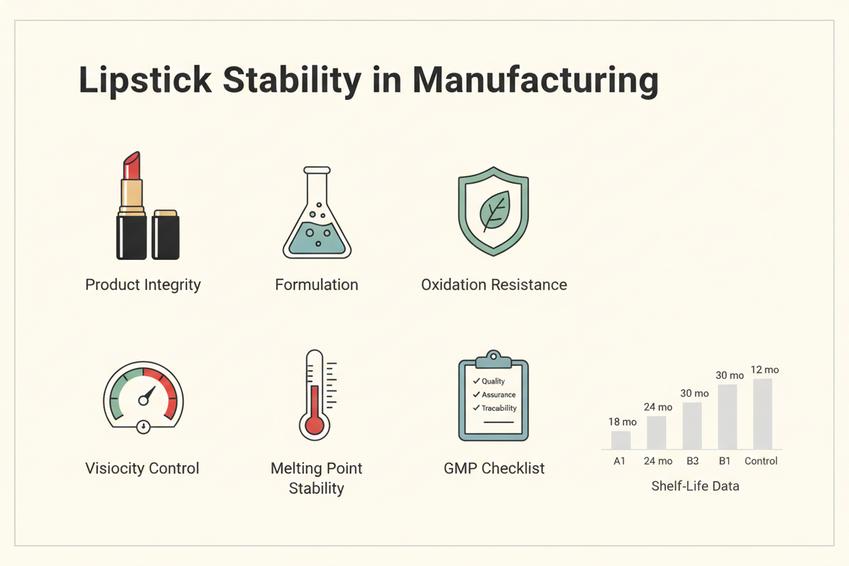
Enhancing Formula Stability with Antioxidants
When asking how is lipstick manufactured, stability always starts with the formula. Antioxidants slow oxidation, protecting oils and pigments from degradation while improving shelf life and overall formula stability.
Key protective actions include:
- Blocking free radicals in wax–oil blends
- Preserving sensitive ingredients like natural butters
- Supporting long-term preservation of color integrity
In real production, chemists don’t just toss in vitamin E and hope for the best. The process usually flows like this:
- Analyze raw oil profile for oxidation risk
- Select compatible antioxidants
- Run accelerated aging tests
- Adjust dosage for optimal formula stability
Below is a typical stability screening result used during lipstick manufacturing:
| Sample Batch | Antioxidant % | Oxidation Index (30 Days) | Color Shift ΔE | Estimated Shelf Life (Months) |
|---|---|---|---|---|
| A1 | 0.10% | 5.8 | 2.1 | 18 |
| A2 | 0.20% | 3.2 | 1.4 | 24 |
| A3 | 0.30% | 2.9 | 1.2 | 30 |
| B1 | 0.15% | 4.6 | 1.9 | 20 |
| Control | 0% | 9.7 | 3.8 | 12 |
Formulation experts refine these ratios carefully because even a tiny shift affects texture and scent. That’s a big part of answering how lipstick is made for global markets.
Ensuring Consistency through Viscosity and Melting Point Testing
Ask any production manager how is lipstick manufactured at scale, and you’ll hear about viscosity, melting point, and tight quality control.
Consistency depends on:
- Accurate rheology readings
- Stable cooling curves
- Reliable testing protocols
A typical workflow looks like this:
- Heat wax blend to target range
- Measure molten viscosity
- Pour into molds
- Record melting point after solidification
- Compare against internal consistency benchmarks
If texture feels draggy or too soft, labs trace it back to wax ratios or cooling speed. That’s how lipstick manufacturing avoids batch drama. At Topfeelpack, in-process checks ensure each run matches approved standards before final makeup packaging. Topfeelpack offers sustainable lipstick packaging designed to properly protect these refined formulations.
Complying with FDA Regulations and GMP Standards
Stability means nothing without compliance. So, how is lipstick manufactured safely? Through strict FDA regulations, documented GMP standards, and disciplined manufacturing practices.
Core compliance pillars include:
- Ingredient review for regulatory requirements
- Batch-level documentation
- Ongoing quality assurance audits
- Worker hygiene and facility safety controls
The flow is straightforward but serious:
- Verify raw material certificates
- Produce under validated GMP standards
- Record every batch detail
- Conduct microbial and stability tests
- Release only after quality assurance approval
Brands that follow this path don’t just make lipstick—they build trust. And when clients ask how lipstick is made responsibly, that transparency becomes the real selling point.
References
- What is the Manufacturing Process of Lipsticks? – jccosmopack.com
- Lipstick Formulation: The Art And Science Behind Every Perfect Swipe – maybelline.co.in
- Waxes in Lipstick: Beeswax, Carnauba, Candelilla & More – cere.it
- Cosmetic Homogenizer Machine Guide: Working, Types, and Buying Tips – kpfillingmachine.com
- Cosmetic Homogenizer Solutions & Equipment – hommak.com
- What are the methods of homogenization of cosmetic products with the use of the Skaker? – kalstein.eu
- Cosmetics Guidance Documents – fda.gov
- Good Manufacturing Practice (GMP) Guidelines/Inspection Checklist for Cosmetics – fda.gov
Post time: Jul-10-2026