
What Makes a Great Setting Powder? A Guide for Beauty Brands
A great setting powder depends on particle size, oil management, skin feel, and batch consistency.
Microfine silica and starch ratios belong in a base-makeup development brief before evaluating samples.
Topfeel Beauty develops color cosmetics, including setting powder, with custom formulation and packaging support.
Key Insights to Great Setting Powder
→ Microfine Finish: Assess particle selection and application in the intended format.
→ Oil Management: Balance absorbency, comfort, and finish.
→ Skin-Friendly Positioning: Support finished-product claims with evidence.
3 Key Benefits Of A Great Setting Powder
A great setting powder aligns finish, oil management, and comfort in a usable formula brief.
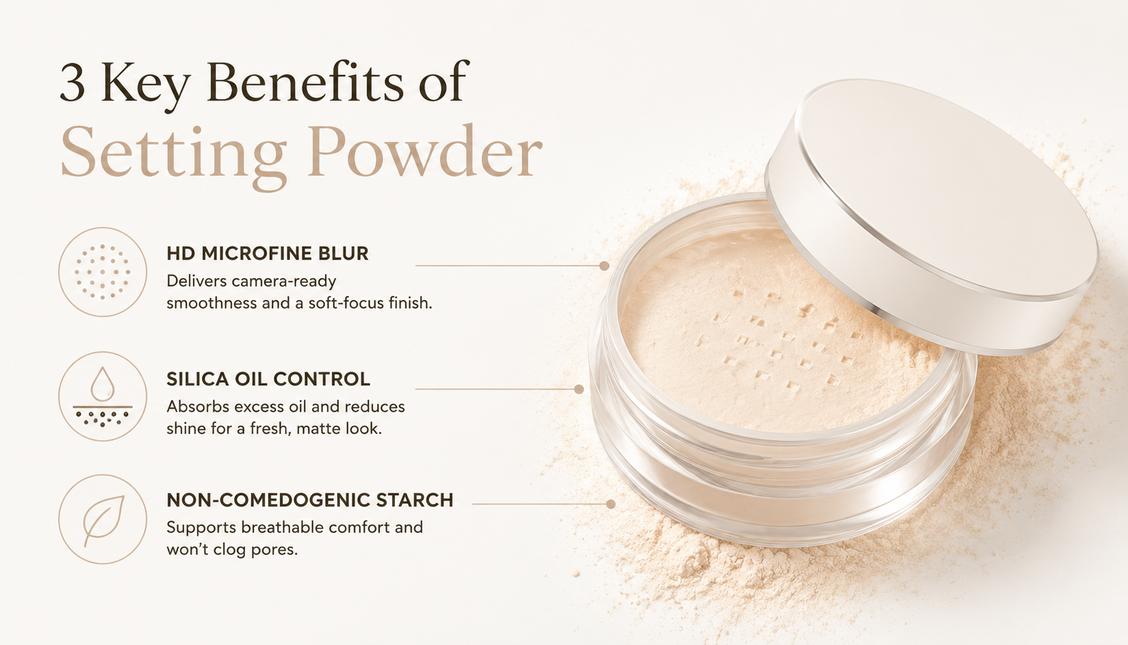
HD microfine powder for camera-ready smoothness
Assess a great setting powder in relevant lighting and use conditions.
- Finish quality
- Microfine powder can be evaluated for smooth silk texture.
- Translucent pigment should be checked over intended foundation shades.
- Camera performance
- A refined HD finish needs photography testing.
- The review should cover cast, texture, and evenness.
Oil control silica that locks shine all day
Judge oil control against a defined wear protocol.
- Shine management
- Silica, also known as silicon dioxide, may be selected as a sebum absorber.
- That test should define shine reduction.
- It should retain the intended matte finish comfortably.
- Silica, also known as silicon dioxide, may be selected as a sebum absorber.
- Lasting appearance
- Long-wear and pore minimizing claims need finished-product support.
Topfeel Beauty can align development with a finish, texture, and packaging brief.
Non-comedogenic starch ensuring skin-friendly wear
Comfort matters just as much as finish in a great setting powder.
- Skin-conscious base
- Natural starch can be assessed for oil pickup and lightweight wear.
- A non-comedogenic, pore-friendly position needs finished-product support; CIR ingredient assessments can inform ingredient-level research.
- Everyday comfort
- A breathable formula needs appropriate wear testing.
- For sensitive skin positioning, dermatologist tested claims should be backed by suitable finished-product testing.
A clearer powder brief: When microfine finish, oil control, and starch comfort are reviewed together, teams can make sample feedback actionable. Topfeel Beauty can turn those criteria into a custom formulation route that helps define the product direction.
Review the criteria before committing to a formula.
How To Choose Fillers For Great Setting Powder
Compare how the full formula manages shine, comfort, finish, and wear in samples.
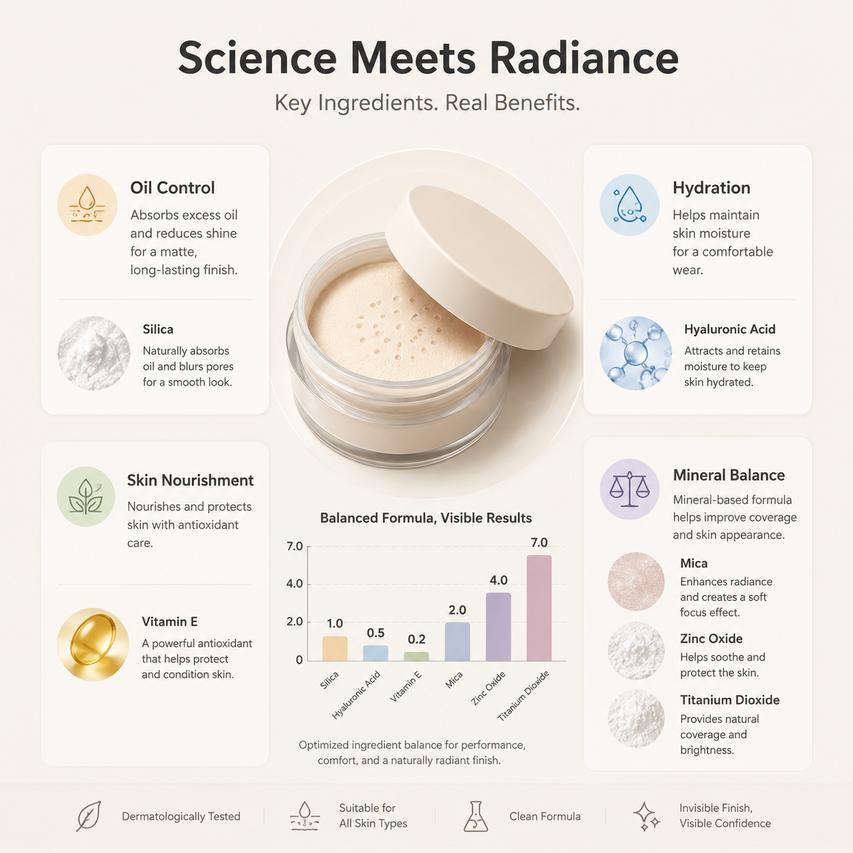
Prioritizing oil control silica vs. talc-free formula
For oily-skin positioning, silica is one porous powder option to evaluate.
- Performance priorities
- Oil control: define the desired finish and wear period.
- Sebum absorption: assess expected shine areas.
- Too much absorbency may feel dry.
- A balanced mattifying agent should be judged for shine reduction and texture.
- Positioning priorities
- A talc-free option still needs formula-specific evidence; review talc-free positioning and the EU common-criteria regulation.
Hyaluronic acid-infused blends for lasting hydration
Hyaluronic acid is a humectant; its powder role depends on the full formula.
| Blend target | HA-treated powder (%) | Silica (%) | Mica (%) |
|---|---|---|---|
| Dry-skin feel | 1.0 | 2.0 | 35 |
| Balanced wear | 0.5 | 4.0 | 30 |
| Matte wear | 0.2 | 7.0 | 25 |
These starting points show how a hydration blend can be explored. Testing determines the final moisture retention, skin hydration, and finish.
Vitamin E enriched fillers to nourish skin
Vitamin E, often listed as tocopherol, may support an antioxidant ingredient story.
• Use coated fillers for even distribution.
• Keep the emollient load controlled for free flow.
• Treat skin nourishment as a supported formula claim; a protective filler must still set well.
Crafting mineral setting powder with balanced minerals
A comfortable mineral powder needs balanced minerals.
- Build the skin-friendly base.
- Mica can be assessed for slip and touch.
- Other natural minerals can be screened for adhesion and oil pickup.
- Tune coverage carefully.
- Zinc oxide can affect opacity.
- Titanium dioxide can affect opacity; check applicable U.S. color-additive regulations.
The result is a great powder that sets makeup with a natural-looking finish.
Test the trade-offs early: A talc-free route, hydration story, vitamin E filler, and mineral balance only work when the complete formula still feels and wears as intended.
Topfeel Beauty can co-create textures and claims through OEM/ODM services. Explore that route to prepare a focused sampling decision.
Micro-Milled Vs. Standard: Great Setting Powder
Particle design affects feel, finish, pickup, and package fit. Compare micro-milled and standard formats through application and wear testing.
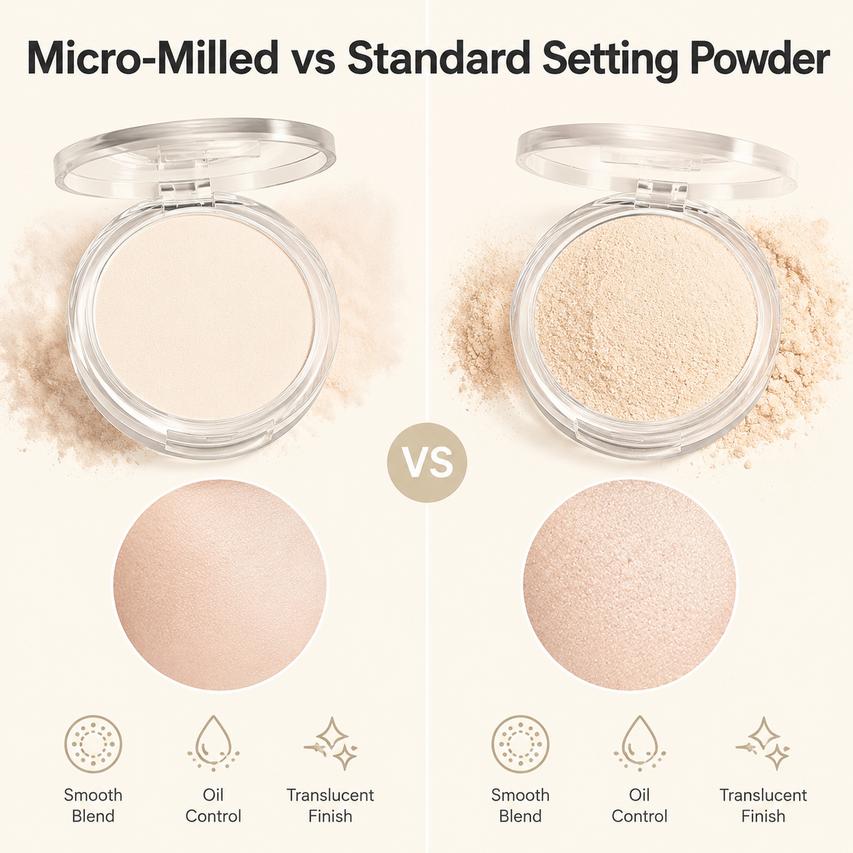
Micro-Milled Powder
Micro-milling can pursue a more consistent fine texture for sample evaluation.
- Particle design
- Smaller, uniform particles support a seamless blend with brushes or puffs.
- A lightweight formula needs coverage and comfort evaluation.
- Finish and application
- Pore blurring claims need finished-product evidence.
- A translucent finish should be tested over representative shades.
- For the baking technique, test pickup and dry-down.
Finely milled setting powder may suit smoothness-focused projects.
Standard Powder
Standard particles offer a distinct feel and application profile.
- Choose the format: a pressed compact supports touch-ups, while loose powder suits broader setting. See the pressed-versus-loose comparison.
- Tune oil control and matte coverage without cakiness.
- Test a talc base or alternative for slip, payoff, and cost.
- Check durability in wear trials.
Careful formulation keeps standard setting powder practical.
Choose the format with intent: Particle design, application method, and packaging should be validated as one product decision, whether the launch needs loose powder or a compact. Contact Topfeel Beauty to compare setting powder options for that decision.
Use the contact page to share the finish, tool, and pack concept for a sampling path.
Private Label Pitfalls: Weak Oil Control
Oil management depends on ingredient ratios, skin comfort, and testing. Shortcuts can leave a powder dry, chalky, or inconsistent.
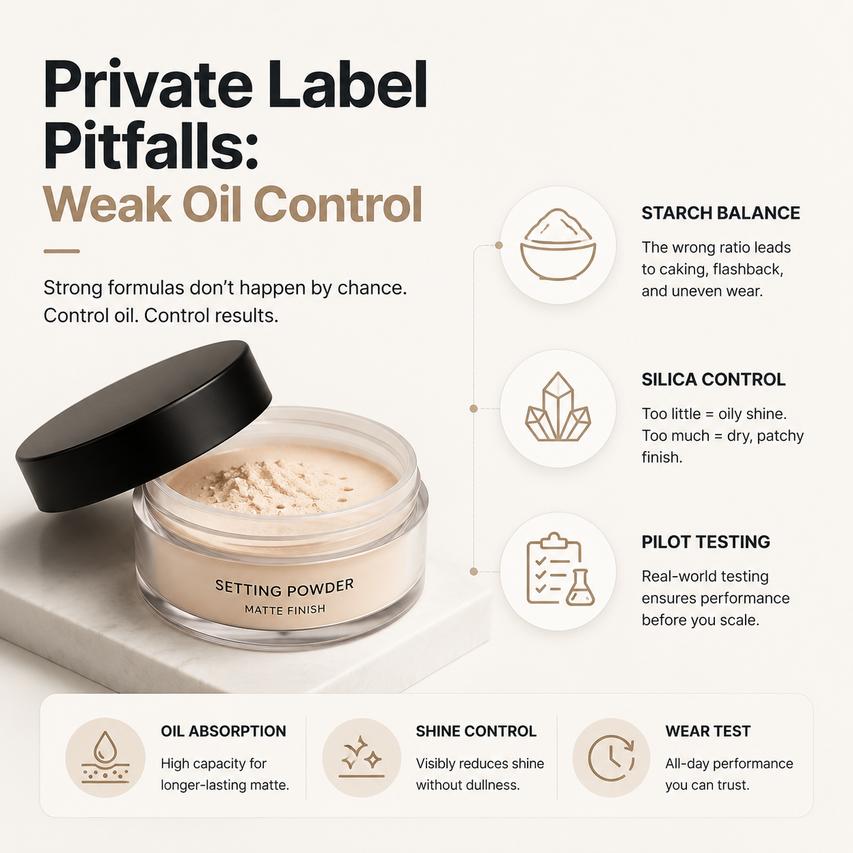
Overlooking non-comedogenic starch levels
A great setting powder needs a starch approach assessed in the full formula.
- Starch selection
- Tapioca starch can be screened for a light feel.
- Cornstarch can be assessed for oil pickup by concentration and grade.
- Skin compatibility
- Check Pore-clogging, Breakouts, and Skin sensitivity with formula-appropriate evidence.
- Review Formulation safety for starches, Botanical powders, and claims.
A custom formulation lab can tune ratios before bulk production.
Skimping on oil control silica content
Silica can contribute to oil management, but the formula needs a comfortable balance.
For better balance:
- Set the Mattifying effect and Shine control.
- Test Porous microspheres for oil capture and application.
- Adjust silica for a comfortable Long-wear finish.
Ignoring pilot run sample testing
A Lab sample can expose issues before production.
- Performance checks
- Review Texture evaluation and a Wear test.
- Check Humidity resistance.
- Production checks
- Monitor Batch stability.
- Use a Flashback test.
- Record findings through Quality assurance.
That pilot run checks shade, packaging, application, and production readiness for qualified cosmetic manufacturers. The EU cosmetics regulation sets a separate framework for the EU market.
Validate before scale-up: A pilot connects starch, silica, and testing before a bulk decision.
Topfeel Beauty’s 100,000-level purification workshop supports controlled production through a documented quality-control workflow. Submit the formula brief and use the contact page to start consultation, sampling, and pilot approval planning today.
References
- CIR Reports — Cosmetic Ingredient Review
- Commission Regulation (EU) No 655/2013 — EUR-Lex
- Silicon Dioxide — PubChem
- Tocopherol — PubChem
- 21 CFR Part 73 — eCFR
- Regulation (EC) No 1223/2009 on cosmetic products — EUR-Lex
Post time: Aug-26-2026