
Private Label Eyebrow Pencil: Ingredients and Formula Options
“Formula design can make a brow-pencil order glide smoothly or create rework. Waxes, oils, pigments, packaging, and claims shape the finished product.
“U.S. cosmetics must meet applicable labeling requirements. Connect the ingredient list, shade system, pack, testing, and claims before production.
“Use this brow-pencil buying guide to organize format and application questions before supplier discussions.”
Reading Notes: Eyebrow Pencil Ingredients Unveiled
- Structure & Texture: Balance synthetic and microcrystalline waxes with carnauba wax and hydrogenated soybean oil for firmness and glide.
- Color & Coverage: Combine permitted iron oxides, titanium dioxide, carbon black, ultramarines, or ferric ferrocyanide according to shade and market requirements.
- Stability & Compliance: Match antioxidants or preservation support to the complete formula, then verify testing, documentation, claims, and target-market duties.
Private Label Eyebrow Pencil Essentials
Good eyebrow pencil ingredients balance color, glide, wear, safety, and packaging fit. Understanding each material’s role makes supplier discussions more precise. This cosmetic ingredient guide helps frame the brief.
Core Ingredients Unveiled: Synthetic Wax & Microcrystalline Wax
- Base structure
- Synthetic Wax adds hardness and helps the tip retain its shape.
- Microcrystalline Wax works as a flexible Binding Agent, supporting cohesion without excessive stiffness.
- Feel and payoff
- An Emollient such as hydrogenated soybean oil supports glide.
- Carnauba wax acts as a Texture Agent, helping adjust firmness and wear.
Balancing the structural and softer materials is central to a smooth Cosmetic Formulation.
Colorants and Pigments Essentials: Iron Oxides to Ultramarines
Iron Oxides build brown, red, and black tones, while Titanium Dioxide adjusts opacity and Ultramarines can shift undertones. U.S. rules permit iron oxides for cosmetics, including the eye area, subject to the stated specifications and good manufacturing practice.
For dependable Color Payoff, select permitted Cosmetic Grade colorants for the market and use level. These Mineral Pigments create depth and shade direction.
Preservatives & Stabilizers Demystified for Longer Shelf Life
- Protect the formula
- Preservatives support Microbial Control when the complete system requires them.
- Caprylyl glycol and ethylhexylglycerin may support the preservation approach.
- Limit oxidation
- Tocopherol can serve as an Antioxidant.
- Ascorbyl palmitate may reinforce Formulation Stability.
Actual Shelf Life depends on stability, compatibility, and microbiological assessment rather than an ingredient list alone.
Packaging Components & Compliance: Twist-Up Mechanisms to FDA Approval
A Twist-Up Mechanism should advance the pencil cleanly without snapping. Container Design may include spoolies, plastic barrels, aluminum casings, and other Packaging Components.
Compatibility testing connects the formula to the pack. A Safety Assessment, GMP controls, documentation, and Cosmetic Regulations should match the destination market. The EU framework centers on Regulation (EC) No 1223/2009; the manufacturer review guide helps structure questions.
Build a cleaner specification: Formula roles, pigment permissions, preservation, packaging compatibility, and documentation should move as one approval path. Topfeel Beauty’s integrated workflow covers formulation, packaging design, manufacturing, and quality control, helping buyers reduce late-stage mismatches.
Compare the decisions in custom solutions before sampling.
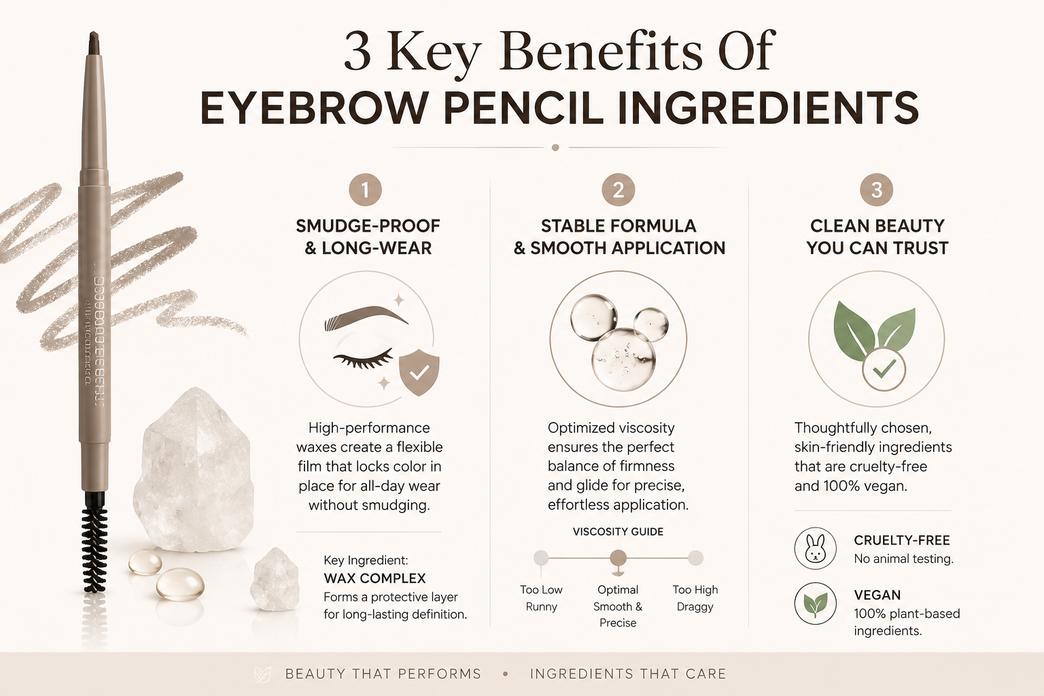
3 Key Benefits Of Eyebrow Pencil Ingredients
Choosing eyebrow pencil ingredients is about more than color. The mix affects glide, shape, wear, consistency, and production controls.
Smudge-Proof Performance with Carnauba Wax and Stearic Acid
Carnauba wax adds firmness and helps the tip retain shape, while Stearic acid adjusts texture and payoff.
- Performance during application
- Natural waxes can balance glide with structural strength.
- A tuned wax system can support Smudge-proof positioning without making strokes overly stiff.
- Performance after application
- Better adhesion can support Long-lasting wear.
- Water-resistant positioning requires formula-specific performance testing.
For an Eyebrow pencil, users still need clean strokes without a hard, draggy tip.
Long-Wear Formula Stability through Viscosity Testing
Brow-pencil materials must behave predictably. Viscosity testing provides useful information for mixing and pigment distribution.
Quality control tracks defined properties across batches. Texture consistency, temperature exposure, packaging compatibility, and finished-product checks contribute to Formula stability. ISO 22716 provides GMP guidance for production, control, storage, and shipment.
Clean & Responsible: Cruelty-Free, Vegan Formulation Advantages
A Cruelty-free claim concerns animal-testing practices, while a Vegan formulation excludes animal-derived inputs under the chosen standard. The terms are related but not interchangeable: the FDA notes that U.S. law does not define the use of “cruelty-free” or “not tested on animals” on cosmetic labels.
For Clean beauty positioning, review Plant-based ingredients, declarations, and records before making claims. The Vegan Society’s definition of veganism addresses animal-derived materials. A clean beauty overview helps separate vegan, cruelty-free, and synthetic-free requirements.
Layered Formula Breakdown: Wax, Oil, Pigment
A good formula is more than a list. Wax controls firmness, oils support glide, and pigments create shade. The brow-pencil buying guide adds format context.
Wax Layer: Balancing Synthetic Wax, Carnauba Wax, Hydrogenated Soybean Oil
- Pencil structure starts with the wax blend.
- Synthetic Wax can raise firmness and shape retention.
- A Hardness Modifier helps tune resistance to pressure.
- Microcrystalline Wax may improve cohesion.
- Carnauba Wax adds hardness and heat resistance.
- Too much can make the tip feel stiff or reduce payoff.
- Synthetic Wax can raise firmness and shape retention.
- Softer components balance that structure.
- Hydrogenated Soybean Oil can improve glide while retaining a solid form.
- Beeswax and Stearic Acid may further adjust body and texture.
Oil Layer: Enhancing Smooth Glide with Tocopherol and Caprylyl Glycol
The oil phase keeps the tip from feeling dry or grabby. Jojoba Oil and Castor Oil can act as an Emollient or Glide Agent, helping pigment move across brow hairs and skin.
Tocopherol serves as an Antioxidant, supporting formula stability. Caprylyl Glycol adds conditioning and can provide multifunctional preservation support, although the complete system determines preservation needs.
Pigment Layer: Titanium Dioxide, Carbon Black & Ferric Ferrocyanide
- Color comes from carefully balanced materials.
- Titanium Dioxide increases opacity and brightness.
- Carbon Black creates deeper color.
- Iron Oxides can build natural brown, red, or black tones.
- Ultramarines offer additional cool-color options.
- Ferric Ferrocyanide works as a cool-toned Colorant.
- Like any Mineral Pigment, its permitted use depends on the market and product area; the European Commission’s CosIng database organizes ingredient and annex information for EU cosmetics.
Sample the balance: Coordinate carnauba-led wax structure, tocopherol and caprylyl glycol oil-phase behavior, and titanium dioxide or iron oxide pigment payoff.
Topfeel Beauty’s formulation engineers prepare initial samples in 3-7 days according to the supplied knowledge base. Use the OEM/ODM route and adual-ended brow pencil format to compare firmness, glide, shade payoff, and pack compatibility before approval.
Oil Vs. Wax: Texture Comparison
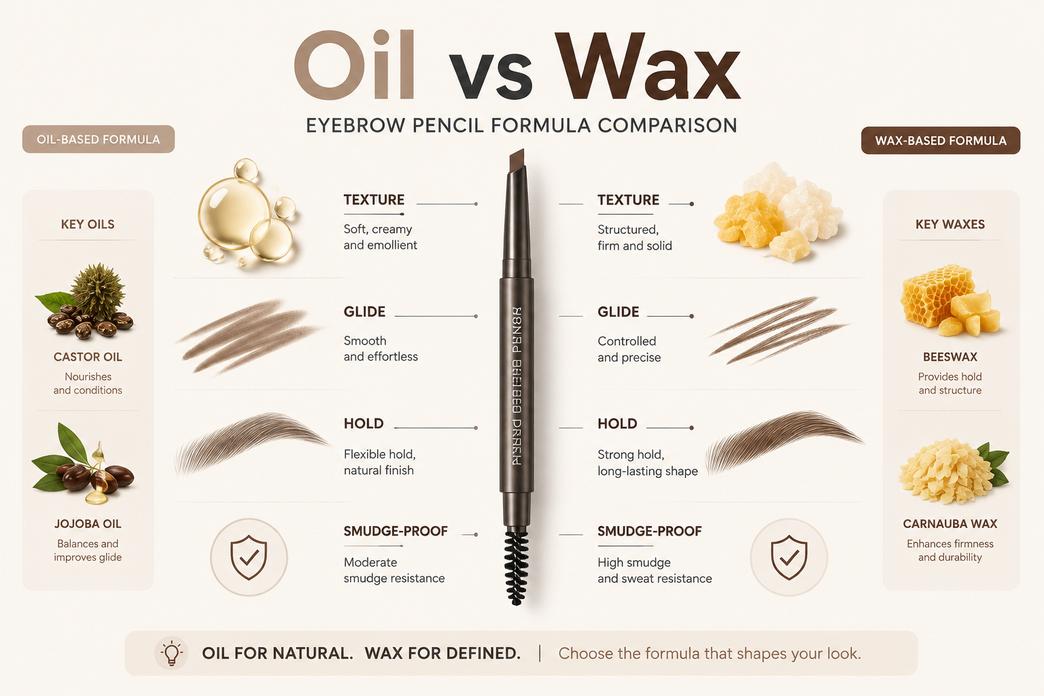
Oil and wax change how the pencil feels. Oils control slip, while waxes support shape. The goal is easy drawing without a greasy or weak product.
Oil
Oil mainly controls how readily color moves from the pencil onto the brow. More oil generally means easier movement and softer payoff.
- Oil-rich base
- Application
- An emollient such as castor oil can support smooth application and pigment transfer.
- Jojoba oil may add hydration and comfortable glide, reducing drag across brow hairs.
- Texture
- A higher level can create a creamy texture that feels forgiving when filling gaps.
- Too much oil may weaken wear and increase smudging.
- Application
An oil-rich pencil therefore needs a middle ground: smooth enough to apply, but not overly slick.
Wax
Wax gives the formula its backbone. Compared with an oil-heavy system, more wax generally produces a harder tip, sharper lines, and better shape retention.
- Hardness and control: beeswax adds body and structure, helping the pencil resist bending while giving strokes better hold.
- Wear performance: carnauba wax, a hard plant wax, can raise firmness and support longevity.
- Finish: A balanced wax blend can reduce oily slip and help create a more matte, smudge-proof result.
Several waxes can support precision while compatible oils maintain comfort. Evaluate the ratio in the intended component.
Too soft or too stiff?
Turn the oil-wax comparison into a sample brief covering stroke width, glide, payoff, wear, temperature exposure, and twist-up compatibility. Share the target market, shades, claims, and packaging through Contact us so Topfeel Beauty can prepare the next formulation discussion.
References
- Cosmetics Labeling Guide — fda.gov
- 21 CFR 73.2250: Iron oxides — ecfr.gov
- Cosmetics legislation — europa.eu
- ISO 22716:2007 — iso.org
- Cruelty-Free and Not Tested on Animals Claims — fda.gov
- Definition of Veganism — vegansociety.com
- CosIng Cosmetics Ingredients — europa.eu
Post time: Sep-01-2026