
What Creates a Dewy or Matte Finish in a Setting Spray Formula?
“Dewy vs matte setting spray comes down to formula balance: humectants and light oils boost glow, while oil control and silica cut shine. For private label buyers, that choice can make or break positioning.
Topfeel Beauty’s official materials identify R&D, GMP production, quality control, and packaging development as core private label capabilities for cosmetics.
Film formers handle wear, while spray quality affects application. Next comes matching ingredients, claims, packaging, and production scale to your customer.”
Key Points: Dewy vs Matte Setting Spray Essentials
➔ Formula Balance: Dewy sprays blend humectants and lightweight oils for radiant glow; matte sprays prioritize oil-free bases and silica powders to absorb shine.
➔ Skin Suitability: Choose dewy for dry or sensitive skin with hydration boosters; opt for matte if you have oily, combination, or acne-prone skin.
➔ Performance Benefits: Dewy finish offers luminous, plump appearance; matte delivers shine control, pore-minimizing effect, and transfer-resistance for long-wear.
➔ Production & Packaging: Ensure GMP compliance, scalable mixing, and stability testing; select fine mist applicators and airless or recycled-plastic bottles to preserve finish integrity.
Why Ingredients Matter For Dewy Vs Matte Finish
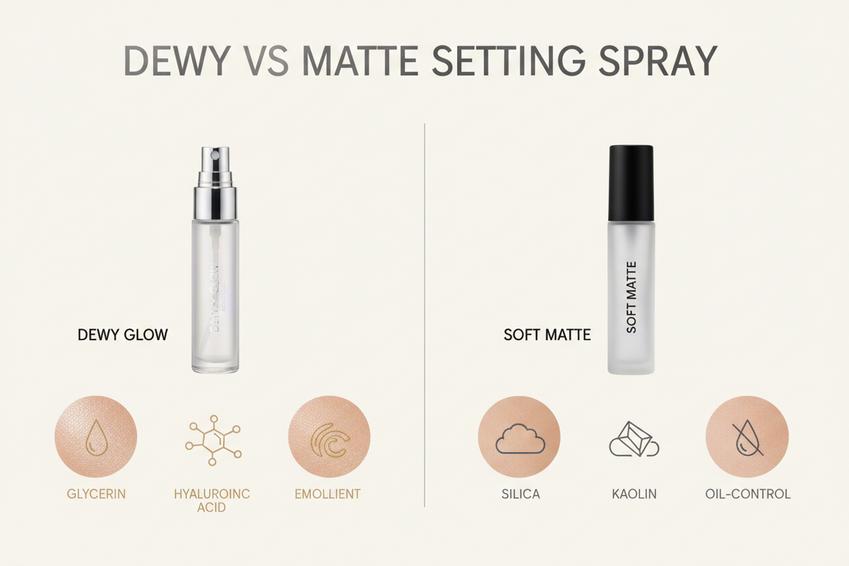
Picking a dewy vs matte setting spray often comes down to what’s inside the bottle. Hydrators can boost glow, while oil-control ingredientshelp curb shine. A good setting spray should match your skin needs, so the finish feels comfortable instead of looking overdone.
How Hydrating Ingredients Create a Radiant Finish
For dry-looking makeup, a dewy vs matte setting spray with humectants can make a noticeable difference.
-
Moisture-focused ingredients draw or retain moisture at the skin’s surface.
-
Glycerin and hyaluronic acid support a plumper appearance.
-
Emollients help smooth rough-feeling areas.
- That smoother surface catches light beautifully, creating a dewy, radiant look without piling on shimmer.
-
Role of Oil-Free Formulas in Shine Control
An oil-free setting spray skips added oils, which can be handy when sebum already leaves the T-zone glossy. Pretty simple.
- Ingredients such as silica or kaolin may provide oil absorption.
- Less visible shine helps preserve a matte makeup finish.
- Some formulas also create a soft-focus, pore-minimizing effect.
For oily or combination skin, this side of the dewy vs matte setting spray choice can keep makeup looking fresh longer.
Alcohol-Free Sprays for a Weightless, Natural Finish
-
An alcohol-free formula can feel gentle and non-drying.
- That matters for dry or sensitive skin and may better suit a comfortable skin barrier routine.
-
A fine mist keeps application weightless.
- The result can feel refreshing, lightweight, and close to a natural finish rather than overly glossy or flat.
Topfeel Beauty can develop setting-spray formulas around these finish goals, giving brands options across dewy and matte makeup preferences.
Oils Versus Powders: Matte Spray Secrets
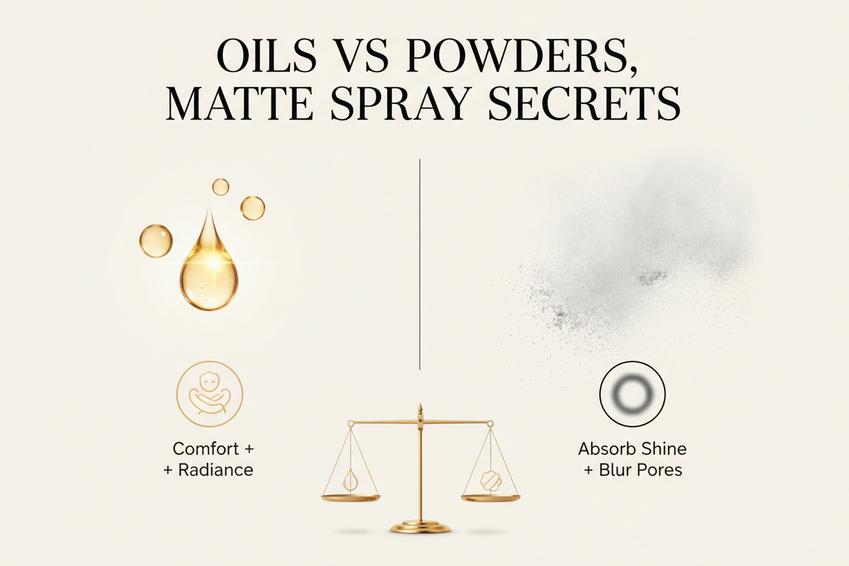
Choosing between oils and powders can change how a setting spray looks hours after application. In the dewy vs matte setting spray debate, oils tend to boost glow, while powders tackle shine. For brands developing formulas with Topfeel Beauty, balancing comfort and oil control is the real trick.
Oils
Light oils aren’t automatically the bad guy in matte formulas. Used carefully, they can improve feel without turning a matte finish glossy.
-
Oils mainly influence comfort and reflection.
- Emollients and beneficial fatty acids can support hydration and a comfortable skin barrier.
- Their moisturizing character may soften a dry-looking finish.
-
The amount matters.
- A small oil phase can add a subtle luminous effect.
- Too much pushes the look toward a dewy finish, which works against shine control.
For dewy vs matte setting spray development, that balance can make or break the final look.
Powders
Powders take a different route: they manage surface oils rather than adding glow. That’s why matte setting spray formulas often rely on finely dispersed absorbent materials.
- Silica can support oil absorption and soften visible reflection.
- Talc, where suitable for the intended formula and market, can contribute to sebum control and shine reduction.
- Fine particles may add pore blurring, giving skin a smoother-looking matte finish.
So, dewy versus matte comes down partly to formula architecture. Topfeel Beauty can tune powder systems to keep the finish soft rather than chalky.
4 Components That Dictate Your Spray’s Finish
Choosing a dewy vs matte setting spray comes down largely to ingredient balance. Some ingredients pull in moisture, while others tackle oil or help makeup stay put. Knowing these basics makes finding your preferred setting spray finish much less of a guessing game.
Humectants for a Hydration Boost
-
Humectants support a softer dewy setting spray feel.
-
Glycerin draws water toward the skin’s surface, boosting hydration.
-
Hyaluronic acid also helps retain moisture.
- That extra water can soften a dry look and support the skin barrier, creating a fresh dewy finish.
-
This side of the dewy vs matte setting spray choice is especially handy when makeup tends to look flat or powdery.
Film Formers Ensuring Makeup Longevity
Film formers such as cosmetic polymers create a thin flexible film over makeup. That film adds setting power, supports transfer resistance, and improves wear time without deciding the finish all by itself.
For brands developing long-wear formulas, Topfeel Beauty can pair these materials with dewy or matte components to target makeup longevity alongside the desired look.
Mattifying Powders Delivering Shine Control
-
Mattifying powders tackle surface oil.
-
Silica supports oil absorption and soft-focus effects.
-
Starch can help reduce greasy-looking shine.
- Together, these ingredients improve shine control and encourage a steady matte finish.
-
This approach manages visible oil rather than literally stopping sebum regulation, a useful distinction when comparing matte setting spray options.
Lightweight Oils Achieving a Luminous Effect
A radiant setting spray takes another route. Lightweight oils, including squalane and jojoba oil, work as emollients, adding slip and softness.
Used carefully, these oils create a subtle sheen, radiant glow, and greater skin luminosity rather than a greasy coating. Topfeel Beauty can balance oil level with other finish agents, producing a controlled luminous effect that keeps the dewy-versus-matte choice wearable.
Scalability: Bulk Produce Dewy Vs Matte Sprays
Scaling a dewy vs matte setting spray takes more than making a lab formula bigger. Mixing force, raw materials, filling speed, and testing can shift the final feel fast. For brands comparing dewy setting spray with matte setting spray, Topfeel Beauty connects controlled production with practical quality checks, so bulk runs stay on spec.
Production Scalability and Batch Consistency
A stable Manufacturing process links Scale-up strategies with suitable Equipment utilization. That keeps Batch uniformity in check as Production volume climbs.
- Set Quality control parameters for mixing time and temperature.
- Tune Process optimization around spray output and finish.
- Confirm Formulation stability before routine filling.
| Scale | Mix time (min) | Temperature (°C) | Spray dose (g) |
|---|---|---|---|
| 100 kg | 25 | 25 | 0.12 |
| 500 kg | 32 | 25 | 0.12 |
| 1,000 kg | 38 | 26 | 0.13 |
| 2,000 kg | 45 | 26 | 0.13 |
Values illustrate process targets; actual limits require formula-specific validation.
Ingredient Procurement for Large-Scale Formulation
Good Raw material sourcing makes dewy vs matte setting spray production less of a headache. Dewy spray may rely more on humectants and oils, while matte spray can require powders or film formers.
- Supplier qualification verifies Ingredient purity and Bulk ingredient specifications.
- Supply chain management, Logistics planning, and Inventory control help avoid production gaps.
GMP Standards in Quality Assurance
Good Manufacturing Practices support repeatable production through a documented Quality management system. Documentation control records each lot, while Product testing protocols check spray function, microbial limits, stability, and finish.
Regular Internal audits track Quality metrics and Regulatory compliance. For Topfeel Beauty manufacturing programs, those controls help keep bulk dewy and matte formulas consistent from filling through expected shelf life.
Packaging Impact On Spray’s Final Sheen
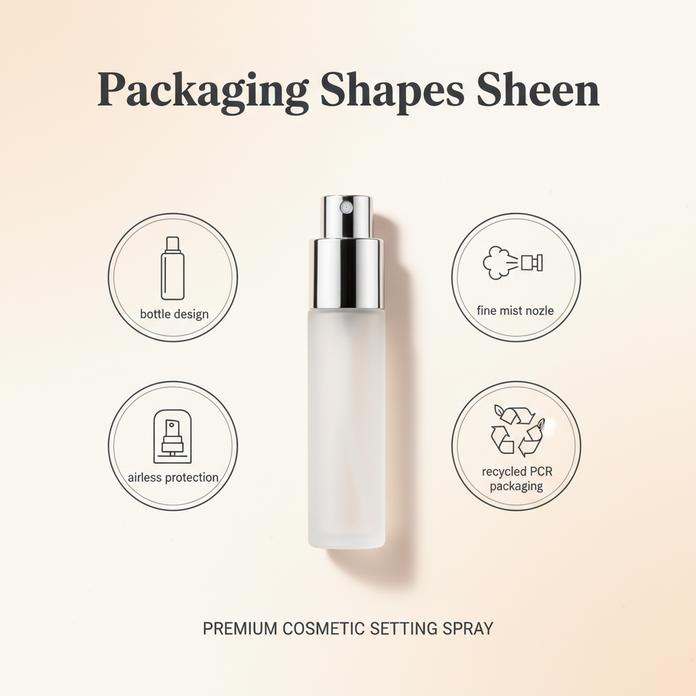
Packaging affects far more than shelf appeal: bottle protection, mist quality, and storage can change how a setting spray lands and looks. For dewy vs matte setting spray, smart packaging helps keep finish, wear, and formula behavior on track from opening day onward.
Custom Bottle Design Enhancing Luminous Effect
A thoughtful Bottle design connects Packaging aesthetics with formula protection. With dewy vs matte setting spray, controlled light exposure can support Finish perception, while shape, color, and Customization communicate the intended Luminous effect before the first spritz. Nice-looking packaging has a job to do, not just look cool.
Spray Applicator for Transfer-Resistant Application
Nozzle design directly shapes Application quality.
- A Fine mist promotes Even distribution without soaking isolated spots.
- Faster, balanced drying can improve Transfer resistance and Finish durability.
- A reliable Spray applicator keeps dewy and matte results more predictable.
That consistency matters when comparing dewy vs matte setting spray performance.
Airless Packaging Preserving Formula Stability
Airless systems limit repeated contact with outside air, supporting Oxidation prevention, Contamination protection, and Ingredient integrity. Better Product preservation can maintain Formula stability and spray behavior longer.
For Topfeel Beauty packaging development, that protection can help keep a dewy setting spray luminous or a matte setting spray shine-controlled through routine use, supporting practical Shelf-life extension.
Recycled Plastic Options for Sustainable Label Customization
Using Recycled plastic, including Post-consumer resin (PCR), can lower reliance on virgin Material sourcing while allowing flexible Label customization.
Still, Sustainable packaging needs compatibility checks. Eco-friendly materials should maintain barrier performance and nozzle function so dewy vs matte setting spray keeps its intended sheen without trading away formula protection or increasing Environmental impact elsewhere.
References
- Dewy vs Matte Makeup – nyxcosmetics.co.uk / NYX UK
- Film Formers – sensient-beauty.com / Sensient Beauty
- What are Humectants – revivalabs.com / Reviva Labs
- Glycerin – drmtlgy.com / DRMTLGY
- Silica – specialchem.com / SpecialChem
- The Science of Kaolin Clay – skintypesolutions.com / Skin Type Solutions
- Humectants and Emollients – elchemy.com / Elchemy
- Silica – sincereskincare.com / Sincere Skincare
- Matte vs Dewy Makeup – nyxcosmetics.com / NYX Cosmetics
- Hyaluronic Acid Setting Spray – ulta.com / Ulta Beauty
- Makeup Setting Spray – crodabeauty.com / Croda Beauty
- Squalane – nuhanciam.com / Nuhanciam
- Organic Jojoba Oil – biopark-cosmetics.com / Biopark Cosmetics
- Custom Beauty Packaging – carepac.com / CarePac
- PCR Film Laminations – glenroy.com / Glenroy, Inc.
Post time: Aug-13-2026