
How to Evaluate Cosmetic Manufacturing Companies for Your Brand
Pick the wrong cosmetic manufacturing companies and your brand pays for it—late launches, shaky quality, and customers who don’t come back.
You need a partner who can keep formulas consistent, scale without drama, and package products that actually sell, not just look cute in samples.
Recent research from McKinsey and Euromonitor notes demand for reliable, compliant suppliers as beauty buyers prioritize quality control, speed to market, and long-term cost stability over low pricing.
Key Points for cosmetic manufacturing companies
➔ Manufacturing Versatility: Assess blending, filling, hot-pour and compacting capabilities to handle diverse products smoothly.
➔ Ingredient Integrity: Confirm high-quality sourcing and testing of pigments, emollients, preservatives and antioxidants for consistent performance.
➔ Compliance Assurance: Ensure GMP adherence, stability and microbiological testing, plus full traceability from raw materials to finished goods.
➔ Packaging Expertise: Choose partners skilled in tubes, bottles, palettes and cartons to protect products and enhance shelf appeal.
➔ Private Label Services: Look for turnkey solutions—R&D, formulation development and contract manufacturing—to accelerate your market launch.
5 Key Criteria For Choosing Cosmetic Manufacturing Companies
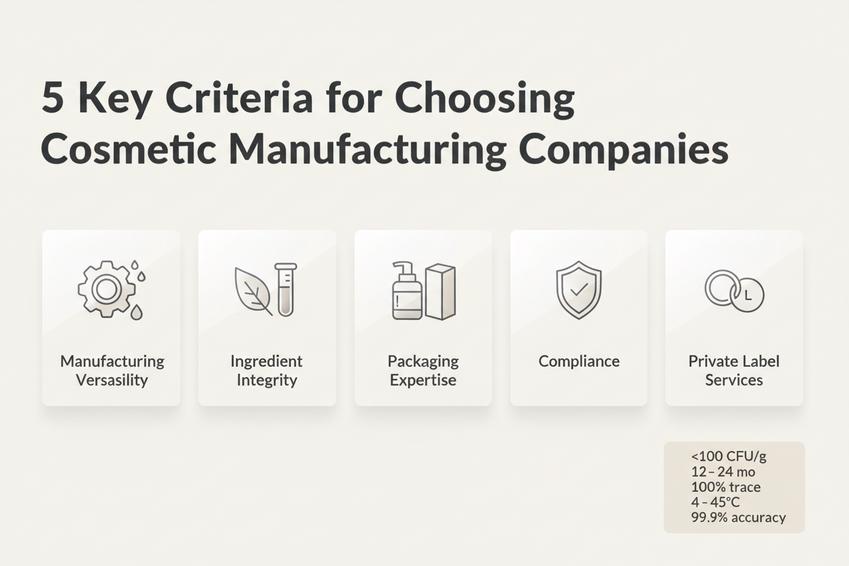
Picking among cosmetic manufacturing companies isn’t just a vibe check. You’re weighing quality, speed, and brand fit. From cosmetic manufacturers to beauty product manufacturers, small gaps in process or sourcing can quietly wreck a launch.
Manufacturing Versatility: Blending, Filling & Hot Pour Capabilities
- Core Manufacturing Process matters more than flashy claims
- Check Blending, Filling, and Hot Pour range
- Ask about Production Capacity and backup Equipment
- Audit scale → lab, pilot, bulk
- Match SKUs → lipstick, base, mascara
- Confirm Customization flexibility
A cosmetic manufacturing company that can switch textures without delays keeps timelines sane.
Ingredient Integrity: From Pigments to Antioxidants
- Clean Raw Materials and tight Ingredient Sourcing
- Stable Pigments + active Antioxidants
- Strong Quality Control for Purity and Efficacy
Quick checks:
• COA availability
• Batch consistency
• Support for Natural Ingredients
Reliable cosmetic manufacturers treat inputs like assets, not costs.
Packaging Expertise: Tubes, Bottles, Palettes & More
A beauty manufacturer should sync Packaging Design with formula behavior.
- Material Selection → compatibility
- Labeling → compliance
- Assembly → speed + accuracy
Nested flow:
-
Primary pack
- Tubes, Bottles, Palettes
-
Secondary pack
- cartons, inserts
-
Final Packaging Solutions
- sealing, QC
Topfeel Beauty keeps packaging aligned with formula stability.
Compliance Assurance: GMP, Stability Testing & Traceability
| Metric | Target | Method |
|---|---|---|
| Microbial count | Lab assay | |
| Stability | 12–24 mo | Accelerated test |
| Batch trace | 100% | Digital logs |
| Temp tolerance | 4–45°C | Cycling |
| Label accuracy | 99.9% | QC scan |
Look for GMP, Stability Testing, and full Traceability. Solid Documentation and Safety Standards separate real cosmetic manufacturing companies from risky ones.
Private Label Services: R&D, Formulation Development & Turnkey Solutions
Steps that keep launches smooth:
- Market Research → trend fit
- R&D + Formulation Development
- Prototyping → quick iterations
- Custom Formulations approval
- Turnkey Solutions → fill, pack, ship
Topfeel Beauty supports concept-to-shelf, which many cosmetic manufacturing companies promise but few execute cleanly.
Cosmetic Manufacturing Companies: Quality Vs. Cost Comparison
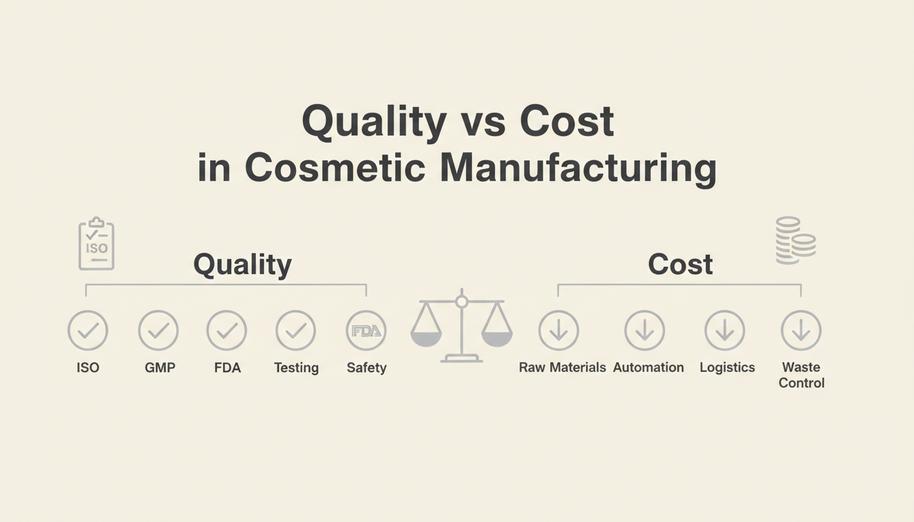
Picking between cosmetic manufacturing companies isn’t just about price tags or shiny claims. It’s about how cosmetic manufacturers balance safety, performance, and spend. This quick breakdown helps you size up cosmetic production partners without overthinking it.
Quality
When people compare cosmetic manufacturing companies, quality quickly separates the serious cosmetic manufacturers from the risky ones. It’s not just vibes; it’s systems, checks, and consistency that keep products safe and sellable.
-
Core pillars of quality in cosmetic manufacturing companies:
-
Certifications
- ISO standards
- GMP verification
-
Regulatory Compliance
-
Ingredient Sourcing
- Traceable suppliers
- Allergen screening
-
- Process-driven execution
-
Manufacturing Standards
- Batch consistency controls
- Equipment sanitation cycles
-
Product Testing
-
Stability tests
-
Microbial checks
- Innovation layer:
- R&D Capabilities
- Formula customization
- Texture and wear testing
- Protection systems:
- Quality Control
- In-line inspections
- Safety Protocols
- Contamination prevention
-
Topfeel Beauty stands out among cosmetic manufacturing companies by tightening each of these loops without slowing production, which is rare in cosmetic production at scale.
Cost
Cost in cosmetic manufacturing companies isn’t just a number—it’s a chain reaction. Smart cosmetic manufacturers trim waste, not quality, and that’s where real competitiveness shows.
-
Cost structure breakdown:
-
Raw Material Expenses
- Bulk vs premium sourcing
-
Labor Costs
- Skilled technicians vs automation
-
- Operational layers
-
Operational Efficiency
- Workflow design
- Downtime reduction
-
Production Overhead
-
Energy use
-
Facility maintenance
- Movement of goods:
- Logistics Management
- Shipping routes
- Inventory timing
- Waste control:
- Waste Management
- Scrap reduction
- Recycling systems
- Optimization engine:
- Supply Chain Optimization
- Vendor consolidation
- Lead-time control
- Manufacturing Process
- Lean production steps
-
Some cosmetic manufacturing companies cut corners to drop costs; others, like Topfeel Beauty, rebalance inputs so cosmetic production stays efficient without dragging quality down. That’s the sweet spot most cosmetic manufacturers chase but don’t always hit.
Can You Trust Their Quality Control?
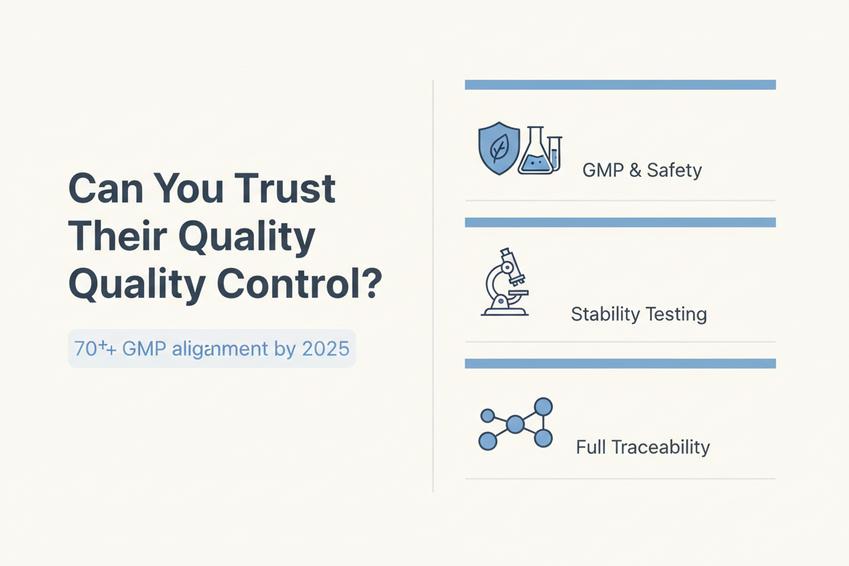
Picking among cosmetic manufacturing companies can feel like a gamble if you don’t peek behind the curtain. Quality control isn’t just paperwork; it’s the difference between safe formulas and costly recalls. From cosmetic manufacturers to beauty product manufacturers, the details tell you who’s serious.
Do They Follow GMP and Safety Assessment Standards?
When comparing cosmetic manufacturing companies, start with the basics, but don’t stop there.
-
Core checkpoints:
- GMP compliance
- regulatory standards
- documented safety assessments
-
Internal systems
-
quality systems guide daily operations
-
routine audits flag weak spots
- third-party audits add another layer
- corrective actions must be traceable
-
-
Product safety path
- toxicology reviews
- ingredient-level risk screening
- final product safety validation
“By 2025, over 70% of global beauty product manufacturers have strengthened GMP alignment to reduce compliance risk and improve consumer trust.” — Global Cosmetics Regulatory Report, 2025
Brands like Topfeel Beauty show how cosmetic manufacturers can align compliance with real-world safety expectations, not just paperwork.
How Robust Is Their Microbiological and Stability Testing?
Not all cosmetic manufacturing companies test the same way.
-
Testing flow:
- microbial testing → detects contamination early
- stability studies → simulate heat, light, time
- verify shelf life under stress
-
Lab controls
-
contamination control protocols
-
repeat batch validation
- failed samples trigger reformulation
-
-
Formula durability
- preservation efficacy checks
- monitor product integrity across months
Short version? If a cosmetic manufacturer rushes testing, the product won’t last.
Is Full Traceability Ensured Across Raw Material Procurement and Production?
Among cosmetic manufacturing companies, traceability separates careful operators from risky ones.
-
Supply chain clarity:
- raw material sourcing
- verified vendors
- logged batch records
-
Ingredient journey
-
ingredient verification at entry
-
supplier vendor qualification
- risk scoring per supplier
-
-
Production tracking
-
detailed production documentation
-
mapped quality control points
- issue → isolate batch → recall fast
-
-
End-to-end visibility
- full supply chain traceability
- digital logs reduce human error
A cosmetic manufacturer that can trace every drop builds trust fast. Topfeel Beauty leans into this, making it easier for brands to scale without losing control.
References
- McKinsey – mckinsey.com/McKinsey
- Euromonitor – euromonitor.com/Euromonitor
- Raw Materials – harpersbazaar.com/Harper’s Bazaar
- Packaging Design – packagingdigest.com/Packaging Digest
- ISO standards – iso.org/ISO
- GMP verification – sgs.com/SGS
- FDA alignment – fda.gov/FDA
- EU cosmetic regulations – europa.eu/European Commission
- Allergen screening – mayoclinic.org/Mayo Clinic
- Waste Management – epa.gov/EPA
- Supply Chain Optimization – ibm.com/IBM
- toxicology – toxicology.org/Society of Toxicology
- Global Cosmetics Regulatory Report – gcimagazine.com/GCI Magazine
- microbial testing – criver.com/Charles River
- stability studies – intertek.com/Intertek
Post time: Aug-03-2026