

How Cosmetic Filling and Packaging Works Step by Step
Cosmetic filling and packaging isn’t a backroom detail—it’s the make-or-break moment where products either hit shelves flawless or fall apart fast. Brands chasing scale and consistency can’t afford guesswork, not when every drop, seal, and label carries dollars and reputation. As a cosmetics packaging supplier and manufacturer, Topfeel Beauty offers related packaging solutions alongside formula development for brands exploring production options.
The process looks real simple, yet each formula, container, and finish calls its shots. Get it right, production hums; miss a step, costs stack quick.
Key Insights on Cosmetic Filling and Packaging
➔ Machine Selection: Choose volumetric, piston, gravity, vacuum or hot filling systems based on product viscosity and container type.
➔ Streamlined Process: Implement GMP-compliant batch control, precise filling, capping, sealing, labeling, cartoning and shrink-wrapping.
➔ Custom more private label Setup: Match packaging components (bottles, jars, tubes, compacts) and materials (glass, plastic, aluminum) to brand and formulation needs.
➔ Decoration & Quality Assurance: Apply screen printing, UV coating or metallization for branding, and enforce inspection, stability testing and defect detection.
Types Of Filling Machines Explained
Getting cosmetic filling and packaging right can feel like dialing in a recipe—small tweaks, big impact. From thin serums to thick balms, each method shapes product feel, shelf life, and speed on the line. Here’s a friendly walk through how cosmetic filling & packaging, cosmetic filling, and packaging systems actually work in practice.
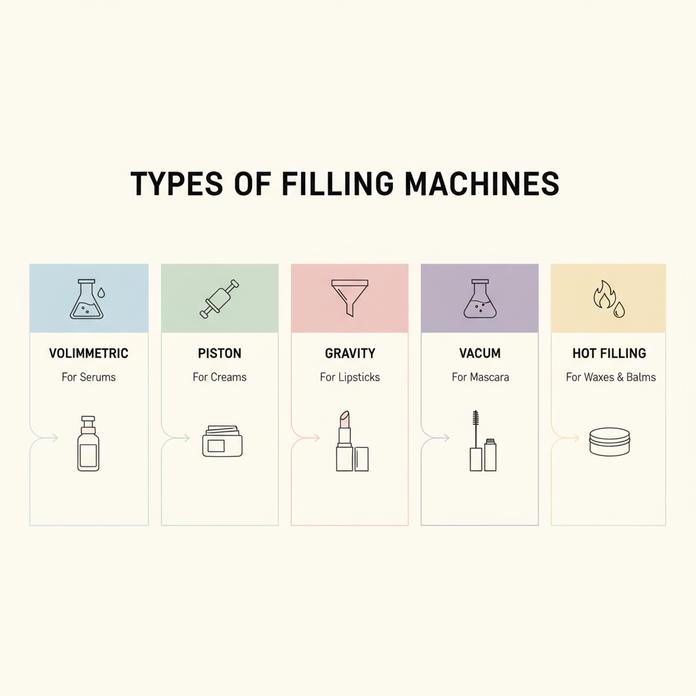
Volumetric Filling for Serums and Liquid Foundations
-
Precision matters when handling thin liquids like serum and liquid foundation; volumetric systems meter exact dosage every cycle.
-
- Calibrate volume → 2) stabilize flow → 3) verify accuracy with sample checks.
-
• Minimal waste, consistent shade distribution, clean dropper fills.
Short notes: steady viscosity in, steady fill out; changeovers stay quick; ideal for high-SKU cosmetic filling packaging lines. Many labs pair this with inline weight checks to keep cosmetic filling and packaging tight and repeatable.
Piston Filling in Cream and Lotion Jars
-
Thick textures call for a piston filler pushing viscous products like cream and lotion into jars with smooth dispensing.
-
Multi-step:
-
Prep
- Heat slightly for semi-viscous flow
- De-air mix
-
Fill
- Stroke control for consistency
- Bottom-up nozzle to avoid pockets
-
Finish
- Wipe, cap, torque
-
This setup shines in cosmetic filling, packaging, and sealing where texture uniformity sells the product.
Gravity Filling of Lipsticks and Blush Tubes
-
Gravity filling suits free-flowing or molten products; flow rate does the work.
-
Quick flow:
Gentle handling keeps pigments stable. It’s simple gear, easy to scale in cosmetic filling & packaging lines.
Vacuum Filling Pumps for High-Viscosity Mascaras
-
For mascara with high viscosity, a vacuum filler removes air bubbles, protecting product integrity.
-
Nested flow:
-
Vacuum stage
- Pull air from container
- Prime pumps
-
Fill stage
- Controlled draw for precise filling
-
Seal stage
- Immediate closure to lock texture
-
Manufacturers like Topfeel Beauty often favor this for clean, glossy results in cosmetic filling and packaging.
Hot Filling Systems for Waxes and Balms
-
Hot filling melts wax and lip balm, then cools to firm shape—timing is everything.
-
Mix of steps and tips:
- Heat with tight temperature control
- Fill into molds or tins during melting phase
- Managed cooling for even solidification
Used well, it delivers smooth sticks and crack-free surfaces. Topfeel Beauty offers related packaging solutions and integrates this with end-to-end cosmetic filling packaging lines to help maintain finish consistency across batches.
3 Key Cosmetic Filling And Packaging Steps
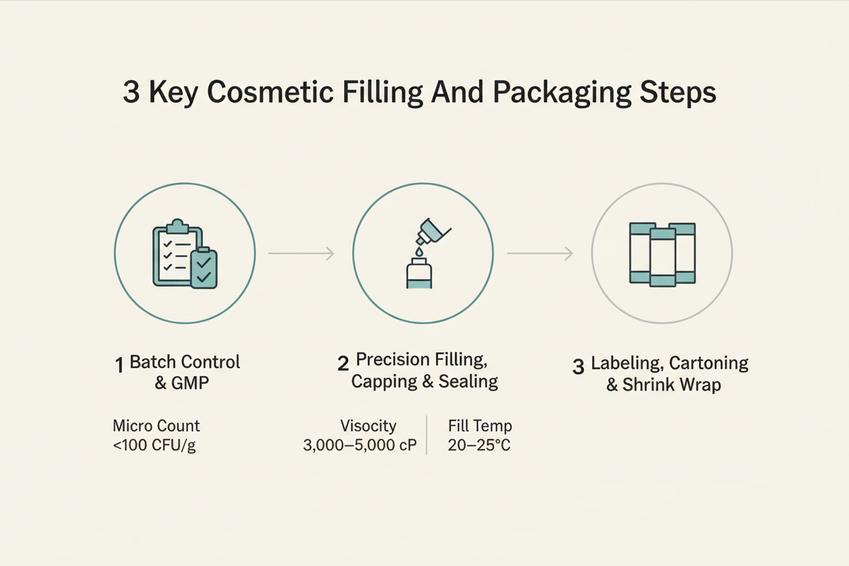
Cosmetic filling and packaging might sound technical, but it’s really about keeping products safe, clean, and ready for shelves. From early checks to final wrapping, each move affects quality. When cosmetic filling, cosmetic packaging, and full cosmetic filling and packaging workflows sync properly, brands avoid leaks, mix-ups, and costly recalls.
Step 1: Batch Control, Inspection, and GMP Compliance
-
Core control layers in cosmetic filling and packaging:
-
- lot coding
- batch reconciliation
-
quality assurance
- sampling checks
- defect thresholds
-
- hygiene routines
- equipment validation
-
- Incoming phase
- raw material inspection ensures custom solutions meet spec
- contamination risks flagged early
- In-process phase
- process control keeps viscosity and temperature stable
- operators log data into documentation
- Output phase
- traceability systems connect every unit to source batch
Table snapshot:
| Control Point | Target Range | Risk Level |
|---|---|---|
| Viscosity | 3,000–5,000 cP | Medium |
| Fill Temp | 20–25°C | Low |
| Micro Count | High |
Short note: clean data equals clean product.
Step 2: Precision Liquid Filling, Capping, and Sealing
Smooth cosmetic filling depends on tuned equipment and timing.
- liquid filling machines handle creams, serums, gels
- container feeding keeps bottles aligned
- accurate dosing avoids underfill complaints
Flow looks like this:
• product enters hopper
• nozzles dispense exact volume
• capping mechanisms lock closures
• sealing technology adds tamper safety
Small but critical details:
- uneven torque? leads to leaks
- poor product containment? contamination risk jumps
- slow packaging line automation? output drops fast
In everyday terms, it’s like pouring, closing, and double-checking—just at high speed and zero tolerance for error.
Step 3: Label Application, Cartoning, and Shrink Wrapping
-
Final cosmetic packaging layers:
-
label applicators
- alignment sensors
- adhesive control
-
cartoning machines
- folding accuracy
- insert placement
-
shrink wrapping equipment
- heat tunnels
- film tension
-
Nested flow:
-
Product identification
- product identification codes printed
- compliance text verified
-
Secondary packing
- secondary packaging protects items
- cartons stacked uniformly
-
Dispatch readiness
- final packaging sealed
- palletizing organizes loads
- logistics preparation ensures shipping stability
Quick takeaway: if cosmetic filling and packaging ends clean and organized, retailers get shelf-ready goods without extra handling.
Private-Label Makeup: Custom Filling Setup
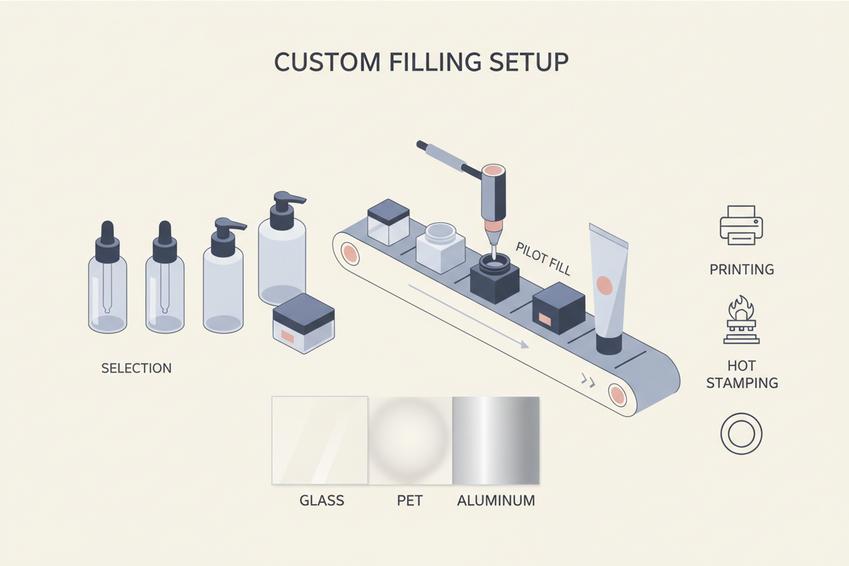
A smooth cosmetic filling and packaging flow isn’t just factory talk—it shapes how a product feels, looks, and survives shipping. From picking parts to finishing touches, each call affects usability, cost, and brand vibe. For brands exploring packaging options, Topfeel Beauty offers related packaging solutions alongside in-house formulation R&D.
Selecting Packaging Components: Bottles, Jars, Compacts
Getting the right mix of bottles, jars, compacts, and tubes keeps your cosmetic filling and packaging line sane.
-
Core picks:
- closures must seal tight yet open easy
- pumps suit liquids; droppers fit serums
- applicators define user experience
- Match formula → 2) check compatibility → 3) test dispensing
Short notes: thick creams like wide-mouth jars. Runny liquids? go bottles + pumps. Color oem face makeup leans on compacts.
Choosing Materials: Glass, Plastic, Aluminum, Acrylic
Material choice quietly drives durability and shelf appeal in cosmetic filling and packaging.
- glass feels premium but fragile
- plastic like PET, PP, HDPE keeps costs down
- aluminum blocks light, great for actives
- acrylic gives that luxe, clear look
Key comparison:
| Material | Barrier Strength | Cost Index | Recyclability |
|---|---|---|---|
| glass | high | high | high |
| PET | medium | low | medium |
| aluminum | high | medium | high |
Small takeaway bursts:
Light-sensitive formula? pick metal or aluminum. Budget line? go plastic.
Tailoring Filling Technologies: Volumetric, Gravity, Powder
Dialing in tech keeps cosmetic filling consistent.
→ Liquids
- gravity for low-viscosity
- volumetric for accuracy
→ Semi-liquid
- piston or pump systems
→ Dry formats
- setting powder fillers for eye shadow
Quick flow: test viscosity → select method → calibrate → run pilot batch. Mess this up and your cosmetic packaging line wastes product fast.
Applying Decoration & Finishing: Screen Printing to Metallization
Looks matter—buyers judge fast.
-
Visual upgrades:
- screen printing for logos
- hot stamping adds shine
- metallization boosts shelf pop
Steps that usually click:
- base surface prep
- coating or frosting
- branding via labeling, embossing, or debossing
Tiny details, big impact. A clean finish ties the whole cosmetic filling and packaging story together, making even simple formulas feel high-end.
References
- batch management – fda.gov / FDA
- quality assurance – cossma.com / COSSMA
- Good Manufacturing Practices – iso.org / ISO
- raw material inspection – personalcarecouncil.org / PCPC
- process control – isa.org / ISA
- traceability systems – gs1.org / GS1
- tamper safety – packagingdigest.com / Informa Markets
- packaging line automation – pmmi.org / PMMI
- compliance text – europa.eu / European Commission
- secondary packaging – worldpackaging.org / WPO
- logistics – cscmp.org / CSCMP
- glass – gpi.org / Glass Packaging Institute
- PET – plasticsindustry.org / Plastics Industry Association
- aluminum – aluminum.org / The Aluminum Association
- metallization – finishingandcoating.com / Finishing and Coating
Post time: Jul-20-2026