

Cosmetic Contract Manufacturers: How Beauty Brands Choose the Right Production Partner
Cosmetic contract manufacturers can make or break your brand overnight—one bad batch, one late shipment, and suddenly your reputation’s on thin ice.
Smart brands don’t gamble here; they pick partners who keep formulas steady, timelines tight, and compliance locked down, so real growth doesn’t come with nasty surprises.
Essential Insights for Cosmetic Contract Manufacturers
- Conduct rigorous stability and microbiological testing to guarantee formula safety and regulatory compliance.
- Verify GMP standards and ISO certification to maintain batch consistency and robust quality assurance.
- Evaluate scalability, lead times, and distribution networks to ensure launch readiness and efficient logistics.
- Secure confidentiality agreements and balance cost efficiency without compromising quality control.
How Do Beauty Brands Vet Production Partners?
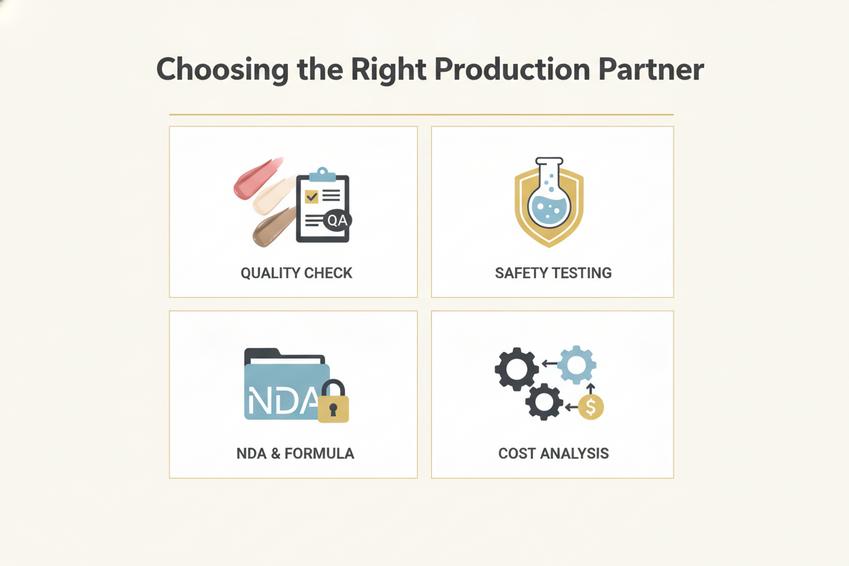
Beauty brands don’t just pick factories off a list. Behind every serum or lipstick sits a network of cosmetic contract manufacturers, contract cosmetic manufacturers, and private label cosmetic manufacturers working quietly in the background. Choosing the right cosmetic manufacturers shapes product quality, brand voice, and long-term growth. It’s serious business—but it’s also about trust, gut instinct, and smart homework.
Why Private Label Manufacturing Matters for Brand Trust
When brands evaluate cosmetic contract manufacturers, the focus goes far beyond price sheets. It centers on how private label cosmetic manufacturers protect consistency, reputation, and long-term consumer perception.
-
Product Quality and Consistency
-
Formula replication
- Batch-to-batch accuracy
- Ingredient verification systems
-
Process control
- In-line inspections
- Final QA sign-off
-
-
Brand Reputation and Market Positioning
- Packaging precision
- Shade matching reliability
- Claims substantiation for differentiation
-
Intellectual Property and Differentiation
- Protection of custom formulas
- Restricted access labs
- Clear ownership clauses
- Reliable cosmetic contract manufacturers reduce variation.
- Stable output strengthens market positioning.
- Strong oversight protects intellectual property.
A brand’s name sits on the label. The cosmetic manufacturer stands behind it.
Ensuring Formula Safety with Comprehensive Testing Procedures
Safety isn’t flashy, yet it’s the backbone of trust. Leading cosmetic contract manufacturers apply layered checks tied to ingredient sourcing, strict quality control, and evolving regulatory compliance standards.
- Core testing pillars
- Stability testing across temperatures
- Microbial testing for contamination risks
- Dermatological testing for skin tolerance
- Efficacy testing to confirm claims
- Validation flow
- Raw material screening
- Pilot batch review
- Scale-up verification
- Documentation audit
- Small shifts in pH matter.
- Preservative balance matters.
- Packaging compatibility matters.
Contract cosmetic manufacturers that document every phase make audits smoother and recalls far less likely. In short, careful testing protects both users and brand equity.
Confidentiality Agreements and Cost Efficiency in Partner Selection
Behind closed doors, negotiations get detailed. Smart brands assess how cosmetic contract manufacturers balance intellectual property protection with smart operational costs.
-
Legal Safeguards
- Non-disclosure clauses
- Clear ownership of molds and formulations
- Exit terms within formal legal agreements
-
Financial Evaluation
- Breakdown of operational costs
- Raw material sourcing transparency
- Audit of the supply chain
-
Scale Advantages
- Access to economies of scale
- Bulk ingredient negotiation
- Long-term capacity planning
♦ Confidentiality builds confidence.
♦ Smart negotiation protects margins.
Private label cosmetic manufacturers that respect boundaries while optimizing cost structures become long-term partners—not just vendors.
Inconsistent Batches? Choose Certified Manufacturers.
In beauty manufacturing, inconsistency kills momentum. Brands working with cosmetic contract manufacturers need more than speed—they need proof. Certifications, testing, and disciplined systems separate stable growth from messy recalls.
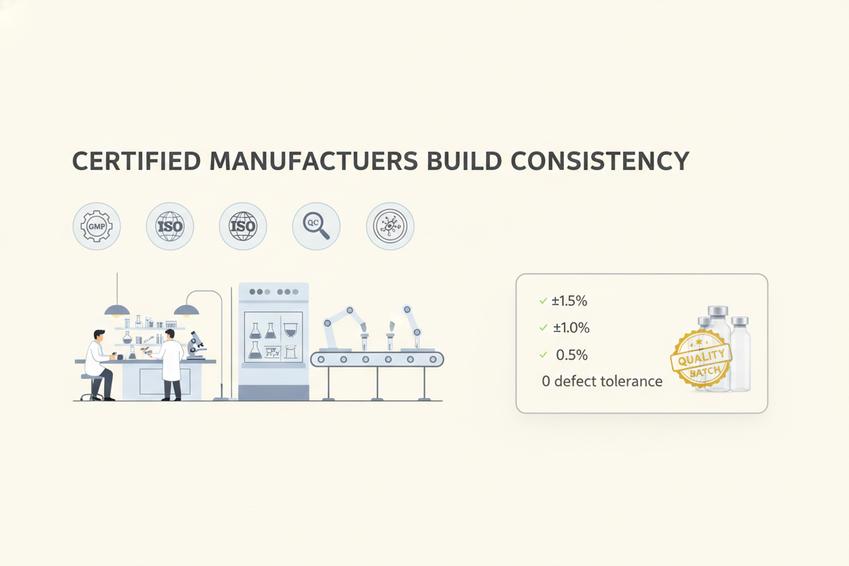
GMP Standards: Guaranteeing Batch Consistency
Reliable cosmetic contract manufacturers build their workflow around GMP and strict manufacturing practices. That foundation keeps batch consistency tight across creams, powders, and sticks.
- Clear quality control checkpoints
- Documented production standards
- Verified regulatory compliance
But it goes deeper than a checklist.
- Raw material verification
- In-process inspection
- Finished goods release review
- Retention sampling
- Ongoing stability tracking
At Topfeel, alignment with quality management systems means:
-
Facility Controls
- Environmental monitoring
- Equipment calibration logs
- Cleaning validation records
-
Process Controls
- Standard batch sheets
- In-line weight checks
- Deviation reporting
-
People Controls
- Skill certification
- Hygiene audits
- Routine retraining
| Control Area | Inspection Frequency | Acceptable Variance | Documentation Type | Risk Level |
|---|---|---|---|---|
| Raw Materials | Every batch | ±1.5% | COA + Intake Log | Medium |
| Mixing Phase | Per 30 min | ±1.0% | Batch Record | High |
| Filling Weight | Hourly | ±0.5% | QC Sheet | High |
| Packaging Seal | Every lot | 0 defect tolerance | Inspection Log | Medium |
| Stability Test | 1–6 months | Visual + micro pass | Stability File | High |
Consistency is not luck. It’s enforced discipline.
ISO Certification and Quality Assurance Protocols
Strong cosmetic contract manufacturers rely on ISO certification to structure quality assurance beyond surface claims. It’s about a working quality management system, not a framed certificate.
Short truths:
• No standard operating procedures, no traceability.
• No audit trail, no accountability.
• No compliance culture, no long-term clients.
Topfeel integrates:
-
Documentation Layer
- Controlled SOP updates
- Digital batch coding
-
Audit Layer
- Internal audit cycles
- Third-party audit validation
-
Compliance Layer
- Cross-border international standards review
- Regulatory mapping per market
Recent 2025 McKinsey manufacturing insights note that certified facilities show “measurably lower deviation rates and higher on-time release performance across regulated industries.”
“Manufacturers with mature quality systems reduce operational deviations by double-digit percentages compared to non-certified peers.” — McKinsey Operations Report, 2025
That’s why smart brands choose certified cosmetic manufacturers, not just low quotes.
Microbiological Testing to Prevent Production Flaws
Even the best formula fails without strict microbiological testing. In creams and mascaras, contamination prevention protects both shelf life and brand trust.
Here’s how professional cosmetic contract manufacturers manage risk:
-
Laboratory Analysis
-
Control Benchmarks
- Defined microbial limits
- Preservative efficacy validation
- Batch sterility confirmation
-
Ongoing Monitoring
- Water system testing
- Airborne particle checks
- Swab tests on equipment
No drama. Just numbers, pass/fail data, and release decisions based on product safety and quality control.
When brands evaluate cosmetic contract manufacturers, sterility data often tells the real story. And yes, experienced partners like Topfeel treat microbiology as non-negotiable.
4 Steps To Vet A Cosmetics Partner
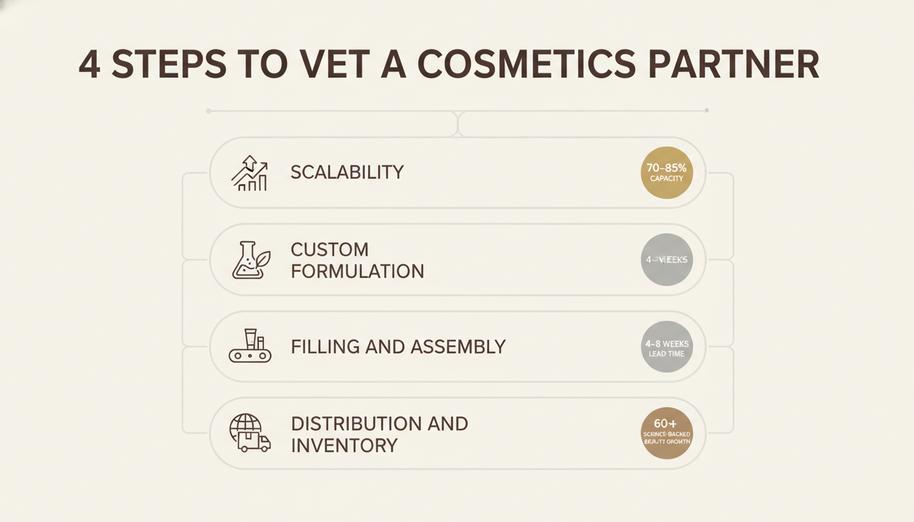
Choosing among cosmetic contract manufacturers can feel overwhelming. The market is packed with cosmetic manufacturers, contract cosmetic manufacturers, and private label cosmetic manufacturers promising speed and scale. This guide breaks down how to evaluate cosmetic contract manufacturers in a practical, no-fluff way so your launch stays on track and your margins stay healthy.
Assessing Scalability and Lead Times for Launch Readiness
When screening cosmetic contract manufacturers, start with operational depth.
- Review current production capacity and monthly manufacturing volume.
- Audit historical lead time averages.
- Check flexibility in the production schedule during demand spikes.
- Capacity Planning
- Base output vs. surge output
- Backup production lines
- Redundancy in critical equipment
- Demand Alignment
- Forecast matching against market demand
- Safety stock buffers
- Raw material reservation systems
- Launch Execution
- Defined launch readiness benchmarks
- SOPs for scaling operations
- Cross-functional production meetings
| Metric | Standard Range | Risk Threshold | Impact on Launch |
|---|---|---|---|
| Lead Time (weeks) | 4–8 | >10 | Delayed rollout |
| Capacity Utilization | 70–85% | >95% | Bottlenecks |
| Batch Failure Rate | <2% | >5% | Rework costs |
| MOQ Flexibility | 5k–20k | >50k | Cash strain |
| Surge Output | +30% | <10% | Stockouts |
Smart cosmetic contract manufacturers will show clean data, not vague promises.
Evaluating Custom Formulations and Formulation Development Expertise
Not all cosmetic manufacturers excel at custom formulation.
Look for:
- In-house formulation development chemists
- Active R&D capabilities pipelines
- Transparent ingredient sourcing partners
Under formulation review:
- Innovation Depth
- Novel actives
- Stability validation
- Texture optimization for liquid, gel, and powder SKUs
- Compliance & Testing
- Microbial product testing
- Claims substantiation
- Global regulatory compliance documentation
“By 2025, over 60% of beauty growth is tied to science-backed innovation and ingredient transparency,” notes McKinsey’s 2025 Global Beauty Report.
Experienced cosmetic contract manufacturers will map each formula to regulatory markets before scale-up. That foresight protects both timeline and reputation.
Vetting Filling Services, Assembly Services, and Turnkey Solutions
Operational flow matters more than flashy branding.
Core checkpoints:
- Automated filling services for bottles, tubes, airless pumps
- Integrated assembly services
- End-to-end turnkey manufacturing
Drill deeper:
- Production Line Review
- Line speed per SKU
- Changeover time
- In-line quality control systems
- Packaging & Co-Processing
- Sustainable packaging solutions
- Reliable co-packing partners
- Tamper-evident sealing
A capable contract cosmetics manufacturer should handle formulation to final carton without juggling five vendors. Fewer handoffs mean fewer headaches.
Topfeel stands out among cosmetic contract manufacturers by combining automated lines with strong QA checkpoints, keeping defect rates low while maintaining output speed.
Reviewing Distribution Networks and Inventory Management Systems
Growth stalls when logistics break down.
Evaluate:
- Breadth of the distribution network
- Digital inventory management dashboards
- Real-time stock control reporting
Assessment structure:
- Supply Chain Visibility
- End-to-end supply chain mapping
- Demand forecasting software
- Supplier scorecards
- Logistics & Fulfillment
- Regional warehousing hubs
- Omnichannel fulfillment capability
- International shipping compliance
- Risk Mitigation
- Buffer inventory rules
- Alternate freight providers
- Emergency replenishment plans
Reliable cosmetic contract manufacturers treat logistics as part of brand strategy, not an afterthought. When distribution syncs with production, launches land smoothly and shelves stay stocked.
Stages Of Selecting A Manufacturer
Choosing among cosmetic contract manufacturers can feel overwhelming. The right cosmetic contract manufacturer shapes product quality, speed to market, and compliance. From raw materials to warehousing, each checkpoint filters serious partners from risky ones. Brands working with experienced cosmetic manufacturers like Topfeel often notice smoother timelines and fewer surprises.
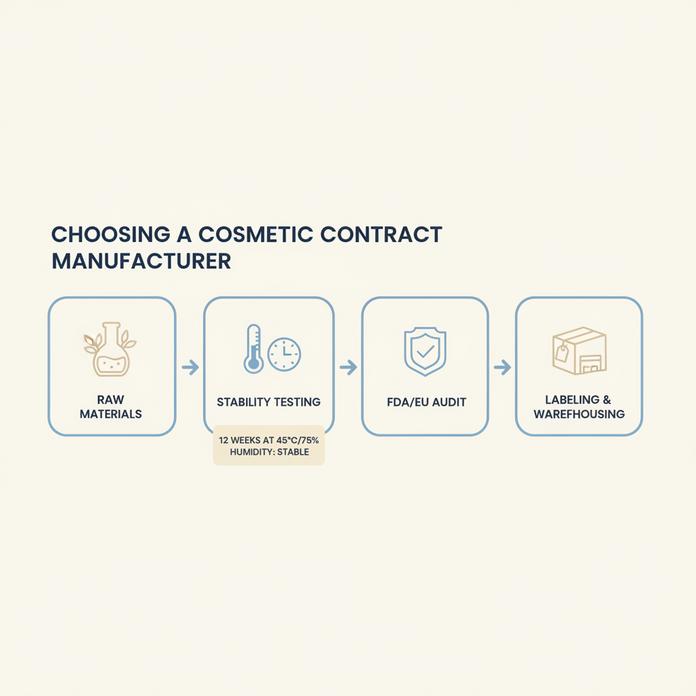
Initial Raw Material Sourcing and Ingredient Procurement
Selecting suppliers inside professional cosmetic contract manufacturers requires layered evaluation:
-
Raw materials
- Origin verification
- Batch traceability
- Allergen screening
-
Ingredients
- Stability compatibility
- Safety data sheets
- IFRA/FDA alignment
-
Sourcing & procurement
- Dual-channel supply chain backup
- Cost benchmarking
- MOQ flexibility
Within reliable cosmetic contract manufacturing, procurement teams cross-check:
- Quality certificates
- Heavy metal limits
- Microbial thresholds
And then:
- ✔ Lab sampling
- ✔ Pilot blending
- ✔ Retention archiving
Consistency in quality standards keeps foundations and concealers performing the same way—no drama, no reformulation panic.
Conducting Product Development Trials and Stability Testing
Inside established cosmetic contract manufacturers, product development flows through structured layers:
-
R&D Stage
- Prototype formulation
- Texture calibration
- Shade matching
-
Validation Stage
- Accelerated stability testing
- Packaging compatibility
- Microbial quality control
-
Performance Stage
- Consumer trials
- Wear testing
- Efficacy scoring
Stability Test Data Example
| Test Condition | Duration (Weeks) | Temp (°C) | Humidity (%) | Result |
|---|---|---|---|---|
| Accelerated | 12 | 45 | 75 | Stable |
| Room Temp | 24 | 25 | 60 | Stable |
| Refrigerated | 24 | 4 | 40 | Stable |
| Freeze-Thaw | 6 cycles | -5/40 | — | Pass |
| Light Exposure | 8 | 30 | 65 | No fade |
Solid data like this separates serious contract manufacturers from basic blending labs.
Onsite Audits for FDA Compliance and EU Cosmetic Regulations
Audit flow inside qualified cosmetic contract manufacturers usually runs like this:
- Pre-audit document review
- Facility inspection
- Documentation verification
- CAPA review
During inspection, teams examine:
- GMP workflows
- Cleanroom zoning
- Batch coding systems
- Regulatory affairs files
Clear proof of FDA compliance and alignment with EU regulations reduces customs delays and retailer pushback. A sharp quality assurance culture speaks louder than marketing slides.
Finalizing Labeling Requirements and Warehousing Solutions
Clean labeling requirements avoid recalls. Smart packaging artwork prevents misprints. That’s basic—but critical.
Key checkpoints:
- INCI accuracy
- Net weight validation
- Barcode registration
- Claims substantiation
On the backend, strong warehousing and logistics systems inside advanced cosmetic contract manufacturing networks handle:
- Climate-controlled storage
- FIFO inventory management
- Multi-region distribution
Topfeel supports brands with integrated dispatch planning, so products move fast without stock chaos.
When reviewing cosmetic contract manufacturers, balance compliance, testing data, sourcing depth, and operational muscle. That mix keeps launches smooth and reputations solid.
References
- intellectual property – wikipedia.org/Wikipedia
- regulatory compliance – fda.gov/FDA
- economies of scale – wikipedia.org/Wikipedia
- GMP – wikipedia.org/Wikipedia
- ISO certification – iso.org/ISO
- McKinsey – mckinsey.com/McKinsey
- microbiological testing – wikipedia.org/Wikipedia
- E. coli – wikipedia.org/Wikipedia
- S. aureus – wikipedia.org/Wikipedia
- supply chain – wikipedia.org/Wikipedia
- IFRA – ifrafragrance.org/IFRA
- stability testing – wikipedia.org/Wikipedia
- FDA compliance – fda.gov/FDA
- EU regulations – europa.eu/European Commission
Post time: Jun-26-2026