
Contract Manufacturing vs Private Label for Cosmetics
In the contract manufacturing vs private label showdown, your makeup brand isn’t picking a factory—it’s choosing how fast it can breathe, sell, and stay sane under pressure. One path piles on labs, long lead times, and bigger checks; the other gets product on shelves without the circus.
You want speed, lower cash, simpler compliance, and manageable inventory, not a chemistry degree. This guide breaks costs, control, MOQs, and scaling.
Reading Notes: contract manufacturing vs private label in Harmony
- Cost Efficiency: Contract manufacturing means higher R&D, custom solutions, and bigger MOQs; private label cuts development, packaging, and compliance costs with pre-built formulas.
- Brand Control: Go bespoke with contract manufacturing for full label design, ingredient transparency, and unique identity; private label limits customization within set options.
- Scaling Flexibility: Negotiate MOQs by vetting suppliers, aligning lead times, using demand forecasting, and securing tiered pricing to grow from small batches to bulk orders.
5 Cost Differences: Contract Manufacturing Vs Private Label
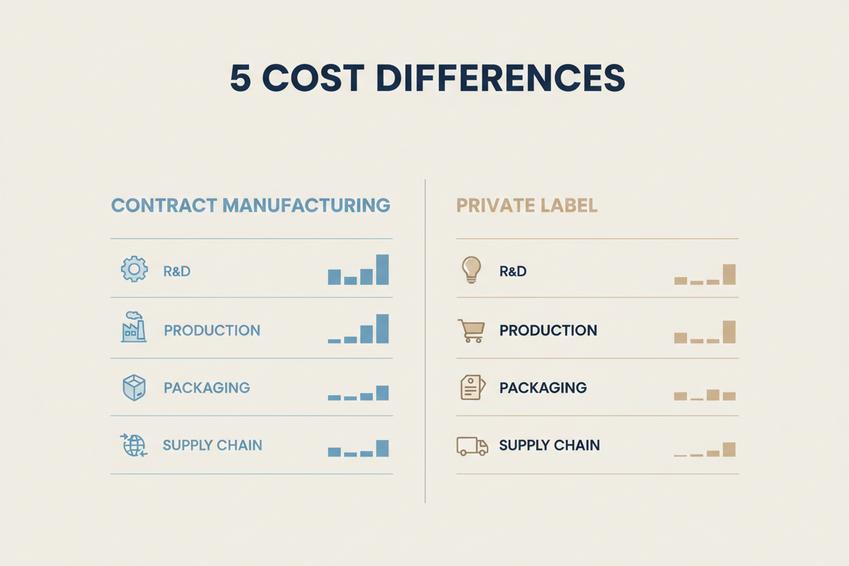
Picking between contract manufacturing vs private label can feel like splitting hairs, but the money trail tells a clear story. From lab work to logistics, each path shapes cost, control, and speed. Let’s break down contract manufacturing vs private label in a practical, no-fluff way.
Formulation Development Cost
In contract manufacturing vs private label, the early spend sits in the lab. With contract manufacturing, ingredients selection and Research and Development drive custom shades, textures, and claims.
-
Custom route
-
- Prototyping cycles → adjust feel, payoff
-
- Stability Testing → shelf life under heat/light
-
- Efficacy Testing → prove claims
-
- Intellectual Property → formula ownership
-
- Expertise fees → chemists, labs
-
-
Private label route
- Pre-built formulas cut R&D; tweaks are minor
- Faster sampling, lower upfront cash
As a cosmetics supplier, Topfeel Beauty supports both routes, helping brands weigh contract manufacturing vs private label without overbuilding early. For brands seeking specialized formulations, Topfeel Beauty offers related R&D support for textures and color matching, alongside a library of market-ready options for faster launches.
Bulk Production Cost
Contract manufacturing vs private label diverges at scale.
-
Contract manufacturing
-
- Batch Size minimums
-
- Raw Materials procurement
-
- Labor + Equipment setup
-
- Overhead and Quality Control
-
-
Private label
- Shared Manufacturing Process lines
- Smaller MOQs, smoother ramp
Packaging Materials Cost
Packaging often sneaks up on budgets in contract manufacturing vs private label.
-
Custom path
- Containers, pumps, molds
- Packaging Design + Printing
- Multi-part Components sourcing
-
Private label path
- Standard Labels, Boxes, jars
- Lower tooling, quicker restock
For brands exploring packaging options, Topfeel Beauty offers related packaging solutions ranging from standard stock components to custom mold development, working to align design requirements with production capabilities.
Regulatory Compliance Cost
Costs stack differently across contract manufacturing vs private label.
-
Contract manufacturing
-
- Safety Testing
-
- Documentation packs
-
- certifications and Audits
-
- Meeting global Regulations and Legal Requirements
-
-
Private label
- Often pre-aligned with GMP; easier Market Access
Facilities like those operated by Topfeel Beauty maintain GMPC and ISO 22716 certifications, providing essential documentation such as MSDS and COA to support regulatory compliance standards.
Supply Chain Operations Cost
Operations can make or break margins in contract manufacturing vs private label.
-
Contract manufacturing
- Logistics planning
- Supplier vetting, longer Transportation lanes
- Multi-node Warehousing
-
Private label
- Lean Inventory Management
- Faster Distribution and Fulfillment
- Better Operational Efficiency
For brands testing the waters, contract manufacturing vs private label isn’t just a cost choice—it’s a timing and control play, and a balanced approach helps secure product delivery without overcomplicating the path.
Branding Control: Contract Manufacturing Vs Private Label
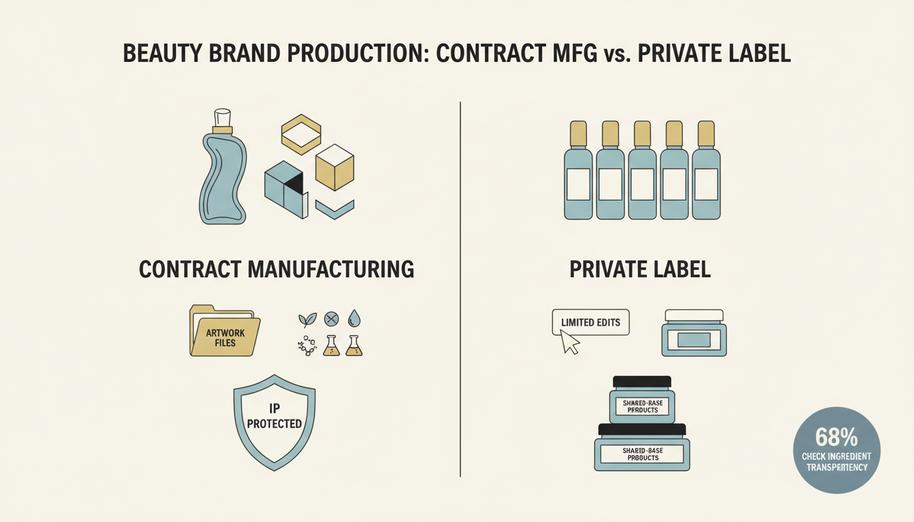
Picking between contract manufacturing vs private label isn’t just a supply call—it shapes your whole vibe. From label choices to brand control, each path hits differently. If you’re comparing contract manufacturing vs private label, the trade-offs show up fast in design freedom, ingredient choices, and how unique your line feels on shelves.
Custom Labeling and Packaging Design
When it comes to label, packaging, and design, contract manufacturing vs private label plays out like this:
-
Contract manufacturing vs private label:
-
Contract route:
- Full artwork control
- Flexible materials and finishes
- Custom aesthetics aligned with your visual identity
-
Private label route:
- Pre-set packaging templates
- Limited design tweaks
- Faster but less distinctive output
-
- Define your visual identity
- Match regulations with packaging specs
- Finalize label compliance details
Ingredient Listing Transparency
Here’s where contract manufacturing vs private label gets real for formulations and transparency:
-
Contract manufacturing:
- Full formulation input
- Clear disclosure and INCI control
-
Private label:
- Fixed listing
- Limited compliance flexibility
“By 2025, over 68% of beauty consumers actively check ingredient transparency before purchase,” notes a recent NielsenIQ beauty report.
Short take:
Control builds consumer trust.
Limited visibility weakens it.
That’s why contract manufacturing vs private label often tilts toward brands wanting honest, clean positioning. To support this approach, Topfeel Beauty offers vegan, cruelty-free, and paraben-free formulations for brands prioritizing responsible ingredient choices.
Brand Identity Ownership
This is the big one—brand, identity, and ownership.
-
Contract manufacturing vs private label comparison:
-
Contract:
- Full intellectual property rights
- Strong differentiation
- Clear market positioning
-
Private label:
- Shared bases
- Reduced uniqueness
- Harder to build long-term reputation
-
Step-by-step feel:
- Choose your model
- Define your brand identity
- Lock in your control level
Contract manufacturing vs private label isn’t just about the product—it decides how memorable your brand becomes.
How To Negotiate MOQ In Private Label Partnerships
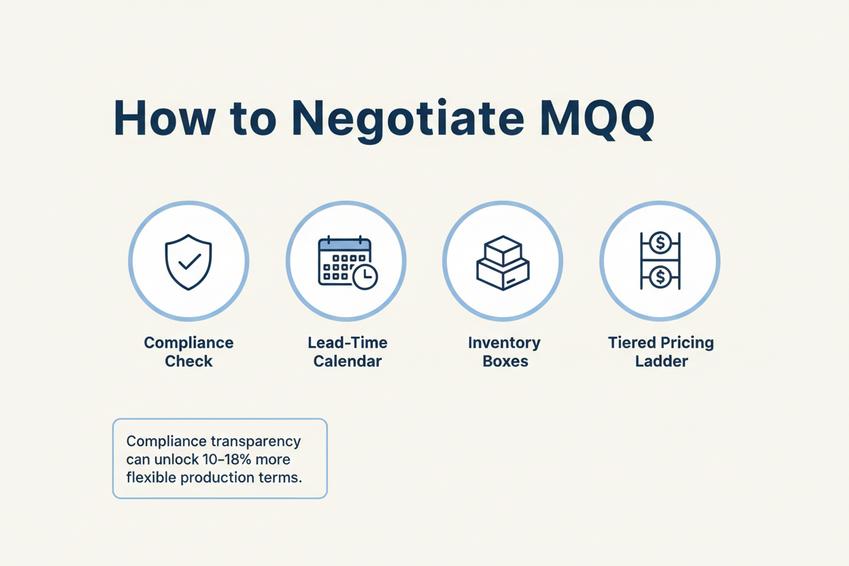
Getting MOQ down without hurting supplier relationships is a real balancing act. In contract manufacturing vs private label, smart negotiation blends data, trust, and timing.
Evaluate Supplier Vetting Criteria
When comparing contract manufacturing vs private label, suppliers care about risk. Show you’re low-risk.
- Strong quality standards and verified certifications reduce hesitation
- Share past audit reports and highlight supplier reputation alignment
- Keep clear communication channels to speed decisions
- Review production capabilities
- Confirm regulatory compliance
- Align on ethical practices
McKinsey (2025) notes that buyers demonstrating compliance transparency often secure “10–18% more flexible production terms,” including MOQ adjustments.
Working with a facility that maintains clear records helps here. Topfeel Beauty operates 100,000-level purification workshops and provides documentation to make vetting suppliers smoother and negotiations less tense.
Align Lead Time Expectations
Shorter lead time often means higher MOQ. Flip that logic.
- Extend production timeline slightly
- Sync material procurement with real demand
- Improve logistics coordination
Multi-step flow:
-
Map manufacturing phases
-
Adjust capacity planning
-
Set realistic delivery schedules
- Weekly updates
- Clear communication frequency
-
Build risk mitigation buffers
This approach works especially well when balancing private label vs contract manufacturing expectations.
Optimize Inventory Management Strategies
Suppliers drop MOQ when your plan looks stable.
- Tight stock control and smart warehouse operations
- Accurate demand forecasting
- Better inventory turnover
Short bursts:
Small batches. Faster cycles. Less dead stock.
Then expand:
- Improve supply chain synchronization
- Track material flow
- Boost storage efficiency
- Push waste minimization
Facilities often support flexible reorder cycles, making smaller MOQs realistic in private label manufacturing setups when communication remains consistent.
Discuss Tiered Bulk Production Pricing
Instead of fighting MOQ, reshape pricing.
- Ask for production tiers tied to volume thresholds
- Show future growth in manufacturing scale
Nested negotiation:
-
Entry tier
- Small production batches
- Slightly higher cost
-
Growth tier
- Better process efficiency
- Improved resource utilization
-
Scale tier
- Strong economies of scale
- Supplier gains operational leverage
In contract manufacturing vs private label deals, this phased model keeps both sides comfortable while unlocking long-term savings.
References
- Research and Development – wikipedia.org/Wikipedia
- Intellectual Property – wipo.int/World Intellectual Property Organization
- Raw Materials – wikipedia.org/Wikipedia
- Quality Control – wikipedia.org/Wikipedia
- Packaging Design – wikipedia.org/Wikipedia
- Legal Requirements – fda.gov/U.S. Food and Drug Administration
- Inventory Management – wikipedia.org/Wikipedia
- visual identity – wikipedia.org/Wikipedia
- INCI – wikipedia.org/Wikipedia
- consumer trust – mckinsey.com/McKinsey
- brand identity – wikipedia.org/Wikipedia
- communication channels – wikipedia.org/Wikipedia
- demand forecasting – wikipedia.org/Wikipedia
- supply chain synchronization – wikipedia.org/Wikipedia
- economies of scale – wikipedia.org/Wikipedia
Post time: Jul-31-2026