
Color-Adjusting Foundation: What Beauty Brands Must Validate Before Launch
A color adjusting foundation can look like magic at the makeup counter, then turn into a production headache fast. For private label buyers, the real test is simple: can its shade adaptation stay predictable across skin tones, batches, filling, storage, and shelf life?
Encapsulated pigments, iron oxides, base chemistry, GMP controls, and packaging shape that answer. This shows what to validate before thousands of units hit the line.
Reading Notes: Color-Adjusting Foundation Essentials
→ Adaptive Pigments: Encapsulated iron oxides and chroma-adaptive technology ensure shade matching and skin tone blending across diverse users.
→ Quality Control: Implement rigorous color consistency testing, stability trials, and batch uniformity protocols in GMP-compliant facilities to guarantee predictable performance.
→ Packaging & Production: Choose sustainable airless pumps or refillables compatible with automated filling lines, and scale up through controlled batch manufacturing for private label reliability.
What Are Color-Adjusting Foundation Formulations?
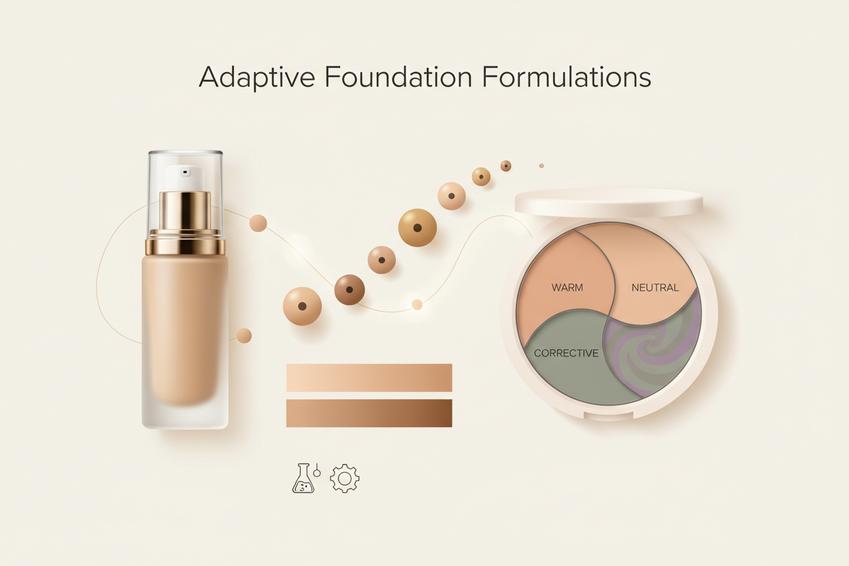
A color adjusting foundation is built to make shade selection easier without promising a one-color-fits-all result. Modern color foundation systems use controlled pigments, texture design, and optical effects to create more natural tone adjustment on skin.
Self-Adjusting Formula Systems
A color adjusting foundation may rely on smart pigments released through encapsulation, rather than truly changing to any complexion.
-
Formula design
- Adaptive technology controls pigment release during rubbing.
- Silicone elastomers support slip and even spreading.
-
Shade checks
- Colorimetric testing measures visible shade movement, while skin chemistry and shade intelligence claims require careful validation.
Topfeel Beauty can develop color adjusting foundation formulation concepts around defined shade ranges, so the final match stays realistic.
Adaptive Pigment Suspensions
Pigment behavior starts inside the base.
-
- Keeps color particles protected until application.
-
Color dispersion
- Balanced rheology helps prevent settling.
- Compatible emollients support smooth payoff and stability.
-
Optical testing
- Optical properties and light refraction affect perceived shade matching.
That control helps a color adjusting foundation develop more evenly from batch to batch.
Tone-Balancing Cream Foundations
Cream formulas tackle visible skin undertones through practical pigment blending.
-
Complexion balance: iron oxides provide tone; titanium dioxide influences opacity.
- Color correction can soften uneven-looking tones.
- Coverage must remain even rather than chalky.
-
Wear feel: hydration, emollients, texture, and blendability shape everyday comfort.
A color adapting foundation still needs several tested shades; adjustment has limits.
Color-Correction Mineral Compacts
Pressed formats take a different route. Topfeel Beauty can combine mineral pigments using color theory for targeted correction.
-
Green tones → redness neutralization
-
Lavender tones → reduce visible sallowness
- Controlled pressing supports pressed powder integrity.
- Balanced particles can add mattifying and skin perfecting effects without emphasizing discoloration.
Develop Your Foundation Line For brands exploring color cosmetics, Topfeel Beauty offers private label and OEM services for face makeup, including liquid and compact foundations. We provide lab co-creation for textures, pigments, and clean beauty options such as vegan and cruelty-free formulas.
4 Key Factors for Color Adjusting Foundation Success
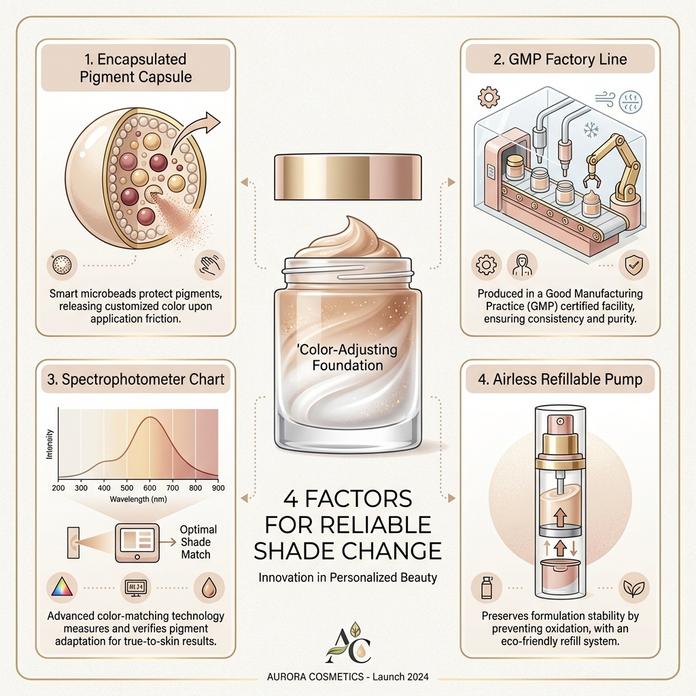
A successful color adjusting foundation has to do more than look clever during application. Reliable color change, repeatable manufacturing, careful testing, and practical packaging all matter once a formula reaches daily use. From color science to quality control, each choice affects shade results, product life, and the experience real customers get from an adjusting foundation.
Encapsulated Pigments for Reliable Shade Matching
For color adjusting foundation, pigments must release at a controlled rate rather than burst unpredictably.
-
Validate encapsulation technology
-
Check rubbing pressure and application time.
-
Compare color matching across a broad skin tone range.
- Record shade accuracy after application and wear.
- Confirm the cosmetic formulation keeps its intended texture.
-
That helps adaptive foundation deliver color change without the shade going wonky halfway through wear.
GMP Compliant Facilities Enabling Batch Manufacturing
Scaling color adjusting foundation requires manufacturing facilities operating to applicable GMP standards. Lab success alone doesn’t cut it.
Production trials should confirm batch production repeatability, filling speed, and production scale while documented quality control supports regulatory compliance. Experienced cosmetic manufacturing teams should also track pigment dispersion and processing conditions between batches.
Rigorous Color Consistency Testing Protocols
Color adjusting foundation needs measured evidence that shades remain dependable.
-
Establish testing protocols
- Measure activated shades using spectrophotometry.
- Define acceptable color consistency limits.
-
Run quality assurance checks
- Assess color stability during storage.
- Compare product uniformity across batches.
- Use documented quality control limits before release.
These checks catch small color shifts before customers do.
Sustainable Airless Pump Bottles and Refillable Containers
Packaging for color adjusting foundation must protect both formula and user experience. An airless pump can reduce air exposure while supporting controlled product delivery.
For lower environmental impact, refillable containers and eco-friendly materials deserve compatibility and filling-line tests. Good sustainable packaging and practical packaging design should also survive repeated handling without leaks, clogging, or messy refills.
Manufacturing & Packaging Support As a cosmetic manufacturer, Topfeel Beauty operates GMPC and ISO 22716 certified facilities. For brands exploring packaging options, we collaborate with our packaging division, Topfeelpack, to offer custom solutions ranging from stock components to custom molds.
Inconsistent Tones? Calibrate Your Color-Adjusting Foundation
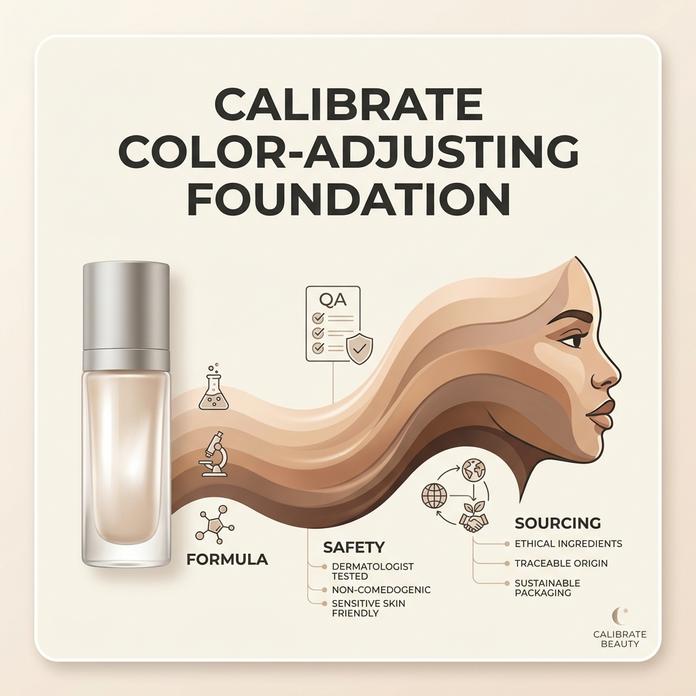
A reliable color adjusting foundation needs more than a clever color shift. Pigments, base chemistry, safety controls, and sourcing all affect the final match. Getting those pieces in sync helps brands produce an adaptive foundation that looks natural and stays consistent from batch to batch.
Formula Modifications to Enhance Skin Tone Adaptation
Fine-tuning starts with pigment technology and practical color matching across a broad skin tone spectrum. A color adjusting foundation should be tested on real skin, not judged only from a lab drawdown.
-
Formula calibration
- Balance iron oxides to control depth and undertone.
- Test encapsulation methods that release pigment during blending.
-
Finish calibration
- Use optical diffusers to soften visible tone differences.
- Check adaptive polymers and pH stabilizers for wear and stability.
Sound formulation chemistry keeps the adjusting foundation smooth instead of patchy. Topfeel Beauty can support development with shade testing aimed at practical, repeatable color performance.
Ingredient Safety Assessment under FDA Guidelines
U.S. commercialization calls for documented regulatory compliance and reliable safety substantiation. A color adjusting foundation also needs careful color-additive review because FDA rules restrict which colorants may be used and under what conditions.
- Build safety profiles using available ingredient toxicology data.
- Run suitable allergenicity screening, dermatological testing, and microbiological checks.
- Complete stability studies covering color, odor, viscosity, and packaging compatibility.
- Verify labeling and colorants against current FDA guidelines, while maintaining processes for required adverse event reporting.
That paperwork may feel less glamorous than shade creation, but it matters.
Raw Material Procurement and Inventory Optimization
Color consistency can slip when pigments vary between deliveries, so raw material sourcing must connect directly with production controls.
-
Supplier control
- Apply supplier qualification before routine purchasing.
- Lock down pigment material specifications and acceptable tolerances.
-
Stock control
- Track stock levels through disciplined inventory control.
- Coordinate supply chain logistics around lead times and shelf life.
-
Batch protection
- Use incoming quality assurance checks before releasing materials.
- Adjust the procurement strategy when supplier or pigment performance drifts.
These controls help each color adjusting foundation batch match its approved standard.
Start Your Cosmetic Project Topfeel Beauty operates as a private label cosmetic supplier and manufacturer, assisting brands with formulation development, quality control, and providing required regulatory documentation like MSDS and COA. Please contact us to request samples.
References
- color adjusting foundation – skincarebysuzie.com
- shade adaptation – elle.com
- Encapsulated pigments – maprecos.com
- iron oxides – diycosmetica.com
- encapsulation – martiderm.com
- Adaptive technology – foreverbloom.com
- Silicone elastomers – maha.asia
- Colorimetric – gaotek.com
- Microencapsulation – colorescience.com
- GMP standards – obelis.net
- spectrophotometry – sensing.konicaminolta.us
- airless pump – airlessbottles.com
- refillable containers – thepkgco.com
- regulatory compliance – allanchem.com
- colorants – fda.gov
Post time: Aug-18-2026