
Private Label Mattifying Setting Spray for Beauty Brands
Sourcing a mattifying setting spray requires aligned production choices.
Buyers need defined oil control, spray performance, samples, packaging, manufacturing, and documentation.
Grand View Research can inform commercial research when buyers evaluate differentiated makeup products.
Quick Insights into the Best Mattifying Setting Spray
- Prioritize Oil-Control Formula: Define the intended finish, wear expectations, and skin-feel criteria before approving a sample.
- Choose Translucent Micro-Mist Delivery: Assess spray coverage, dry-down, and how the package performs with the selected formula.
- Optimize Private Label Packaging: Compare packaging formats, decoration requirements, and handling considerations before locking artwork.
- Verify Compliance & Continuity: Build documentation, quality, and shipping questions into the development brief from the start.
Why Your Brand Needs a Private Label Matte Spray
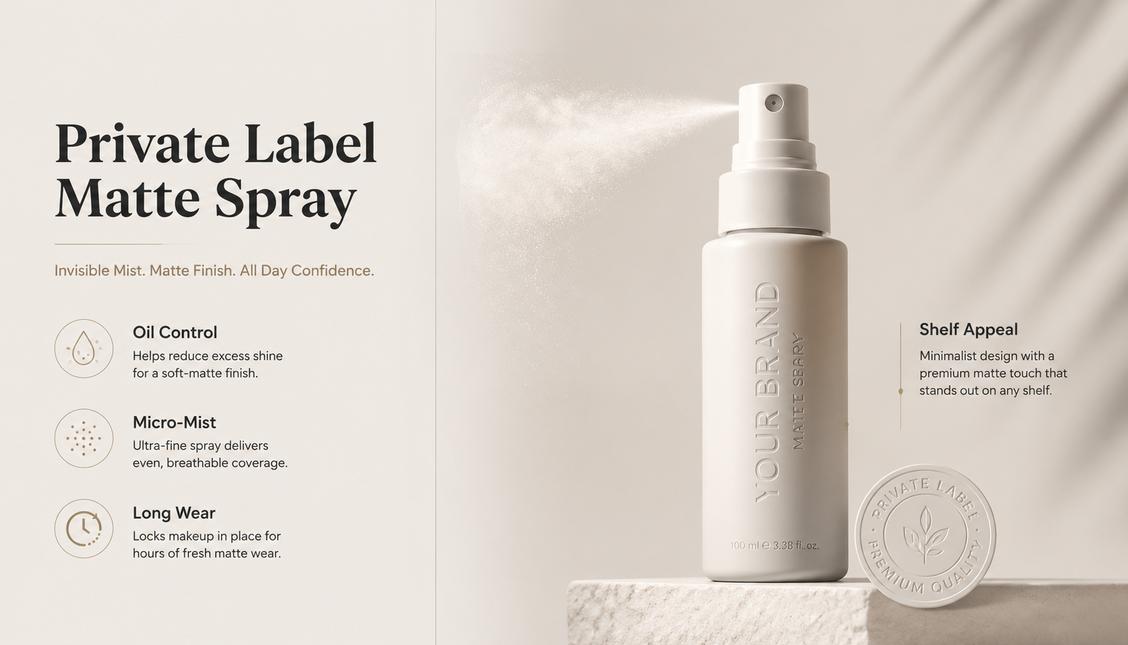
A private label matte spray gives beauty brands a practical way to pair makeup hold with shine control. The product brief should define the visual finish, sensory profile, application pattern, and compatibility with the face-makeup range.
Understanding Oil Control Formula Benefits
A matte formula brief should define finish, comfort, and intended routine.
- Formula performance
- Sebum regulation and mattifying ingredients should be evaluated against the intended shine-control appearance.
- Non-comedogenic ingredients require support appropriate to the product claim and intended consumer group.
- Makeup results
- Pore blurring should be assessed against the intended visible finish.
- Long-wear performance and humidity resistance need a defined evaluation plan before use in product copy.
For shoppers, the mattifying setting spray sample should deliver the intended experience consistently enough for accurate brand communication.
Leveraging Translucent Micro-Mist Appeal
Evaluate the atomizer with the formula, then record coverage, feel, dry-down, and visual finish. Review how it behaves over foundation or setting powder.
A well-developed matte spray can be assessed for an invisible finish, flashback appearance, hydration balance, and refreshing application before the brand selects final product language.
Streamlining Private Label Embossing and Design
- Build recognition
- Match bottle typography with the wider brand identity.
- Use custom packaging to keep shelf presentation consistent.
- Add finishing detail
- Hot stamping should be reviewed against the selected bottle material and artwork.
- Clean label finishing should leave room for required product information.
- Scale with purpose
- Coordinated cartons and decoration should remain aligned before repeat production.
One joined brief: Define oil control, micro-mist behavior, and packaging design together before sample approval.
Topfeel Beauty combines custom formulation work with packaging support from stock components to custom molds. Review an OEM face-makeup route to compare the formula brief. Explore custom solutions to compare packaging choices before artwork approval.
5 Steps to Develop the Best Mattifying Setting Spray
Creating a mattifying setting spray takes formulation, packaging, quality, and logistics decisions. How to find qualified cosmetic manufacturers can help frame supplier questions.
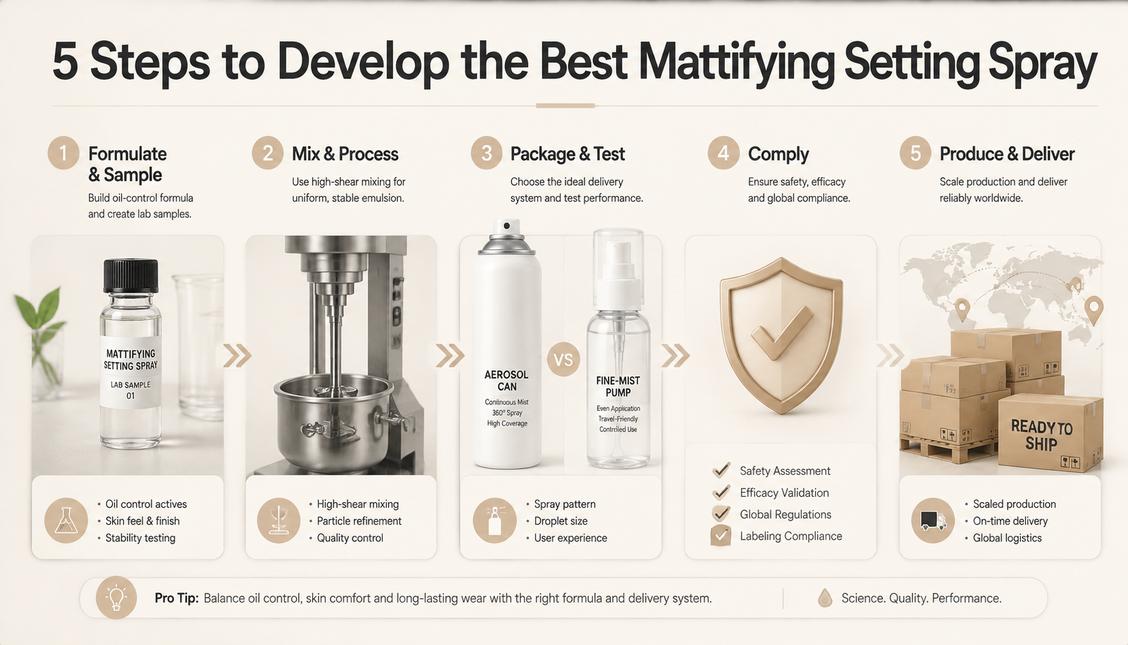
Prototype Sampling for Bulk Formulation
- Start with a cosmetic laboratory sample batch.
- Test oil control polymers and formula components against the intended matte performance.
- Run sensory evaluation for scent, finish, and skin feel.
- Confirm formula stability before bulk approval.
A high-shear mixer specification can help record the intended product result.
Optimizing the Homogenization Process
Set mixing and filling parameters for the chosen formula and package, then compare batches against the approved appearance, texture, and spray behavior.
Selecting Between Aerosol Aluminum Can or Fine-Mist Trigger Pump
- Compare each packaging material.Balance portability, sustainability, and consumer experience before committing.
- Aerosol: assess propellant gas, barrier property, and filling needs with responsible parties.
- Pump: evaluate the sprayer actuator and dispersion pattern with the formula.
A high-shear mixer can support even emulsification and controlled particle size. Make the selected format part of the brief; the U.S. Department of Transportation’s Office of Hazardous Materials Safety provides a starting point.
Verifying FDA Cosmetic Regulation and GMP Certification
- Check regulatory compliance and good manufacturing practices.
- Review safety assessment and ingredient safety records with appropriate advisers.
- Confirm documentation, labeling requirements, and quality assurance expectations before production.
That paperwork matters when a matte setting spray moves from factory floor to market. The FDA’s MoCRA resources, Health Canada notifications, and the EU cosmetics overview help frame market questions.
Establishing Freight Forwarding & Supply Chain Continuity
Plan documentation, customs coordination, warehousing, and delivery terms early. Topfeel Beauty states that it offers EXW, FOB, CIF, and DDP terms and can recommend freight forwarders for new importers.
Five-stage control: Sampling, homogenization, package selection, regulatory review, and freight continuity need one approval path to carry a matte spray from brief to launch. Topfeel Beauty lists initial samples in 3-7 days. Request a consultation once those five decisions are ready.
Review the OEM/ODM process before finalizing the brief.
Mattifying vs Hydrating: Which Setting Spray Suits Your Line?
Choosing between matte and moisture-focused sprays comes down to customer and finish.
Mattifying
A matte spray brief can focus on the intended reduced-shine appearance, comfort, and product compatibility. Matte makeup looks popular again provides a related trend discussion.
- Formula priorities
- Finish
- A sebum absorber should be evaluated against the intended shine reduction.
- Pore blurring should be assessed for the intended natural matte finish.
- Staying power
- A long-wear formula needs evidence appropriate to its market-facing statement.
- Humidity resistant wording needs support before it reaches product copy.
- Finish
For brands comparing matte spray formats, see the difference between pressed powder and loose powder.
Hydrating
Hydrating formulas use different evaluation criteria: comfort, freshness, and glow.
- Build the formula around a moisture boost, with hyaluronic acid considered only when the formula and claim support it.
- Pair the packaging with the selected formula so the spray pattern supports the intended experience.
- Aim for product communication that matches the approved formula and evidence package.
That contrast helps customers compare separate product briefs.
Finish choice with purpose: Decide whether the line needs matte or hydrating positioning by comparing the sensory target, spray behavior, and claim boundary.
Topfeel Beauty’s color-cosmetics R&D support covers custom formulation and compatibility, stability, and safety assessments. Explore custom solutions and review a translucent setting-powder product to compare adjacent face-finish decisions.
Solve Oily Skin Complaints with Best Matte Mist Sprays
Finding a mattifying setting spray needs defined criteria, testing, production, and delivery planning. What is clean beauty products can inform ingredient-positioning research.
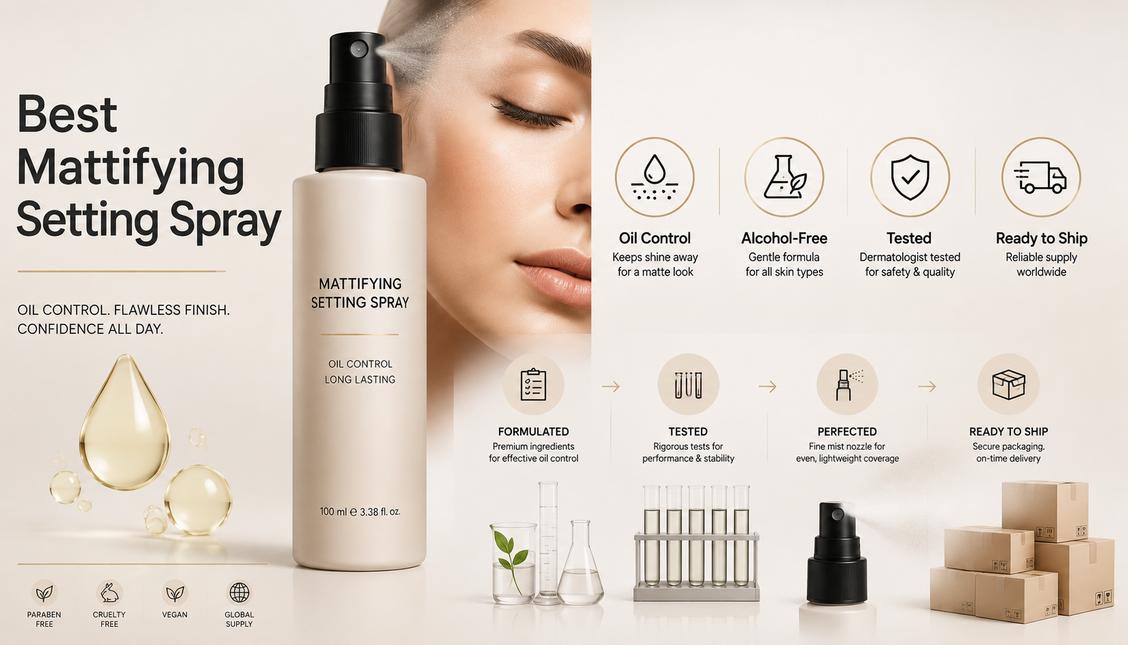
Long-Wearing Polymer for Superior Oil Control
- Formula performance
- A film-forming polymer should be assessed for the intended film feel and finish.
- Oil-absorbing powder and wear language need a defined evaluation plan before product claims are made.
Alcohol-Free Base to Minimize Breakouts
Ingredient choices should follow the brief and target market. Claims such as non-comedogenic or sensitive-skin suitability need appropriate support. The FDA’s cosmetic labeling guide is a starting point for U.S. labeling topics.
Batch Testing to Ensure Pore-Blurring Finish
- Finish checks
- Review particle size and the soft-focus effect against the approved visual target.
- Safety and consistency
- Run stability testing, microbial analysis, and routine quality control as required for the selected product.
- Complete a spray nozzle test as part of the agreed release process.
ISO’s ISO 22716 overview describes guidelines for the production, control, storage, and shipment of cosmetic products. Use the applicable quality system and market requirements to define project-specific checks.
Customs Clearance & Warehouse Storage Tips
Align import documentation, product information, and shipping instructions before dispatch. OSHA’s Hazard Communication Standard covers employer communication about hazardous chemicals, including safety data sheets. Then coordinate freight forwarding, storage conditions, and inventory records around the destination and agreed terms.
Release with confidence: Film-forming and oil-absorbing choices, alcohol-related claim boundaries, batch finish checks, and customs handoffs need one connected release brief. Topfeel Beauty provides MSDS and COA documentation for formulations, helping the team carry approved records into delivery planning.
Explore private label options. Request a consultation through Contact us to submit the formula brief, pack, documentation, and delivery requirements.
References
- Office of Hazardous Materials Safety — U.S. Department of Transportation
- Modernization of Cosmetics Regulation Act of 2022 (MoCRA) — U.S. Food and Drug Administration
- Cosmetics — European Commission
- Cosmetics Labeling Guide — U.S. Food and Drug Administration
- ISO 22716:2007 — ISO
- Hazard Communication Standard — Occupational Safety and Health Administration
- Notification of Cosmetics — Health Canada
Post time: Aug-26-2026