

Why Choose Lab Cosmetics?
Why Choose Lab Cosmetics?
In beauty, standing still is the fastest way to fall behind. Lab cosmetics step in like the straight‑A overachiever who also knows how to throw a punch—science‑backed formulas, tight quality control, and room for your brand’s personality. When customers scan ingredient lists like detectives, you can’t afford guesswork.
Here’s the rub: shoppers want proof, not promises. Potent actives. Clean claims. Packaging that doesn’t scream “cookie cutter.” Brands that miss the mark get ghosted—fast.
A sharp lab partner keeps your launch on schedule and your reputation intact, so you’re not crossing fingers—you’re crossing finish lines.
Key Insights on Lab Cosmetics Success
➔ High-Potency Actives: Lab cosmetics leverage concentrated active ingredients and botanical oils, backed by performance testing, to deliver clinically validated results in serums, moisturizers, and cleansers.
➔ Custom Formulation: Through tailored R&D and ingredient research, private label manufacturers create bespoke skincare aligned with your brand vision, target audience, and emerging trends.
➔ cGMP & ISO Compliance: Rigorous adherence to cGMP standards and ISO certification ensures consistent batch quality, safety assessments, and seamless regulatory approval.
➔ Sustainable Packaging: Eco-friendly solutions—airless pumps, glass bottles, recyclable tubes—enhance product preservation, dosing precision, and consumer appeal.
➔ Optimized Supply Chain: Bulk ingredient sourcing, inventory management, and third-party logistics streamline production timelines, cut costs, and keep launches on schedule.
5 Surprising Reasons Lab Cosmetics Outperform Retail Brands
Lab cosmetics are changing the game. When people hear “lab,” “cosmetics,” or even “cosmetic lab,” they might think clinical and cold. In reality, lab cosmetics blend science with beauty in a way retail shelves often can’t match. From ingredient strength to smarter sourcing, laboratory cosmetics simply work harder—and brands like Topfeel Beauty know exactly how to turn that edge into real market wins.
High-Potency Active Ingredients for Superior Results
At the heart of lab cosmetics lies serious active ingredients power.
● Ingredient Strategy
● Ingredient concentration is calibrated through scientific formulation.
● Higher potency supports measurable efficacy.
● Backed by modern cosmetic science testing.
● Performance Impact
1. Boosted skin renewal cycles.
2. Improved hydration retention.
3. Visible tone refinement.
In a cosmetic lab environment, stability tests and clinical checks push performance beyond what typical retail formulas deliver. Topfeel Beauty develops laboratory-grade blends that keep strength high without irritating the skin—smart balance, no fluff.
Custom Formulation Tailored to Your Brand Vision
Custom work is where lab cosmetic manufacturers shine.
● Brand Alignment
● Define brand identity.
● Clarify target audience.
● Shape a strong unique selling proposition.
● Product Creation Flow
1. Market scan of consumer needs.
2. Focused product development.
3. Testing for product differentiation.
This isn’t copy-paste skincare. In lab cosmetics, every serum or cream reflects strategy. Topfeel Beauty helps brands turn ideas into shelf-ready formulas that actually feel original.
Strict cGMP Standards Ensuring Unmatched Quality
Quality in laboratory cosmetics runs deep.
● Manufacturing Core
● Certified cGMP standards
● Detailed manufacturing practices
● Tight quality control
● Safety Framework
● Raw material purity checks
● Batch consistency validation
● Full regulatory compliance review
The result? Reliable product safety, stable textures, and predictable outcomes—every batch, every time.
Sustainable Packaging Solutions That Impress Consumers
Modern lab cosmetics care about the outside too.
● Material Choices
● Sustainable packaging with eco-friendly materials
● Recyclable materials like glass
● Select biodegradable options
● Brand Effect
● Stronger consumer perception
● Elevated brand image
● Reduced environmental impact
It’s smart science wrapped in responsible design.
Optimized Supply Chain for Bulk Ingredient Supply Efficiency
Behind every successful lab cosmetic line sits a tight system.
● Sourcing Network
● Strategic ingredient sourcing
● Reliable bulk supply partners
● Secure raw material procurement
● Operational Edge
1. Streamlined logistics
2. Inventory forecasting
3. Improved cost-effectiveness
A well-managed supply chain keeps production smooth and margins healthy. That’s how lab cosmetics outperform retail brands—not hype, just smart structure.
Which Lab Cosmetics Certifications Matter?
The world of lab cosmetics sounds technical, yet it’s really about trust. When a cosmetic lab develops formulas, brands want proof that safety, quality, and compliance aren’t just talk. From laboratory cosmetics testing to full-scale lab cosmetic production, certifications and audits keep everything in check. If you’re working with lab cosmetics manufacturers like Topfeel Beauty, knowing what truly matters saves time, money, and headaches.
ISO Certification: Global Quality Assurance
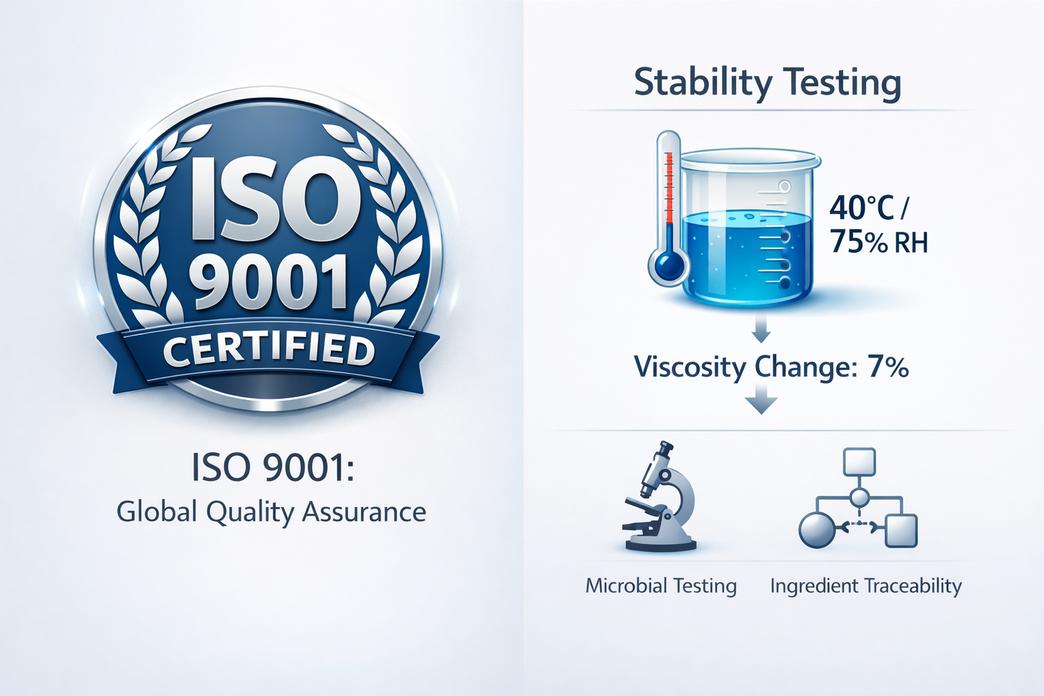
In the lab cosmetics industry, ISO 9001 is more than a badge.
Quality Management System (QMS)
● Clear process documentation
● Defined responsibilities
● Continuous improvement cycles
International Standards Alignment
● Harmonized production rules
● Cross-border acceptance
● Easier entry into global cosmetic lab markets
Audits and Oversight
● Internal audits scheduled quarterly
● External audits by an accredited Certification Body
● Corrective action tracking
Under this framework:
● Compliance is monitored daily.
● Audit findings are logged and reviewed by management.
● Supplier performance links back to the Quality Management System.
For laboratory cosmetics producers like Topfeel Beauty, ISO systems tie purchasing, production, and packaging together. Raw material approval flows into batch production records. Finished goods inspection connects back to documented International Standards. That chain of accountability is what gives lab cosmetic buyers real peace of mind.
Rigorous Stability Testing Protocols
A cosmetic lab can’t guess shelf life. It has to test it.
Stability testing in lab cosmetics usually combines:
● Accelerated studies at 40°C
● Real-time testing at 25°C
● Light exposure simulations
1. Define target Shelf Life (e.g., 24 months).
2. Select packaging for compatibility.
3. Place samples under controlled Environmental Conditions.
4. Monitor Product Degradation and Formulation Stability monthly.
Here’s a simplified data snapshot often seen in a cosmetic lab report:
| Test Condition | Time (Months) | Viscosity Change (%) | Microbial Count (CFU/g) |
|---|---|---|---|
| 25°C / 60% RH | 0 | 0% | <10 |
| 40°C / 75% RH | 3 | 4% | <10 |
| 40°C / 75% RH | 6 | 7% | <10 |
If viscosity spikes beyond 10%, or color shifts visibly, the lab cosmetic formula goes back for adjustment. That’s how Accelerated Testing predicts long-term behavior. Real-time data then confirms it. In laboratory cosmetics production, this process protects brand claims and prevents costly recalls.
Microbial Testing for Comprehensive Safety Assessments
Safety testing in lab cosmetics follows a layered control model.
A. Raw Material Screening
1. Check incoming Raw Materials
2. Verify supplier COA
3. Test for Microbial Contamination
B. In-Process Control
1. Monitor water quality
2. Swab production equipment
3. Validate cleaning procedures
C. Finished Product Evaluation
1. Total aerobic count
2. Yeast and mold count
3. Specific Pathogen Detection (e.g., S. aureus)
Acceptance is based on defined Microbiological Limits. If a batch exceeds limits, it fails. No debate.
Preservative systems also undergo Preservative Efficacy testing:
● Inoculate formula with challenge organisms.
● Measure reduction over 7, 14, and 28 days.
● Confirm Product Integrity remains intact.
For cosmetic lab partners such as Topfeel Beauty, strict safety testing keeps both regulators and consumers comfortable. Clean data equals safe shelves.
Ingredient Traceability and Regulatory Compliance
Traceability in laboratory cosmetics is about tracking every drop.
Level 1: Supplier Control
● Approved vendor list
● Audited Supply Chain partners
● Verified Ingredient Sourcing documents
Level 2: Documentation Flow
● Batch numbers linked to Raw Materials
● Digital archiving of COAs
● Regulatory file maintenance
Level 3: Regulatory Alignment
● Review against regional Compliance Standards
● Updates aligned with guidance from Regulatory Bodies
● Safety assessment reports stored for inspection
In practical terms, if a regulator questions a botanical extract used in a lab cosmetic cream, the manufacturer can trace:
1. Country of origin
2. Extraction method
3. Transportation record
4. Final batch allocation
That transparency supports Product Safety and smooth audits. It also builds brand credibility. In today’s lab cosmetics market, buyers don’t just want pretty packaging. They want proof.
Working with experienced partners like Topfeel Beauty means those systems are already in place, from ingredient traceability to finished product documentation. In a competitive cosmetic lab environment, certifications aren’t paperwork. They’re your safety net.
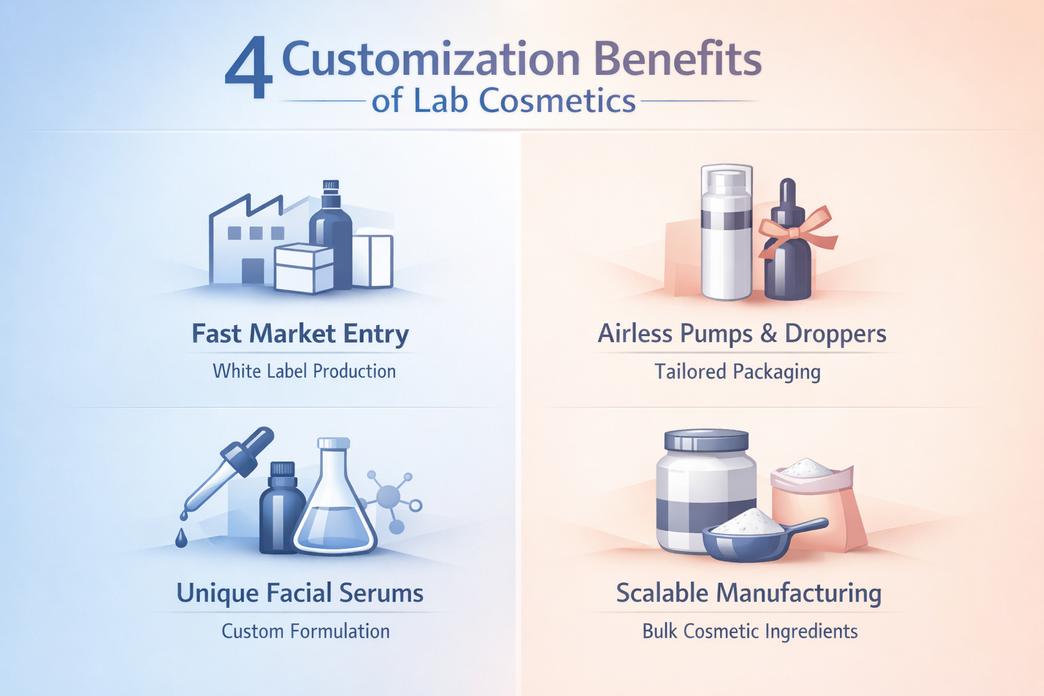
4 Customization Benefits Of Lab Cosmetics
Lab cosmetics are changing how beauty brands get started and grow. From cosmetic lab testing to scalable lab beauty production, smart customization makes lab cosmetics more flexible, faster, and honestly, way more brand-friendly than old-school manufacturing.
White Label Production Enables Fast Market Entry
With lab cosmetics, speed comes down to how well the system is built:
● Foundation layer: Ready solutions
● white label and private label options based on ready-made formulas
● Pre-checked compliance within cosmetic manufacturing standards
● Documents prepared for smoother product launch
● Brand layer: Market positioning
● Quick tweaks for shade, scent, or texture to support brand development
● Packaging swaps without restarting the full lab process
● Faster sampling cycles to improve speed to market
● Scale layer: Growth readiness
● Flexible batch sizes inside structured lab cosmetics workflows
● Expansion from pilot run to retail volumes without formula changes
At Topfeel Beauty, lab cosmetics are built to move at retail pace, not lab speed alone.
Custom Formulation Development for Facial Serums
Great lab cosmetics don’t stop at stock bases. For facial serums, customization feels personal:
1.Define the target audience and skin concern.
2. Adjust ingredient selection for texture and absorption.
3. Test for product efficacy in small cosmetic lab batches.
● Focus on custom formulation for oil control, brightening, or repair.
● Blend actives into unique blends that stand out in crowded skincare products shelves.
● Refine scent, viscosity, and finish.
This mix of laboratory cosmetics precision and creative direction helps brands avoid “same-old” serum launches.
Tailored Packaging with Airless Pumps or Dropper Bottles
Packaging in lab cosmetics works in tiers:
● Container strategy
● airless pumps for oxidation-sensitive formulas
● dropper bottles for controlled dosing
● Other container options aligned with formula weight
● Performance focus
● Better preservation through limited air exposure
● Stable actives supported by cosmetic lab compatibility checks
● Market impact
● Elevated product presentation
● Smoother user experience from first press to last drop
Topfeel Beauty aligns lab cosmetics filling systems with packaging specs, so what looks premium also works flawlessly.
Bulk Cosmetic Ingredients for Scalable Manufacturing
Scaling lab cosmetics is about structure, not guesswork:
● Input control
● Verified bulk ingredients and certified cosmetic raw materials
● Supplier audits tied to supply chain tracking
● Production strength
● Managed production capacity for large-scale production
● Standardized processes supporting scalable manufacturing
● Output consistency
● Ongoing quality control inside every cosmetic lab run
● Batch stability checks before distribution
From startup drops to nationwide launches, lab cosmetics backed by Topfeel Beauty keep growth steady, not chaotic.
Lab Cosmetics Vs. Mass-Market Products
Lab cosmetics are popping up everywhere, but not all beauty products play the same game. Some focus on science and precision. Others chase scale and shelf space. Here’s how lab cosmetics stack up against mass-market options in real-world terms.
Lab Cosmetics
Lab cosmetics sit at the crossroads of scientific formulation and serious performance. A lab cosmetic brand usually works through contract labs that obsess over data, stability, and ingredient synergy.
1. Development Core1.1 Formula Design
● Built on research and development pipelines
● Uses high-quality ingredients at functional percentages
1.2 Testing Phase
● Backed by clinical testing
● Benchmarked for measurable efficacy
2. Ingredient Philosophy2.1 Transparency
● Clear INCI lists support ingredient transparency
2.2 Targeting
● Focus on targeted solutions like barrier repair or brightening
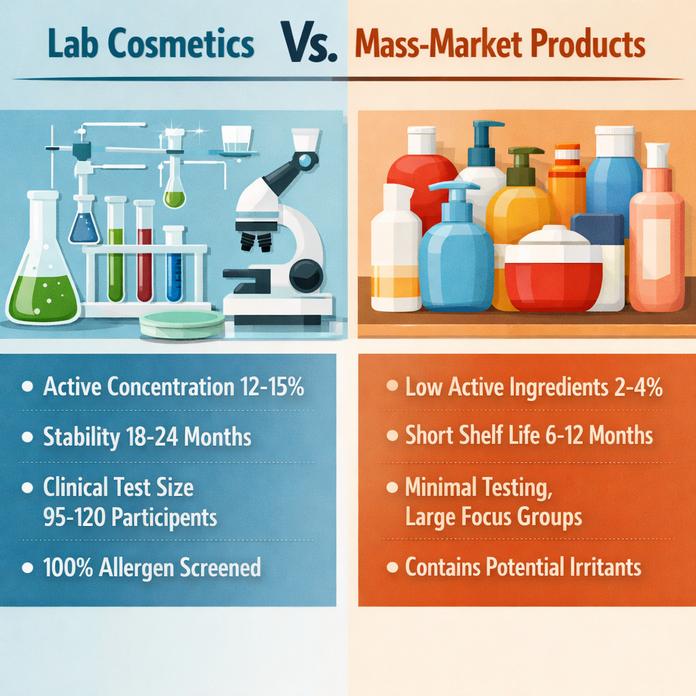
Here’s a simplified comparison often seen in lab cosmetics production:
| Parameter | Lab Cosmetic Batch A | Lab Cosmetic Batch B | Industry Avg. |
|---|---|---|---|
| Active Concentration % | 12% | 15% | 6% |
| Stability (Months) | 24 | 18 | 12 |
| Clinical Test Size | 120 participants | 95 participants | 30–50 |
| Allergen Screening | 100% screened | 100% screened | Partial |
Brands like Topfeel Beauty align with lab cosmetics standards by combining lab cosmetic precision, custom lab formulations, and scalable lab production. In short, lab cosmetics are built to perform, not just to sit pretty.
Mass-Market Products
Mass-market products move fast. Lab cosmetics move carefully.
1. Production Logic1.1 Scale
● Driven by mass production
● Distributed through wide availability channels
1.2 Cost Control
● Ingredient swaps for affordability
2. Market Orientation2.1 Appeal
● Designed for broad appeal
● Often trend-driven
2.2 Formula Style
● Relies on standardized formulas
● Prioritizes consumer accessibility over customization
Mass products win on price and speed. Lab cosmetics, including lab cosmetic lines developed by Topfeel Beauty, win on depth, lab-backed data, and long-term skin results. If skin goals matter more than hype, lab cosmetics usually take the lead.
FAQs
What makes lab cosmetics outperform typical retail skincare brands?
Lab cosmetics are built inside controlled environments where performance comes before packaging hype.
1. High-potency active ingredients are measured precisely under cGMP standards, so facial serums and moisturizers deliver visible changes faster.
2. Strict microbial testing and stability testing protect texture, scent, and strength over time.
3. Custom options from a private label cosmetics manufacturer allow:
● Targeted facial serums for aging skin
● Lightweight cleansers for sensitive users
● Rich body lotions with botanical oils
The result feels intentional—products behave the same from the first pump to the last drop.
How do manufacturers ensure ingredient safety and regulatory compliance?
Safety is built into every stage of contract manufacturing.
● Ingredient research screens natural extracts, organic compounds, and preservative systems before blending.
● Ingredient traceability tracks each batch of bulk cosmetic ingredients.
① Microbial testing confirms purity
② safety assessments validate skin compatibility
③ Regulatory compliance reviews prepare documents for global markets
This layered control protects both brand reputation and customer skin.
Can lab cosmetics be customized to fit a brand vision?
Yes—and this is where creativity meets science.
Through custom formulation and toll manufacturing, brands shape private label skincare or private label makeup that reflects their identity. The process often includes:
● Product prototyping for shampoos, lip balms, or moisturizers
● Ingredient research into essential oils or advanced emulsifiers
● Performance testing and sensory evaluation for feel and absorption
● Claims substantiation backed by data
White label production offers speed; bespoke development offers distinction. Many brands start simple, then evolve into signature lines that customers recognize instantly.
Why is sustainable packaging important in lab cosmetics?
Packaging is the silent ambassador of a formula.
Airless pumps protect active ingredients from oxidation.
Glass bottles signal purity and premium positioning.
Tubes and plastic jars offer practicality for daily use.
Add custom packaging design and sustainable packaging choices, and the product speaks before it is opened. Eco-aware buyers notice recyclable materials and reduced waste. Preservation meets presentation—and trust grows from both.
What supply chain advantages come with working with a lab cosmetic manufacturer?
Consistency is not luck; it is logistics.
A structured network connects:
● Bulk ingredient supply for steady raw material access
● Organized inventory management
● Secure finished goods warehousing
● Reliable distribution networks and third-party logistics
References
1. active ingredients - ncbi.nlm.nih.gov / NIH
2. botanical oils - ncbi.nlm.nih.gov / NIH
3. cGMP standards - fda.gov / FDA
4. skin renewal cycles - ncbi.nlm.nih.gov / NIH
5. Sustainable packaging - ellenmacarthurfoundation.org / Ellen MacArthur Foundation
6. Recyclable materials - epa.gov / EPA
7. Supply Chain - hbr.org / Harvard Business Review
8. ISO 9001 - iso.org / ISO
9. Quality Management System - asq.org / ASQ
10. Shelf Life - ncbi.nlm.nih.gov / NIH
11. Microbiological Limits - ncbi.nlm.nih.gov / NIH
12. clinical testing - clinicaltrials.gov / NIH
13. safety assessments - cosmeticsinfo.org / Cosmetics Info
Related Products

Top Selling Products






- Related Blog
- Related Videos
- Reviews
