
Tested: Does a Water Based Lip Stain Really Last All Day?
Survived meetings, tacos and iced coffee: our water based lip stain ended at a soft, even tint by hour 8. Get wear-test data before bulk orders.
A water based lip stain that vanishes by lunch means another application.
Meetings, meals, and iced coffee provide useful occasions to record color changes and transfer during wear.
Topfeel Beauty provides MSDS and COA documentation for formulations, alongside custom-formulation support.
Key Points: Where Water Based Lip Stain Fades and Stays
→ Test Method: Compare application, daily activities, and reapplication consistently.
→ Hour-by-Hour Result: Record color, edges, and comfort separately.
→ Comfort: Include tightness and flaking in the evaluation.
→ Versus Oil Tint: Compare complete formulas rather than base names alone.
→ Before Bulk Ordering: Request viscosity, pH, and leakage results.
How We Tested Water Based Lip Stain Wear
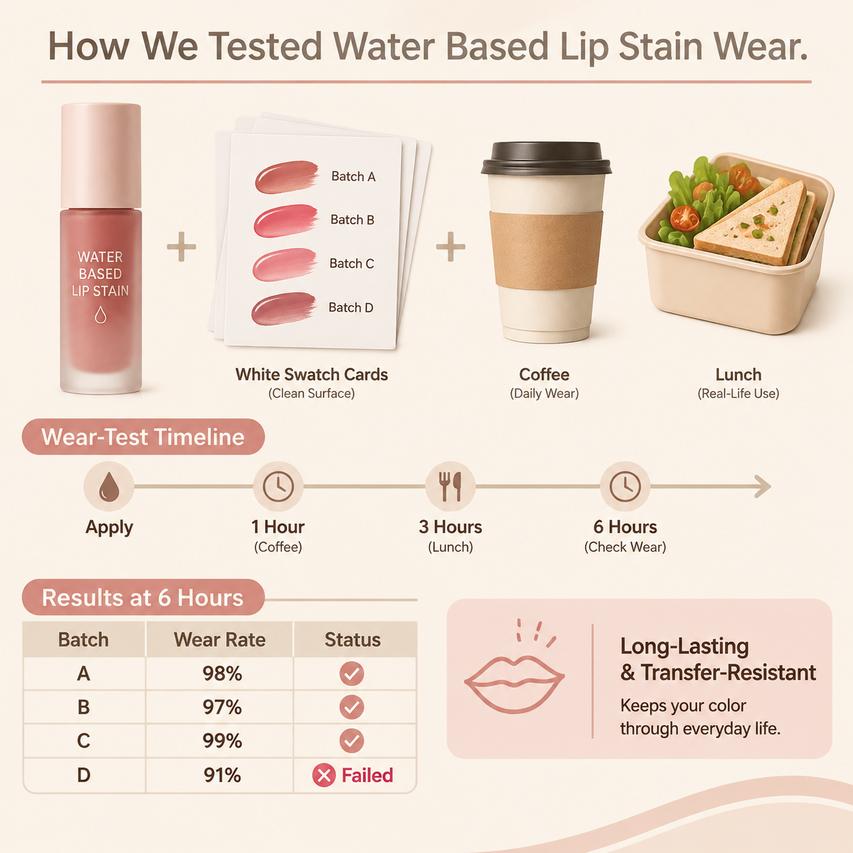
Label promises belong alongside real-day wear evaluation. For EU marketing, cosmetic claims need adequate, verifiable evidence, and studies must match the product and claimed benefit.
Test Setup: Stain Longevity Test Across Real Wear Conditions
Testers can go about their normal day while keeping application and observation conditions consistent across samples.
- Morning start
- Everyone uses the same application method, recording layers and applicator
- No balm underneath unless that is the agreed application routine
- Midday grind
- Normal daily activities include commuting, chatting, and calls
- Coffee mugs and water bottles help document transfer resistance
- Evening check-in
- Wear time and color strength belong in the same observation log
- Any reapplication after dinner belongs in that log too
The goal is to compare longevity under the intended use conditions, including meals and touch-ups.
Why Pigment Dispersion and Glycerin Base Shaped Our Sample Selection
Good formulation starts with a clear ingredient brief and the desired color and feel.
Pigment dispersion describes color-particle distribution. A glycerin base belongs in the formula discussion alongside texture and moisture preferences.
- Even pigment distribution is part of the color intensity assessment
- Glycerin belongs in the texture discussion
- Both belong in sample comparison before approval
Topfeel Beauty’s custom lip makeup development includes texture and color requirements.
Checking Color Swatch Uniformity Before Every Application
A baseline test uses the same card, tool, and lighting. For US products, permitted color uses and restrictions distinguish lipstick use from external-use categories.
| Batch | Shade accuracy (%) | Pigment consistency (variance %) | Coverage (swipes to full color) |
|---|---|---|---|
| A | 98 | 1.2 | 2 |
| B | 97 | 1.5 | 2 |
| C | 99 | 0.9 | 2 |
| D | 91 | 4.8 | 3 |
Compare each color swatch with the approved shade before moving to lip application.
Make sampling count: Connect the wear routine, formula selection, and swatch approval in one sample brief. Topfeel Beauty’s formulation engineers prepare initial samples in 3-7 days, giving buyers a concrete stage for comparing texture and color before approval.
Review its custom solutions and lip development to prepare that coordinated sample brief.
Hour-by-Hour Water Based Lip Stain Results
Color, comfort, smudges, and staying power deserve separate entries, from initial application through the evening check.
Hours 0 to 2: Fresh Color Payoff from Pigment
The pigment and applicator belong in the initial-application record. Compare the edge, hue, and feel before judging the finished look.
- Feel: record thinness, tack, and weight
- Finish: compare the desired natural tint with the sample
- Build: record the effect of additional layers
Does Hyaluronic Acid Infusion Keep Lips Comfortable by Hour Four?
- What’s doing the work
- Hyaluronic acid retains water and is used in moisturizing products
- Aloe vera extract belongs in the ingredient review when present
- How lips felt at hour four
- Lip comfort: record tugging during speech
- Hydration level: note tightness and flaking
- Moisture barrier: record balm use
- Dryness prevention: compare comfort across samples
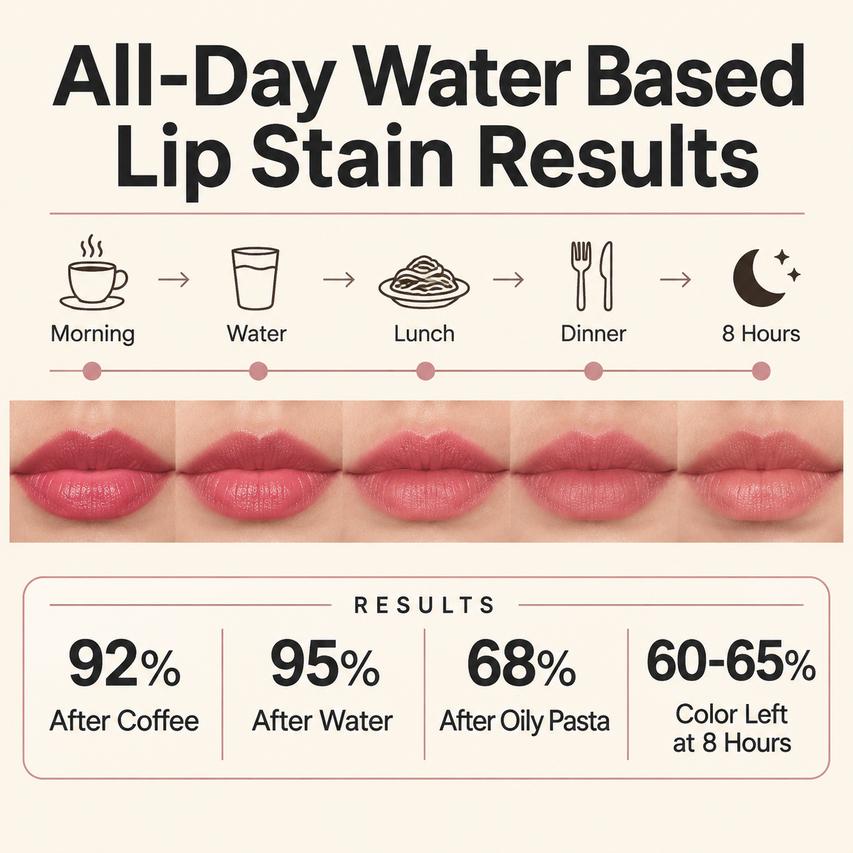
Smudge Resistance Assay After Meals and Drinks
The meal test pairs food and drink conditions with a consistent transfer record.
| Test | Transfer Score (0–5) | Color Left (%) | What We Saw |
|---|---|---|---|
| Hot coffee | 1 | 92 | Faint ring on the mug |
| Water bottle | 0 | 95 | Spotless |
| Sandwich lunch | 1 | 85 | Light wear at the center |
| Oily pasta | 3 | 68 | Oil broke down the edges |
| Napkin blot | 1 | 80 | Soft pink tint on paper |
Drink transfer, center wear, and edge fading belong in separate observations for each sample.
Eight Hours Later: How Much Stain Remains?
- What we saw at the mirror
- Remaining stain: assess intensity and evenness
- Fading pattern: compare center and edges
- What it means for your day
- Color retention: compare against initial photographs
- Pigment persistence: record touch-up needs
For all day performance, compare the application record with the touch-up routine planned for customers.
Water Based Lip Stain vs. Oil Based Tint
Water or oil is a starting point for discussing texture, finish, and comfort within a lip-color lineup.
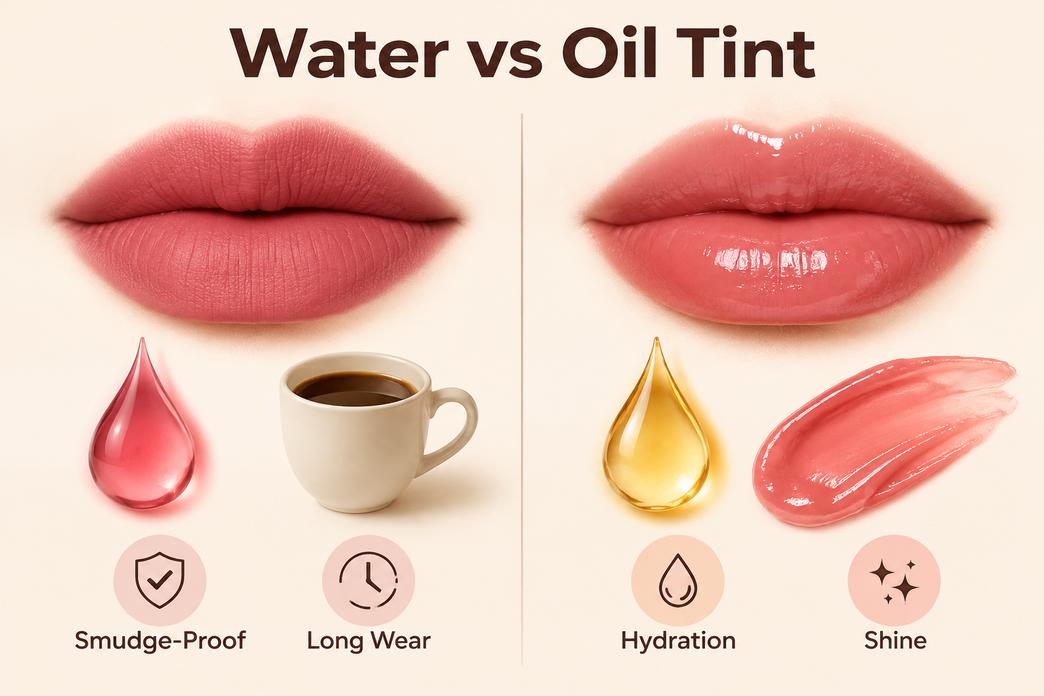
Water Based Lip Stain
Compare the dry-down and finish of each stain sample rather than relying on its category name.
- How it wears
- Finish and feel
- A lightweight texture can be a sample preference
- A soft matte finish belongs in the finish brief
- Staying power
- Smudge-proof claims need product-specific testing
- The pigment belongs in the wear assessment
- Finish and feel
- What’s inside
- Formula basics
- An aquatic formula still needs an ingredient review for vegan requirements
- A natural tint describes the desired appearance
- The catch
- Water content alone does not describe the finished texture
- Add-ins belong in the lip-comfort discussion
- Formula basics
Formulators distinguish humectants, occlusives, and emollients: they draw water, limit moisture loss, or smooth skin, respectively.
Oil Based Tint
An oil-based tint offers another route for a gloss-focused product brief.
Here’s what to compare:
- Moisturizing oils belong in the lip-oil selection
- A soft coating belongs in the comfort assessment
- Some formulas target a fuller-looking finish
Compare color coverage, migration, and mug transfer with each formula rather than assuming a category-wide winner.
For dry, chapped lips, dermatologists recommend non-irritating products and stopping products that burn or sting.
Build a clearer lineup: Which texture and finish should your next lip launch prioritize?
Topfeel Beauty develops custom formulas around texture, color, and finish requirements. Compare custom formulation with its lip oil route to prepare a side-by-side brief covering comfort, appearance, and wear expectations for sampling.
3 Stability Tests Every Water Based Stain Needs
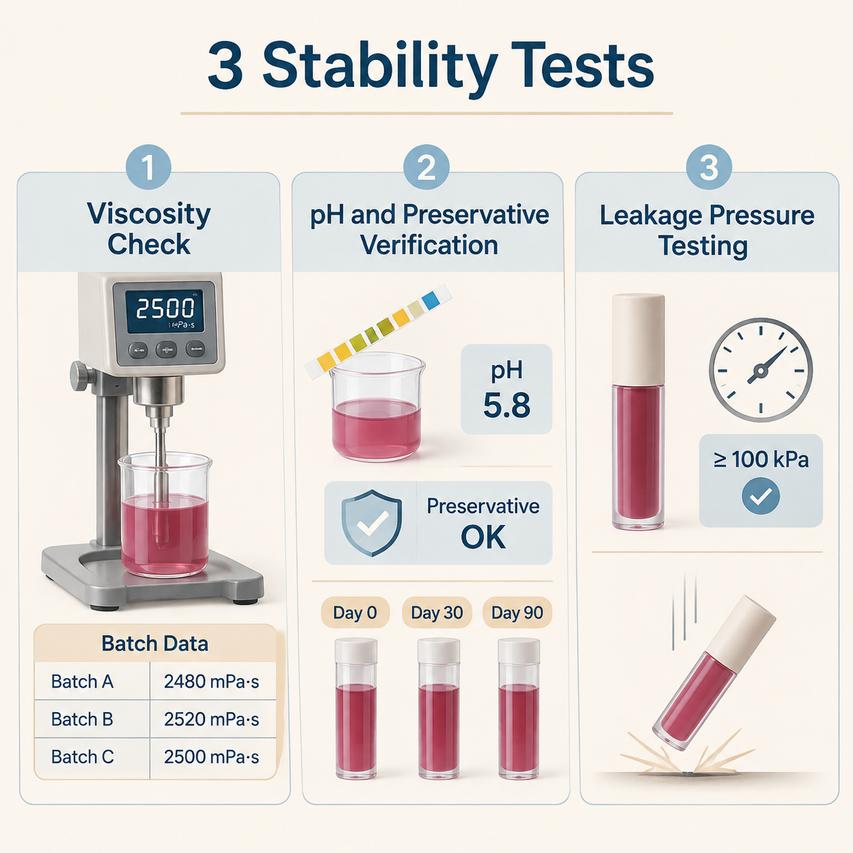
Stability planning connects the lab sample with its shipping box, intended packaging, and storage conditions.
Viscosity Consistency Check for Reliable Bulk Batches
Thin stains need a clear texture specification for application and filling.
- Measuring the flow
- A viscometer belongs in the agreed flow-measurement method
- Tracking rheology requires consistent measurement conditions
- Matching every batch
- Each run gets compared to the approved texture profile
- Tight batch uniformity requires agreed acceptance criteria
| Batch | Shear Rate (s⁻¹) | Viscosity (mPa·s) | Result |
|---|---|---|---|
| B-01 | 10 | 1,850 | Pass |
| B-02 | 10 | 1,920 | Pass |
| B-03 | 10 | 2,640 | Rework |
| B-04 | 10 | 1,880 | Pass |
pH Stabilization and Preservative System Verification
A stain’s pH belongs in its stability protocol. The stability-testing framework leaves manufacturers to specify and justify methods, specifications, and conditions for each product.
→ Acid-base balance belongs in the formula specification.
→ A microbial challenge belongs in preservative-system assessment.
→ The right antimicrobial agents are part of preservation planning.
Inadequate preservation and protective packaging are among the contamination routes identified by FDA.
Leakage Pressure Check for Polypropylene Tube Packaging
Packaging assessment connects the filled product with shipping and handling conditions.
- Pressure trials
- Vacuum decay belongs in the leakage-method discussion
- Burst pressure belongs in the package-strength discussion
- Material and seal checks
- Polypropylene bodies need product-specific handling checks
- Wipers and caps belong in container closure assessment
Topfeel Beauty’s custom-formulation work includes compatibility, stability, and safety assessments within the manufacturer-selection discussion.
Before bulk approval, bring viscosity, pH stabilization and preservative verification, and closure requirements into one validation discussion. Topfeel Beauty’s integrated development workflow connects formula development with packaging and quality control, helping buyers coordinate the filled-product specification rather than approve those decisions separately.
Submit your formula and packaging requirements to discuss the assessment scope before sampling.
References
- Regulation 655/2013 — europa.eu
- Color Additives Permitted for Use in Cosmetics — fda.gov
- Hyaluronic Acid — clevelandclinic.org
- Choosing the Best Moisturizer for Dry Skin — clevelandclinic.org
- 7 dermatologists’ tips for healing dry, chapped lips — aad.org
- ISO/TR 18811:2018 — iso.org
- Microbiological Safety and Cosmetics — fda.gov
Post time: Nov-17-2026