
Natural Preservatives for Cosmetics: Key Options for Formulators
Preservation requires balancing pH, water activity, heat, packaging, compatibility, shelf life, and certification goals.
Potassium sorbate, sodium benzoate, gluconolactone, Leuconostoc ferment, and ethylhexylglycerin behave differently. Pair formulation fit with challenge testing, GMP controls, traceability, and supply planning. The FDA’s information on cosmetic preservatives explains why choices belong in a finished-product safety plan.
Reading Notes on Natural Preservatives for Cosmetics
→ Supply Scalability: Secure bulk sodium benzoate or gluconolactone through vetted suppliers with consistent COA.
→ Formulation Fit: Match preservative to product pH, water activity, and matrix—e.g., potassium sorbate in acidic creams, ethylhexylglycerin in heated blends.
→ Microbial Validation: Use microbiological assays and challenge testing under ISO 22716 to assess protection. FDA’s microbiological safety guidance covers microbial contamination control.
→ Certification Compliance: Partner with ISO-certified or Ecocert/COSMOS-approved manufacturers.
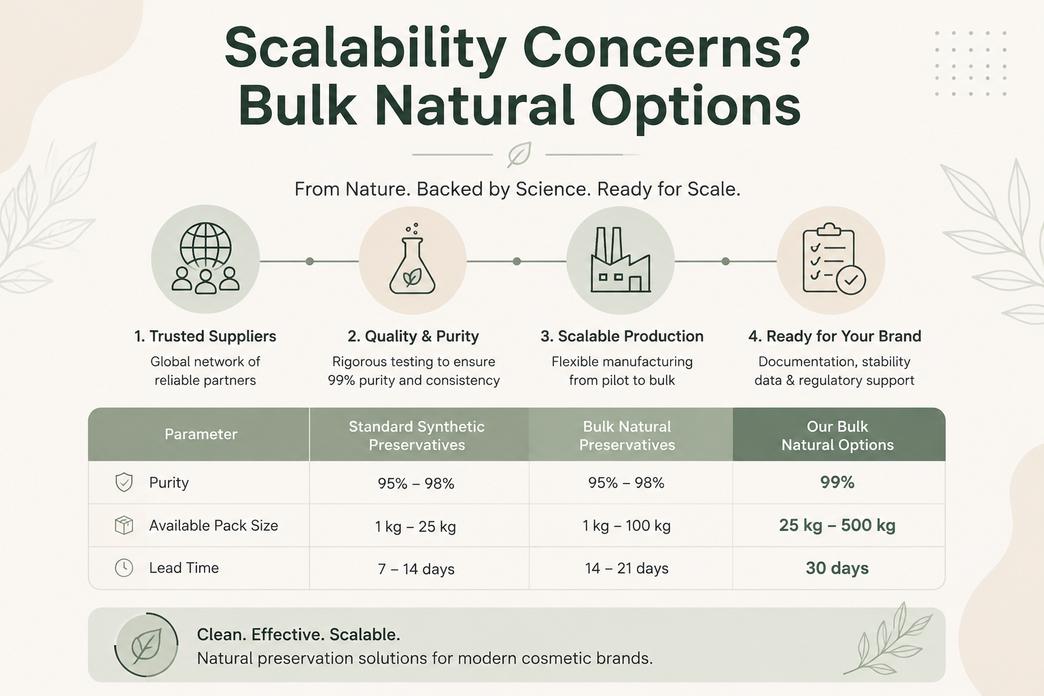
Scalability Concerns? Bulk Natural Options
Scaling natural preservatives for cosmetics takes more than buying drums. Sourcing, production controls, and testing must align. Private label makeup support connects planning to a launch route.
Ensuring Bulk Supply of Sodium Benzoate
For Sodium Benzoate, qualify more than one cosmetic grade source.
- Supply planning
- Check bulk supply, lead time, and minimum orders.
- Compare certificates of analysis between batches.
- Production control
- Review GMP records and inventory management.
- Track supply chain stability and preservative efficacy.
Good raw material procurement keeps supply scalable.
Raw Material Sourcing for Gluconolactone
Gluconolactone, a polyhydroxy acid, can also act as a chelating agent in a cosmetic formulation. During supplier qualification, check purity, traceability, microbiological limits, pH behavior, and organic certification. Confirm identity with the potassium sorbate ingredient profile.
| Check | Target | Pilot | Scale |
|---|---|---|---|
| Purity | ≥99% | 25 kg | 500 kg |
| pH, 10% solution | 2.5–3.5 | 3.1 | 3.0 |
| Lead time | ≤30 days | 18 | 24 |
Contract Manufacturing of COSMOS-Approved Blends
Commercial contract manufacturing needs matching paperwork and controls. ISO 22716 provides a cosmetics GMP framework, while the COSMOS standard defines requirements for natural and organic cosmetics.
- Confirm ISO 22716 and regulatory compliance.
- Verify ingredient traceability.
- Review batch records.
- Validate COSMOS-approved preservative blends.
- Check compatibility with natural cosmetics.
- Plan production scaling and private label runs.
Custom Formulation with Shelf Life Stability
Custom formulation brings the pieces together: tune pH, packaging, dose, and compatibility, then verify preservative efficacy. An ingredient guide helps define requirements before production.
- Confirm shelf life stability through accelerated storage.
- Run microbial testing and challenge testing against expected contamination risks.
- Use results to guide formulation development and product safety decisions.
Scale with control: Are bulk sourcing, batch records, and shelf-life testing being planned as one system? Topfeel Beauty’s one-stop service covers raw material sourcing, formula development, manufacturing, and quality control, so growing brands can turn preservative requirements into a documented production brief.
Review the custom solutions route to define the specification, then contact the team with your product type and target market.
5 Natural Preservatives for Cosmetics Overview
Choosing natural preservatives for cosmetics means matching each ingredient to pH, water, heat, and microbial risk. There is no one-size-fits-all fix. The foundation category offers a route for discussing texture and stability.
Potassium Sorbate: Broad Spectrum Activity in Creams
- Potassium Sorbate suits acidic Creams, especially where yeast and mold control matters.
- Its Antimicrobial reach is not truly Broad Spectrum alone.
- In an Emulsion, pair it with compatible cosmetic preservatives and challenge-test the finished product; research on preservative systems supports evaluating the complete emulsion.
Sodium Benzoate for Water-Soluble Bases
Sodium Benzoate brings Water-Soluble performance to an aqueous Cosmetic Base. Acidic pH, suitable concentration, and compatibility help support Microbial Control in Formulations.
Gluconolactone’s pH Stability in Lotions
- Gluconolactone slowly forms gluconic acid in Lotions.
- This can support an Acidic Range.
- As a Chelating Agent, it can also help preservation.
- Its humectant and Skin Conditioning roles add formulation value.
Leuconostoc Radish Root Ferment Filtrate’s Antimicrobial Efficacy
- Leuconostoc Radish Root Ferment supports Natural Preservation.
- Its Antimicrobial Efficacy varies by formula.
- So, no shortcuts: challenge testing should confirm protection when using these systems; a 2024 cosmetic-preservation study illustrates why activity should be assessed in the intended product.
- Its Antimicrobial Efficacy varies by formula.
Ethylhexylglycerin’s Thermal Tolerance Benefits
Topfeel Beauty may use Ethylhexylglycerin as a Booster where heat is involved.
- Its Heat Stability suits heated Manufacturing.
- Its mild Emollient character supports skin feel.
- Paired correctly, it can strengthen Preservative Efficacy rather than stand alone.
Choose by formula: Compare acidic sorbates, water-soluble benzoates, ferment systems, and heat-tolerant boosters against pH, water, heat, and microbial risk. Topfeel Beauty’s OEM/ODM route helps turn that framework into a product brief.
Which Natural Preservatives Suit Oils?
Choosing natural preservatives for cosmetics gets tricky when oils, water, and emulsions behave differently. A cream system may not translate to a dry oil base. Screening focuses on water exposure, pH, product use, and microbial testing. The lip gloss category helps compare a relevant format.
Potassium Sorbate in Lip Gloss Base
Potassium sorbate prefers water, so a fully anhydrous lip gloss base may not give it much room to work.
- Check water activity before choosing natural preservatives for cosmetics.
- Low available water can reduce contamination risk.
- Added aqueous ingredients change that calculation.
- Review pH stability and expected antimicrobial efficacy.
- An emulsion system needs suitable dispersion.
- Cosmetic safety and lip compatibility still require finished-product assessment.
Ethylhexylglycerin for Mascara Formulation
Ethylhexylglycerin works as a multifunctional additive, not an automatic standalone answer. In a mascara formulation, it can act as a preservative booster with moisturizing agent benefits.
- Control microbial growth with a compatible preservative system.
- Confirm viscosity stability after adding oils and pigments.
- Validate eye area safety and challenge-test the finished mascara.
Gluconolactone in Liquid Foundation
For water-containing liquid foundation, gluconolactone is a polyhydroxy acid that can aid pH control and chelation. A sodium benzoate ingredient profile provides a reference point for the ingredient’s identity when comparing systems.
- Its useful supporting traits include:
- skin conditioning
- antioxidant properties
- mild preservation
- Final checks should cover:
- formulation stability and even mixing
- preservative compatibility and microbial challenge results
Protect the right format: Lip gloss, mascara, and liquid foundation can require different preservation decisions.
Topfeel Beauty’s custom solutions helps compare oils, emulsions, water-containing bases, texture, packaging, and compatibility. Review the private label lip gloss service to prepare a format checklist covering water exposure, dispersion, and testing.
Scenario — Private Label Makeup Preservation
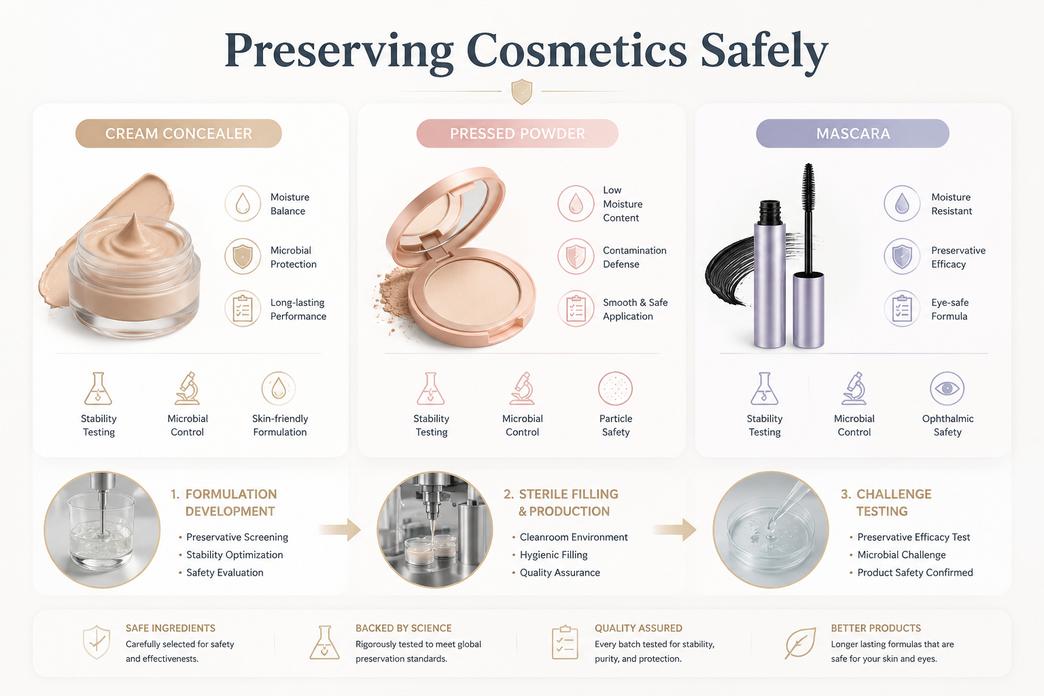
Private label preservation changes with product type, water content, and heat. Ingredient choice is only part of the job; production and testing matter too. Topfeel Beauty pairs contamination controls with product-specific checks. Its OEM face makeup service can carry that brief into production planning.
Cream Concealer Emulsification & Microbial Testing
For cream concealer, good emulsification helps distribute each natural preservative evenly.
- During formulation:
- Control mixing and homogenization.
- Check water activity, since available water affects microbial growth.
- After batching:
- Run microbial testing for contamination and possible pathogen risks.
- Use challenge tests to measure antimicrobial efficacy over time.
Pressed Powder Sterile Filling with Ecocert Compliance
A pressed powder usually behaves like an anhydrous system, so low available moisture may reduce microbial growth.
- For contamination control:
- Keep equipment, pans, and filling areas hygienic; true sterile filling should only be claimed when validated.
- Apply routine quality assurance checks.
- For Ecocert compliance:
- Review every ingredient against applicable COSMOS/Ecocert criteria for organic certification goals.
- Confirm any natural preservatives for cosmetics fit the intended certification route.
Mascara Hot Pour Blending & Challenge Testing
Mascara needs careful microbial attention because applicator use can introduce contamination.
- Hot pour blending
- Match preservative heat stability with processing temperature and viscosity.
- Assess a compatible preservative booster where useful.
- Challenge testing
- Test natural preservatives for cosmetics against relevant microorganisms.
- Monitor the microbiological limit and protection against repeated-use contamination through expected shelf life.
Move from brief to batch: Can your concealer, powder, and mascara plans carry preservation discipline from formulation through filling and QC? Topfeel Beauty’s OEM face makeup workflow combines custom formulation with production and quality control, giving brands one route for requirements. Its documented workflow includes initial samples in 3-7 days.
Contact Topfeel Beauty to submit the product formats, packaging, target claims, and testing questions that should shape the first discussion. Submit the brief through the contact form.
References
- Parabens in Cosmetics — fda.gov
- Microbiological Safety and Cosmetics — fda.gov
- ISO 22716:2007 — iso.org
- COSMOS Standard — cosmos-standard.org
- Potassium Sorbate — pubchem.ncbi.nlm.nih.gov
- The Role of Preservatives and Multifunctionals on Cosmetic Products — mdpi.com
- A Radish Root Ferment Filtrate for Cosmetic Preservation — mdpi.com
- Sodium Benzoate — cosmeticsinfo.org
Post time: Sep-07-2026