
Do Moisturizing Oils for Lips Actually Work?
Lip oil can’t fix a licked mouth. Private label brands: pick moisturizing oils for lips, make safe claims, and dodge the returns pile.
Moisturizing oils for lips belong in a comfort-focused routine. Private label brands need clear product expectations.
What should your brand promise? Consider the formula, ingredients, and launch checks together.
Reading Notes: Moisturizing Oils for Lips, Soft Where the Day Gets Dry
→ Coat or heal: Separate everyday dry-lip care from treatment claims.
→ Oils worth using: Compare squalane, jojoba, and shea-derived ingredients in the finished blend.
→ Water side: Consider the humectant and oil phase together during development.
→ Test before launch: Define texture, microbiological, stability, safety, and package-compatibility checks before production.
Do Lip Oils Heal or Just Coat?
Lip oils are cosmetic products. Distinguish comfort and appearance from treatment claims.
How Plant-Based Squalane Supports the Lip Barrier
Plant-based squalane is used as an emollient in skin care.
- Why it fits so well
- Skin compatibility: squalane is a skin-care emollient.
- Natural oils provide plant-derived feedstocks for some squalane grades.
- What it does day to day
- Boosts moisture retention by helping reduce water loss.
- Works as an emollient to soften skin.
- Keeps moisture at the skin surface rather than supplying water itself.
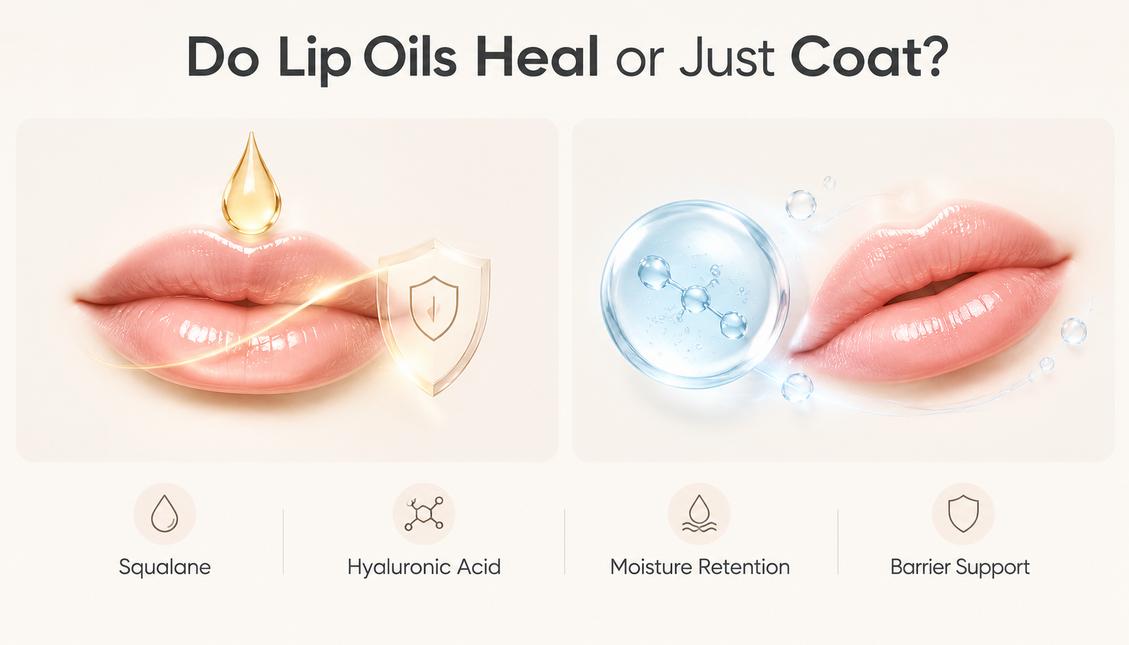
Hyaluronic Acid Spheres and the Water Side of Lip Care
Hyaluronic acid can retain water. Its role in a particular lip product depends on the ingredient form and finished formula.
For a hydrating lip serum, distinguish the two formulation roles:
- The hyaluronic acid component binds water.
- The oil layer contributes the product’s coating and feel.
Topfeel Beauty develops custom formulas, with compatibility and stability assessments alongside safety review.
Can a Lip Oil Really Repair Chapped Lips?
Short answer: oils support comfort, but habits matter for chapped lips. Dermatologists recommend avoiding irritating ingredients and lip licking.
- Where oils help
- Surface occlusion helps reduce moisture loss.
- Nourishing oils soften the skin’s surface.
- A protective coating contributes to moisture retention.
- Where oils fall short
- Constant licking can worsen dryness.
- Dehydration is not a condition for a cosmetic oil to treat.
Comfort with a clear brief: Barrier feel, hyaluronic acid design, and chapped-lip expectations belong in one development conversation. Topfeel Beauty develops custom lip formulas with stability assessments, helping brands evaluate the finished product rather than an ingredient story alone.
Compare the private label lip oil to shape a comfort-and-claims specification.
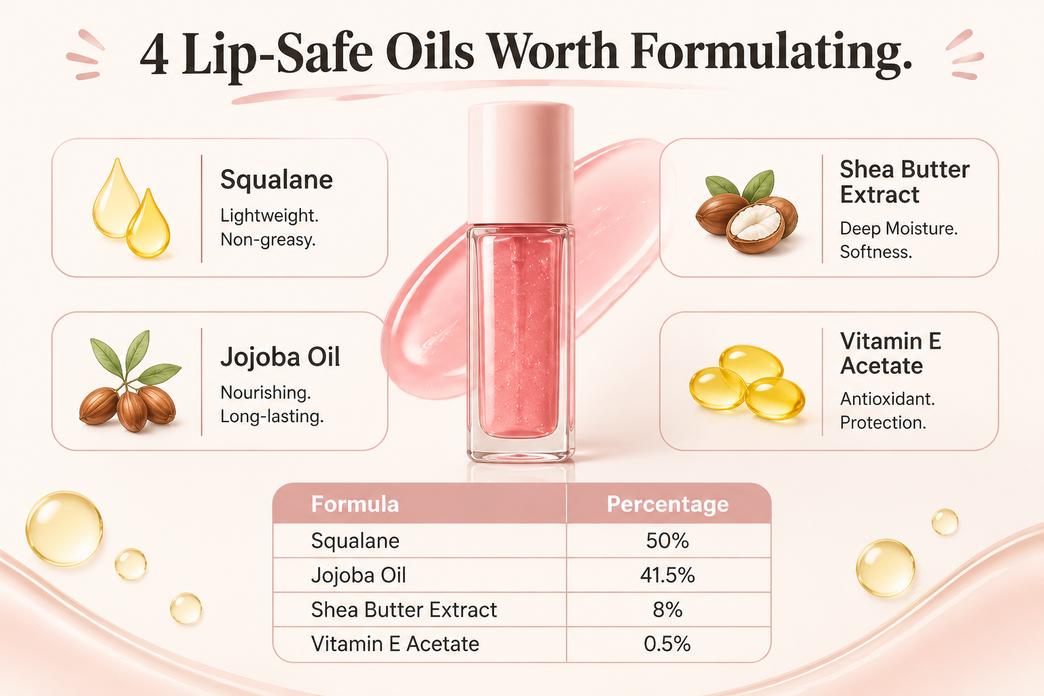
4 Lip-Safe Oils Worth Putting in Your Formula
Good moisturizing oils for lips balance glide, cushion, ingredient identity, and shelf stability. Evaluate the blend in its intended pack.
Plant-Based Squalane for Lightweight Glide
- How it feels
- Spreads with the blend’s intended glide
- Totally non-greasy formulas depend on the whole blend, not squalane alone
- What it does for lips
- Works as an emollient ingredient
- Supports the moisture barrier through emollient action
- Why packaging teams like it
- Flows through the applicator as part of the finished formula
Why Cold-Pressed Organic Jojoba Oil Suits Lip Formulas
Jojoba oil is a liquid wax with emollient properties, discussed in a review of topical plant oils. Topfeel Beauty’s cosmetic ingredient guide provides related ingredient reading.
- Cold-pressed extraction avoids heat and chemical refining treatments
- Organic sourcing needs appropriate documentation
- It has high oxidative stability and resistance to degradation
Its wax esters contribute to jojoba’s use in skin moisturizers.
Shea Butter Extract for Cushioned, Longer-Lasting Comfort
- What it adds
- A soft cushion from a butter-derived ingredient
- A mixture of fatty acids and unsaponifiable compounds
- How much to use
- About the concentration: it depends on the particular butter or extract used
- Push up the shea share and the liquid-oil share falls
Shea butter contains oleic, stearic, linoleic, and palmitic fatty acids.
Where Vitamin E Acetate Fits in a Bespoke Formulation
Vitamin E acetate appears alongside the oils in this sample formulation:
| Ingredient | Main Role | Sample Blend (%) | Typical Range (%) |
|---|---|---|---|
| Squalane | Glide | 50 | 30–60 |
| Jojoba oil | Nourishment | 41.5 | 20–50 |
| Shea butter extract | Cushion | 8 | 2–10 |
| Vitamin E acetate | Antioxidant | 0.5 | 0.1–1 |
| Total | n/a | 100 | n/a |
Topfeel Beauty’s OEM lip makeup development allows custom requirements for texture, color, and finish.
One blend, deliberate choices: Give glide, cushion, and ingredient roles a shared sample brief.
Topfeel Beauty’s formulation engineers prepare initial samples in 3-7 days within its customization workflow. Review custom solutions to prepare a blend-comparison brief, making ingredient priorities and applicator expectations explicit before choosing the formula to take forward.
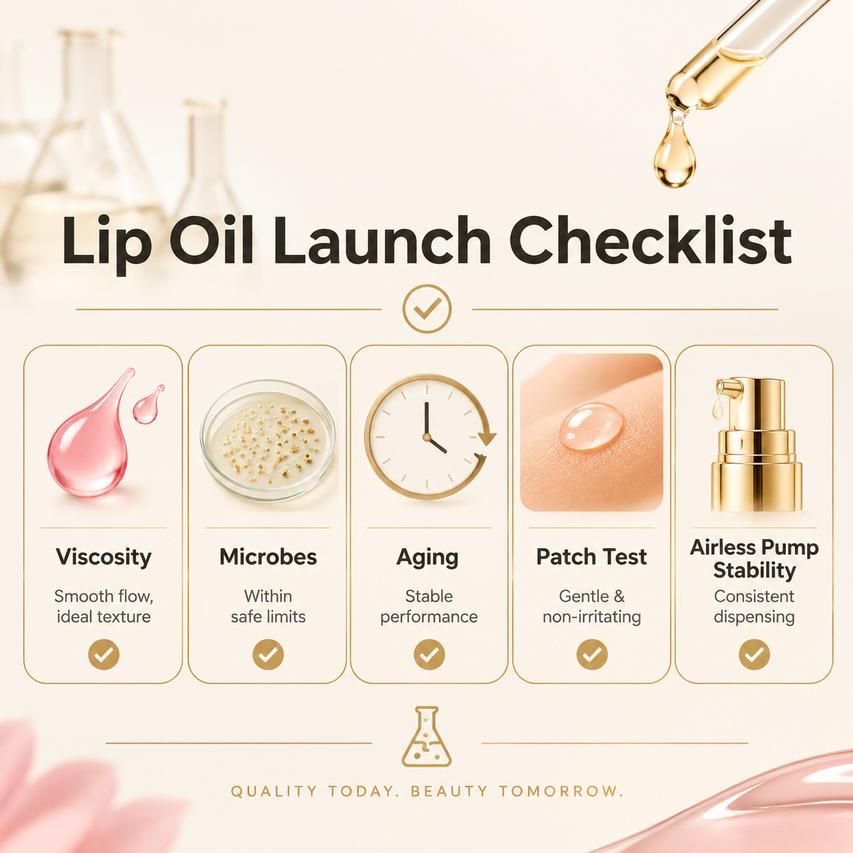
Testing Checklist Before You Launch Lip Oils
Before launch, connect formula quality with packaging performance. Use these five areas to organize the development review and agree on acceptance criteria.
Viscosity Measurement for Consistent Gloss and Texture
- Viscosity checks
- Each batch needs a defined measurement method
- This gives the team a shared consistency specification
- Rheology results
- Show the measurements for the selected method
- Flag samples for further gloss and texture review
Microbial Limit Tests and Heavy Metal Screening
People using lip products need protection from microbial contamination, which the FDA identifies as a cosmetic safety concern.
- Microbial limit tests belong in the agreed safety plan.
- Heavy metal screening needs defined analytes and acceptance criteria.
Topfeel Beauty provides microbiological testing and MSDS/COA documentation; its manufacturer-selection guide offers a starting point for supplier review.
Accelerated aging analysis: will the oil stay stable on the shelf?
The FDA explains that shelf life depends on formulation and storage. Agree on storage conditions and observations for accelerated aging, then review odor, appearance, and dispensing against the product specification.
Patch Test Verification and the Cosmetic Safety Report
➤ A patch test needs a defined protocol and appropriate interpretation.
➤ Dermatological testing should match the intended claim.
➤ Toxicology information belongs in the safety assessment.
For the EU, a cosmetic product safety report is required before placing a cosmetic product on the market.
Does Your Airless Pump Container Hold Up Under Thermal Stability Testing?
- Thermal stress cycles
- Swings between specified temperatures belong in the agreed test plan
- The dispensing mechanism needs functional acceptance criteria
- Container compatibility
- Oils and packaging should be evaluated together
- Topfeel Beauty provides compatibility considerations during product realization
Ready to connect the checks? Texture, safety, shelf stability, and pack performance need one launch specification. Topfeel Beauty’s integrated development-to-QC workflow gives brands a route for coordinating those decisions before production.
Review its OEM/ODM service, then discuss your requirements with the team using a formula-and-packaging test brief.
References
- Squalane: What It Is and Benefits — clevelandclinic.org
- Hyaluronic Acid: What It Is, Benefits, How To Use & Side Effects — clevelandclinic.org
- 7 Dermatologists’ Tips for Healing Dry, Chapped Lips — aad.org
- Anti-Inflammatory and Skin Barrier Repair Effects of Topical Application of Some Plant Oils — nih.gov
- Microbiological Safety and Cosmetics — fda.gov
- Shelf Life and Expiration Dating of Cosmetics — fda.gov
- Consolidated Regulation (EC) No 1223/2009, 18 May 2026 — europa.eu
Post time: Nov-13-2026