
Meaning of Concealer Formulating Liquid and Cream Base Makeup OEM
For beauty brands, the meaning of concealer goes far beyond hiding blemishes: it’s an OEM sourcing decision where liquid versus cream, shade consistency, coverage, wear, packaging, and compliance can make or break a launch.
Behind every approved sample, high-shear mixing, pigment micronization, emulsion control, and vacuum degassing keep production on track. This guide covers customization, shade matching, stability, packaging compatibility, ISO 22716, COAs, and FDA considerations.
Essence & Meaning of Concealer: Key Overview
- Customization: OEM shade matching service and Pantone color matching ensure uniform coverage and brand identity.
- Formulation: High shear mixing, emulsion blending, and pigment micronization deliver smooth texture and full coverage performance.
- Packaging: Choice of airless pump bottles, doe-foot applicators, or pots influences stability, dispensing precision, and user experience.
- Compliance: ISO 22716 certification, COA verification, FDA registration, and MSDS documentation underpin safety, traceability, and regulatory readiness.
What Is The Meaning Of Concealer In OEM?
The meaning of concealer in OEM goes beyond hiding spots. It covers formula development, shade control, branded packaging, and quality checks. For a private label, the concealer meaning is simple: a ready-to-brand product built around specific market needs.
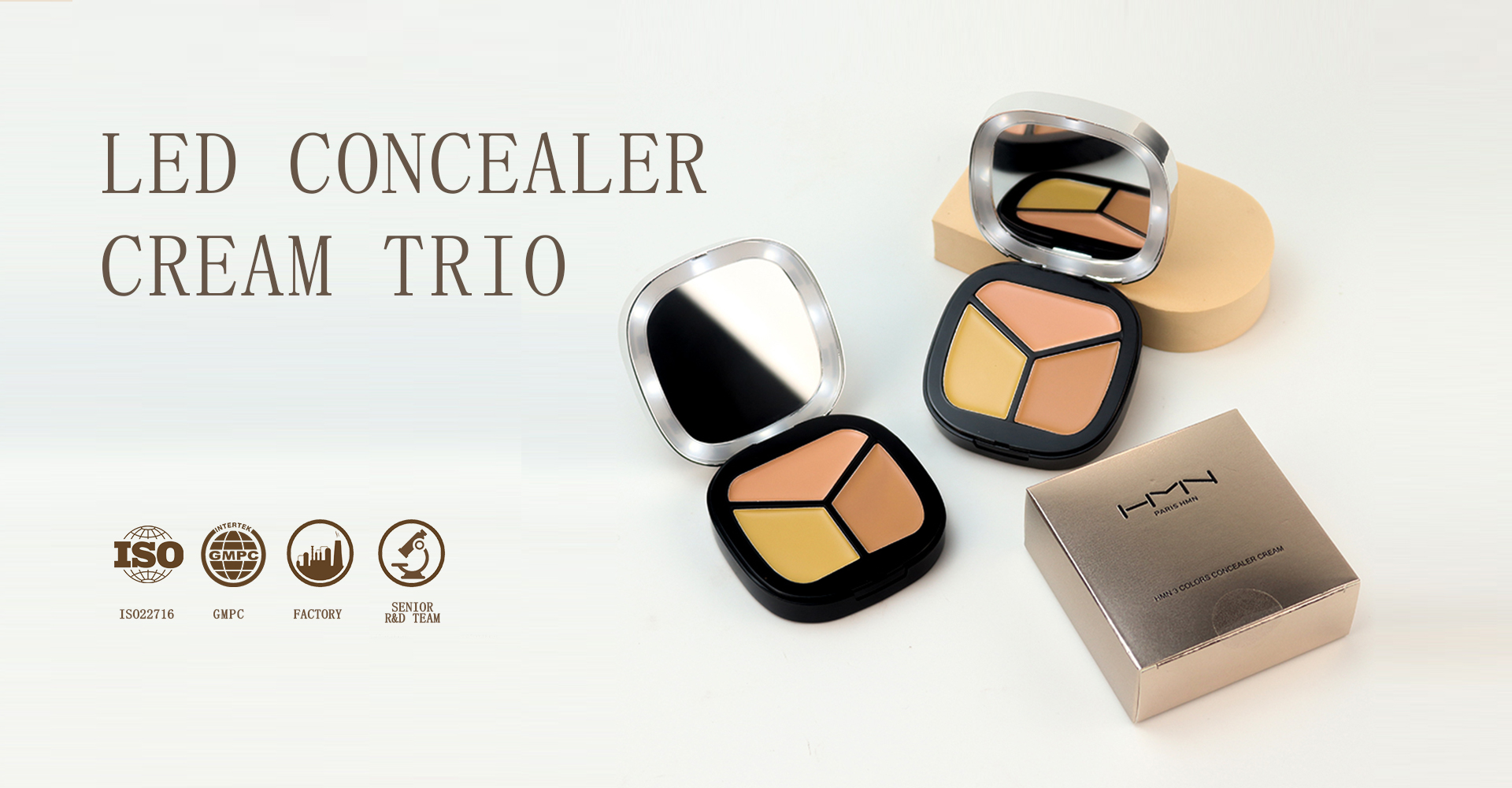
Defining Liquid Concealer and Cream Concealer in Private Label
Understanding the meaning of concealer starts with the product itself. Both formats belong to base makeup, but the feel and finish can be quite different.
-
Liquid formats
- Liquid concealer usually has a fluid texture suited to doe-foot, tube, or pump packaging.
- Its formulation can target sheer-to-full coverage, quick blending, or a natural finish.
-
Cream formats
- Cream concealer is thicker, often giving concentrated coverage for spots and discoloration.
- In cosmetic manufacturing, firmness and payoff can be adjusted for pots, sticks, or palettes.
For brands exploring custom cosmetics, Topfeel Beauty provides private label and OEM solutions to align formula textures and finishes with specific market positioning.
Key OEM Benefits: Shade Matching Service & Pantone Color Matching
A useful OEM service ties product color and brand presentation together.
-
Shade matching focuses on the makeup itself.
- A cosmetic laboratory can adjust pigment formulation for a target skin tone or reference sample.
- Multiple undertones help create practical shade families.
-
Pantone color matching focuses mainly on branded visual elements.
- Color customization can coordinate cartons and components.
- Custom silk screening and private embossed logos add a more distinctive look.
That pairing keeps shade development and packaging identity on the same page. For brands exploring packaging options, Topfeel Beauty offers related packaging solutions, collaborating with its packaging division to assist with custom molds, 3D prototyping, and diverse surface decorations.
From ISO 22716 to COA Verification: Compliance Essentials
Compliance gives the OEM concealer meaning a practical quality angle, not just a marketing one.
-
Manufacturing controls
- ISO 22716 provides cosmetic GMP standards for production, storage, and quality practices.
- Each destination market may bring its own regulatory requirement, including applicable FDA rules.
-
Product documentation
- MSDS/SDS records support ingredient and handling information.
- COA verification checks specified batch results against quality criteria.
-
Supporting evidence
- Analytical testing can confirm selected product specifications.
- Cruelty-free documentation, traceability, and cosmetic safety records support quality compliance and market readiness.
Meaning Of Concealer: Liquid Vs. Cream
Understanding the meaning of concealer gets easier once texture enters the conversation. Liquid and cream formulas can both hide discoloration, yet their consistency, coverage, blending style, and finish make each one handy for different makeup needs.
Liquid concealer
Liquid formulas help explain the meaning of concealer in everyday makeup: flexible coverage applied exactly where skin needs a little help. A fluid emulsion gives liquid concealer its fluid texture, keeping application easy around the eyes, nose, and larger facial areas.
-
Coverage and feel
-
Lightweight coverage works well when you want skin to look like skin rather than heavily made up.
- Good blendability makes spreading thin layers with fingers, brushes, or sponges pretty simple.
- Formulas made with hydration in mind may feel more comfortable on dry-looking areas.
-
-
Finish and application
-
A natural finish can suit daily makeup and under-eye brightening.
- Some formulas offer oil control, which can help reduce excess shine.
- An applicator wand makes small dots and precise placement a breeze.
-
In practical terms, the meaning of liquid concealer is adaptable coverage: start sheer, then build only where needed.
Cream concealer
Cream concealer takes a more concentrated route. Its thick consistency holds concentrated color in place, making this concealer type especially useful when a small area needs stronger correction.
-
Coverage:
- Full coverage can hide marks using relatively little product.
- High pigmentation supports blemish camouflage and visible discoloration correction.
-
Application:
-
Spot correction works best with a small brush or fingertip and controlled blending.
- Tap around the edges instead of spreading the product too far.
- Build thin layers to avoid a cakey look.
-
Traditional pot packaging allows quick access to the dense formula.
-
A matte finish is common, though individual formulas vary. That distinction rounds out the meaning of concealer: liquid products favor fluid, flexible blending, while cream products usually prioritize concentrated concealing power.
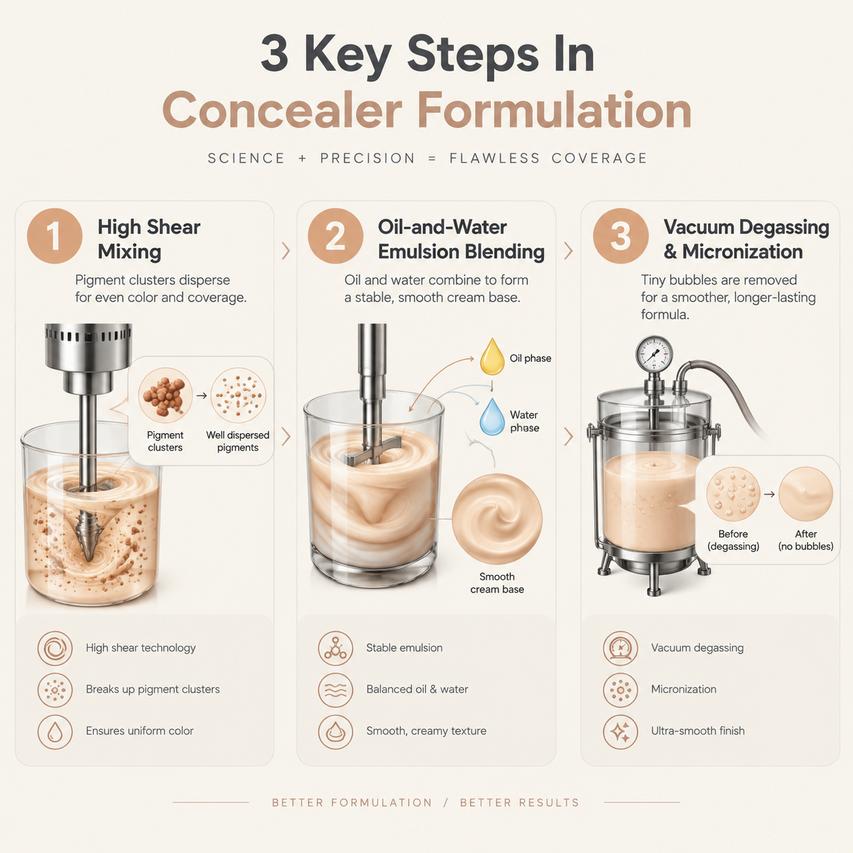
3 Key Steps In Concealer Formulation
Understanding the meaning of concealer starts with how the formula is actually made. From pigment handling to air removal, careful production turns color and texture into reliable coverage. For brands, these three production stages are where the magic really happens.
Step 1: High Shear Mixing for Full Coverage Pigment
A high shear mixer breaks apart pigment clusters inside the liquid base, producing a fine pigment dispersion. That matters because the meaning of concealer is closely tied to hiding discoloration without leaving patchy or heavy-looking color.
-
Pigment control
- Better dispersion improves color uniformity across every batch.
- Evenly distributed particles support full coverage with less streaking.
-
Texture control
- A rheology modifier helps manage thickness after mixing.
- Balanced flow keeps application smooth rather than, well, gloopy.
Careful shear speed and mixing time help protect the desired feel while developing consistent concealer coverage.
Step 2: Emulsion Blending with Non-Comedogenic Ingredients
Concealer meaning goes beyond camouflage; wear comfort counts too. In a typical oil-in-water formula, controlled blending creates a cream base that can spread easily while maintaining emulsion stability.
- Non-comedogenic ingredient choices can support formulas designed to avoid pore-clogging materials.
- A suitable emulsifier keeps oil and water phases evenly combined.
- Humectants may improve hydration, while thoughtful ingredient selection supports skin compatibility.
For OEM development, Topfeel Beauty offers R&D support to align these choices with the target finish, featuring capabilities for cruelty-free, vegan, and paraben-free formulation options.
Step 3: Vacuum Degassing and Micronization of Pigments
The meaning of concealer also shows up in the final finish: coverage should look smooth, not grainy or bubbly.
-
Pigment refinement
- Micronization controls particle size and improves distribution.
- Finer dispersion supports a smooth texture and more even coverage.
-
Air management
- Vacuum degassing removes trapped air bubbles before filling.
- Less trapped air can improve visual consistency and support formula stability.
For makeup OEM production, these controls also promote cleaner filling and more consistent packaging performance.
How To Solve Concealer Separation Issues
Understanding the meaning of concealer goes beyond covering spots or dark circles; the formula also needs to stay smooth from bottle to skin. For Topfeel Beauty, solving separation means matching emulsion design, packaging, and wear technology. Get those pieces right, and concealer can keep its coverage, matte feel, and everyday staying power.
Optimizing Emulsifier Ratios for Matte Finish Stability
For anyone exploring the meaning of concealer, stable texture is a big deal. A balanced emulsifier ratio helps keep an oil-in-water emulsion uniform instead of letting oils and pigments drift apart.
-
Formula balance
-
Match emulsifiers to oil and water levels.
- This improves emulsion stability and lowers the risk of phase separation.
-
Adjust powders carefully.
- Too much can hurt glide even when the matte finish looks spot-on.
-
-
Texture control
-
Use a suitable rheology modifier.
- Good viscosity control keeps pigment suspended without making concealer feel heavy.
-
Through its professional laboratories, Topfeel Beauty provides formulation R&D support to achieve this balance, ensuring smooth and consistent application.
Packaging Solution: Airless Pump Bottles to Prevent Phase Split
The meaning of concealer also includes how reliably the product performs after weeks of daily use. Packaging can lend the formula a hand.
- Choose an airless pump bottle with a dependable dispensing system to reduce repeated air contact.
- Check the vacuum seal and oxygen barrier performance against the actual formula.
- Run container compatibility testing before launch; oils, solvents, and seals need to play nicely together.
These checks help protect product integrity and support expected shelf life. Packaging cannot rescue an unstable emulsion, but it can keep a sound one in better shape.
Incorporating Crease-Resistant Polymers for Long-Wear Waterproof Formula
For users asking about the meaning of concealer in practical terms, coverage should stay put without turning stiff.
-
Polymer design
-
Select a compatible crease-resistant polymer.
- A flexible film former can improve skin adhesion while limiting migration into fine lines.
-
Pair it with the right waterproof agent.
- The goal is stronger wear resistance, not a dry, tight finish.
-
-
Real-world performance
-
Test the long-wear formula through facial movement.
- Check coverage after moisture and sweat-proof wear testing.
- Confirm flexibility around the eyes and smile lines.
-
In short, concealer meaning extends from coverage to comfortable, dependable wear. For brands seeking to develop or expand their makeup lines, Topfeel Beauty offers full-service cosmetics manufacturing options, from custom formulations to finished packaging.
References
- high-shear mixing – dosimixtechnologies.com
- pigment micronization – schedio.ch
- vacuum degassing – buschvacuum.com
- ISO 22716 – registrarcorp.com
- Pantone color – apackaginggroup.com
- FDA rules – fdahelp.us
- MSDS/SDS records – japagregulatorysolutions.com
- COA verification – mar-kov.com
- blemish camouflage – augustmonroe.com
- rheology modifier – cleanformulation.com
- Non-comedogenic – specialchem.com
- emulsion stability – rodanco.nl
- oil-in-water emulsion – vizorsun.com
- airless pump bottle – lotioncrafter.com
- crease-resistant polymer – elfcosmetics.com
Post time: Oct-05-2026