
Is a Makeup Eyeliner Pencil Actually Better Than Liquid?
A makeup eyeliner pencil that snaps on the first twist can become a returns issue rather than a beauty disaster. For sourcing teams, repeated complaints about brittle cores, jammed mechanisms, or drifting hot-pour batches can also put pressure on a launch plan.
So skip the old format debate and review the three product risks that matter to your brief: core feel, mechanism function, and batch consistency. That’s where this guide starts.
Makeup Eyeliner Pencil Reading Notes: From Launch Data to First Production Run
- Format Momentum: Compare intended application, package format, and the user needs behind pencil and liquid concepts.
- Performance Layers: Review the shade target, application feel, and wear criteria as separate parts of the product brief.
- Sample Gatekeeping: Check sample handling, mechanism function, and formula-specific safety documentation before sign-off.
- Batch Drift: Compare the approved process records and sample results across production lots before release.
- Launch Logistics: Align production readiness, shipping arrangements, and the applicable GMP documentation with the launch plan.
Data: Pencil Liners Still Lead Eye Makeup Launches
When reviewing fresh eye makeup launches, note the application and package each new pencil or liquid concept is designed for.
Compare pencil and liquid formats for the intended application
Compare pencil formats and liquid eyeliner by intended use and package. For mass market and prestige beauty briefs alike, a guide to eyeliner looks offers consumer-facing examples.
| Format | Sharpening | Smudge resistance | Share of new drops |
|---|---|---|---|
| Retractable automatic | Not needed | Strong | About 6 in 10 |
| Twist-up gel | Not needed | Strong | Climbing |
| Wood pencil | Needed | Fair | Small, steady |
| Liquid pen | Not applicable | Fair | Flat |
| Gel pot | Not applicable | Weak | Shrinking |
Match the application experience to the concept, then review the sample and package together.
Why retractable automatic eyeliner suits some application briefs
Retractable eyeliner needs no sharpener; compare each format with the intended use:
- No sharpening
- nothing extra to pack for sharpening
- no loose shavings
- Fewer exposed tips in a makeup bag
- the tip moves back into its case
- Faster precision application
- twist and line
Check how the beauty packaging protects the tip and whether it closes securely after the mechanism retracts. Compare the eyeliner range and the eyeliner application guide for the intended eye makeup use.
Define wear criteria for waterproof gel eyeliner concepts
For a waterproof eyeliner brief, define transfer, crease, and moisture criteria for the finished gel eyeliner sample. Compare the liquid eyeliner range if the brief also calls for a liquid pen rather than a pencil format.
Keep package wear wording tied to the finished formula and the conditions assessed.
Which liner belongs in the lineup? Compare pencil and liquid application, retractable handling, and waterproof gel wear criteria before you brief a sample. Topfeel Beauty’s four-color liquid glitter option gives you a specific liquid format to assess alongside pencil concepts.
Compare the eyeliner range with the liquid glitter liner to shortlist formats for sampling.
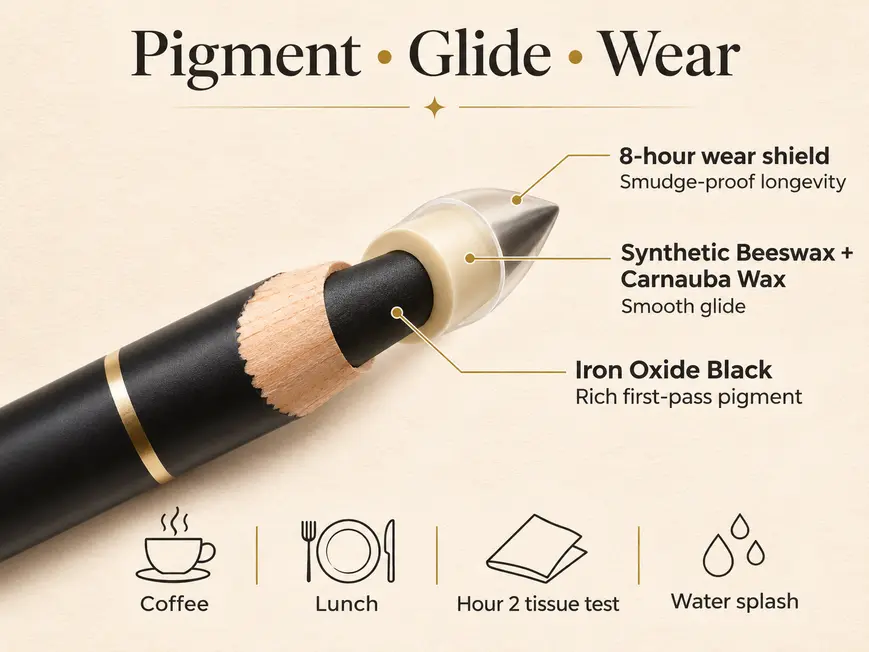
Layers of Eyeliner Performance: Pigment, Glide, Wear
If you have drawn a wing on a bare face, you know which parts to watch. Does the color land on the first pass, does the tip glide without drag, and does the line hold through the intended wear period?
How iron oxide black pigment contributes to shade selection
For iron oxide black, document the pigment load and first-pass opacity target, then confirm ingredient identity and permitted eye-area use. Review the eCFR color-additive listing before approving a shade.
- Heavy load, tight dispersion
- deep color payoff against the approved initial swatch
- fewer passes, if relevant to the brief
- Light load, coarse grind
- grayish line versus the approved target
- patchy shade intensity under sample review
Check whether one pass of a solid eyeliner pencil achieves the finish specified for the liquid comparison sample. CIE standard illuminant D65 provides a defined daylight reference for the shade check.
Synthetic beeswax, carnauba wax formulation and the glide they build
Assess glide and tip firmness on finished samples made with synthetic beeswax or carnauba wax. Check whether a soft tip crumbles in the sharpener or drags across the lid. Topfeel Beauty’s OEM eye makeup service includes custom eye-makeup formulation development.
Record how the texture formulation affects the feel of application and note any skipping or pulling. For a shade check on opaque specimens, ASTM D2244 covers how to calculate color differences from instrumentally measured coordinates.
What smudge proof performance testing should cover
Wear claims are easy to print. Define the sample, method, and conditions for testing, then record transfer, crease appearance, flaking, and moisture response separately.
- Press a tissue at the outer corner; record transfer resistance.
- Check the crease and record sebum resistance.
- Look for under-eye flakes or fading.
- Splash water and blot; record waterproofing response.
Use the observations to compare samples. Tie any smudge proof or longevity statement to the formula, full wear time, and conditions assessed.
Align the formula brief: Pigment, wax formulation, and smudge-proof performance need a shared sample target.
Topfeel Beauty develops custom eye-makeup formulations. Review the custom solutions page to prepare a brief that links iron oxide shade, glide, and wear evidence, then compare pencil and liquid samples under the same conditions.
5 Steps to Test a Pencil for Private Label
Before you sign off on a private label makeup eyeliner pencil, run the handling checks, twist the mechanism, and read the formula records for the production run. This manufacturer qualification guide offers a supplier-review starting point.
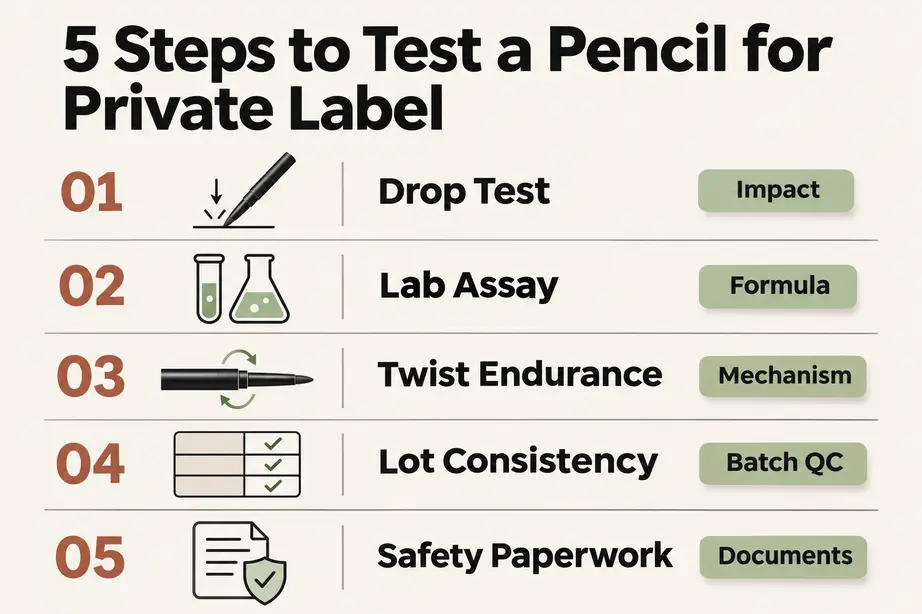
Review core handling before you sign off on a sample
Agree on a handling method and record visible damage against the acceptance criteria.
- Drop the eyeliner lead during the agreed sample-handling check.
- Check for chips.
- Anything outside the agreed acceptance criteria gets recorded.
- Torque the tip during the agreed handling check.
- Low resistance or a change in tip shape should be recorded.
Keep observations with the sample identifier for comparison.
Request the heavy metal content assay and microbial limit test early
Ask for formula records with the first sample package, before the mold gets cut. FDA guidance covers microbiological safety in cosmetics. The EU Cosmetics Regulation sets the EU safety and product-information framework. For Great Britain, check the cosmetics market-access guidance. If Canada is on the launch list, confirm who will file the cosmetic notification.
- A heavy metal assay with method and scope identified; elemental-impurity testing for cosmetics lists analytes laboratories may assess.
- Mercury and cadmium results, if assessed.
- A microbial limit test report.
- A toxicology report for the formula under review.
For quality assurance, check which pigment lots the contamination screening covers and whether each report names the product or formula.
Check the retractable automatic eyeliner mechanism through repeated use
Run the agreed twist endurance cycle by hand. Note any skips, a sticky swivel component, or changes in dispensing action.
Log every skip and hard stop during functional testing of the retractable automatic pencil.
Compare hot-pour molding consistency across production lots
Compare hot-pour temperature and fill weight across lots of the same formula. Check the records and core hardness against the approved specification before release.
| Lot | Pour temp (°C) | Fill weight (g) | Core hardness | Read |
|---|---|---|---|---|
| A-118 | 78 | 0.42 | 61 | On target |
| A-119 | 81 | 0.45 | 68 | Slightly hard |
| A-120 | 76 | 0.39 | 54 | Too soft |
| Spec target | 78 | 0.42 | 60 | Reference |
| Reject line | ±4 | ±0.04 | <50 | Stop run |
Review product-specific eye-safety paperwork before approval
Check that ophthalmologist tested and other eye-area wording matches product-specific documentation. The American Academy of Ophthalmology’s eye-makeup guidance advises removing eye makeup before sleep. The FDA’s eye-cosmetic safety guidance calls out applicator injuries and advises against applying eye makeup in a moving vehicle.
Set a sample approval gate: Test the private-label pencil by reviewing core handling, retractable mechanism, molding consistency, and eye-safety paperwork together.
Topfeel Beauty uses first-article checks to compare sample texture with the approved specification. Discuss your test checklist with the team to agree on how sample results and formula records will be reviewed before approval.
Private Label Launch: Pencil-Led Liner Lineup
Plan the liner range so pigment, packaging, and paperwork decisions reach the same team before sample sign-off. Set the launch date with production costs and shipping in view.
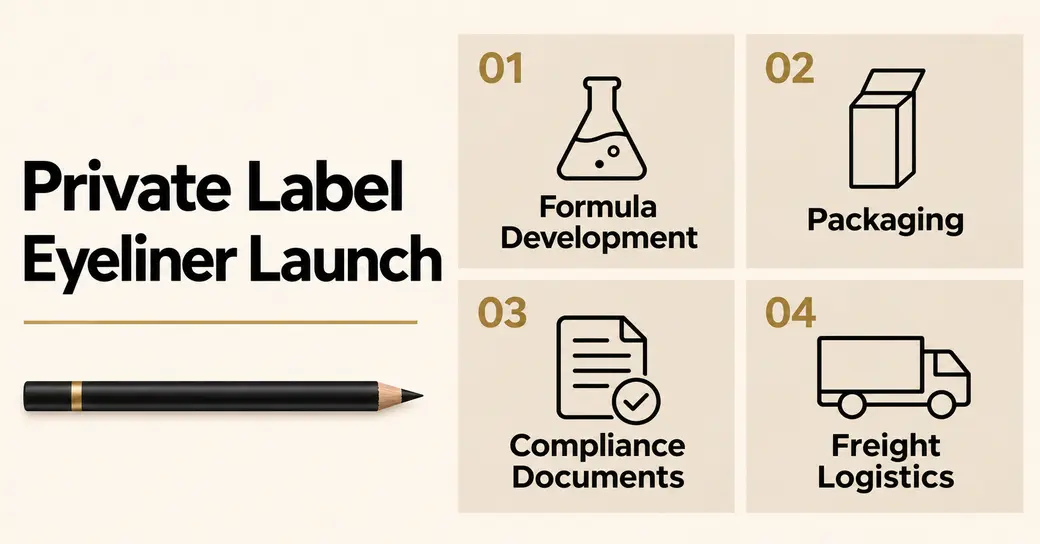
Custom formula development: from a synthetic beeswax base to a full shade range
- Base work
- Synthetic beeswax is one ingredient to identify when documenting the texture profile of a sample.
- Trade off texture and application feel when reviewing a revised formulation against the approved sample.
- Shade building
- Pigment load and shade belong in the formula brief. Review how iron oxides are used as cosmetic colorants when comparing formula options.
- Run sample comparisons against the approved target before locking the shade range.
- Sign-off
- One approved custom formula record per shade keeps the specifications together at sign-off.
Custom printed paper box, tamper evident shrink wrap, or both?
Compare a printed paper box, tamper evident shrink wrap, or both against the brief. Check available space for required copy, package presentation, and how the seal fits the intended product before approving secondary packaging.
GMP cosmetics compliance and ISO 22716 documents for your first run
Ask which file set applies to the site and market before confirming the manufacturing plan. ISO 22716 specifies guidance on good manufacturing practices for cosmetic products; check certificate scope and site details against the supplier documents.
- CertificatesTypical turnaround
- ISO 22716 certificate, in date, with the site address matching the quote.
- GMP compliance audit summary plus a clean audit trail across batch records.
| Document | Issued by | Lead time | Blocks what |
|---|---|---|---|
| ISO 22716 cert | Certifying body | 2–4 weeks | Factory approval |
| GMP audit report | Third-party auditor | 3–6 weeks | Purchase order |
| Facility registration | FDA listing | 1–2 weeks | US shipment |
| Batch records | Manufacturer | On request | Release |
| Safety assessment | Qualified assessor | 2–3 weeks | Label print |
Contract manufacturing service versus in-house bulk cargo palletization costs
Compare the contract manufacturing quote with an in-house scenario using the same assumptions for tooling, labor, palletization, forecast volume, and fixed costs. A clear side-by-side estimate makes the trade-offs visible without treating one production model as right for every brand.
Global freight forwarding timelines for a dual ended kajal pencil program
Build the calendar backwards from launch.
- Ocean freight
- Freight forwarding starts with confirming the booking window for the planned shipment.
- Shipping timelines should account for customs clearance and export documentation agreed with the freight partner.
- Air bridge
- Reserve an air option for time-sensitive sample or launch units.
- Each delivery milestone should follow the carrier’s confirmed transit schedule.
Coordinate the eyeliner pencil booking with molding slots and the approved launch calendar. Compare Topfeel Beauty’s OEM eye makeup service with its private-label options before deciding what to include in a manufacturing brief.
- The buyer’s brief should connect format, shade, and intended application before sample review. Use the
##heading for the product decision in a shared Markdown brief. - The sample plan should record mechanism, texture, packaging, and documentation under separate
###headings in that brief. - The launch checklist should align records, supplier sign-off, and shipping with the agreed production plan.
Bring the launch plan together: Connect formula, packaging, documentation, production economics, and freight so supplier decisions stay aligned with the product brief.
Topfeel Beauty’s one-stop development service lists 3-7 days for initial sample preparation. Its private-label options give buyers a starting point for the formula and pack brief. Share your launch requirements with the team to discuss the target market, documents, and delivery schedule.
References
- Color Additives Listed in 21 CFR Part 73 — ecfr.gov
- Standard Illuminant D65 — cie.co.at
- ASTM D2244 — astm.org
- Microbiological Safety and Cosmetics — fda.gov
- Regulation (EC) No 1223/2009 on Cosmetic Products — eur-lex.europa.eu
- Elemental Impurity Testing for Cosmetics — intertek.com
- Eye Makeup — aao.org
- Eye Cosmetic Safety — fda.gov
- Making Cosmetic Products Available to Consumers in Great Britain — gov.uk
- Notification of Cosmetics — canada.ca
- Iron Oxides — cosmeticsinfo.org
- ISO 22716:2007 — iso.org
Post time: Nov-27-2026