
Lipstick vs Lip Tint: Which One Lasts Longer?
Lipstick vs lip tint isn’t a beauty-aisle squabble, folks — it’s a physics problem you happen to be buying five thousand times over, and the wrong pick shows up as returns long before it shows up as reviews. One format wears like paint, the other wears like a rumor.
Grand View Research sizes the U.S. lip color cosmetics market at roughly $7.0 billion for 2025, with lipstick alone holding about 55.7% of category revenue — meaning the crowd has not wandered off, it has simply gotten pickier about wear claims.
So the whole game narrows down: which one clears your shelf without gnawing on your margin?
Lipstick vs Lip Tint: Quick Answers From the Shelf
- Wear window: Polymer lipstick holds near eight hours; water-based tint fades to about four.
- Mechanism: Wax binders and a cross-linked film shield pigment, while tint leaves dye that sheds with surface cells.
- Color payoff: A pigment saturation base delivers more intensity per swipe, so touch-ups stay rare.
- Unit cost drivers: Thick bulk viscosity and per-shade color matching set the floor before packaging begins.
- Tooling call: Frosted glass vials win at low volume; custom molded tubes amortize at scale.
- Hidden margin leak: GMP runs, hypoallergenic panels, tamper-evident sealing and palletized freight inflate landed cost.
Lipstick vs Lip Tint: The Basics
Two little tubes, two very different jobs. One coats the surface, the other sinks right in. Get the lipstick vs lip tint basics down and you’ll stop grabbing the wrong one on a whim at checkout.
Long-Wear Polymer Lipstick
-
The formula underneath
- A wax base plus oils carries the color and gives the bullet its body.
- A film former sets over the top, so color holds through coffee and a full lunch.
-
Why it reads bold
-
Pigment concentration runs high in this format.
- Full coverage arrives in a single swipe.
- Saturation stays true instead of going muddy by mid-afternoon.
-
Build it thin and the shade still looks solid.
-
-
The honest trade-off
- Transfer-resistant is not bulletproof, and a heavy matte finish can pull moisture out — balm underneath earns its keep.
Topfeel Beauty formulates around that balance, keeping the set firm without the tight feeling.
Lightweight Staining Lip Tint
Different animal entirely. A water-based dye soaks into the outer lip layer and stays there once the water lifts off. The gel formula feels like nothing at all, which is the whole appeal. Working with one is simple:
- Prep with balm, then let it sink in for a minute.
- Swipe once for a natural flush, then decide if you want more.
- Tap extra down the center to fake gradient lips.
- Gloss on top if the sheer finish feels too quiet.
One thing worth knowing about absorbency: dry patches drink dye unevenly, so smooth texture matters more than shade choice. Hydration comes first, color second.
Compare lip tint vs lipstick on a twelve-hour day and the difference surfaces fast.
| Trait | Long-wear lipstick | Staining tint | Picks itself when |
|---|---|---|---|
| Wear time | Roughly 8–12 hours | About 4–6 hours | You want one-and-done |
| Water content | Low; oil and wax carry it | High; water carries the dye | Your lips feel parched |
| Feel on skin | Creamy, then set | Nearly weightless | Heavy makeup bugs you |
| Touch-ups | Rarely needed | A few a day | You like topping up |
Topfeel Beauty keeps both on the shelf for exactly that reason — mood changes, so the formula should too.
Which Lasts Longer, Lipstick or Lip Tint?
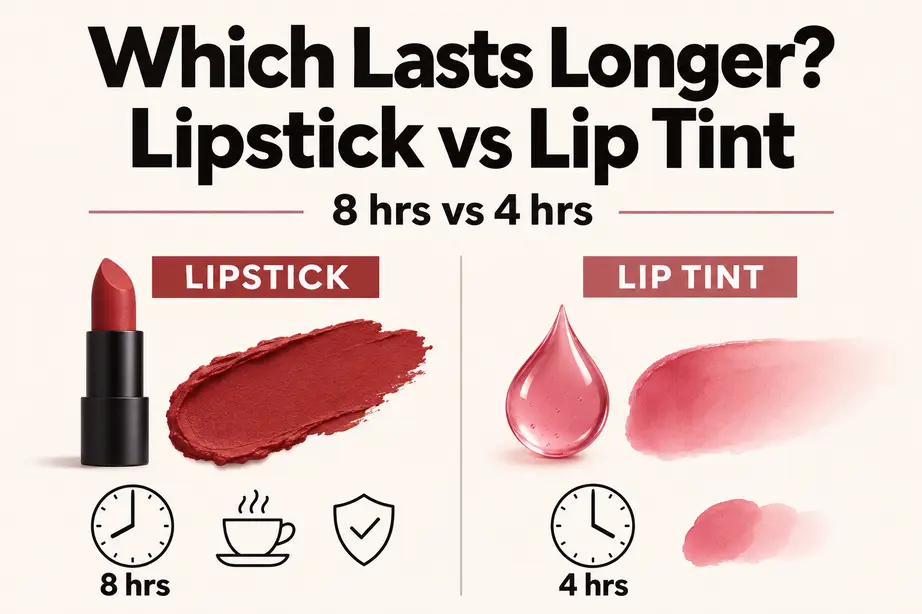
Short answer: the bullet usually outlasts the bottle. The reason has less to do with price tags than with chemistry — film formers, waxes, and how fast your lips shed surface cells. The lipstick vs lip tint question comes down to timing, not quality. Both belong in a bag; each just clocks out at different hours.
How a matte finish formula locks onto lips
A matte finish isn’t a vibe — it’s a mechanism, and it plays out in about ninety seconds. Anyone comparing lipstick vs lip tint usually starts right here.
-
The flash-off. Volatile carriers leave fast, pulling the formula tight against skin.
- Pigment stays where it lands instead of sliding into fine lines.
- Wax and film formers set the color as the liquid disappears.
-
The trade-off. That same grip costs hydration. Skip balm underneath and the adhesion is real, the comfort isn’t.
-
The payoff. Solid adhesion means fewer touch-ups and less color on your coffee cup.
The texture feels dry on purpose. That dryness is the lock.
What water-based tint does once the water is gone
Dab a water-based tint on and the first minute feels like nothing — water, dye, done. Then evaporation takes over and the story flips.
What’s left is a stain, not a film:
- a thin pigment layer with zero cushion
- bright, flat color payoff straight away
- absorption into the upper skin layer rather than a coating on top
So it fades with your lips instead of wearing thin at the center. Surface cells shed, and the color leaves along with them — patchy at the edges, uneven in the middle. Liquid lipstick vs lip stain, in one line: one sits on you, the other sinks in.
Wear-test numbers: 8 hours down to 4
Controlled wear-test panels put polymer lipstick near eight hours and water tint around four. The gap is real, though the curve matters more than the headline.
- Hour 0–2: identical. Performance is a tie.
- Hour 3: tint thins at the center; durability drops where lips meet.
- Hour 4–5: tint wants a touch-up; matte still holding.
- Hour 8: matte shows fade at the inner rim, nothing dramatic.
A lipstick vs lip tint longevity comparison is really a question about your day. One coffee and two meetings? Tint is plenty. Twelve hours plus dinner? Topfeel Beauty’s long-wear matte holds the line, and a Topfeel Beauty tint earns its spot for lighter days.
3 Reasons Lipstick Outlasts Lip Tint
Some days you want color that survives coffee, lunch, and a long commute. Other days you want something soft you can swipe on and forget. The lipstick vs lip tint question comes up a lot, and the short answer lives in the formula itself. Three reasons the bullet wins on staying power.
A long-wear polymer film that refuses to budge
Staying power starts with what the color sits on. Follow the chain:
-
The base sets the rules
-
A polymer film cross-links into a flexible shield over the lips
- Talking, eating, sipping — friction lands on the shield, not the pigment beneath
-
-
The shield has to keep its shape
- Long-wear technology keeps that layer supple instead of cracked and flaky
- Transfer-resistant edges mean fewer marks on mugs, collars, and straws
-
The payoff at hour eight
- Still smudge-proof after a napkin, a mask, and a second coffee run
Formulators such as Topfeel Beauty lean on this flexible formula for one plain reason: a cosmetic coating that bends with the lip lasts longer than one that fights it. Wear time follows from physics, not luck.
Pigment saturation base means fewer touch-ups
The lipstick vs lip tint split shows up fastest in color load. Tints carry pigment in water; bullets pack it into a dense base.
- Higher pigment concentration in every swipe.
- Stronger color saturation on the very first pass.
- Better color payoff even as the top layer thins out.
- Fewer reach-for-the-tube moments, so touch-up frequency drops.
A rich formula holds hue intensity visible long after the shine fades to a stain. That’s opulent coverage without the constant top-ups.
Waxy binders hold color while water simply evaporates
Water is a bad roommate — it leaves. A tint’s water carrier dries off and drags most of the color with it, so the shade you loved at 8 a.m. is a ghost by noon.
-
Waxy binders anchor pigment to the lip surface
- Lip wax adds structure, so color grips instead of sliding
- An emollient base keeps the texture structure comfortable
-
Water works the other way
- Moisture evaporation carries color off with it
- No hydration barrier means color retention falls fast
Topfeel Beauty builds around the wax side of that trade-off. In the lipstick vs lip tint argument, slow evaporation wins the day.
Low Margins? Private Label Lipstick vs Lip Tint
Margins in private label color cosmetics go thin fast. The lipstick vs lip tint call alone reshapes your cost base before a single unit ships. Topfeel Beauty sees it every week: two formulas, two cost stories, one invoice. Here’s where the money really goes, plainly.
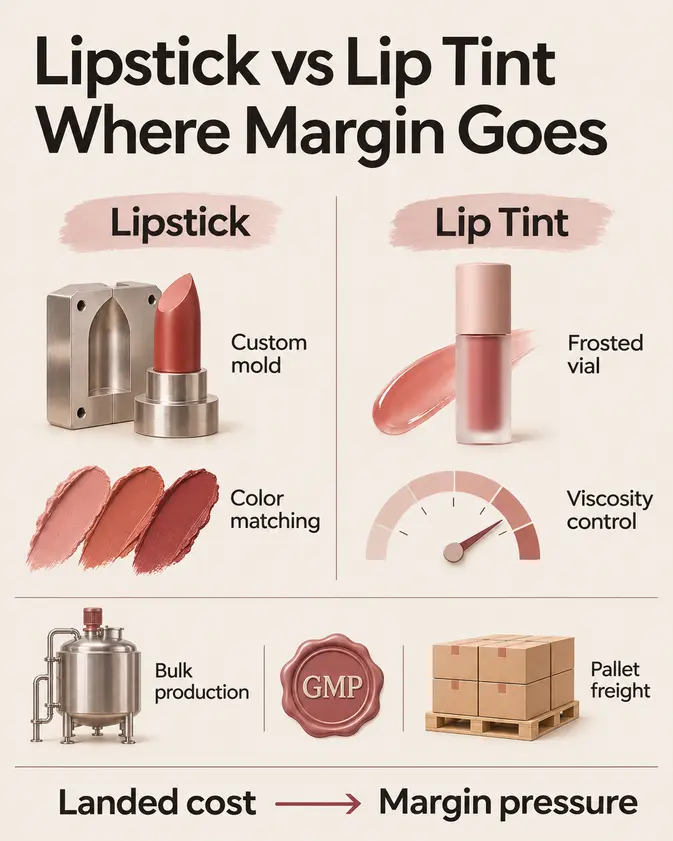
Where your unit cost really starts: bulk viscosity level and batch color matching
Cost starts in the bulk tank, not on the invoice.
-
Bulk viscosity
- Thin tints fill fast and lift manufacturing yield
- Thick long-wear masses crawl, so rheology control earns its keep
-
Batch color matching
- Every shade buys lab hours
- Pigment dispersion quietly sets raw material cost and formulation stability
That’s the lipstick vs lip tint gap in a nutshell — same tube, very different fill times.
Custom molded tube or frosted glass vial — which one eats the tooling budget?
Tooling is the fork in the road. A custom mold for an injection molding line is a big cheque up front; frosted glass vial stock needs almost none. Component sourcing flips the math once volume climbs.
| Option | Upfront | Per unit | Sweet spot |
|---|---|---|---|
| Custom molded tube | High tooling cost | Low | 50k+ units |
| Frosted glass vial | None | Higher | Small runs |
| Stock tube | Low | Mid | Market tests |
Packaging design and surface finish decide whether those savings survive contact with reality.
GMP certified facility and hypoallergenic tested, priced per batch
Compliance doesn’t scale down.
• GMP certification — a fixed fee per run
• Hypoallergenic testing — panels priced by batch
• Quality assurance — identical paperwork for 5k or 50k units
• Regulatory compliance and batch testing — never negotiable
Small runs carry the same production facility cost across fewer jars. Safety assessment is where a cheap quote cracks first.
Palletized freight prep and the landed-cost surprise
Palletized freight prep, tamper seals, master cartons — logistics preparation bills by the hour. Watch shipping dimensions; oversized tubes pay for air. Customs clearance and warehousing land on top of all of it.
Quoted unit price is a starting line, not the finish. Topfeel Beauty builds landed cost into every lip color quote — lipstick vs lip tint included — so nothing jumps out later. Supply chain surprises love silence.
References
- U.S. Lip Color Cosmetics Market Size & Share Report, 2026-2033 – Grand View Research (grandviewresearch.com)
- Film forming – Methods and materials – Cosmetics – SpecialChem (specialchem.com)
- Transepidermal Water Loss (TEWL) — SYNC Skin Encyclopedia – SYNC Beauty (syncbeauty.com)
- Cosmetic Film Formers: Long-Lasting & Sensorial Formulations – PolymerExpert (polymerexpert.fr)
- Analysis of clinical presentations, lip transepidermal water loss and associated factors – PubMed Central / NIH (pmc.ncbi.nlm.nih.gov)
- What Makes Lipstick Truly Long Lasting? Chemistry – Lipseek (lipseek.com)
- How to Formulate Lipsticks, Glosses, Balms & Lacquers – Let’s Make Beauty (letsmakebeauty.com)
- Design and Optimization of Natural Lipstick Formulations Using Vegetable Waxes and Oils – International Journal of Pharmaceutical Sciences (ijpsjournal.com)
- Color Cosmetics Ingredients & Makeup Formulation – Grand Ingredients (grandingredients.com)
- Glass vs Plastic Cosmetic Packaging: Which Is Better for Your Brand? – PackingCosmetic (packingcosmetic.com)
- GMP / ISO 22716 support – Cosmetic Labs (cosmetic-labs.com)
- Validating Hypoallergenic Claims – RIPT Testing Essentials – CPT Labs (cptclabs.com)
- Modernization of Cosmetics Regulation Act of 2022 (MoCRA) – U.S. Food and Drug Administration (fda.gov)
- How to Pack Large and Heavy Shipments – DHL (dhl.com)
Post time: Nov-24-2026