
Never Pick the Wrong Lipstick Color for Skin Tone Again
Finding the right lipstick color for skin tone involves more than picking a pretty pink or bold red. Warm, cool, and neutral undertones provide starting points for comparing shades.
For private label lipstick brands, shade selection and custom formulation belong in the same collection brief.
Key Points for Lipstick Color for Skin Tone
- Start with undertone: compare coral orange and nude peach for warm palettes; blue red and mauve pink for cool palettes; both for neutral palettes.
- Match finish to effect: compare matte color, satin softness, and glossy shine.
- Consider skin depth and complexion: compare berry red, plum purple, and nude shades on fair, deep, and olive complexions.
- Check product quality: consider pigment dispersion, ingredient selection, and batch consistency.
Lipstick Shade Basics
Shade families, finishes, textures, and ingredients shape the finished product. Understanding these basics gives a brand a clearer starting point for its lipstick color for skin tone brief.
Berry Red to Nude Peach: Core Lipstick Shade Families
Consider undertone alongside the lightness or depth of your skin tone.
- Warm undertone
- Nude peach and coral pink are starting points for a warm palette.
- Brick-leaning reds offer a bolder alternative.
- Cool undertone
- Berry red and mauve are options for a cool palette.
- Plum purple offers a deeper shade to compare.
- Neutral undertone
- Pretty much any shade family can enter your color palette comparison.
Matte Finish, Satin Finish, and Glossy Shine Explained
The same shade can read differently with a different finish. Compare the surface appearance rather than shade names alone.
| Finish | Light reflection (approx. %) | Typical wear (hours) | Pigment feel (1–5) |
|---|---|---|---|
| Matte finish | 5–10 | 6–8 | 5 |
| Velvet | 15–25 | 5–6 | 4 |
| Satin finish | 30–40 | 4–5 | 4 |
| Cream | 40–50 | 3–4 | 3 |
| Glossy shine | 70–80 | 1–2 | 2 |
Compare matte lipstick finishes with gloss and satin when defining the collection’s visual direction.
Cream Formulation vs. Velvet Texture for Everyday Wear
- Cream formulation
- Packed with oils or a lighter feel: compare lip comfort.
- Gives smooth application? Check the feel during try-on.
- Velvet texture
- A semi-matte appearance to compare.
- Feels lighter or richer? Compare with full matte.
For everyday wear, compare comfort as well as appearance; hydrating lipstick choices offer another formulation reference.
Mineral Pigment and Candelilla Wax in Shade Performance
Consider pigment and wax choices together when developing the formula.
▸ Compare mineral pigment options for the desired color payoff.
▸ Candelilla wax.
▸ Review ingredient choices alongside the intended clean-beauty positioning.
Topfeel Beauty’s laboratory color matching and custom finish development give brands a route from a reference shade to a formulation brief.
Make the shade reproducible: A shade family needs a matching finish and workable formula. Topfeel Beauty’s laboratories match brand-supplied color samples, while custom development covers specific textures and finishes, connecting the color reference to the product customers actually apply.
Compare custom formulation solutions with the lipstick offering to define a shade–finish–texture brief.
What Is Your Skin Tone
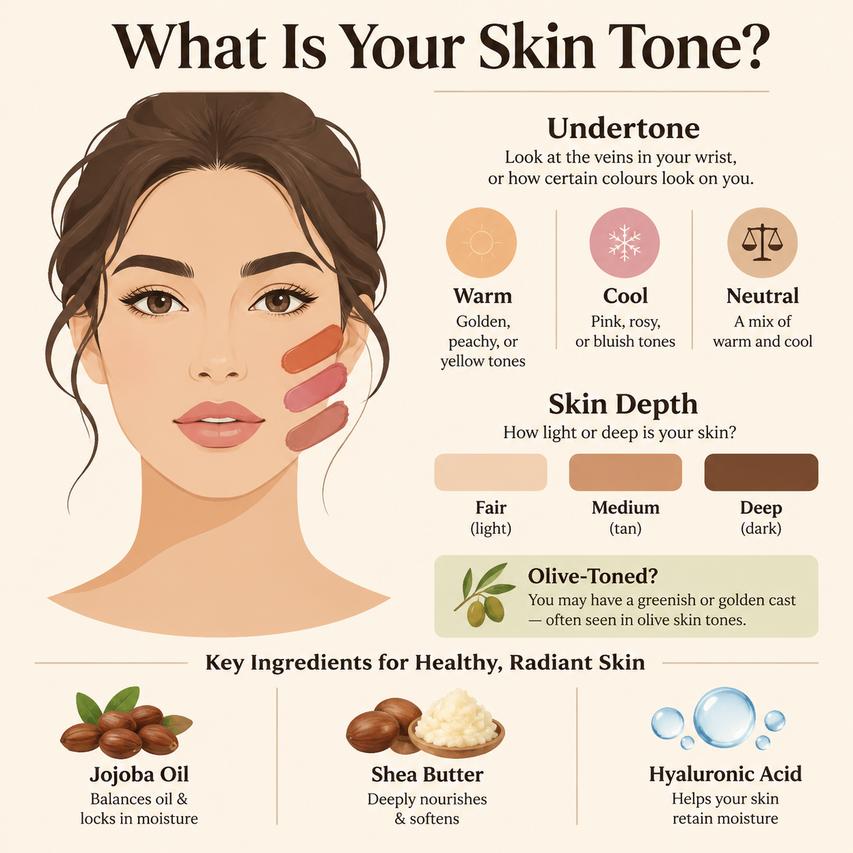
Depth, undertone, and lip comfort all belong in the comparison. Use these as starting points when assessing lipstick color for skin tone.
Warm Undertone, Cool Undertone, or Neutral Undertone?
Distinguish the surface depth of your skin complexion from the warm, cool, or neutral direction you see in a swatch comparison.
- Wrist vein test
- Green veins: a clue to compare warm undertone shades.
- Blue or purple veins: a clue to compare cool undertone shades.
- A mix of both: compare neutral undertone options.
- Jewelry check
- Gold looks better: compare warm.
- Silver wins: compare cool.
- Both work: compare neutral.
Compare corals and brick reds with blue-based pinks. Personal preference still matters when choosing between those palettes.
Fair Skin Tone and Deep Skin Tone Identification
Complexion depth describes how light or dark your skin looks. Melanin contributes to skin pigmentation; people with more melanin generally have darker skin. Compare the contrast level between your lips and face.
- Fair skin tone and porcelain skin: compare sheer pink with a darker plum.
- Medium skin: compare rosy nudes and true reds.
- Deep skin tone with rich melanin: compare berries, deep browns, and saturated reds.
Try a richer nude alongside a pale one when choosing a lipstick color for skin tone.
Olive Complexion Clues That Change Lipstick Choices
For an olive complexion, compare muted and brighter shades rather than relying on the shade name alone.
- Nude peach
- Can look flat or gray to you; check the swatch.
- Fix: compare a peach with a hint of gold.
- Mauve pink
- Plays with muted tones in your comparison.
- Berry red
- Usually prefer berry? Compare its contrast with peach and mauve.
Use the comparison to guide your lip color selection.
Jojoba Oil, Shea Butter, and Hyaluronic Acid for Comfort
A preferred shade still needs comfortable wear. The American Academy of Dermatology’s lip-care guidance includes shea butter among ingredients that can help chapped lips. In moisturisers, humectants attract and retain water in the outer skin layer.
→ Jojoba oil.
→ Shea butter is another option to consider for lip comfort.
→ Hyaluronic acid.
Topfeel Beauty’s lip-care material provides another reference for discussing comfort alongside color.
Lipstick Color For Skin Tone By Undertone
Warm, cool, and neutral palettes provide a useful way to organize swatch comparisons, rather than a single answer for every wearer.
Warm Undertone Pairings for Coral Orange and Nude Peach
Compare warm shades if you prefer the effect of gold jewelry or see greenish veins.
- Daily go-tos
- Nude peach is one option for a golden complexion.
- Soft terracotta is a deeper alternative.
- Statement picks
- Coral orange: compare against a yellow undertone.
- Sunset shades: try alongside your preferred bronze makeup.
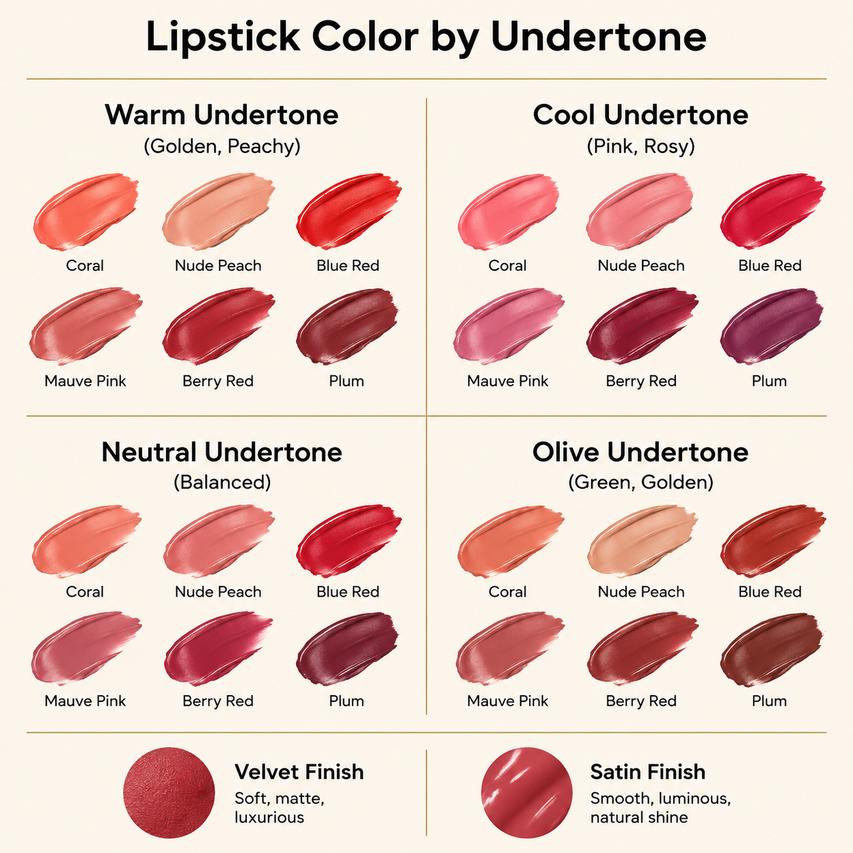
Cool Undertone Matches for Blue Red and Mauve Pink
For a cool undertone palette, compare a blue base with orange-leaning shades.
Try blue red for a stronger contrast, or mauve pink and berry tones for a softer direction.
Neutral Undertone Flexibility Across Most Lipstick Shades
For a neutral undertone, compare a flexible palette across different shade families:
- Warm side
- Universal nude with a peachy tint
- Cool side
- Dusty rose or mauve pink
- Bold side
- Classic red, berry red, or plum purple
Choose the contrast and color you prefer.
Olive Complexion Tips for Berry Red and Plum Purple
For an olive complexion, compare berry, plum, and nude swatches directly.
- Shades that win
- Berry red offers a stronger contrast to compare.
- Plum purple and muted rose provide alternatives.
- Shades to skip
- Pale, frosty pinks: check whether they look gray on you.
- Yellow-heavy nudes: compare with less yellow alternatives.
Consider rich pigments alongside naturally dark lips in your swatch comparison.
Velvet Texture or Satin Finish for Undertone Balance
Compare a velvet texture with a satin finish in the same shade family. The matte-finish discussion helps frame the visual comparison without making finish a substitute for a swatch.
- Velvet: compare color and shine.
- Satin: compare smooth application and glow.
Lipstick Color For Skin Tone In E-Commerce
Shoppers cannot swatch through a screen. Production, formulas, packaging, and paperwork therefore belong alongside shade photography in a lipstick color for skin tone brief.
Bulk Production Strategies for Shade Consistency at Scale
Keep the approved warm nude or berry reference available throughout production.
- Getting the shade right
- Grind pigments with even pigment dispersion in mind.
- Run color matching against a master sample.
- Keeping it right
- Do batch testing as specified.
- Log results for quality control review.
| Check | Typical target | What it protects |
|---|---|---|
| Color difference (ΔE) vs. master | 1.0 or lower | Shade looks identical |
| Pigment grind size | Under 20 microns | Smooth, grit-free payoff |
| Pour temperature | 75–85°C | Even texture |
Discuss the approval process when evaluating cosmetic manufacturers.
Custom Formulation Options for Private Label Lipstick Lines
Start with color undertone, then compare the pigment balance on the intended complexions.
Pick the feel:
- Matte finish for a low-shine appearance.
- Satin texture for color with a little glow.
Discuss oils, butters, fragrance, and vegan requirements together. Fragrances can be contact allergens in lip cosmetics. The Vegan Society’s Vegan Trademark programme checks each product application with manufacturers and suppliers.
Bullet Case, Magnetic Closure, and Acrylic Tube Packaging
Packaging belongs in the product-photo and usability review. The FDA’s cosmetic labeling guide covers US requirements for identity, net contents, and ingredient labeling.
- Bullet case
- Classic twist-up format: compare usability.
- Needs for the case include a seal and bullet-condition review.
- Magnetic closure
- The closure and unboxing feel belong in the assessment.
- Acrylic tube
- Clear walls: compare product visibility.
Consider a tamper evident band and ergonomic design in the packaging brief.
GMP Compliance, ISO Standard, and Cruelty Free Certification
Review the relevant documentation. ISO 22716 provides cosmetic GMP guidelines for production, control, storage, and shipment.
▸ Cruelty free logos.
▸ Check the scope of vegan certification.
▸ Review safety testing documentation; in Great Britain, a qualified safety assessor must check product safety before consumer availability.
▸ Ask how the audit trail links batches and raw materials.
Include documentation in the factory evaluation alongside the formulation and packaging review.
One coordinated launch brief: E-commerce shade promises need formulation, production, packaging, and documentation considered together.
Topfeel Beauty’s one-stop development workflow carries the approved formula into packaging and production planning. Review its OEM/ODM services to prepare shade approval and packaging requirements together with quality documents for the e-commerce launch.
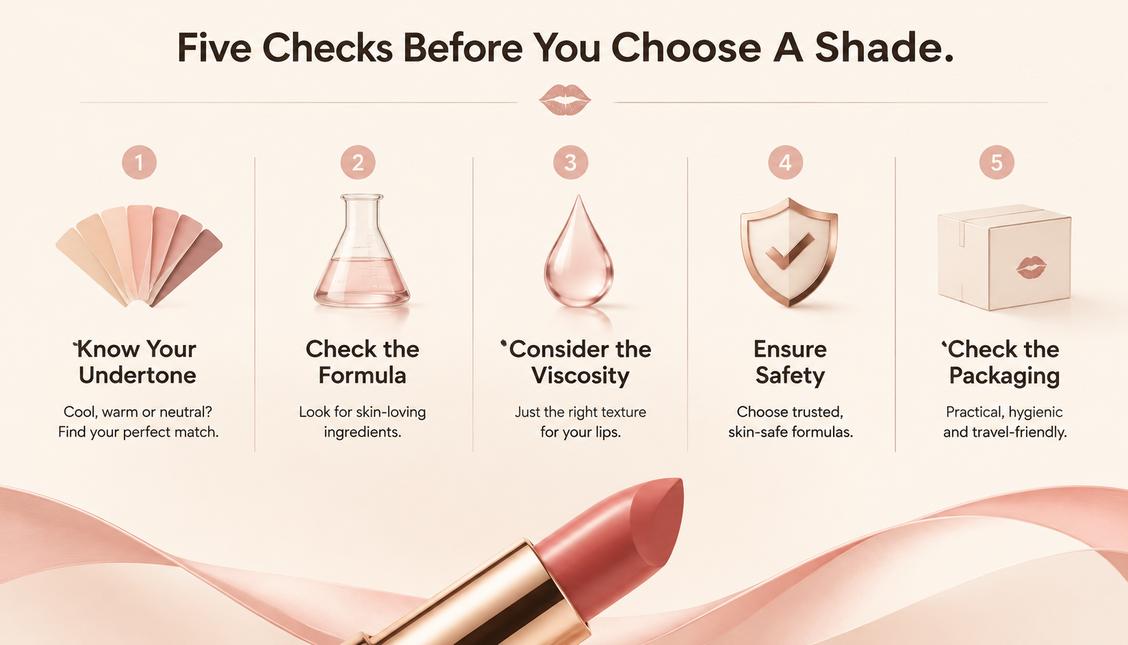
Five Checks Before You Choose A Shade
The checks below connect the shopper’s shade comparison with laboratory, production, safety, and packaging review.
Check Undertone First, Then Test the Lipstick Shade
- Find your base
- Greenish veins and gold jewelry: compare a warm shade such as brick or coral.
- Bluish veins: compare berry and blue-red.
- A neutral complexion: compare both.
- Test it for real
- Do a swatch test on your lips.
- Stand near a window and compare with store lighting.
- Your skin undertone belongs in the overall shade comparison.
Check Pigment Dispersion and Viscosity Testing Before Launch
In the cosmetic laboratory, include these points in the review:
- Pigment dispersion: check for clumps or streaks.
- Viscosity testing: compare the flow of the base.
- Formulation stability: review sweating or cracking.
- Color payoff and texture evaluation: compare the applied product with the bullet.
Check Batch Consistency Across Matte Finish and Glossy Shine
- Color match
- Batch consistency: compare successive lots.
- Color uniformity: compare against the master sample.
- Finish match
- A matte finish: compare the feel and appearance.
- Glossy shine: compare the sheen level.
- Sign-off
- Production quality: record the approval or hold decision.
Check Heavy Metal Testing and Cosmetic Safety Report Status
Review FDA guidance on lead in lip products: its recommended maximum for lead as an impurity is 10 ppm. For the EU, the cosmetic product safety report belongs to the pre-market safety assessment.
- Read the safety report and its toxicology assessment.
- Confirm ingredient purity certificates from suppliers; Canada’s Cosmetic Ingredient Hotlist identifies prohibited and restricted cosmetic ingredients for that market.
- Check regulatory compliance for each target market; EU cosmetics legislation requires a safety assessment before market placement.
- Review dermatological safety results.
Check Applicator Wand, Secondary Carton, and Twist Mechanism Quality
- Parts that work
- Twist mechanism: check smooth turning and bullet stability.
- Applicator wand: check the tip and product pickup.
- Parts that protect
- Secondary carton: assess shipping protection.
- Product sealing and packaging durability: review closure integrity.
- Functional testing: check repeated opening and closing.
Ready to turn all five checks into a sample brief? Connect undertone swatches, laboratory and batch review, safety documentation, and packaging function before approval.
Topfeel Beauty’s engineers prepare initial samples in 3-7 days within its customization workflow. Contact the team with your shade reference and five-check brief to discuss sampling and the subsequent formula-and-packaging verification stage.
References
- Melanin: What Is It, Types & Benefits — Cleveland Clinic
- Cosmetics Labeling Guide — FDA
- 7 Dermatologists’ Tips for Healing Dry, Chapped Lips — American Academy of Dermatology
- Emollients and Moisturizers — DermNet
- Trademark — The Vegan Society
- ISO 22716:2007 — ISO
- Making Cosmetic Products Available to Consumers in Great Britain — GOV.UK
- Limiting Lead in Lipstick and Other Cosmetics — FDA
- Legislation — European Commission
- Cosmetic Ingredient Hotlist — Health Canada
- Allergic Contact Cheilitis — DermNet
- Regulation (EC) No 1223/2009 — EUR-Lex
Post time: Nov-10-2026