
7 Different Kinds of Makeup Foundation You Need to Know
Choosing among kinds of makeup foundation means coordinating coverage, finish, packaging, and positioning. Liquid, powder, cream, mineral, and stick formats give a private-label brief different starting points.
Topfeel Beauty’s formulation engineers develop foundation formulas with customized shades, finishes, and packaging.
Meet the formats worth comparing for your customers.
Quick Points: Kinds of Makeup Foundation Unveiled
➔ Liquid, Powder, Cream: Compare textures alongside coverage and finish.
➔ Mineral & Stick: Consider ingredient requirements and portable application.
➔ Full-Coverage Features: Specify pigment payoff, finish, and application.
➔ Packaging & Additives: Match pumps or compacts to the formula brief.
➔ Certifications & Claims: Define cruelty-free, vegan, organic, and testing requirements.
What Are Liquid, Powder, And Cream Foundations?
The main kinds of makeup foundation differ in texture, coverage, and finish. Match the product brief to skin needs and application habits.
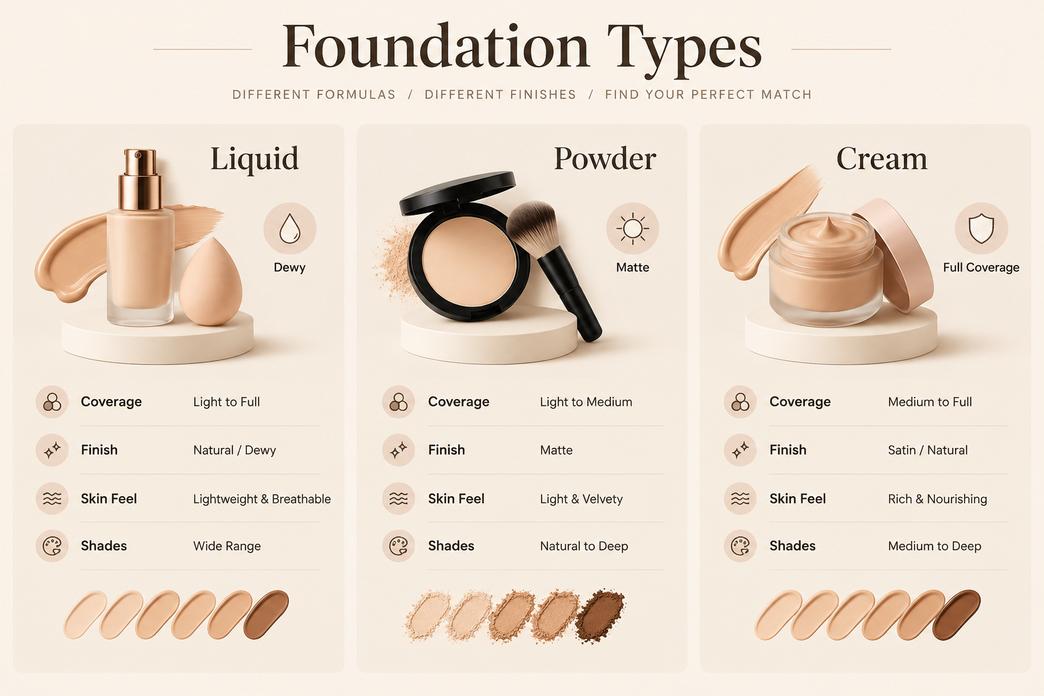
Liquid Foundation for Dewy & Lightweight Coverage
Liquid foundation gives brands room to develop different coverage and finish targets.
- For lighter everyday makeup:
- A skin tint aims for light coverage rather than an opaque base.
- Easy blendability matters around the jaw and hairline.
- For normal or dry skin:
- Formulas designed for hydration need a defined skin-feel target.
- A dewy finish is a visual preference, not a coverage level.
Topfeel Beauty’s foundation development can start from coverage, finish, and skin-feel requirements.
Powder Foundation with Matte Finish & Oil Control Agents
Powder foundation suits a brief built around brush or sponge application. Compare pressed and loose powder handling before choosing the pack.
- Choose a pressed powder for portable application.
- Look for oil control formulas with a clear performance-testing plan.
- Pick a soft matte finish and evaluate its appearance on skin.
For a powder brief, compare pressed and loose textures rather than assuming mineral positioning determines the finish.
Cream Foundation: Medium to Full Coverage Solution
Cream foundation provides another texture direction for stronger-coverage briefs.
- Coverage goals
- Medium coverage should be assessed against the desired amount of visible skin.
- Full coverage needs evaluation on discoloration and uneven tone.
- Wear and feel
- A creamy base needs smooth application in thin layers.
- Added hydration belongs in the formula brief alongside finish.
For higher-coverage foundation briefs, Topfeel Beauty’s custom formulation work can address shade and finish requirements.
Choose a workable texture: Liquid, powder, and cream comparisons need a shared coverage, finish, and application brief. Topfeel Beauty prepares initial formulation samples in 3-7 days, giving your team a concrete starting point for evaluating that brief before choosing a production direction.
Compare custom solutions to prepare your liquid, powder, and cream sample requirements.
5 Key Features Of Full-Coverage Foundations
Full coverage is a product target, not a guarantee supplied by texture alone. Compare color payoff, finish, application, dispensing, and claim documentation together.
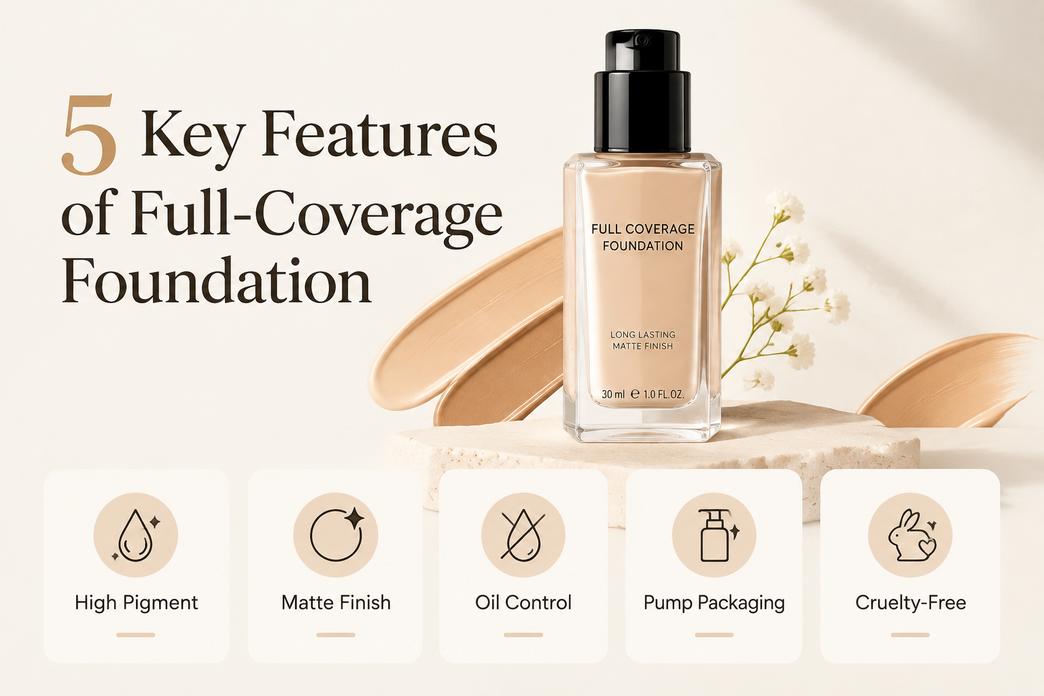
Intense Pigmentation with Buildable Coverage
- Coverage performance starts with high pigment goals and color payoff evaluation.
- Layered application adds product where needed.
- This allows focused blemish concealment.
- Customizable coverage needs a clear application brief.
- Layered application adds product where needed.
Matte Finish for Shine-Free Results
A matte formula targets a less shiny appearance.
- A soft velvet texture is a sensory development target.
- Pore blurring needs evaluation under consistent lighting.
- Excess sebum absorption and wear claims require separate performance evidence.
Oil Control Agents in Oily Skin Formulas
- Oily-skin foundations often combine:
- Mattifying ingredients, selected for the formula brief.
- A balancing formula with a defined finish target.
- Good oil management should be assessed during wear testing.
Glass Bottle with Pump for Precise Dispensing
Packaging needs evaluation with the finished formula.
- A hygienic pump needs appropriate cleaning and use instructions.For Topfeel Beauty, packaging support includes color-cosmetic compatibility considerations.
- Less contact does not replace preservation assessment.
- Transparent packaging makes the product visible.
Cruelty Free Certification & Paraben Free Promise
- Claim clarity helps customers understand the product.
- Cruelty free certification should name the applicable standard; the Leaping Bunny Standard requires supplier monitoring and annual recommitment.
- A paraben-free claim describes an ingredient exclusion.
- It does not establish skin safety or hypoallergenic ingredients.
Cream Vs. Liquid Foundation: Side-By-Side Comparison
Compare cream and liquid samples using the same texture, coverage, finish, and skin-feel brief. Topfeel Beauty can develop foundations around those requirements.
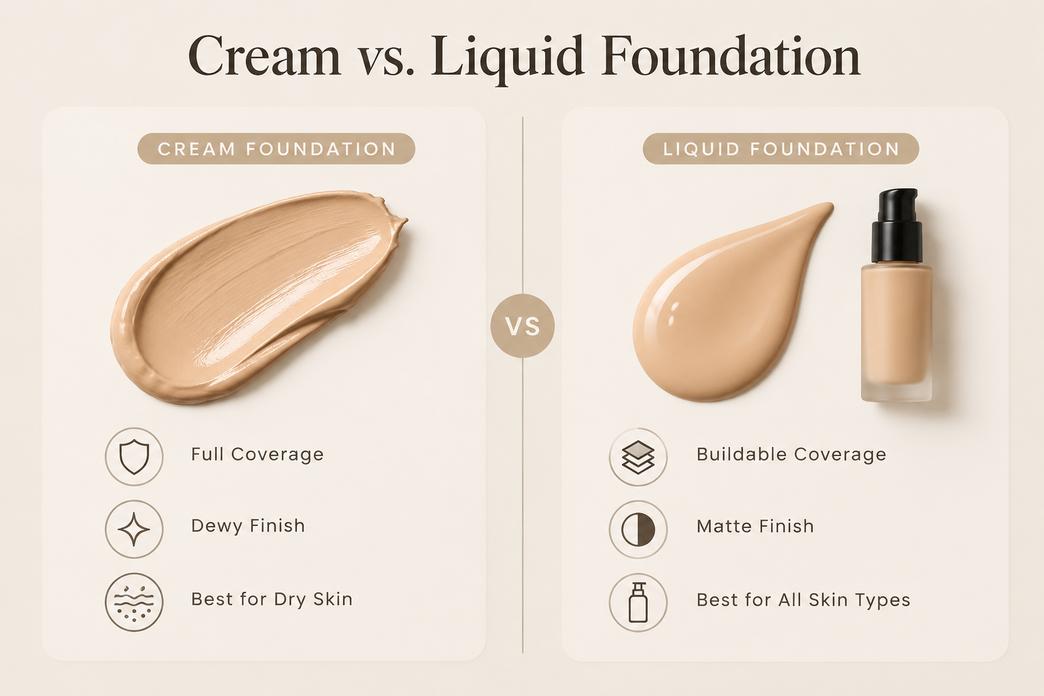
Cream Foundation
Cream formulas can be specified for a richer texture; check the actual sample rather than the format name alone.
- Coverage and appearance
- Full coverage is one possible development target.
- Strong blemish concealment should be evaluated in application.
- A natural, satin, or dewy finish needs a visual reference.
- Full coverage is one possible development target.
- Skin feel
- Added hydration requires suitable ingredient selection.
- For dry skin, compare thin layers with consistent preparation.
- Added hydration requires suitable ingredient selection.
Use the foundation-clumping guide when planning application comparisons.
Liquid Foundation
Liquid foundation briefs can range from light coverage to a fuller appearance.
- Pick the formula for your skin.
- An oil-free option matches dermatologists’ makeup-selection guidance for acne-prone users.
- A matte finish is a separate visual target.
- Check application and shade.
- Easy blendability matters at the edges of application.
- Broad skin tone matching needs shade evaluation.
- A pump dispenser needs a formula-compatible dispensing test.
Topfeel Beauty’s formulation development includes custom textures, pigments, and finishes.
Which cream-versus-liquid texture fits your coverage and skin-feel brief?
Topfeel Beauty’s lab co-creation works on textures and pigments, helping translate your references into sample requirements. Review liquid foundation alongside your cream reference to prepare a consistent comparison covering finish, application, and skin feel.
Foundation Label Essentials For Private-Label Brands
Formula, packaging, skin needs, and claims belong in one launch brief. Topfeel Beauty’s integrated service connects formula development with packaging design and quality control.
Packaging Choice: Airless Pump Bottle vs. Compact Case with Mirror
For fluid formulas, evaluate dispensing with the intended pack rather than assuming the bottle alone establishes shelf life.
- Bottle format
- Limits repeated handling of the bulk product.
- Offers a defined dispensing mechanism.
- Compact case
- An integrated mirror supports portable application.
- Custom packaging can reinforce brand identity.
Functional Additives Spotlight – SPF Protection & Hyaluronic Acid
Some foundation briefs include moisturizing ingredients or SPF. Under U.S. sunscreen regulation, sunscreens are nonprescription drugs; Topfeel Beauty’s SPF foundation guide provides a starting point for the formulation brief.
- Confirm permitted sunscreen ingredients and testing.
- Substantiate SPF, hydration, or anti-aging properties before printing claims; Great Britain guidance requires marketing claims to reflect the product’s actual characteristics.
Tailoring Formulas for Sensitive and Acne Prone Skin
Sensitive-skin briefs need attention to ingredient selection.
- Skin-comfort priorities
- A fragrance-free, gentle formulation addresses one possible trigger: fragrances can cause contact reactions, while other ingredients can also cause reactions.
- Soothing botanicals still require irritation assessment.
- Acne-focused priorities
- Non-comedogenic positioning should guide product selection.
- Pore-clearing positioning requires ingredient and claim review.
- Appropriate testing supports dermatological safety assessment.
Showcasing Vegan, Organic, and Hypoallergenic Tested Ingredients
Topfeel Beauty offers vegan-friendly formula options. Define clean-beauty language clearly rather than treating different claims as interchangeable.
- For organic claims, check USDA labeling categories where applicable: its “organic” category requires at least 95% organic ingredients, excluding water and salt, alongside certification requirements.
- For a hypoallergenic formula or allergy-tested claim, keep testing records; FDA’s explanation states that no U.S. federal definition governs “hypoallergenic.”
- Treat clean beauty as defined brand language, not a safety guarantee.
Build a coherent launch brief: Packaging, functional additives, sensitive-skin positioning, and ethical claims need to agree before artwork approval. Topfeel Beauty’s compatibility assessments connect the chosen formula with its intended pack, giving your team a defined development question to resolve before finalizing claim documentation.
Submit your foundation requirements to discuss the formula, packaging, and documentation needed for your launch.
References
- Hypoallergenic Cosmetics — FDA
- Sunscreen: How to Help Protect Your Skin from the Sun — FDA
- The Corporate Standard of Compassion for Animals — Leaping Bunny
- Labeling Organic Products — USDA
- I Have Acne! Is It Okay to Wear Makeup? — American Academy of Dermatology
- Contact Reactions to Cosmetics — DermNet
- Making Cosmetic Products Available to Consumers in Great Britain — GOV.UK
Post time: Oct-19-2026