
Is a Makeup Primer Necessary?
Your foundation is slipping and your pores are showing. So, is a makeup primer necessary? Not always! Choose preparation around your intended finish.
For brands, define the user and compare samples with their usual foundation.
Key Points: Is a Makeup Primer Necessary?
- A silicone-based primer is one formulation option for a texture-focused product brief.
- Non-comedogenic gels deserve consideration for acne-prone users, alongside their existing skincare.
- Hyaluronic acid infusions bring a hydration-focused direction to a primer brief.
- Oil-free, waterproof formulas need separate checks for finish and claimed wear.
- Skipping primer suits a simpler routine when moisturizer and foundation already work together.
Is A Makeup Primer Necessary?
Is a makeup primer necessary? Define what a makeup base should change: application feel, visible texture, or finish.
Why a Silicone-Based Face Primer Preps Your Canvas
A silicone-based face primer belongs in a texture-focused comparison. Dimethicone has skin-conditioning cosmetic uses; evaluate the complete formula.
Here’s how to compare silicone formulas in your makeup routine:
- Smoother application
- Creates a smooth texture across rough areas?
- Helps foundation application around fine lines?
- Better makeup wear
- Supports the desired long-lasting coverage?
- Reduces visible patchiness during the day?
- Easier skin preparation
- Adds a comfortable layer during skin prep?
- Works as a makeup base after moisturizer?
Compare silicone primer on uneven texture with foundation alone.
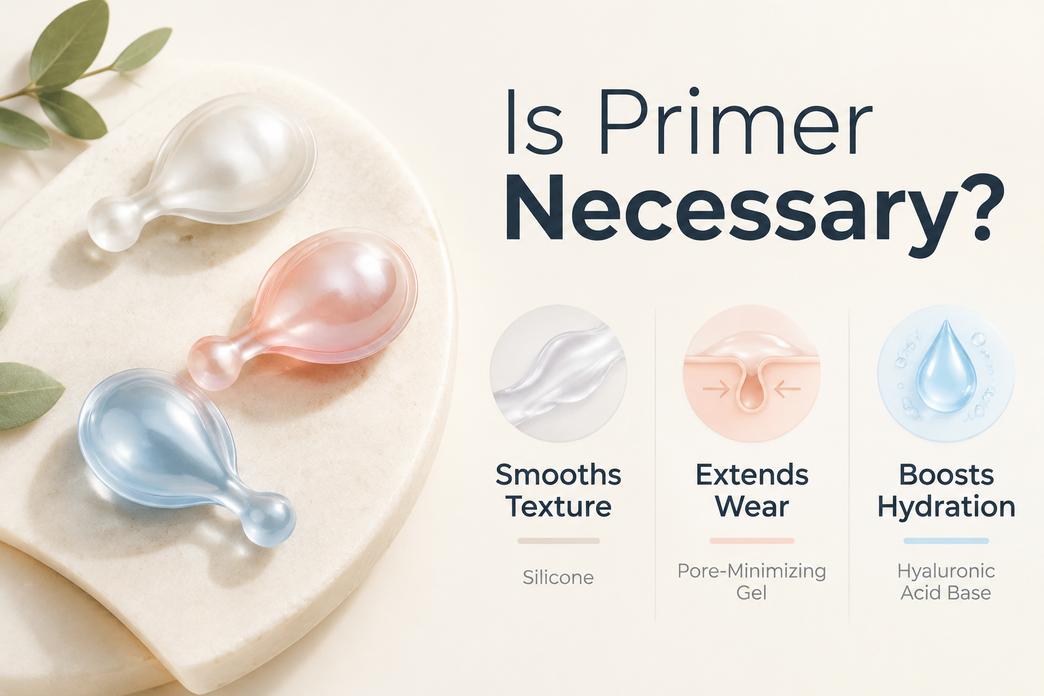
Evaluating Non-Comedogenic Pore Minimizing Gel
Visible pores deserve targeted application rather than automatically adding more coverage.
A non-comedogenic pore minimizing gel can be evaluated alongside skin-type considerations. Dermatologists recommend oil-free, non-comedogenic makeup for acne-prone users; hypoallergenic labeling has no US federal definition.
For better application results:
- Apply a thin layer over visible pores.
- Gently press the formula into your skin texture.
- Allow it to settle before applying foundation.
Compare the oil control finish with the same foundation alone.
Compare the finish without piling on extra makeup.
Illuminating Base Benefits from Hyaluronic Acid Infusion
Dry skin needs a considered preparation routine.
An illuminating base with hyaluronic acid offers a hydration-focused direction: the ingredient retains water, while finished appearance depends on the complete product.
This moisture-focused skin infusion gives three comparison points:
- Radiance: Compare the visible glow.
- Moisture: Note comfort beneath foundation.
- Smoothness: Check evenness of application.
A hydrating primer remains optional.
Choose for your skin and foundation.
Make the base earn its place: Texture smoothing, pore appearance, and hydration belong in the same primer brief. Topfeel Beauty’s lab co-creation covers textures and skincare actives, giving your team a concrete starting point for comparing these three priorities rather than selecting a formula by its headline ingredient.
Review the moisturizing face primer to decide which finish to take into sampling.
3 Reasons Is A Makeup Primer Necessary
What should change compared with foundation alone? Compare wear, finish, and color correction separately.
Evaluating Longevity of Oil-Free, Waterproof Formulas
For longer coverage, compare an oil-free formula and claimed waterproof base under realistic conditions. In the United States, cosmetic claims must be truthful and not misleading.
- Better makeup staying power
- Shine control: Observe oil-related separation.
- Sweat resistance: Compare results during normal activity.
- Reliable daily performance
- All-day wear: Record touch-ups at agreed intervals.
- Smudge proof: Check unwanted movement.
For oily skin, compare this extra layer using the same foundation amount.
Assessing Texture with Silicone-Based, Mattifying Lotion
When foundation emphasizes pores, compare a silicone primer against your usual preparation before changing coverage.
Here’s how to assess a mattifying lotion:
- Pore minimizer: Compare visible pore appearance.
- Makes uneven skin texture less noticeable?
- Helps foundation spread evenly?
- Matte finish: Compare surface shine.
- Reduces the appearance of fine lines?
- Keeps oily areas looking fresh?
Compare skin texture without extra foundation using consistent base-makeup application.
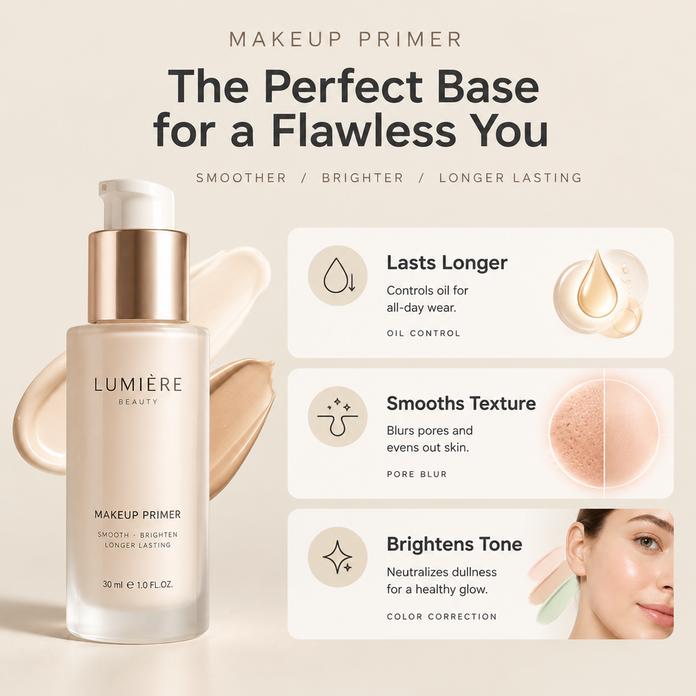
Evaluating Radiance with Color Correcting Cream
For a brighter-looking complexion, identify the discoloration you want to address first.
A color corrector brings a pigment-based option to an illuminating base comparison.
- Redness neutralization: Compare the chosen tint over redness.
- Dullness correction: Check the result on the intended skin tone.
- Even skin tone: Evaluate the combined effect beneath foundation.
Compare sample shades rather than container color; foundation products add color and coverage to the combined base.
Consider your daily routine.
How Primers Layer Under Foundation
Start with the user’s routine and add one product at a time to compare base-makeup combinations.
First Step: Airless Pump Bottle Dispense of Face Primer
An airless pump provides a dispensing option for face primer. Aptar lists a 1,000–80,000 cps viscosity range for its airless portfolio; assess the actual dispenser with the selected formula.
For application:
- Prepare your skin
- Apply moisturizer and let it settle.
- Use a small amount of makeup base.
- Apply strategically
- Spread the silicone base over the intended areas.
- Concentrate your pore minimizer where needed.
- Allow the layer to settle before foundation.
Add primer when you prefer its finish.
Mid Layer: Squeeze Tube Illuminating Base for Glow
A squeeze tube offers another dispensing option for an illuminating base.
For a radiant finish, compare this layering technique:
- Targeted glow
- Dab a little glow booster onto cheekbones.
- Blend gently over primer.
- Soft luminosity
- Mix with foundation only as the product directions allow.
- Avoid stacking excess liquid highlighter.
Compare a dewy complexion without buildup; the highlighter development guide helps define the glow component.
Skincare Step: Glass Dropper Bottle Hyaluronic Acid Serum
Apply hyaluronic acid serum as skincare before primer and foundation, following product directions.
A glass dropper offers a serum dispensing format.
- Build hydration
- Apply serum according to its directions.
- Follow with moisturizer as appropriate.
- Prepare for makeup
- Allow facial skincare to settle.
- Add primer only where needed.
For a dewy topcoat effect, evaluate a compatible finishing mist separately.
Good hydration-focused skincare starts with moisturizer suited to skin needs and a manageable sequence.
Can the whole routine work together?
A compatibility assessment in Topfeel Beauty’s custom-formulation process gives the complete routine one development checkpoint. Explore custom solutions to compare hydration with primer dispensing and glow layering before choosing a pump, tube, or serum companion; take forward one formula-and-packaging brief for the whole sequence.
Primer Vs. No Primer: Why It Matters
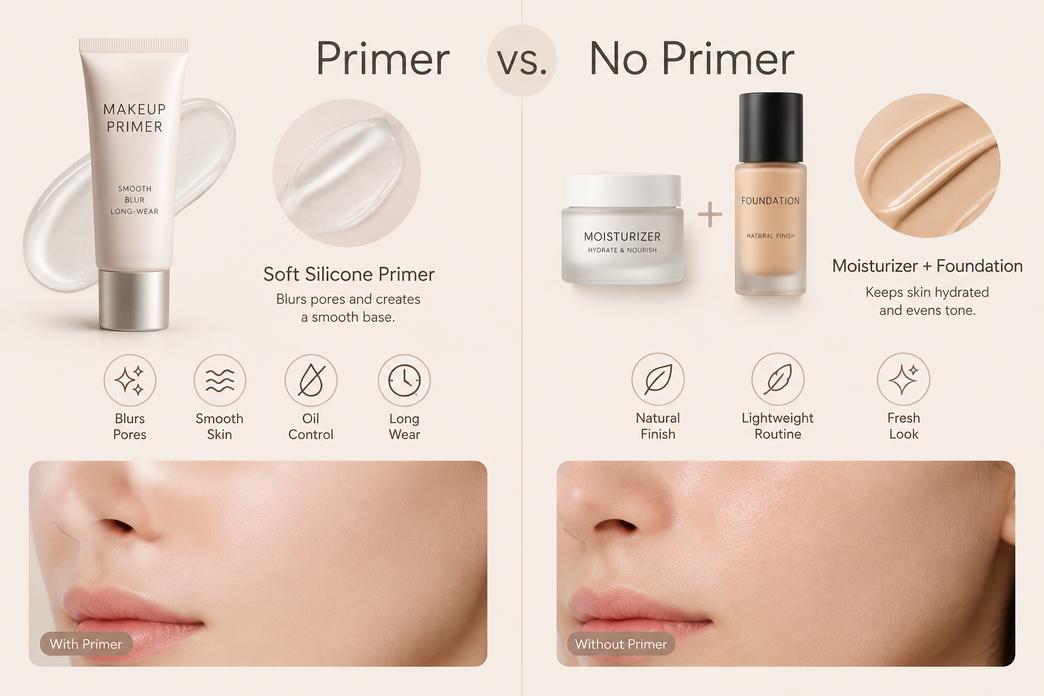
Compare primer and no primer with the same foundation and skincare. The useful result is the combination that matches your preferred finish and routine, not the greatest number of layers.
Primer
A makeup primer adds a base layer between skincare and foundation.
Compare that layer against your needs:
- Smoother Makeup Application
- Skin smoothing: Compare rough patches.
- Pore minimizer: Check visible pore appearance.
- Texture correction: Assess evenness around textured areas.
- Better Makeup Performance
- Oil control: Note shine around the forehead and nose.
- Longevity: Record fading during wear.
- Grip: Compare foundation movement.
For a comfortable finish, compare primer selection using consistent foundation application.
No Primer
Skipping primer gives you a simpler comparison routine.
Why go primer-free?
- Minimalist routine: Fewer application steps.
- Natural finish: Assess foundation over prepared skin.
- Hydration: Keep moisturizer in the comparison.
- Direct application: Apply foundation after skincare settles.
- Lightweight: Compare how fewer layers feel.
- Bare skin: Judge comfort and appearance with fewer layers.
Note fading or dry patches; contact reactions to cosmetics are a separate concern from finish preferences.
Choose the result you prefer for your intended wear period.
Short-Lasting Makeup? Primer Extends Wear
Evaluate primer shine, skin texture, and foundation wear; use the manufacturer-selection guide to prepare supplier questions.
ISO Certified, GMP Compliant Primer Manufacturing
Topfeel Beauty’s factory certifications include ISO 22716 and GMPC. The GMP standard’s scope concerns production, control, storage, and shipment, separately from finished primer wear.
Key performance factors include:
- Long-lasting wear
- Helps foundation stay even during wear?
- Reduces makeup breakdown around oily areas?
- Quality assurance
- Checks product stability and ingredient consistency.
- Evaluates foundation compatibility.
- All-day hold
- Supports adhesion under the intended wear conditions?
- Requires performance testing for wear claims.
For customers noticing fading foundation, compare primer samples against the brief.
Custom Jar Mattifying Lotion from Factory Direct Supply
For a mattifying lotion, agree the desired finish before finalizing the package.
Topfeel Beauty’s packaging support ranges from stock components to custom molds, with formula-compatibility considerations.
- Oil control: Define the target finish.
- Custom jar: Confirm the available component.
- Packaging design: Agree colors, labels, and visual details.
Coordinate packaging with ingredient sourcing and production planning.
White Label Service for Bulk Supply and Global Shipping
For a primer launch, compare stock-formula private label with custom OEM development. Selling in Great Britain also requires a UK-established Responsible Person.
Topfeel Beauty’s workflow gives brands a way to coordinate:
- Private label development
- Brand-focused packaging.
- Flexible custom formulation options.
- Bulk supply
- Scalable production planning for wholesale cosmetics.
- Consistent packaging and product specifications.
- Global shipping
- Export documentation including MSDS and COA.
- Coordinated international logistics terms.
Choose a primer development route that matches the intended routine and launch requirements.
Put the wear brief to work: Coordinate checks at certified facilities, packaging for mattifying lotion, and global delivery planning before bulk supply. Topfeel Beauty’s formulation engineers prepare initial samples in 3-7 days, giving your team an early development milestone rather than a complete launch timetable.
Send your target finish, foundation pairing, package preference, and destination through the project inquiry page to define the sampling brief and production requirements.
References
- Dimethicone, Methicone and Substituted-Methicone Polymer Ingredients — Cosmetics Info
- I have acne! Is it okay to wear makeup? — American Academy of Dermatology
- Hyaluronic Acid: What It Is, Benefits, How To Use & Side Effects — Cleveland Clinic
- Cosmetics labeling claims — FDA
- Foundations — Cosmetics Info
- Airless packaging — Aptar
- How to pick the right moisturizer for your skin — American Academy of Dermatology
- Cosmetics Allergy: Causes, Symptoms, and Treatment — DermNet
- ISO 22716:2007 — Cosmetics — Good Manufacturing Practices (GMP) — Guidelines on Good Manufacturing Practices — ISO
- Making cosmetic products available to consumers in Great Britain — GOV.UK
- “Hypoallergenic” Cosmetics — FDA
Post time: Nov-05-2026