

How to Use Lip Scrub?
When your lip scrub glides like warm sugar, customers stay hooked. Build a private label hit that turns every swipe into profit.
A lip scrub isn’t just a cute jar on a shelf—it’s the difference between “meh” and money-maker. In a market where U.S. lip care sales topped $1.2 billion in 2023 (Statista), shoppers aren’t playing around. If the scrub drags, melts, or feels like gravel, customers bounce. Fast. But when it glides like brown sugar on warm toast? That’s repeat business.
Here’s the kicker: how a lip scrub is used tells buyers everything about its build. Grit size. Oil balance. Rinse-off feel. One bad batch and your brand’s reputation is toast. I’ve seen retailers drop a line over texture alone—it’s that serious.
As Mintel notes, “texture and sensorial experience drive repurchase in lip care.” Smooth application isn’t fluff; it’s strategy. And that’s where this story gets interesting.
Types of Lip Scrub Exfoliants
A good lip scrub is more than a sweet-smelling jar. The right lip exfoliator shapes texture, feel, and even how your lip balm sits afterward. From classic sugar crystals lip polish blends to enzyme-based lip care, each lip scrub formula works a little differently.
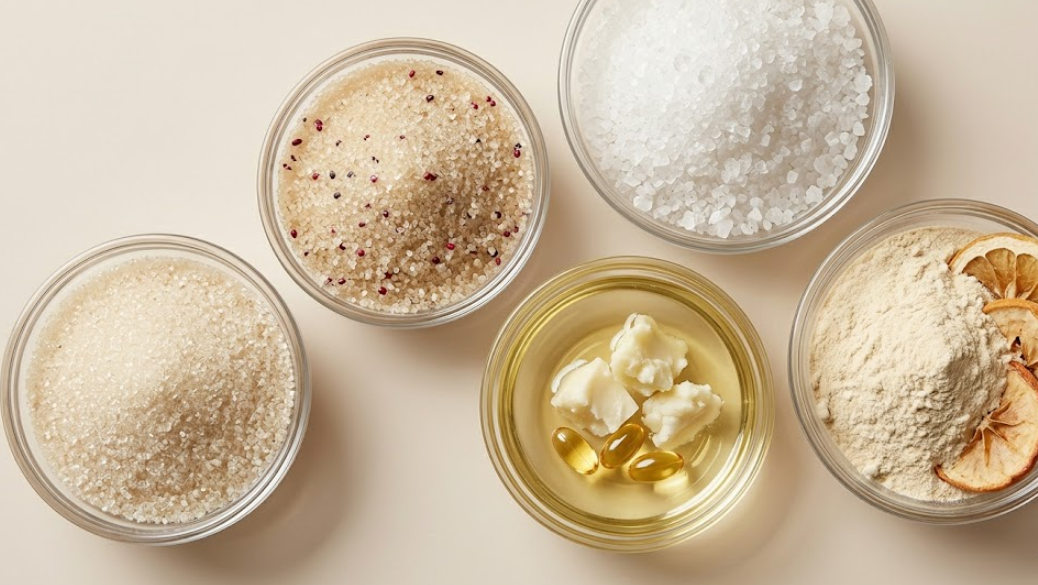
Sugar-Crystal Exfoliants with Superior Texture Consistency
When people think of a lip scrub, they usually mean sugar.
- Core exfoliating base
- Sugar crystals act as a natural sweetener and physical buffer.
- Fine grades use fine granules for gentle exfoliation.
- Medium grades create a smooth texture with consistent application.
- Sugar crystals act as a natural sweetener and physical buffer.
- Functional benefits
- Even particle size reduces scratchy drag.
- Balanced grit supports steady lip exfoliation without overdoing it.
- Consumer appeal
- Familiar scent profile.
- Easy rinse-off.
- Reliable results for everyday lip polish routines.
Salt-Based Scrubs: Exfoliating Agents for Deeper Buffing
A salt-driven lip scrub feels stronger right away.
- Particle composition
- sea salt delivers mineral-rich contact.
- Epsom salt offers larger, coarse particles.
- Performance impact
- Promotes intense exfoliation.
- Boosts visible dead skin removal.
- Target users
- Heavy lipstick wearers.
- Dry climate consumers.
- Fans of bold lip care routines.
- Key caution
- Deeper buffing calls for follow-up hydration.
Oil-Infused Formulas Combining Natural Oils and Moisturizing Ingredients
Some lip scrub blends feel almost like a lip balm with grit inside.
- Oil foundation
- coconut oil for glide.
- jojoba oil for lightweight conditioning.
- shea butter for richer sealing.
- Moisture strategy
- Moisturizing agents support hydrating properties.
- The nourishing blend leaves a soft lip balm effect after rinse-off.
- Texture balance
- Exfoliation happens.
- Lips stay cushioned, not stripped.
This type of lip exfoliator works well for frequent lip scrub users.
Enzyme-Powered Options: Gentle Efficacy without Abrasive Particles
Not every lip scrub relies on grit.
- Active components
- Fruit enzymes such as papain and bromelain.
- Mechanism
- Mild chemical exfoliation loosens buildup.
- Entirely non-abrasive surface action.
- Ideal match
- • Sensitive skin profiles
- • Users prone to micro-cracks
- • Fans of quiet, gentle renewal
This style of lip scrub skips the scrubby feel but still refreshes lips, giving modern lip care a softer edge.
3 Essential Steps for Perfect Lip Scrub
A good lip scrub can turn dry, flaky lips into something soft and smooth without drama. This guide breaks down how a lip scrub, lip exfoliator, or scrub for lips is built, blended, and checked before it reaches your routine.
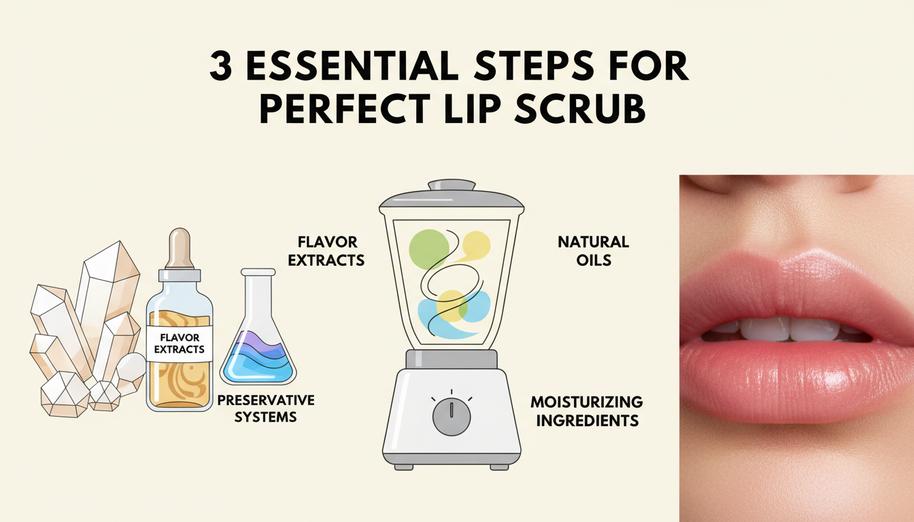
Step 1: Selecting Sugar Crystals, Flavor Extracts, and Preservative Systems
A solid lip scrub starts with tight Ingredient Selection inside the Formulation Base:
- Sugar Crystals
- Particle size
- Fine (150–250 µm): gentle lip exfoliator feel
- Medium (250–400 µm): stronger lip polish effect
- Source purity
- Moisture content control
- Particle size
- Flavor Extracts
- Natural vs. synthetic
- Allergen screening
- Stability in oil systems
- Preservative Systems
- Broad-spectrum efficacy
- pH compatibility
- Regulatory compliance
| Parameter | Fine Sugar | Medium Sugar | Target Range | Test Method |
|---|---|---|---|---|
| Particle Size (µm) | 180 | 320 | 150–400 | Sieve Analysis |
| Moisture (%) | 0.2 | 0.3 | ≤0.5 | Karl Fischer |
| Microbial Limit (CFU/g) | <10 | <10 | <100 | Plate Count |
| Flavor Stability (°C) | 45 | 45 | 40–50 | Heat Test |
| Preservative Efficacy (log reduction) | 3.5 | 3.5 | ≥3 | Challenge Test |
This groundwork keeps every lip scrub consistent, safe, and ready for real-life use.
Step 2: Blending in Natural Oils and Moisturizing Ingredients with Proper Mixing Equipment
Texture makes or breaks a lip scrub. The Blending Process links Natural Oils, Moisturizing Ingredients, and calibrated Mixing Equipment into one smooth mass.
- Oil Phase
- Jojoba for glide
- Shea for cushion
- Humectant Phase
- Glycerin for water retention
- Vitamin E for antioxidant support
Inside controlled Emulsification:
- Low-speed pre-mix
- Gradual sugar fold-in
- Shear balance for even Texture Development
A scrub for lips should feel plush, not greasy. Too much shear? The lip exfoliator turns pasty. Too little? Oil separation shows up fast. Tight mixing control keeps the lip polish stable on shelves and steady in your bathroom.
Step 3: Application, Quality Control Checks, and Post-Scrub Moisture Lock
Performance testing connects lab work to real Lip Application habits.
- Quality Control
- Exfoliation grading
- Stability cycling
- Micro testing
- User Routine Mapping
- Apply pea-sized lip scrub
- Massage 30 seconds
- Rinse or wipe
- Moisture Lock
- Balm layering
- Occlusive finish
- Shine evaluation for Final Finish
During Product Testing, labs score smoothness after one use. In daily lip care routine, results show up as softer texture and less flaking. A well-made lip scrub does the heavy lifting; the follow-up balm seals the deal.
In-Store vs. Homemade Lip Scrub
A good lip scrub can totally change how your lipstick sits. From shelf-ready lip scrub jars to quick DIY lip exfoliator mixes, the choice shapes texture, safety, and vibe. Let’s break down store-bought scrub for lips and homemade lip care in a real-world way.
In-Store Lip Scrub
Commercial lip scrub products are built with layered planning.
- Product Development
- Exfoliation System
- Sugar crystals calibrated for even application
- Particle size tested to avoid micro-tears
- Moisturizing Ingredients
- Shea butter blends
- Vitamin E infusion before rinse off
- Exfoliation System
- Compliance & Packaging
- Tamper seals
- Batch coding for inventory
- Clear labeling for post-application care like lip balm
- Brand Strategy
- Texture differentiation
- Seasonal lip scrub launches
- Retail display impact
Below is a technical comparison often reviewed by suppliers such as Topfeel Beauty when designing a lip scrub line:
| Parameter | In-Store Lip Scrub | Lab Standard Range | Consumer Expectation |
|---|---|---|---|
| Particle Size (μm) | 300–500 | 250–600 | Smooth feel |
| pH Level | 5.5–6.5 | 5.0–7.0 | No irritation |
| Preservative % | 0.8–1.2 | ≤1.5 | Safe storage |
| Shelf Life (months) | 18–24 | 12–24 | Long-lasting |
A ready-made lip exfoliator feels polished. Twist, swipe, rinse off, done.
Homemade Lip Scrub
DIY lip scrub is chill and personal. You grab sugar, mix with oil, maybe a drop of honey, and create gentle exfoliation for dry lips.
Quick combo ideas:
- Sugar + coconut oil
- Honey + brown sugar
- Olive oil + fine sugar
How people usually do it:
- Blend a teaspoon of sugar with a few drops of oil.
- Massage onto lips for soft application.
- Light rinse, then moisturize with lip balm.
No heavy preservatives. Short shelf life. Total control over texture.
Some beauty startups, including customized services, notice rising interest in private label scrub for lips formulas because users want simple ingredient lists and fresh batches.
A homemade lip exfoliator feels raw but real. A store lip scrub feels refined. Both get your lips smooth; it just depends on how hands-on you like your lip care routine.
FAQs
What types of exfoliating agents are used in lip scrub formulations?
A lip scrub lives or fails by how it feels on the mouth. Formulators balance touch, scent, and care through a tight mix of ingredients:
- Sugar crystals for smooth exfoliation efficacy and gentle texture consistency
- Enzyme-based exfoliating agents for sensitive target demographics
- Natural oils and moisturizing ingredients that soften during massage, not after
- Flavor extracts and preservative systems that protect aroma profiles and shelf life stability
Each choice shapes brand differentiation and reflects consumer preferences tied to current market trends.
How do manufacturers keep texture consistent in bulk lip scrub production?
Texture consistency depends on discipline more than scale. In real production rooms, control comes from:
- Calibrated mixing equipment that protects sugar crystals from breakdown
- Batch production records paired with quality control checks at set intervals
- Filling lines matched to jar containers or tube packaging to avoid separation
- Inventory management aligned with raw material sourcing to limit color variations
The reward is trust—OEM strategy backed by repeat purchase confidence.
What regulatory factors affect lip scrub products for export markets?
Crossing borders adds pressure. Export-ready lip scrub lines meet people’s expectations by staying compliant:
- Cosmetic regulations covering ingredient safety and allergen declarations
- Labeling requirements applied through labeling machinery and approved label materials
- GMP standards supported by sanitization protocols and traceable batch production
- Export documentation prepared for customs clearance, freight forwarding, and distribution networks
When done right, shelf life stability and brand credibility travel together.
References
- U.S. Sales of Lip Care Products 2023 – statista.com/Statista
- Texture and Sensory Experience in Lip Care – mintel.com/Mintel
- Benefits of Sugar Scrubs for Lips – healthline.com/Healthline
- How to Safely Exfoliate Your Skin – aad.org/American Academy of Dermatology
- Differences Between Sea Salt and Table Salt – medicalnewstoday.com/Medical News Today
- How to Remove Dead Skin from the Face – medicalnewstoday.com/Medical News Today
- Health Benefits of Coconut Oil – ncbi.nlm.nih.gov/NIH
- Jojoba Oil in Dermatology – pubmed.ncbi.nlm.nih.gov/PubMed
- Everything You Need to Know About Shea Butter – medicalnewstoday.com/Medical News Today
- Papain: Uses and Scientific Insights – sciencedirect.com/ScienceDirect
- Honey as a Natural Antibacterial Agent – ncbi.nlm.nih.gov/NIH
- Federal Food, Drug, and Cosmetic Act Regulations – fda.gov/FDA
- ISO 22716: Cosmetics Good Manufacturing Practices – iso.org/ISO
- Tactile Texture and Sensory Evaluation of Cosmetics – cosmeticsandtoiletries.com/Cosmetics & Toiletries
- How to Keep Your Lips Healthy – pennmedicine.org/Penn Medicine
Post time: Mar-27-2026