

How to Find Your Foundation Shade?
Picking the perfect foundation shade isn’t vanity—it’s ROI. Nail the tone, win loyalty, and watch your private label profits glow.
Picking the right foundation shade isn’t just makeup talk—it’s money on the table. One mismatch and customers bounce faster than a bad blind date. For private label brands, shade accuracy is the difference between cult favorite and clearance bin. Skin tone isn’t paint-by-numbers; it’s chemistry, lighting, and trust bottled up.
McKinsey’s 2023 Beauty Report notes inclusive shade ranges are directly tied to higher repeat purchase rates.
Get the shade science right, and you’re not just selling foundation—you’re building loyalty that sticks like primer on a humid July afternoon.
Quick Answers: Foundation Shade Essentials
➔ Evaluate skin tone & undertone with wrist and jawline tests to ensure seamless matches.
➔ Test under natural and simulated light to monitor oxidation, flashback, and finish consistency.
➔ Optimize formulation for pigment dispersion, emulsion stability, and SPF inclusion to maintain shade accuracy.
➔ Expand shade ranges using demographic insights, trend forecasting, and quality control for inclusive loyalty building.
What Makes a Perfect Foundation Match?
Finding the right foundation shade can feel like trial and error, but it doesn’t have to be. A flawless base comes down to tone awareness, smart formula choices, and real talk about what customers actually want. When a foundation shade truly matches, skin looks like skin—just smoother, fresher, and more even.
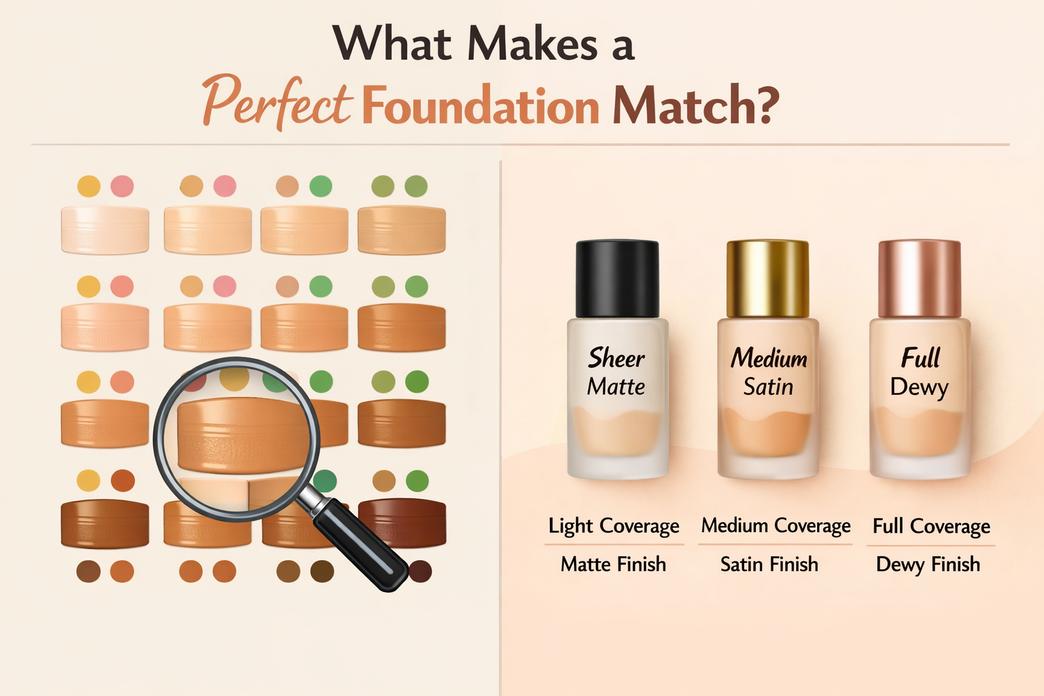
Evaluating Skin Tone and Undertone Compatibility
Achieving the right foundation shade starts with understanding:
- Skin tone depth
- Light
- Medium
- Tan
- Deep
Then comes undertone identification, which shapes how a foundation shade sits on the face:
- Warm undertones – golden or peach hints
- Cool undertones – pink or red hues
- Neutral undertones – balanced mix
- Olive undertones – subtle green cast
For brands refining shade accuracy:
- Analyze understanding your skin type a comprehensive guide to tailored skincare alongside tone
- Use face mapping to detect uneven pigmentation
- Test foundation shade under natural and studio lighting
When tone and undertone align, the foundation shade melts in instead of masking the face.
Choosing the Right Coverage Level and Finish Type
Coverage and finish decide how a foundation shade actually performs in daily life.
Coverage level breaks down into:
- Sheer coverage
- Medium coverage
- Full coverage
Each interacts differently with a chosen foundation shade.
Finish also shifts perception:
- Matte finish controls shine for oily skin
- Satin finish balances glow and control
- Dewy finish boosts radiance for dry skin
Application matters too:
- Prep skin based on skin type.
- Match coverage to personal comfort.
- Blend using brush, sponge, or fingers to protect shade integrity.
A perfect foundation color can look off if the finish clashes with texture.
Ensuring Color Matching Through Pigment Dispersion and Emulsion Stability
Behind every reliable foundation shade sits careful formulation.
Key technical pillars include:
- Pigment dispersion for even color payoff
- Stable emulsion stability to prevent separation
- Controlled oxidation to maintain shade accuracy
Within a strong foundation formula:
- Balance ingredients to protect skin
- Fine-tune how difficult is it to develop a makeup foundation that is closest to skin care for smooth blending
- Match pH to reduce unexpected darkening
If pigment clumps or oxidation kicks in fast, the foundation shade shifts. That’s a dealbreaker.
Considering Consumer Preferences and Shade Range Expansion
Today’s buyers expect real inclusivity.
Shade development often follows this path:
- Study consumer preferences and honest product reviews.
- Expand shade range to cover diverse skin tones.
- Offer testing samples so users can confirm their foundation shade before committing.
Brands focusing on inclusive shades also highlight brand transparency and speak openly about formulation standards. That’s where companies like Topfeel Beauty stand out—balancing technical control with everyday wearability. Topfeel Beauty supports broad foundation shade development designed around real personal needs, not just trend cycles.
At the end of the day, the right foundation shade isn’t luck. It’s science, feedback, and smart design working together.
3 Tests to Find Your Shade
Finding your ideal foundation shade shouldn’t feel like guesswork. The right foundation, shade match, and tone alignment can make skin look real, not masked. These three tests break it down in a chill, practical way so your foundation shade finally clicks.
Wrist Swatch Test – Ingredient Compatibility and Skin Tone Matching
Your wrist tells the truth about skin tone and undertone fast. But it needs structure, not random swipes.
- Step A: Read Your Base Clues
- Check vein color
- Blue/purple → cool undertone
- Green → warm undertone
- Mixed → neutral undertone
- Try the jewelry test
- Silver pops → cool
- Gold glows → warm
- Factor in sun exposure
- Burns easily → likely cool
- Tans quickly → likely warm/olive
- Check vein color
- Step B: Swatch the Foundation Shade
- Draw 2–3 vertical lines of each foundation shade
- Observe:
- Immediate tone shift
- Early oxidation (wait 60–90 seconds)
- Reaction to skin warmth
- Step C: Check Formula Safety
- Scan for ingredient compatibility
- Confirm hypoallergenic claims
- Watch for redness or tingling
| Test Factor | Cool Undertone | Warm Undertone | Neutral Undertone |
|---|---|---|---|
| Vein Color | Blue/Purple | Green | Mixed |
| Jewelry | Silver | Gold | Both |
| Oxidation | Turns Pink | Turns Orange | Slight Darkening |
A strong foundation shade match blends into your wrist without looking chalky or too deep. Brands like Topfeel Beauty design each foundation and shade range with balanced pigment ratios, helping the base tone stay stable instead of shifting weirdly after five minutes.
Jawline Blend Assessment to Validate Undertone and Texture
The wrist gives clues. The jawline gives the verdict.
- Alignment Check
- Apply your chosen foundation shade across the jawline.
- Compare face vs. neck.
- If it disappears → tone alignment works.
- If it leaves a line → undertone mismatch.
- Texture Evaluation
- Examine foundation texture
- lightweight liquid foundation: flexible, everyday wear
- Cream: higher coverage
- Serum: light, skin-like finish
- Watch blendability
- Does it melt in?
- Does it drag?
- Examine foundation texture
- Finish & Skin Type Match
- Oily skin type → soft matte finish
- Dry skin → radiant finish
- Combination → natural finish
Let it sit for 10 minutes. Check pores. A tips to avoid clumping foundation won’t clog or sit heavy. The goal isn’t full mask coverage; it’s clean fusion between tone and finish. When the undertone syncs from cheek to neck, your foundation shade feels invisible but polished.
Flashlight Simulation Stability Testing for Consistent Finish
Now the real-world stress test. Lighting flips everything.
Start with controlled lighting conditions:
- Stand in natural light near a window.
- Move to artificial light indoors.
- Turn on flash to mimic flash photography.
Look closely.
Does the foundation shade throw white cast? That’s often flashback from SPF. Does oxidation deepen the tone after 20 minutes? That affects color accuracy. Long events demand long-wear stability, not a disappearing act.
Key checkpoints:
- Oxidation level after 30 minutes
- Pigment dispersion under flash
- Finish shift from matte to oily
- Overall consistent finish
A stable foundation shade keeps tone true across settings. Chinese foundation makeup has entered the golden age because it addresses these pigment balances under varied light so the base makeup shade you pick at noon won’t betray you at night.
Lock in the right foundation. Lock in the right shade. When your foundation shade survives wrist, jawline, and flash tests, you’re not guessing anymore—you’re set.
Daylight Testing: True Foundation Shade Revealed
Daylight is the real judge of any foundation shade. Store lights can hype it up, but natural sun shows the truth fast. This cluster breaks down how SPF, sun exposure, and outdoor wear affect your foundation shade, color match, and overall finish in real life.
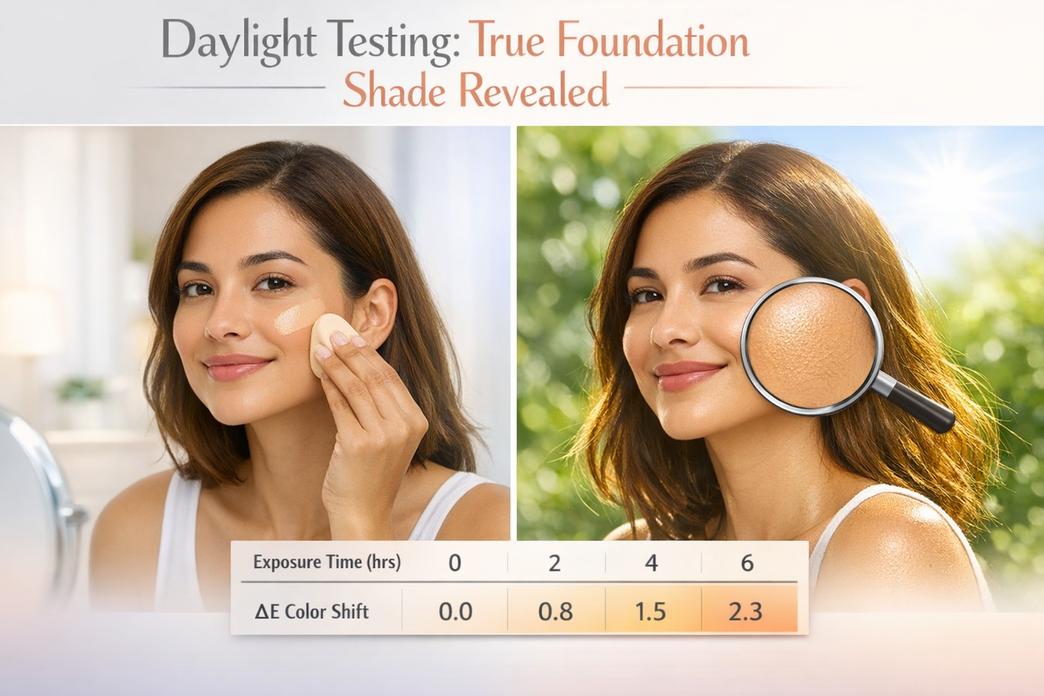
Assessing SPF Inclusion Effects on Color Perception
When SPF or sun protection factor enters a formula, your foundation shade can shift under direct light. That shift links closely to light reflection and subtle pigment alteration.
- SPF and Visual Shift
- Mineral filters
- Higher zinc oxide levels may increase surface reflection.
- Can create mild cast, affecting color perception.
- Chemical filters
- Lower visible residue.
- May still influence foundation shade warmth after oxidation.
- Mineral filters
- Flashback Risk in Daylight
- High SPF (30+)
- Greater reflection under strong natural sunlight.
- Balanced SPF (15–25)
- More stable foundation shade match outdoors.
- High SPF (30+)
At custom solutions, lab teams compare does foundation with spf really protect against sun protection foundation shade performance indoors and outside to catch tone distortion early. A true shade match means your shade foundation looks consistent from selfie light to noon sun.
Dermatologist-Tested Stability Under Natural Sunlight
Claims like dermatologist tested must hold up under UV exposure and long hours outside. Real wear data tells the story.
- Stability Monitoring Framework
- Skin Reaction Review
- Check redness or sensitivity during extended wear.
- Confirm skin stability across skin types.
- Shade Tracking
- Measure color consistency after 2, 4, and 6 hours.
- Compare baseline foundation shade to post-sun tone.
- Skin Reaction Review
| Exposure Time (hrs) | ΔE Color Shift | Visible Oxidation Level | Wear Rating (1–5) |
|---|---|---|---|
| 0 | 0.0 | None | 5 |
| 2 | 0.8 | Very Low | 5 |
| 4 | 1.5 | Low | 4 |
| 6 | 2.3 | Moderate | 3 |
This type of tracking helps brands like Topfeel Beauty protect foundation wear quality while keeping the original foundation shade close to its intended tone.
Evaluating Emulsion Stability and Pigment Dispersion Outdoors
Outdoor heat, wind, and humidity test emulsion stability and pigment dispersion in ways indoor labs cannot fully copy.
- Environmental Factors Impact
- Heat
- Thins foundation texture.
- May cause uneven color uniformity.
- Humidity
- Alters viscosity.
- Can weaken product integrity.
- Heat
- Pigment Behavior
- Even dispersion
- Maintains smooth shade foundation look.
- Separation
- Leads to patchy foundation shade and tone drift.
- Even dispersion
At Topfeel Beauty, outdoor trials simulate real-life city walks and beach exposure. The goal is simple: your foundation shade, your shade match, and your base color should stay steady, not slide, split, or fade halfway through the day.
Neutral vs. Cool: Which Shade Wins?
Finding the right foundation shade can feel like trial and error, but it gets easier once you break down undertones. Let’s talk neutral and cool vibes in a real, no-stress way.
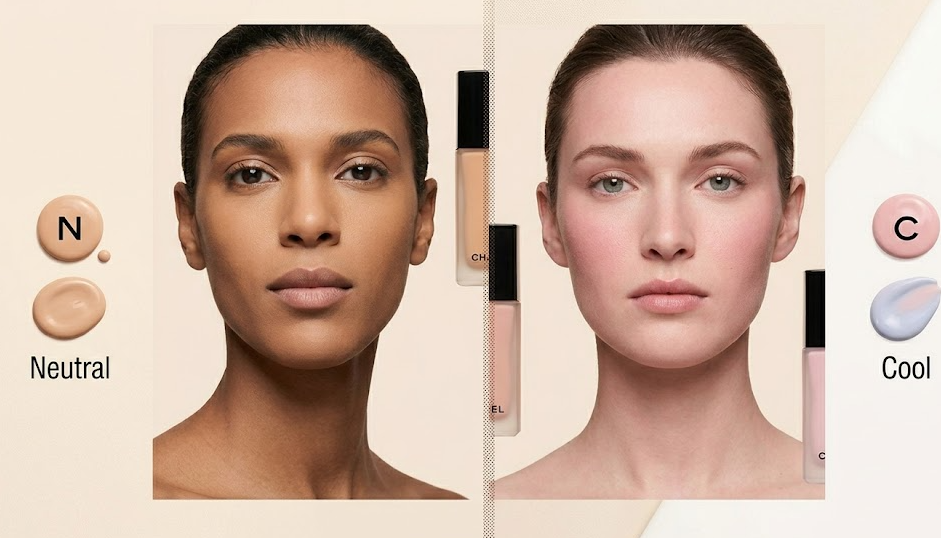
Neutral Undertone
A foundation shade for neutral skin sits right in the middle. Not too warm. Not too pink. Just balanced.
- How to spot it:
- Skin shows a mix of warm undertones and subtle cool hints.
- You may notice touches of yellow undertones or soft peachy undertones, but nothing overpowering.
- Some people lean slightly toward golden undertones or even faint olive undertones.
- Overall look? A pretty balanced complexion.
- When choosing a foundation color:
- Start with a true neutral label in your shade range.
- Check it along your jawline in daylight.
- Let it sit for a few minutes to see if the foundation shade shifts.
- Why neutral wins for many:
- Works across seasons.
- Handles slight tanning.
- Easier oxidation control during wear.
If your foundation shade always looks “almost right” but not pink or yellow enough, you’re likely in neutral territory. The right makeup shade should disappear into your skin tone without drama.
Cool Undertone
Cool undertones lean pink. Sometimes red. Occasionally a soft blue cast.
- Signs you’re cool-toned:
- Visible pink undertones or red undertones.
- A hint of bluish undertones beneath the surface.
- Common with fair skin.
- Natural rosy complexion.
- When your veins appear blue, that’s a strong clue.
- Picking the right foundation shade:
- Look for labels marked cool or C.
- Avoid heavy yellow bases.
- Test under both indoor and outdoor light.
- Watch for oxidation that turns orange.
- Why cool shades need precision:
- Too warm? Skin looks dull.
- Too dark? Redness pops.
- Perfect match? Fresh, bright, and clean finish.
A well-matched foundation shade for cool skin keeps pink tones intentional, not blotchy. When your base blends smoothly into your natural skin tone, your whole look just clicks.
FAQs
How can I achieve accurate foundation shade matching for diverse regional skin tones?
Shade accuracy begins with real human observation and technical discipline working together:
- Color Matching & Undertone Control
- Calibrated systems identify skin tone depth and undertone (warm, cool, neutral).
- Pigment dispersion must stay uniform to avoid streaking across coverage levels.
- Manufacturing Precision
- Strict quality control standards maintain batch consistency.
- Stability testing confirms emulsion stability before mass filling.
- Market Alignment
- Shade range expansion guided by oem face makeup demographic targeting and regional skin tones.
- Competitor analysis and consumer feedback refine gaps in depth or undertone.
When technical balance meets real-world testing, foundation shade stops guessing and starts fitting.
What influences oxidation control in large-scale production?
Oxidation shifts a beautiful match into a dull tone within hours. Control depends on three tightly connected factors:
- Formula chemistry: pH balance, preservative system strength, and ingredient compatibility.
- Structure stability: consistent viscosity control and well-managed pigment dispersion.
- Testing discipline: performance evaluation under daylight with SPF inclusion checked for color shift.
A stable formula type protects skin tone integrity from factory to final wear.
Why is pigment dispersion critical for a consistent shade line?
Uneven dispersion quietly ruins finish type and texture. Strong dispersion ensures:
| Control Area | Impact on Foundation Shade |
|---|---|
| Emulsion stability | Prevents separation during shelf life |
| Coverage level balance | Even color payoff across shades |
| Batch consistency | Identical tone from first unit to last |
| Packaging format safety | No pigment settling during transport |
Without tight dispersion control, shade numbers may match—but faces will not.
What certifications should private label buyers request?
Certification protects both brand trust and regulatory compliance. Focus on:
- Dermatologist tested verification for sensitive skin tone groups
- Allergy testing and safety assessment reports
- Microbiological testing for long shelf life
- Stability testing under heat, cold, and transport stress
- Certification standards confirming hypoallergenic, non-comedogenic, paraben-free, or fragrance-free claims
Clear documentation strengthens consumer confidence and customs clearance alike.
How does finish type affect consumer preferences across markets?
Finish type often reflects climate and lifestyle.
Matte textures attract humid regions with higher seasonal demand for oil control. Dewy finishes resonate in cooler climates where skin comfort matters more than shine reduction.
Trend forecasting and demographic targeting help adjust coverage level, formula type, and packaging format to local habits. Shade is emotional; finish makes it personal.
What supply chain factors impact large private label foundation shade orders?
Behind every bottle sits logistics discipline:
- Raw material availability and supplier reliability secure pigment and emulsifier flow.
- Inventory management maintains fill weight accuracy and reduces production lead time.
- Shipping methods and logistics cost optimization protect emulsion stability.
- Warehousing capacity and customs clearance planning avoid launch delays.
Shade beauty begins in formulation—but success lives in planning, precision, and timing.
References
- The Beauty Market in 2023: A Special Report – mckinsey.com
- How to Find Your Skin Undertones – allure.com
- Face Mapping 101: What Your Breakouts Are Telling You – byrdie.com
- 15 Best Matte Foundations for Oily Skin – cosmopolitan.com
- How to Determine Your Skin Type – webmd.com
- Pigment Dispersions in Cosmetics – cosmeticsandtoiletries.com
- Emulsion Stability Factors – sciencedirect.com
- Importance of Shade Inclusivity in Beauty – vogue.com
- Cosmetics Industry Statista Analysis – statista.com
- How to Find Your Foundation Shade – instyle.com
- Hypoallergenic Cosmetics FAQs – mayoclinic.org
- How to Color Match Foundation – realsimple.com
- How to Avoid Makeup Flashback – glamour.com
- Sunscreen Flashback and Makeup – aad.org
- Skin Undertones and Foundation Matching – healthline.com
Post time: Apr-08-2026