
Lip Stain vs. Lip Tint: How Long Do Lip Stains Last?
Wholesale buyers, how long do lip stains last? Up to 12 hours. Choose the right private label formula before your color ghosts customers by lunch.
Your customers’ favorite lip color shouldn’t vanish by noon, so how long do lip stains last? Start with the particular formula and its application instructions.
Wear time matters when planning a launch.
Pick the formula with your customer’s routine in mind.
Key Points: How Long Do Lip Stains Last Before the Color Whispers Goodbye
→ Wear Time: Compare the finished product’s wear results, not just its stain or tint name.
→ Formula Drivers: Discuss the color system and film-forming approach with your formulator.
→ Trade-offs: Evaluate finish and comfort together during sampling.
→ Launch Checks: Request batch, stability, packaging, and manufacturing documentation before approval.
Stain vs. Tint: Which Lasts Longer?
Ever checked your lip color after lunch? Compare a stain and tint through the same routine before choosing either for your range.
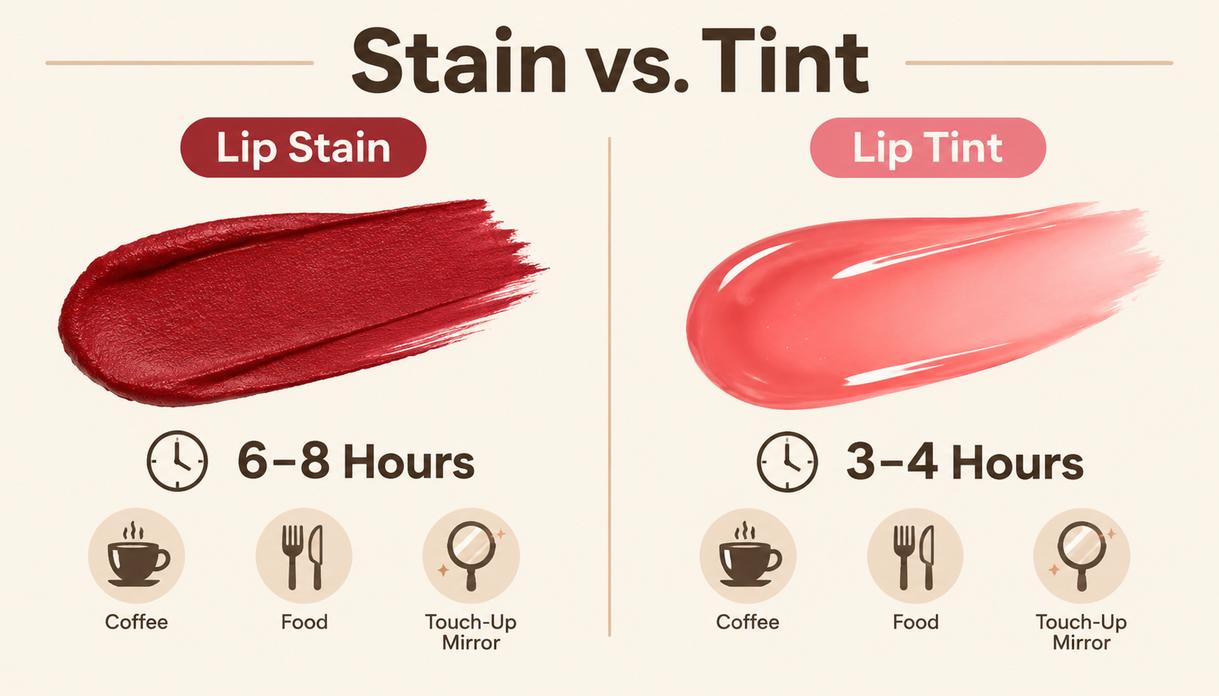
Lip Stain
The formula and matte finish are useful starting points when comparing a stain with another lip color.
- Why it sticks around
- Pigmentation: compare the initial color with what remains after wear.
- Matte finish: include the surface finish in your comparison.
- What real wear looks like
- A wear time target needs a defined application method.
- Longevity checks should include meals and drinks.
- Getting it right
- Application: follow the sample’s directions and allow it to set.
- Hydration: include comfort in the assessment rather than judging color alone.
Topfeel Beauty develops custom lip color with brand-specific texture, color, and finish requirements.
Lip Tint
Tints can suit a sheer color brief. Benefit describes Benetint as both a tint and stain, with a sheer, buildable finish. Compare actual samples rather than category names.
Here’s what to assess:
→ A lightweight feel during wear
→ A natural look that suits the customer’s routine
→ A glossy finish where the brief calls for shine
→ More touch-up considerations after meals and drinks
Choose between stain and tint using the same finish, comfort, and application criteria. Topfeel Beauty’s lip-color customization provides a route for developing that brief.
Choose the right color experience: Stain versus tint is a wear-and-comfort decision, not just a shade choice. Topfeel Beauty’s custom formulation work covers texture, color, and finish, giving your brand a concrete starting point for comparing samples against the same customer routine.
Compare the lip stain offering with the OEM lip makeup route to prepare your stain-versus-tint sample brief.
How Long Do Lip Stains Last on Average?
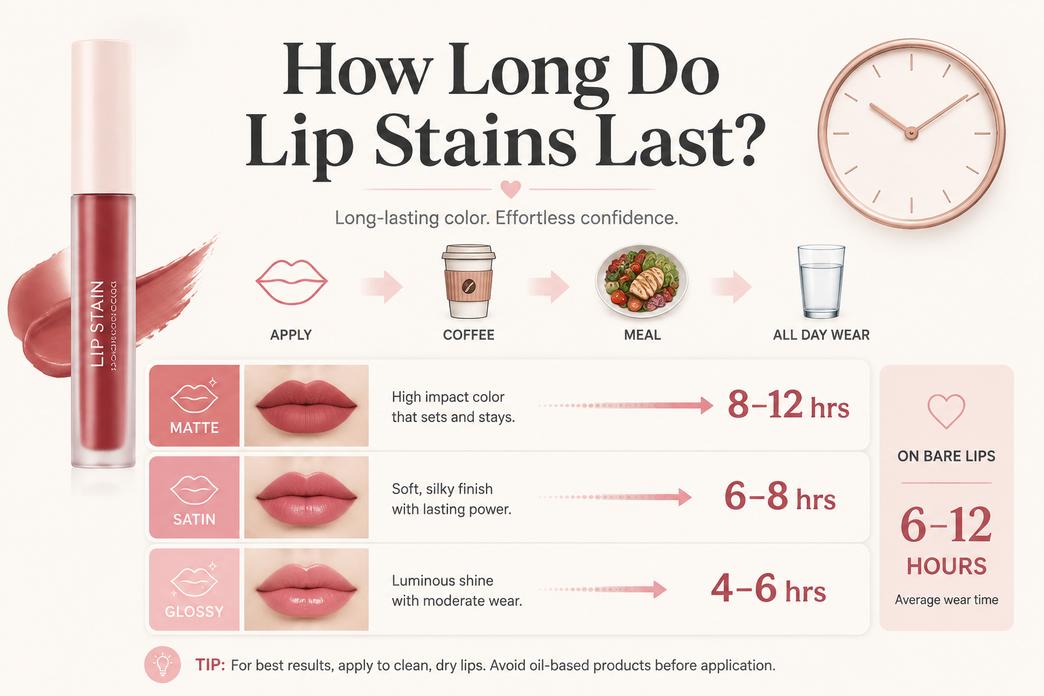
The useful comparison follows the same product from application through meals and touch-ups. Record what remains, how it feels, and whether the finish still matches your brief.
Typical wear time on bare lips
For a stain, begin with the product’s directions and keep the application method consistent between samples.
- What boosts longevity
- Clean, dry bare lips when the directions require them
- Thin layers applied as directed
- What cuts the duration short
- Balms or oils included in the wear routine
- Constant lip licking during the assessment
Careful application makes comparisons more useful. Note the preparation method alongside the wear result.
Smudge resistance and transfer quality after meals
Check smudge resistance separately from remaining color. Include the contact conditions used in any long-wear comparison.
→ Water, coffee, dry snacks: include these in the routine
→ Burgers, fries, salad dressing: record the meal conditions
→ After greasy meals: check the center and edges separately
Blot after eating, then touch up where needed according to the product directions.
Why color fade resistance varies by drying speed and finish
Compare drying speed, finish, and the appearance of fading during sample evaluation.
| Finish | Typical Dry Time | Approx. Wear | Fade Pattern |
|---|---|---|---|
| Matte | Under 1 min | 8–12 hrs | Even |
| Satin | 1–2 min | 6–8 hrs | Mostly even |
| Glossy | 2+ min | 4–6 hrs | Patchy |
- Matte stains
- Set and surface feel belong in the assessment
- Strong pigment retention belongs in the sample assessment
- Glossy stains
- Comfy texture and shine belong in the comparison
- Break down the touch-up routine during evaluation
Compare matte lipstick characteristics with your intended finish, then assess the actual stain sample.
What Factors Decide How Long Lip Stains Last?
Discuss solvents, the color system, moisture, and texture as parts of one formulation brief. Evaluate the finished sample rather than selecting an ingredient in isolation.
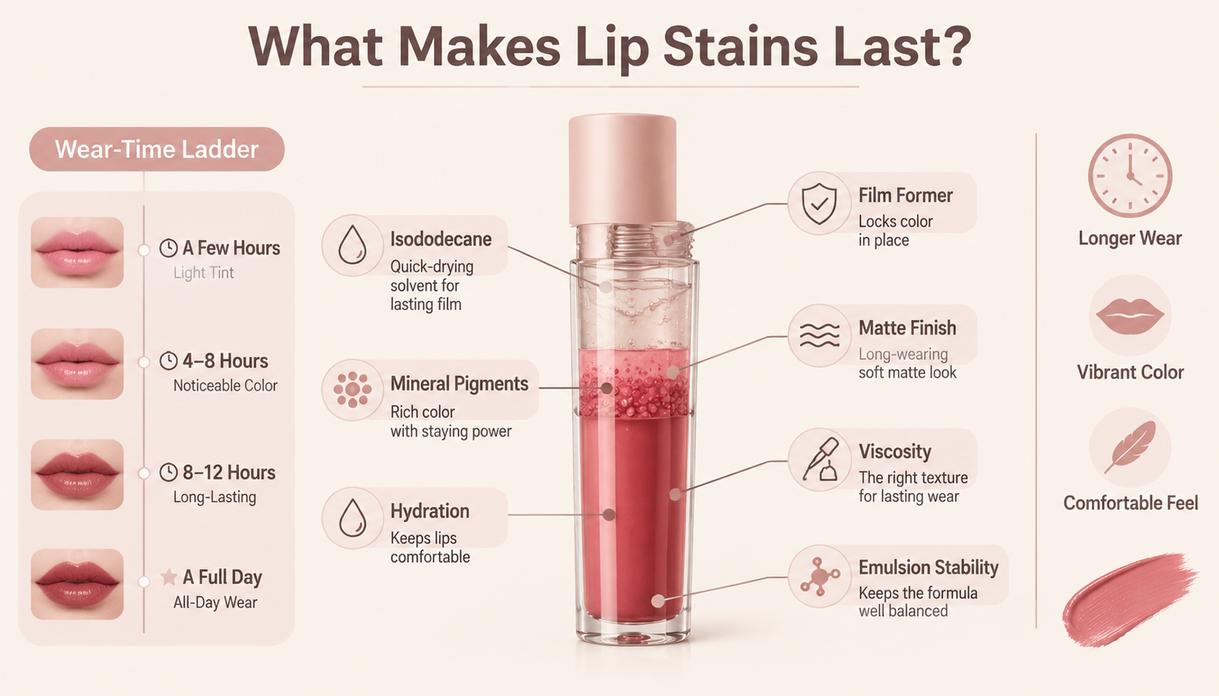
Film former and isododecane in the formulation brief
- The quick exit
- Isododecane belongs in the ingredient discussion when present.
- Once the sample sets, assess its surface feel.
- What stays behind
- A film former should be discussed in the context of the complete formula.
- That formulation needs finished-product wear evaluation.
Topfeel Beauty’s R&D support includes co-creation on textures and pigments; use cosmetic ingredient knowledge to frame the formulation discussion.
Do mineral pigments really outlast dyes?
Discuss pigment type and the color system before comparing wear results.
→ Mineral pigments and other colorants need approval for their intended U.S. use; external-use approval alone does not include lips.
→ Synthetic dyes belong in the same color and wear comparison.
Compare color payoff and fading rather than choosing a formula from the ingredient category alone.
Hydration level, matte finish, and lightweight texture trade-offs
Include comfort in the brief for an emollient-containing formula.
A matte finish and lightweight texture are separate sample criteria.
Compare the hydration level and comfort during wear; the lip-care guide provides a related preparation discussion.
Viscosity and emulsion stability in sample evaluation
- Thickness on the applicator
- The viscosity discussion should cover application and storage conditions.
- Too runny or too thick: record the application issue.
- Holding it together
- Good emulsion stability belongs in the brief: emulsions can separate during storage.
- Solid rheology assessment considers how the product flows.
Topfeel Beauty describes compatibility, stability, and safety assessments within custom formulation development.
Turn ingredients into a brief: Can your solvent-and-color system deliver the texture and comfort your customer expects?
Topfeel Beauty supports lab co-creation on textures and pigments, with stability assessments in custom development. Review its custom formulation service and consultation route to prepare one sample specification joining color retention, hydration, and flow rather than approving those decisions separately.
5 Steps to Launch Lip Stains That Last
Build a launch brief covering formula, testing, packaging, and documentation before approving the finished product.
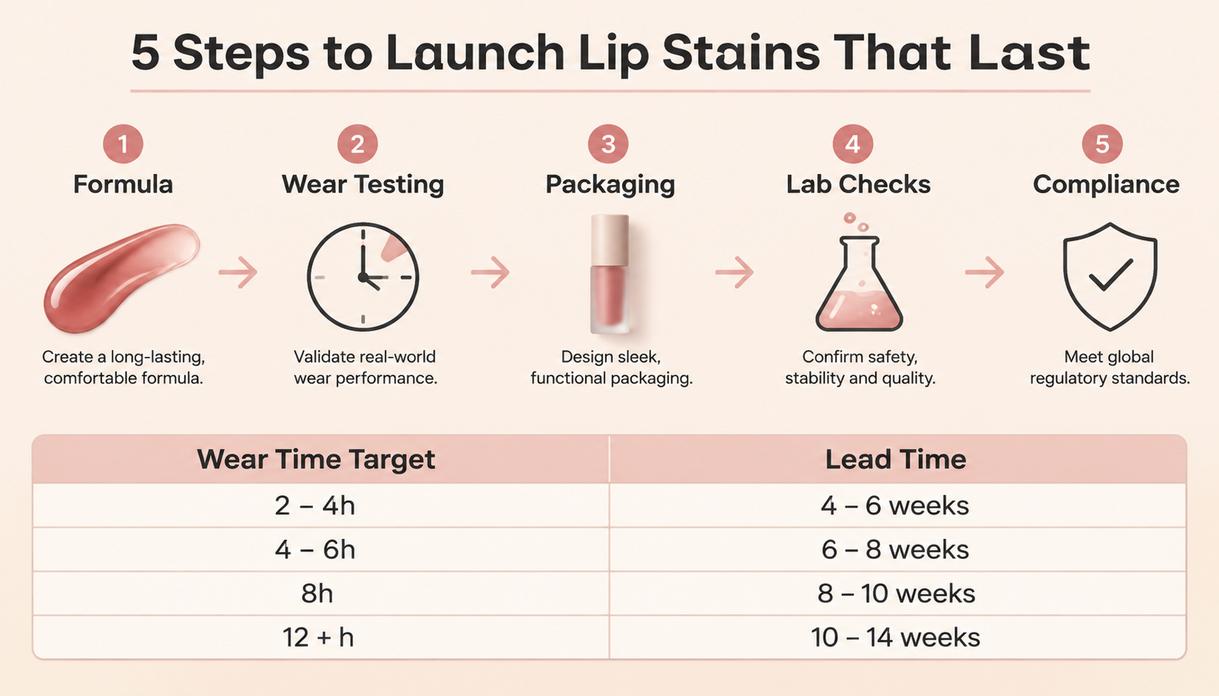
Step 1: Define Your Wear Time Target and Custom Formulation Lead Time
Pick a wear time goal you can demonstrate. Include eating and drinking in your assessment, and agree the custom formulation schedule with your development partner.
| Wear Time Target | Typical Lead Time (weeks) | Revision Rounds |
|---|---|---|
| 2–4 hours | 4–6 | 1 |
| 4–6 hours | 6–8 | 1–2 |
| 8 hours | 8–10 | 2–3 |
| 12+ hours | 10–14 | 3–4 |
Agree the testing plan before final approval.
Lock in hyaluronic acid, vegetable glycerin, and a scent profile that suit your audience
- Comfort boosters
- Hyaluronic acid: discuss its role with the formulator.
- Vegetable glycerin: glycerin is a humectant that helps products retain moisture; assess finished-formula comfort separately.
- Scent profile picks
- Younger shoppers: define the intended audience before choosing scent.
- Buyers with sensitive lips: dermatologists recommend avoiding fragrance on chapped lips.
Choose formulation ingredients for your target audience.
Verify batch consistency and pH stability with contract manufacturing partners
Evaluate cosmetic manufacturing partners through their inspection and reporting process. Topfeel Beauty checks color accuracy and texture during first article inspection.
- Batch consistency
- Color readings across pilot batches
- Wear tests comparing samples from different batches
- pH stability
- Tracked over time where relevant to the formula
- Formulation testing under agreed storage conditions
Request the agreed results in writing.
Choose a doe-foot wand, leak-proof seal, and UV-protective vial
Evaluate the container and formula together during packaging development.
- ✔ Doe-foot wand: Compare application control with the intended formula.
- ✔ Leak-proof seal: Include leakage checks in packaging approval.
- ✔ UV-protective vial: Discuss light exposure in the stability plan.
Confirm ISO 22716, GMP standards, heavy metal screening, and shelf life stability before bulk container shipping
- Paperwork
- An ISO 22716 certificate: its guidelines cover production, control, storage, and shipment.
- A current GMP standards audit
- Lab results
- Heavy metal screening appropriate to the product and market
- Shelf life stability data
Collect the agreed documentation before bulk shipping and retain it with the product approval records.
Move the launch brief forward: Topfeel Beauty’s customization process joins formula development with packaging and quality control. Initial samples are prepared in 3-7 days, giving your team an early review point before approval and production.
Review the OEM/ODM workflow, then send your launch requirements to coordinate wear testing, ingredient preferences, packaging checks, and manufacturing documentation.
References
- Color Additives and Cosmetics: Fact Sheet — FDA
- Shelf Life and Expiration Dating of Cosmetics — FDA
- Benetint Lip & Cheek Stain — Benefit Cosmetics
- Glycerin — Cosmetics Info
- Dermatologists’ Tips for Chapped Lips — American Academy of Dermatology
- ISO 22716: Cosmetics Good Manufacturing Practices — ISO
Post time: Nov-18-2026