
Custom Highlight and Contour Makeup for Beauty Brands
Custom highlight and contour makeup becomes retail-ready when formula, undertone, finish, packaging, and production are developed together. Brands should define the intended user, application, and claims before scale-up.
A capable manufacturer connects formulation with sampling, assessment, manufacturing controls, labeling, quality checks, and delivery.
Quick Points for Highlight and Contour Brilliance
➔ Shade Range Expansion: Build shades around complexion depth and undertone, then review payoff on the intended users.
➔ Formulation Durability: Specify the desired wear, transfer resistance, finish, and application feel before testing prototypes.
➔ Production Efficiency: Link approved standards for color, texture, fill weight, and packaging to batch-level quality control.
➔ Packaging & Compliance: Match palettes, compacts, tubes, or jars to the formula and prepare market-specific safety and labeling documentation.
Why Prioritize Highlight And Contour?
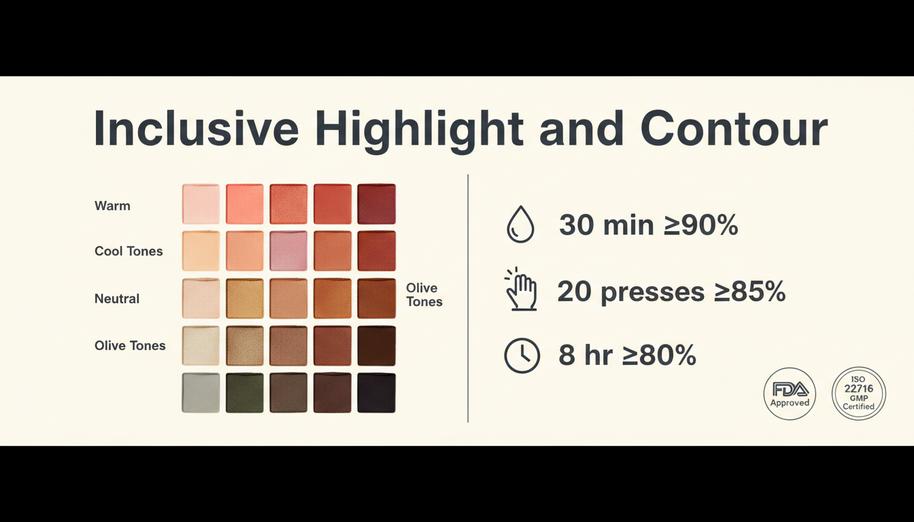
Shade planning, dependable application, and controlled manufacturing help brands serve different complexions while keeping the collection practical to produce.
Ensuring Shade Range Expansion for All Skin Tones
Effective contour and highlight development starts with real diversity across skin tones, not one base shade made progressively darker. A skin-type planning guide can help teams separate complexion needs from shade depth, while skin-tone assessment research shows why teams should document the method used to evaluate complexion groups.
- Build the shade map around:
- Demographics and complexion depth
- Evaluate light through deep color ranges.
- Adjust pigmentation so payoff remains visible without appearing chalky.
- Warm, cool, neutral, and olive undertones
- Use controlled color matching under consistent lighting.
- Check shades on the intended users, not only on color cards.
- Demographics and complexion depth
- Review prototypes with inclusivity in mind:
- Watch for gray-looking contour shades on deeper complexions.
- Check that highlights brighten without leaving an obvious pale cast.
That review supports a more natural-looking range and clearer shade descriptions.
Leveraging Long-Wearing, Waterproof Formulations
For face color, staying power matters when heat, moisture, or repeated contact affects wear. Formulators can balance longevity, durability, and comfortable wearability, but each claim needs a defined method and acceptance criterion.
| Test target | Example condition | Measurement | Development goal |
|---|---|---|---|
| Water exposure | 30 min | Color retention | ≥90% |
| Transfer test | 20 presses | Pigment retained | ≥85% |
| Wear test | 8 hr | Visible definition | ≥80% |
Evaluate water resistance, smudge-proof behavior, and transfer-proof performance separately, then confirm claims through suitable testing.
Meeting FDA Regulations and ISO 22716 Standards
Reliable production connects cosmetic regulatory compliance with practical controls. In the United States, brands should confirm color-additive requirements and maintain records supporting product safety under MoCRA requirements. A manufacturer qualification guide can help buyers organize factory questions before sampling.
- Establish the compliance framework:
- Review applicable FDA requirements.
- Confirm color-additive and ingredient restrictions rather than assuming blanket ingredient approval.
- Maintain required safety and labeling records.
- Apply ISO 22716 cosmetic GMP guidance.
- Set documented production and hygiene controls.
- Preserve batch traceability and quality assurance records.
- Review applicable FDA requirements.
- Verify finished face color products:
- Conduct appropriate product testing.
- Document relevant safety standards and supplier records.
- Treat ISO 22716 certification separately from FDA compliance; one does not automatically establish the other.
Build a clearer brief: Coordinate shade range, waterproof formulation criteria, and FDA/ISO standards before approving a collection. Topfeel Beauty’s custom formulation workflow includes pigment co-creation, helping buyers compare a 3-7 day sample discussion against a custom solutions route.
Explore the highlighter range to prepare a more focused prototype brief.
5 Benefits Of Tailored Contour Formulas
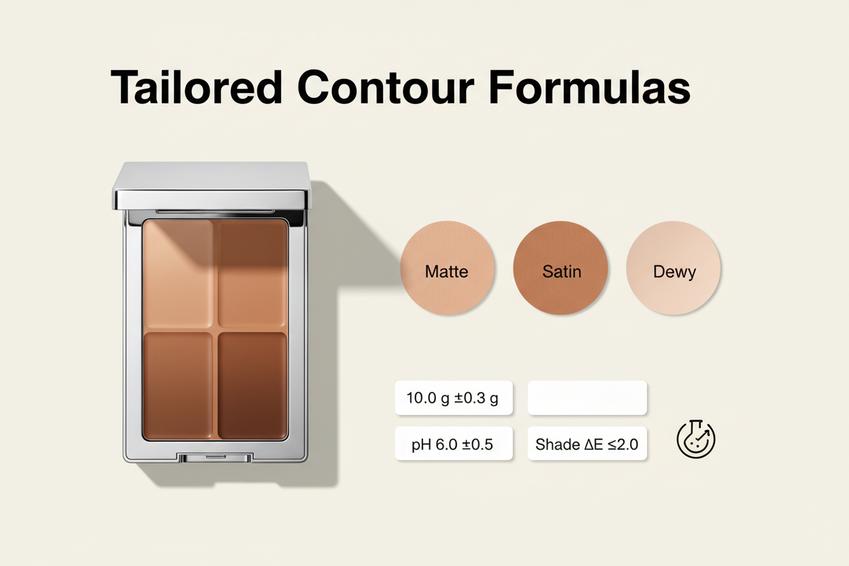
A tailored range gives brands control over shade, feel, wear, and product life. Topfeel Beauty can connect pigment and finish development with compatibility, stability, and safety assessment.
Custom Formulation Development for Precise Color Matching
- Color direction
- Custom formulation development tunes pigment ratios for better precision.
- Undertones can shift warm, cool, or neutral to improve color matching.
- Wear profile
- Coverage and blendability are adjusted alongside each shade, helping the product apply evenly rather than patchily.
Hypoallergenic, Paraben-Free Blends to Minimize Sensitivity
Careful ingredients support formulas created with sensitivity in mind. A brand may request paraben-free blends or a hypoallergenic positioning, but the wording should follow the formula’s actual safety assessment and target-market rules. A primer on cosmetic ingredient roles can help teams frame early questions without treating a free-from label as a guarantee of zero irritation.
The goal is comfortable application for the intended skin types without overpromising.
Bulk Production Efficiency with Consistent Batch Testing
- Manufacturing
- Bulk production planning improves efficiency as approved volumes grow.
- Quality control
- Each batch can undergo testing for shade, texture, and fill-weight consistency.
| QC check | Example target | Example tolerance |
|---|---|---|
| Fill weight | 10.0 g | ±0.3 g |
| pH* | 6.0 | ±0.5 |
| Viscosity* | 20,000 cP | ±10% |
| Shade ΔE* | ≤2.0 | ≤2.0 |
| Drop test* | 1.0 m | 3 drops |
*Illustrative specifications only; actual limits depend on the formula, packaging, method, and applicable standards.
Enhanced Finish Options: Matte, Satin, and Dewy Contours
A face color collection can branch into distinct finish options:
- Matte: controlled shine and a soft-focus aesthetic.
- Satin: balanced sheen with a smooth texture.
- Dewy: brighter reflectivity for a fresh-looking contour effect.
That flexibility gives brands room to match application preferences and positioning. A matte makeup overview can also help teams distinguish low-shine direction from other finishes.
Improved Shelf-Life Stability Testing for Long-Term Performance
- Stability testing
- Checks the product under defined storage conditions using a planned protocol; the industry’s stability-testing guidance helps frame the study.
- Tracks color, odor, separation, and packaging changes.
- Shelf-life review
- Data helps assess long-term performance and expected longevity.
- Monitoring possible degradation can guide packaging or formula adjustments before scale-up.
Topfeel Beauty can incorporate these checks into development, with final shelf-life claims based on the actual protocol and results.
Cream Vs. Powder Contours: Which Wins?
Choosing between cream and powder comes down to feel, finish, control, and intended definition. Topfeel Beauty supports both formats.
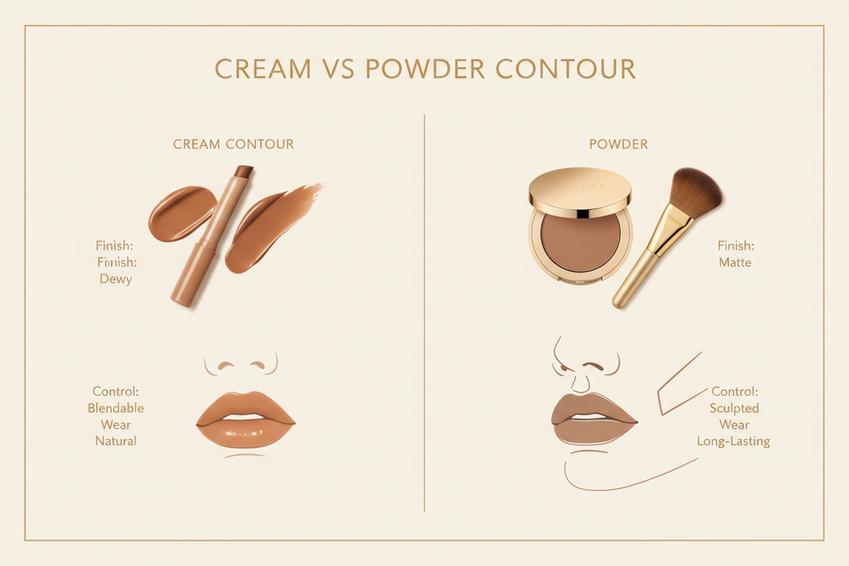
Cream Contour
Cream contour suits seamless edges. Its creamy texture allows placement to be adjusted during application.
- Finish and feel
- A dewy finish adds fresh-looking dimension.
- Strong blendability supports a natural look, especially across the cheeks and jaw.
- Formulas designed with hydration in mind can suit a softer application brief.
- Non-comedogenic positioning should be tied to the formula and substantiation plan.
- Format choices
- A stick format makes targeted placement quick and portable.
- A liquid formula works for sheer, buildable definition.
- Topfeel Beauty can tailor texture and payoff for different routines.
Powder Contour
Powder gives users control over gradual depth, while its dry texture supports layering without adding a creamy feel. The brand’s guide to pressed and loose powder differences helps clarify format expectations.
- Controlled definition
- A pressed powder supports precise application with a suitable brush.
- Light layers build toward a sculpted look.
- Deeper application creates chiseled definition without requiring a thick coat.
- A pressed powder supports precise application with a suitable brush.
- Wear and finish
- A matte finish can complement consumers seeking less visible shine.
- Added oil control should specify the desired sensory and wear outcome.
- A long-lasting claim should follow the finished formula’s test results.
- A matte finish can complement consumers seeking less visible shine.
Topfeel Beauty can develop powder compacts alongside creams and align finish, payoff, and application style.
Highlight And Contour Packaging Options
Each package should match the formula, dispensing style, filling process, decoration, and compatibility plan.
Palette Casing with Built-In Mirror and Applicator
A well-planned Palette keeps shades organized in one Casing, so application feels straightforward.
- Core components
- A fitted Mirror supports quick touch-ups.
- A brush or sponge Applicator adds convenience.
- Product protection
- Each Pan sits securely inside an Insert.
- A dependable Closure limits accidental opening, while the chosen Material balances weight, durability, and appearance.
Compact Jar Designs for On-The-Go Touch-Ups
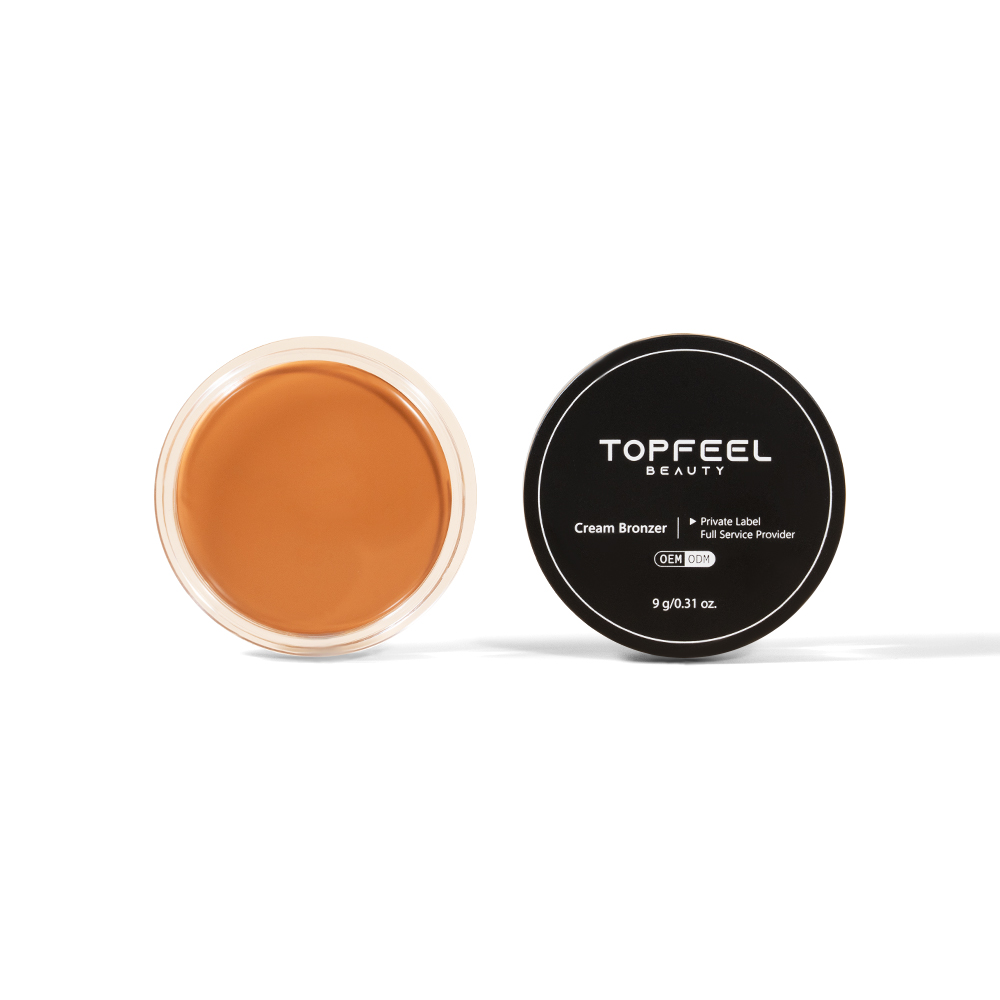
Cream contour and highlighting balm can suit a small Jar that fits a makeup bag. A Compact Container with a tight Lid supports portable use.
For practical Portability, match the Material to formula oils and pigments. A reliable Closure reduces leakage risk, while thoughtful Design supports fingertip or brush application.
Tube and Pump Dispenser Solutions for Hygienic Use
For liquid face color products, controlled dispensing keeps use tidy.
- Choose the pack.
- A squeezable Tube works well for creams.
- An Airless Pump can reduce routine exposure of the bulk formula during dispensing.
- Refine dispensing.
- Match the Dispenser and Nozzle to product thickness.
- Confirm the Closure, Material, and fill Volume before production.
Topfeel Beauty coordinates packaging choices with filling needs through its custom solutions process.
Customizable Labeling Services on Bottles and Jars
Good Labeling helps customers identify product type, shade, and directions.
- Brand presentation combines Printing, Design, and approved Artwork.Practical Customization can include shade names, ingredients, directions, branding, and required cosmetic label information. For EU-bound products, teams should map the pack against the Cosmetics Regulation.
- Suitable label Material and Adhesive help graphics remain attached.
- Matte, gloss, or other Finish options support shelf presentation.
Packaging mistakes surface late when formula compatibility, dispensing, decoration, and label space are reviewed separately.
Validate the whole pack: Topfeel Beauty’s one-stop workflow connects packaging design with formula development and quality control. Compare a baked highlighter palette example with the highlighter range to prepare a compatibility-focused packaging brief before artwork approval.
Editorial Shoots: Highlight And Contour Precision
Pigment control, repeatable production, and tested formulas support clean definition under close camera work.
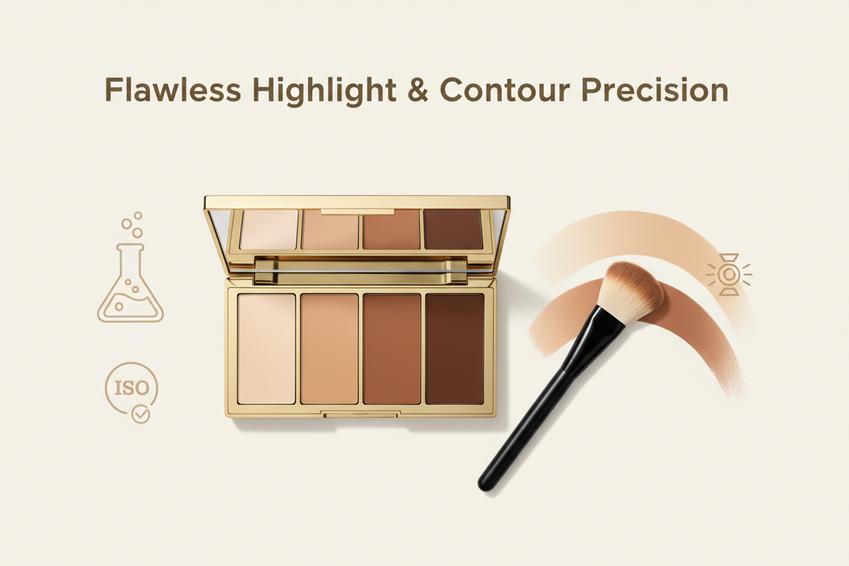
Achieving Flawless Definition with High-Pigment Eyeshadow Palette Techniques
A High-pigment Eyeshadow palette offers a useful application lesson because concentrated color rewards controlled placement. The underpainting technique also shows how placement order can affect the final look.
- Build Flawless definition
- Start light
- Use precise Application where shadow naturally falls.
- Add Contouring gradually.
- Shape brighter zones
- Keep Highlighting focused on selected high points.
- Soften borders through careful Blending.
- Start light
- Refine the finish
- Adapt these Makeup techniques to camera distance and lighting.
- Check the result from several angles before adding more pigment.
Harnessing ISO-Certified Mixing Capabilities for Consistent Texture
Good formulas need repeatable feel as much as strong color. In Cosmetic production, controlled Mixing capabilities support even Ingredient blending, helping pigments remain distributed.
Topfeel Beauty’s ISO 22716-certified system supports documented Quality control throughout the Manufacturing process. Product formulation targets Consistent texture from batch to batch; a cosmetics factory guide can help buyers frame supplier questions.
Stability Testing Protocols to Withstand Studio Lighting
Stability testing helps determine how a formula responds to defined storage and use conditions. Safety assessors can also use the European Commission’s cosmetic ingredient testing guidance when building the broader evidence file.
- Lighting and temperature
- Studio lighting
- Controlled Light exposure can reveal unwanted color or texture changes.
- Higher temperatures
- Heat resistance checks help track softening or separation.
- Studio lighting
- Formula checks
- Product integrity
- Teams monitor appearance, texture, odor, and defined specifications.
- Performance evaluation
- Application checks show how the product behaves after controlled storage.
- Product integrity
- Editorial readiness
- Environmental stress testing supplies data for assessing formula stability.
- Cosmetic durability checks can support dependable application under demanding conditions.
Brand-Worthy Radiance
A strong launch aligns shade choices, certification documentation, production, and delivery planning.
Shade Range Expansion Strategies for Diverse Campaigns
Successful development starts with Diversity in actual complexions rather than only adding lighter and deeper colors.
- Shade planning
- Map Skin_tones from fair through deep.
- Test cool, neutral, warm, and olive Undertones under several lighting conditions.
- Formula development
- Adjust Pigmentation so highlight shades remain visible without appearing chalky.
- Refine contour depth so the Formulation blends without turning gray or orange.
- Commercial planning
- Match each Market_segment with suitable shade demand.
- Build Inclusivity into model casting and Campaign_planning.
This approach supports useful shade variation and believable campaigns.
Incorporating Leaping Bunny and Halal Certification for Market Trust
Certification begins with documentation, not a logo. The Leaping Bunny corporate standard describes a Certification_process with supply-chain monitoring requirements for Cruelty-free positioning.
Halal programs can involve Ingredientcompliance, manufacturing controls, and applicable Religiousstandards. Brands should select a certifier suited to the target market and confirm local Regulatory_approval needs; Malaysia’s health authority explains that cosmetics are not automatically halal-certified.
Verified claims strengthen Consumerconfidence, support Ethicalsourcing, and create credible Market_differentiation.
Streamlined Warehousing and Lead Time Coordination for Timely Launches
A strong product arriving after the campaign date is still late.
- Production control
- Set the Production_schedule around approved formulas, packaging, and inspection.
- Add realistic buffers to the Launch_timeline.
- Stock and delivery
- Connect Inventorymanagement with the broader Supplychain.
- Plan Logistics, Fulfillment, and the Distribution_network around campaign dates.
- Ongoing supply
- Track fast-moving highlight shades and contour colors separately.
- Use reorder points to improve Operational_efficiency and reduce stock gaps after launch.
Protect the launch date: Bring shade range, Leaping Bunny or Halal certification, and warehousing and lead-time planning into one production conversation. Topfeel Beauty’s published workflow moves from consultation and sampling through packaging approval, QC, and delivery, with initial custom samples described as taking 3-7 days.
Start the brief: Contact Topfeel Beauty through the inquiry page to discuss a launch-ready brief; the OEM/ODM overview outlines the decisions needed before sampling starts.
References
- Color Additives and Cosmetics: Fact Sheet — fda.gov
- Modernization of Cosmetics Regulation Act of 2022 — fda.gov
- ISO 22716:2007 Cosmetics — Good Manufacturing Practices — iso.org
- Guidelines on Stability Testing of Cosmetics — cosmeticseurope.eu
- Regulation (EC) No 1223/2009 on Cosmetic Products — europa.eu
- SCCS Notes of Guidance, 12th Revision — europa.eu
- Corporate Standard of Compassion for Animals — leapingbunny.org
- Are Cosmetics in Malaysia Certified Halal? — gov.my
- A Survey of Skin Tone Assessment in Prospective Research — nature.com
Post time: Aug-20-2026