
What Makes a Good Full-Coverage Matte Foundation?
A good full coverage matte foundation needs to balance coverage, shine control, and comfort without looking cakey. Getting that balance right takes formulation work.
For private label beauty brands, consistent quality, customizable shades, and bulk production matter alongside coverage.
Key Notes for a Good Full Coverage Matte Foundation
- Coverage: Choose a high coverage liquid formula with buildable application for redness, blemishes, and uneven tone.
- Finish: Assess a velvet matte finish for softness rather than a flat or cakey appearance.
- Comfort: Consider silica microspheres, hyaluronic acid, and isododecane within the complete formulation.
- Performance: Evaluate transfer resistance, sweat resistance, and feel during wear.
- Production: For private label, confirm GMP documentation, batch tracking, and production quality.
What Defines a Good Full-Coverage Matte Foundation?
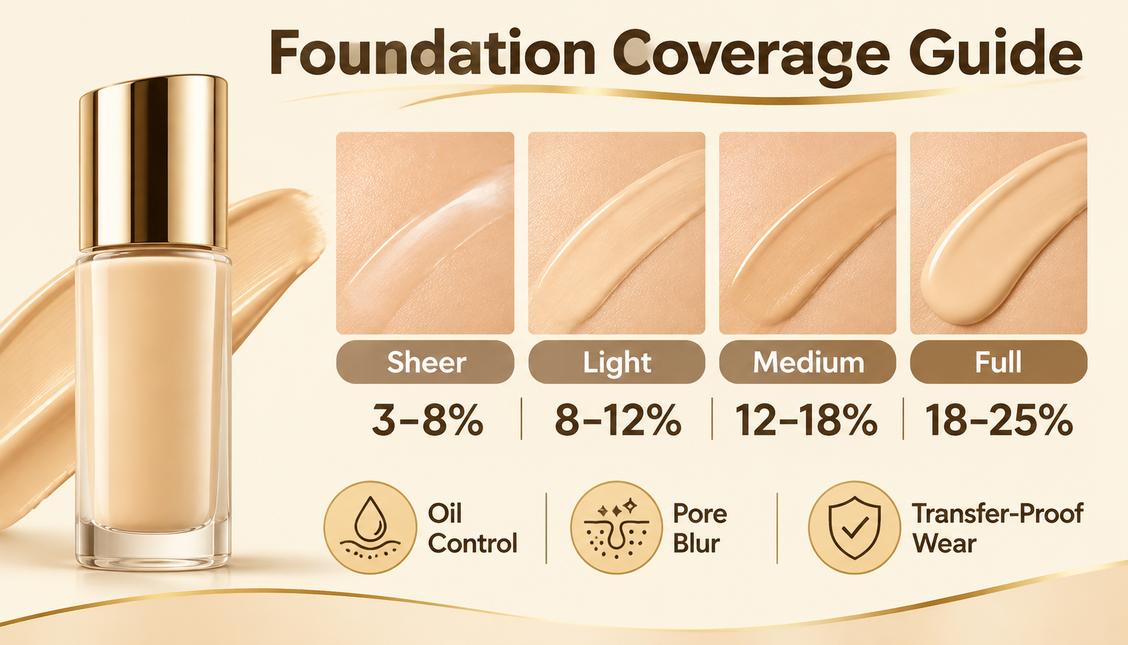
Shopping for a good full coverage matte foundation means comparing coverage, finish, oil control, and wear together. Here’s what to check before choosing a formula.
High Coverage Liquid Formula for Reliable Base Makeup
A full-coverage matte base needs enough coverage without excessive layering.
- What it hides
- Blemish concealment for spots and scars
- Redness, for an even skin tone
- How it feels
- A thin liquid texture for smooth application
- A weightless feel, assessed alongside pigment concentration
| Coverage Level | Typical Pigment Load (%) | Layers Needed | Feel on Skin |
|---|---|---|---|
| Sheer | 3–8 | 3+ | Barely there |
| Light | 8–12 | 2–3 | Very light |
| Medium | 12–18 | 2 | Light |
| Full | 18–25 | 1–2 | Light to moderate |
Velvet Matte Finish With Natural Skin-Like Softness
Flat matte can look like a mask. Compare velvet texture, diffused light, and the desired soft focus effect in a sample.
▸ A non-cakey finish without emphasizing dry patches
▸ A skin-like appearance up close
▸ A smooth complexion in daylight
Oil Control and Pore Blurring for All-Day Polish
Oily skin calls for attention to both shine and texture.
- Oil control
- Mattifying agents selected for the formula
- Sebum regulation claims assessed alongside shine control
- Pore blurring
- Pore minimization as an appearance goal
- A smoothing effect within a long-wear base
Transfer Proof Wear That Holds Up Under Pressure
Masks, scarves, and phone calls make transfer resistance a useful comparison. Evaluate the finished formula after you set makeup.
- Smudge resistance against a finger swipe
- Humidity resistance on muggy days
- Sweat-proof wear evaluated during exercise
A long-lasting formula should meet the wear brief.
Turn finish into a specification: Coverage, velvet softness, oil control, and transfer resistance belong in one foundation brief. Topfeel Beauty develops matte textures and long-wear properties through its custom formulation work, giving brands a concrete starting point for sample discussions.
Explore custom solutions alongside foundation options to define the finish and coverage you want to compare.
Key Ingredients in Good Full Coverage Matte Foundation
A good full coverage matte foundation balances pigment, comfort, and wear. The ingredient choices matter as part of the formula, not just as names on a label.
Silica Microspheres and Titanium Dioxide for Better Coverage
Consider the roles of powders and pigments together.
- Blur and control
- Silica microspheres selected for the intended pore blurring and light scattering effect.
- You get a matte finish to assess during wear.
- Hide and even out
- Titanium dioxide functions as an opacifying agent.
- A pigment load balanced against the mask look.
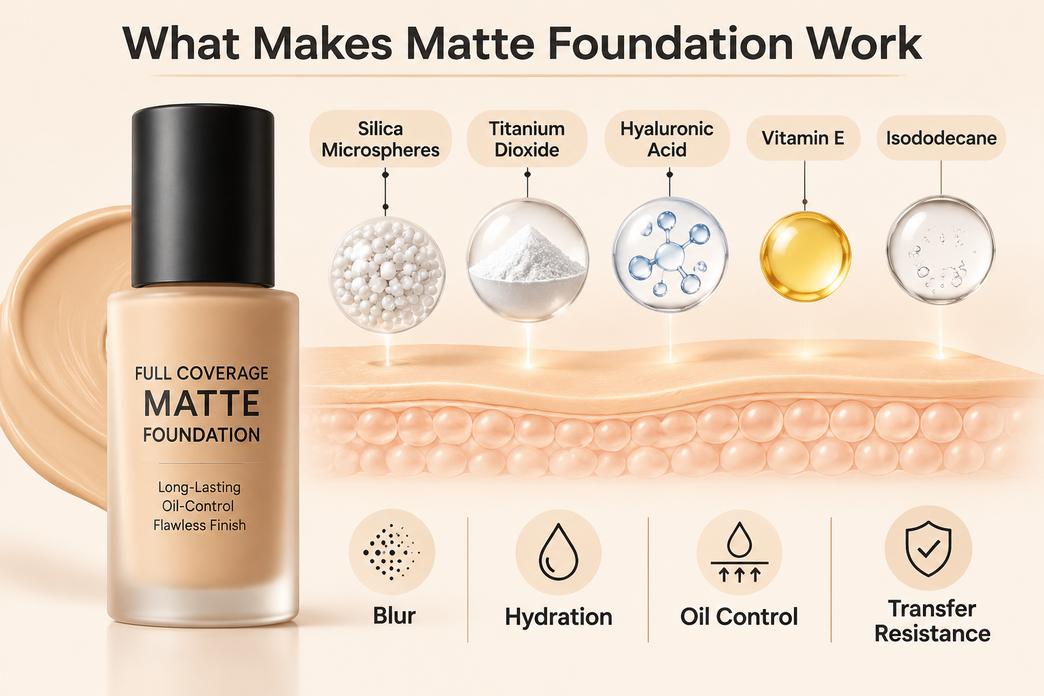
Hyaluronic Acid and Vitamin E Extract for Balanced Comfort
Matte shouldn’t mean dry. Heavy coverage can feel tight, so comfort matters.
» Hyaluronic acid helps retain water.
Isododecane Base for Smooth Spreadability and Fast Setting
- Going on
- Isododecane and spreadability.
- Weightless feel, assessed during application.
- Drying down
- It belongs in the formula’s fast setting brief.
- That’s where long wear and transfer resistance must work together.
Ingredient Choices That Support Non Comedogenic Action
For acne-prone skin, the American Academy of Dermatology recommends non-comedogenic makeup. Check for:
- A lightweight formula with comfortable film formers
- Emollients picked for the skin-comfort brief and oil control
- Proof behind dermatologist tested wording: U.S. cosmetic labeling claims must be truthful and not misleading.
Topfeel Beauty includes compatibility, stability, and safety assessments in custom formulation development.
3 Must-Have Traits of a Good Full Coverage Matte Foundation
A good full coverage matte foundation needs balanced wear, shine control, and comfort. Check these traits together before choosing a base that avoids caking.
Long Wear Duration Without Caking or Breaking Down
Assess longevity through the finish during wear.
- What keeps it locked in
- Pigment adhesion assessed in the finished base
- Crease-resistant wear around eyes and smile lines
- What you’ll notice
- A smooth finish without cakey patches
- All-day wear assessed for touch-ups
Sweat Resistant Property with Strong Shine Control Effect
A humidity-proof, water-resistant brief needs finished-formula evaluation, alongside the desired sebum control and mattifying agent choices.
| Ingredient | Typical Use Level (%) | Main Job |
|---|---|---|
| Silica | 1–5 | Oil absorption |
| Kaolin clay | 2–10 | Soaks up extra sebum |
| Silicone elastomer | 1–8 | Pore-blurring |
| Film former | 2–10 | Holds up against sweat |
Lightweight Feel Sensation for Comfortable Everyday Wear
Heavy coverage shouldn’t mean a heavy face. Compare a good full coverage matte foundation for a second-skin feel.
- Texture check
- Weightless texture during application and after setting
- Easy blendability with fingers or a sponge
- Skin-friendly check
- A breathable formula that feels comfortable
- Non-comedogenic labels for acne-prone skin
Bottom line: assess coverage alongside skin comfort.
Will long wear, sweat resistance, and lightweight comfort come together in your sample?
Topfeel Beauty includes stability assessments in custom foundation development. Review its OEM/ODM services to shape a sample evaluation brief that weighs wear and shine control against everyday comfort, rather than selecting on coverage alone.
How to Compare Good Full Coverage Matte Foundation Options
The bottle, manufacturing route, and quality documentation all matter before a bulk order. Compare them as one product decision.
Airless Pump Dispenser vs Squeeze Plastic Tube
- Airless pump
- A vacuum piston forms part of an airless dispensing system.
- The evacuation rate matters: Aptar describes over 90% evacuation for its airless systems.
- Squeeze tube
- A flexible polymer body for a travel friendly pack.
- Check viscosity compatibility with the matte base.
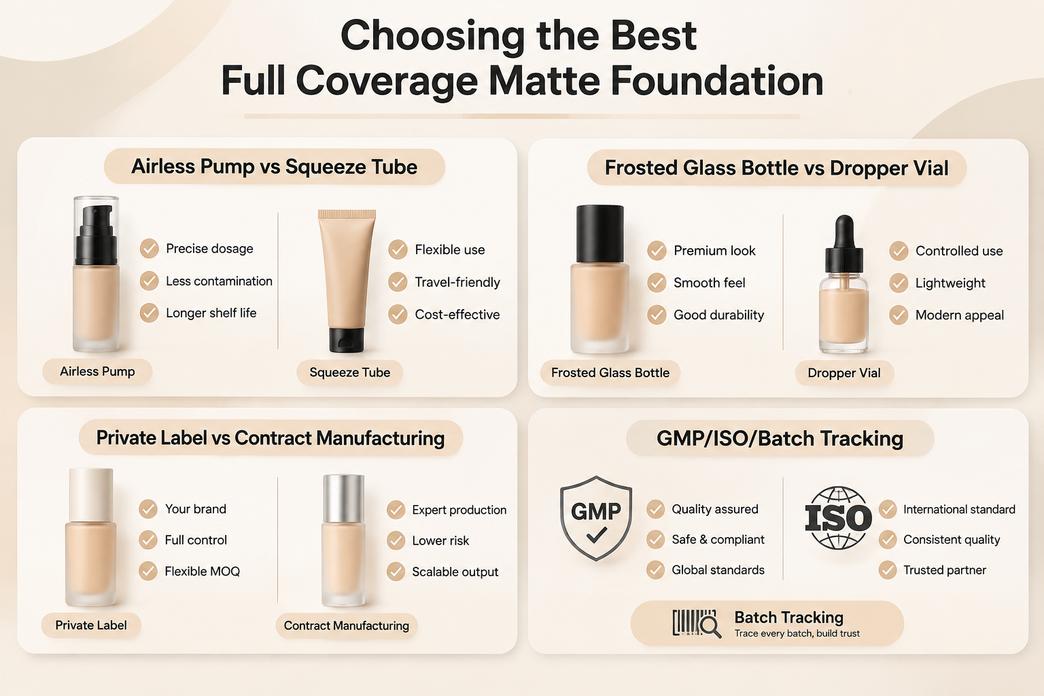
Frosted Glass Bottle vs Dropper Glass Vial
Frosted glass offers an etching finish and heavyweight aesthetic.
→ Droppers use a silicone bulb for dispensing.
→ Check liquid fluidity through the tip.
→ An aperture reducer offers another dispensing format.
Private Label Formulation vs Contract Manufacturing Service
- Private label
- Starts from a stock base formula at Topfeel Beauty.
- The intellectual property for its stock formulas generally remains with Topfeel Beauty.
- Contract manufacturing
- Custom R and D develops shade, texture, and finish requirements.
- Turnkey production connects formulation with packaging and manufacturing.
GMP Facility Compliance, ISO Standard Certification, and Batch Number Tracking
Compare manufacturing documentation with the product brief when qualifying a supplier.
✔ GMP addresses hygiene protocol and contamination control; FDA’s checklist includes production and control records.
✔ ISO 22716 provides cosmetic GMP guidelines for production, control, storage, and shipment.
✔ Clear lot identification supports traceability.
Bring the whole brief: Airless pumps or glass, private-label versus custom formulas, and GMP documentation belong in one supplier comparison. Topfeel Beauty’s customization workflow takes a formula-and-packaging brief from consultation through delivery, with initial samples prepared in 7-10 days.
Discuss your requirements to prepare a formula-and-packaging brief with the documentation needed for your supplier comparison.
References
- Titanium Dioxide — Cosmetics Info
- Hyaluronic Acid — Cleveland Clinic
- Cosmetics Labeling Claims — FDA
- I have acne! Is it okay to wear makeup? — American Academy of Dermatology
- Airless Packaging — Aptar Beauty
- Cosmetic GMP Inspection Checklist — FDA
- ISO 22716:2007 — ISO
Post time: Nov-09-2026