
How Should Beauty Brands Define Warm Foundation Shades?
Getting foundation color for warm skin tone right starts with a clear shade brief.
Golden undertones need precise pigment matching and consistent bulk production.
Sunlit Quick Notes: Foundation Color for Warm Skin Tone
➔ Undertone Harmony: Match golden, yellow or peach undertones with balanced mineral pigments to avoid ashy or orange casts.
➔ Finish Effects: Test radiant, matte, dewy and satin finishes under consistent lighting.
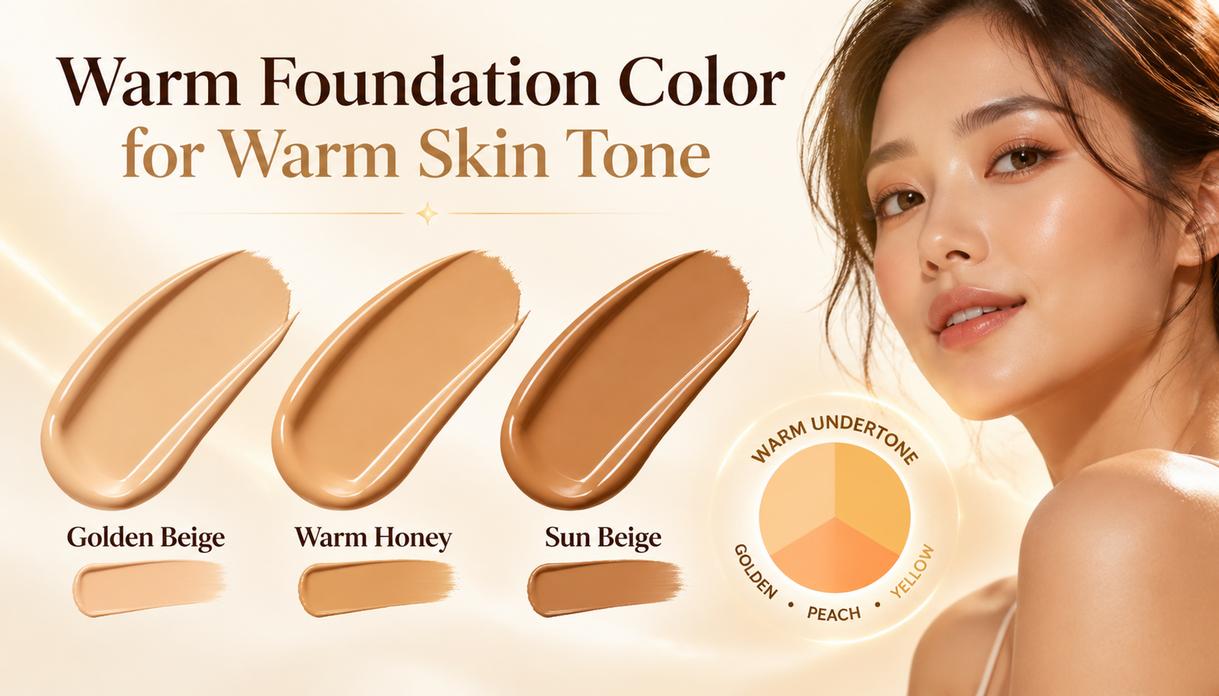
➔ Shade Range: Define tiers—golden beige, warm honey, sun beige—against physical samples, not names alone.
➔ Quality Control: Use spectrophotometers, calibrated lighting and reference swatches; secure reliable pigment sourcing and packaging for batch-to-batch consistency.
Why Does Warm Foundation Color For Warm Skin Tone Matter
Choosing the right foundation color for warm skin tone goes beyond finding a matching shade: evaluate depth, hue and finish together.
The science behind warm undertone matching with golden beige
Understanding skin pigmentation starts with natural melanin, produced by melanocytes. Compare golden beige with warm complexions through applied swatches.
Color theory provides a practical guide:
- Understanding natural warmth
- Yellow undertones: compare golden pigment blends.
- Peach undertones: compare beige swatches.
- Achieving accurate color balance
- Chromatic analysis identifies subtle color differences.
- Matching depth and warmth: compare applied swatches.
Testing a radiant finish on yellow and peach undertones
A radiant finish is an appearance choice; assess reflected light alongside coverage.
Compare luminous liquid foundations with matte formulas through applied samples.
Key benefits include:
- Yellow undertone: Evaluate golden pigment balance.
- Peach undertone: Evaluate the desired glow.
- Skin texture: Check coverage on intended skin textures.
Combine accurate pigment matching with a comfortable coverage target in the brief.
Market demand for custom formulation and shade matching
Define shade matching objectives across the intended skin tone spectrum.
Organize development around two priorities:
- Creating an inclusive range
- Expand warm shades beyond traditional beige options.
- Apply color science to improve undertone accuracy.
- Developing personalized cosmetics
- Use custom formulation to adjust pigment balance.
- Maintain consistent colors across liquid and cream foundations.
Topfeel Beauty supports beauty brands with customized foundation development and laboratory matching of supplied color samples.
TD3-## 5 Steps: Define Warm Foundation Shades Accurately
Define undertones, select pigments and test samples across formulas. Topfeel Beauty’s foundation offering provides a starting point for that product brief.
Identifying core warm undertone categories for consistency
Accurate colorimetry helps brands organize their shade spectrum without confusing warmth with skin depth.
- Golden undertone: Use a defined golden reference.
- Yellow undertone: Specify yellow versus orange balance.
- Peach undertone: Compare yellow-pink reference swatches.
- Olive undertone: Assess muted yellow-green references.
Maintain consistent reference samples across these categories when selecting warm shades.
Selecting golden beige, warm honey, and sun beige hues
Shade names vary by brand; assign each a physical hue and depth reference.
- Golden beige
- Designed for lighter warmth? Confirm against reference samples.
- Uses yellow-golden pigment balance as a development target.
- Warm honey
- Suits the intended medium depth? Compare reference samples.
- Combines golden-brown reference targets in your brief.
- Sun beige
- Complements the intended deeper complexion? Test applied samples.
- Adds the intended warmth? Check golden-brown versus orange appearance.
Topfeel Beauty matches supplied samples to develop warm foundation shades for different complexion groups.
Testing product formulations: liquid foundation, cream, and stick
Compare skincare-oriented foundation development across textures.
Liquid foundation: examine pigment dispersion and blending.
Cream foundation: compare coverage and applied color.
Stick foundation: assess pigmentation and application.
During swatch testing, compare color immediately and after wear alongside texture.
Comparing finishes: matte, dewy, satin, and natural options
Foundation finishes can change how warm pigments appear on the skin.
- Matte finish: Evaluate shine and oil control separately.
- Dewy finish: Assess the desired luminosity.
- Satin finish: Assess soft radiance and coverage.
- Natural finish: Assess the intended skin finish.
Use consistent lighting when comparing finishes; metamerism concerns matches that change under different illuminants.
Securing ingredient sourcing and packaging for uniform batches
Include pigment suitability in ingredient sourcing for accurate color matching; US color additive requirements depend on intended use.
Include three essential manufacturing priorities:
- Raw material quality: Verify mineral pigments, emulsifiers, and stabilizers.
- Packaging compatibility: Test glass bottles, pumps, squeeze tubes, and airless containers.
- Quality control: Monitor pigment dispersion, stability, and batch consistency.
Tone Mapping Vs. Undertone Mapping Explained
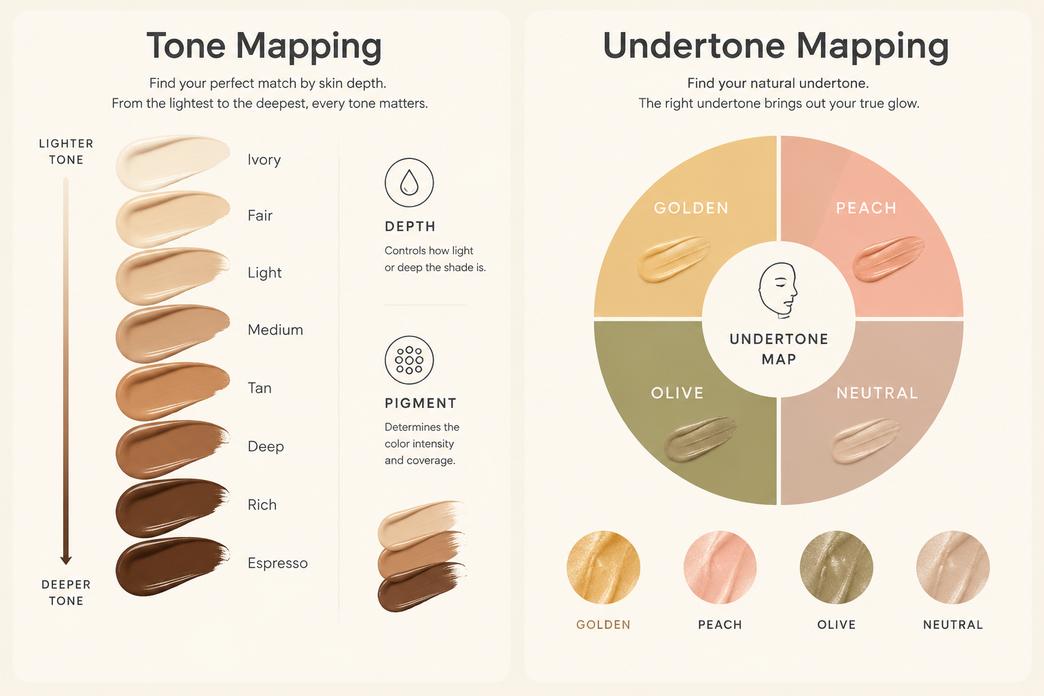
Separate depth from hue when choosing foundation color for warm skin tone. Tone mapping organizes light-to-dark references; undertone mapping compares hue within each depth.
Tone Mapping
Tone mapping organizes foundation shades according to skin depth, helping brands create consistent colors across different complexions.
Match foundation depth before comparing its golden or yellow qualities.
- Understanding skin depth
- Fairness level: Determines how light a foundation appears, from porcelain and ivory to medium beige.
- Complexion darkness: Identifies deeper shade families, including tan, caramel, and espresso.
- Pigmentation scale: Helps manufacturers maintain smooth transitions between light and dark shades.
- Refining foundation appearance
- Surface color: Reflects visible skin characteristics that can change with sun exposure.
- Color saturation: Controls how intense or muted a shade appears without changing its basic depth.
For example, warm honey and golden beige may share similar undertones but differ noticeably in depth.
Topfeel Beauty’s sample-based shade development can address the brand’s intended skin depths.
Undertone Mapping
Undertone mapping compares hue differences at a similar depth.
Two foundations with identical depth can look different once applied; compare their undertones.
Key undertone characteristics include:
- Warm color characteristics
- Golden hues: Add natural warmth to beige, honey, and caramel foundations.
- Yellow baseline: Creates the yellow-leaning foundation shades commonly associated with warm complexions.
- Peach pigments: Introduce soft orange-pink warmth for certain skin tones.
- Color balance considerations
- Olive undertones: Combine yellow warmth with subtle greenish tones.
- Neutral balance: Prevents excessive yellow or orange pigmentation.
- Cool contrast: Helps distinguish warm shades from pink or blue-leaning alternatives.
- Subsurface color: Guides pigment selection independently of skin darkness.
Balance these undertone characteristics against applied samples when choosing the intended shade.
For instance, a golden foundation shade may flatter yellow-based skin but appear too orange on muted olive skin.
Combine depth matching with adjusted warm pigments, checking for visible makeup lines.
Make shade gaps visible: A depth-by-undertone matrix turns two overlapping decisions into a sample plan.
Topfeel Beauty’s laboratories match brand-supplied color samples. Review its OEM/ODM services alongside the foundation offering to decide which depth-and-hue combinations need separate reference samples before extending the range.
Multi-Ethnic Warm Tones—4 Layered Considerations
Assess depth, warmth and texture individually; ethnicity alone does not specify foundation color for warm skin tone.
Golden undertone adaptability in tinted moisturizers
Compare golden pigment levels in tinted moisturizer samples.
- Pigment flexibility
- Adjust golden pigments for different skin depths and ethnic backgrounds.
- Maintain sheer coverage that allows natural skin luminance to show through.
- Comfort and consistency
- Improve pigment dispersion to prevent streaky application.
- Balance hydration level for lasting comfort across dry and oily skin types.
Olive undertone nuance in mineral powder shades
An olive undertone combines subtle green-yellow coloring with a naturally muted complexion.
Key formulation priorities:
- Chromatic balance: Blend milled minerals to reduce unwanted orange or pink tones.
- Neutralization: Control surface redness without creating a gray appearance.
- Shade flexibility: Test each mineral powder across light, medium, and deep complexions.
Compare less saturated samples alongside golden references for muted olive complexions.
Yellow undertone balancing with sun beige and silica powder
Sun beige pigments can complement a yellow undertone, provided the formula avoids excessive warmth.
- Color accuracy
- Control pigment saturation to prevent overly yellow results.
- Use subtle color correction to maintain natural-looking depth.
- Texture performance
- Add silica powder for absorbent or anticaking functions, then evaluate the complete formula.
- Check light reflection under different lighting conditions.
- Conduct photography tests for effective flashback prevention.
Peach undertone optimization in stick foundation lines
A flattering peach undertone requires careful red-yellow pigment balance.
Define three formulation priorities:
- Warmth enhancement: Adjust peach pigments through controlled depth adjustment.
- Cream texture: Balance waxes and oils for comfortable application.
- Blendability: Improve pigment distribution for smooth, even coverage.
Private Label Brands: Warm Foundation Color Strategies
Combine shade development, packaging and ingredient requirements in a single brief for foundation color for warm skin tone.
Partnering for bulk manufacturing and custom formulation
Compare the manufacturing partner against the foundation development brief.
Topfeel Beauty develops custom formulas and handles manufacturing and filling.
- Formula development
- A cosmetic laboratory should evaluate pigment dispersion.
- A suitable rheology modifier helps control thickness and application.
- Production consistency
- Establish shade standards before approving each production batch.
- Apply documented quality assurance checks for color and texture.
Streamlining shade matching for true amber and rich caramel
Accurate shade matching requires more than choosing a golden-looking pigment.
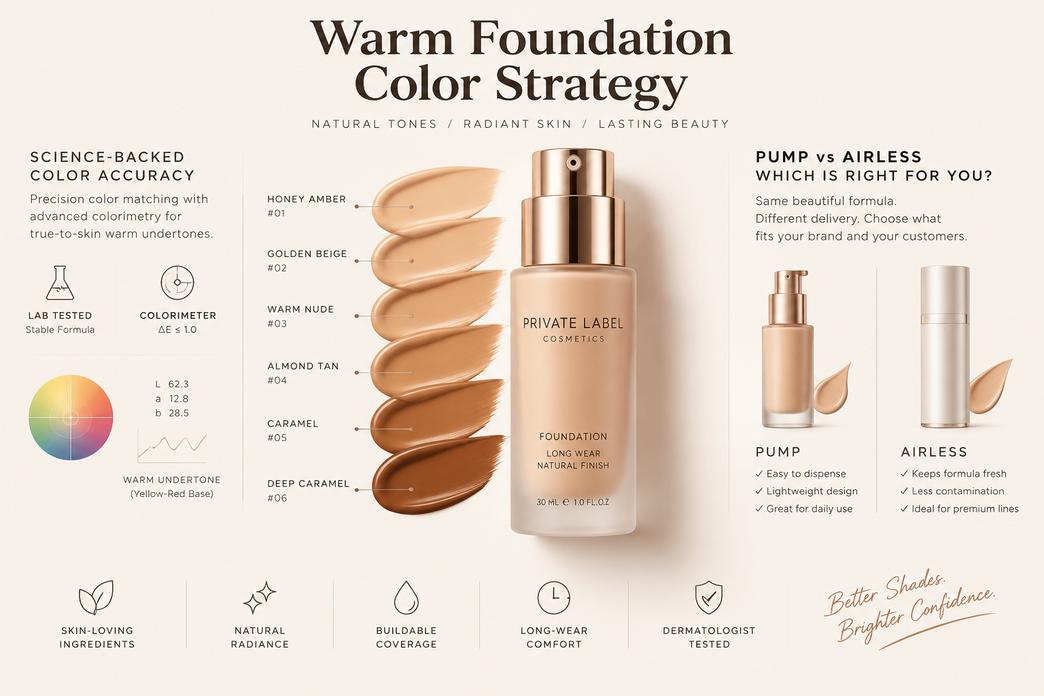
- True amber development
- Balance the amber undertone with golden and subtle red pigments.
- Use a colorimeter to measure color differences objectively.
- Rich caramel development
- Adjust caramel pigment depth without creating unwanted orange tones.
- Check each skin undertone under daylight and indoor lighting.
Test shade matching across the intended color spectrum before final approval.
Choosing pump dispenser vs. airless container for radiant finishes
- Pump dispenser
- Offers convenient application and controlled dispensing.
- Works well when formula viscosity supports consistent pumping.
- Airless container
- Provides suitable barrier protection? Check the selected system.
- Supports product protection? Assess through compatibility testing.
For a radiant finish, prioritize packaging compatibility through actual product testing; Aptar’s airless portfolio specifies a 1,000–80,000 cps viscosity range for its dispensing systems.
Integrating hyaluronic acid, vitamin E, and SPF protection
Define comfortable wear and attractive coverage alongside ingredient choices.
- Hydrating ingredients
- Hyaluronic acid retains water; assess the finished formula’s hydration.
- Vitamin E in its free forms has antioxidant functions; select the derivative and validate formulation performance.
- Sun protection
- Adding SPF protection changes US regulatory treatment: sunscreens are drugs.
- Any broad-spectrum claim needs testing; consult the foundation SPF brief.
One brief, fewer disconnects: Can manufacturing, shade matching, packaging and ingredient requirements move forward together? Topfeel Beauty’s integrated development includes formulation and compatibility assessments, so the brief can connect the shade target with its intended pack and claims.
Review custom solutions to prepare that combined development specification.
Sun-Kissed Campaign—Color Calibration Tips
For foundation color for warm skin tone, align shade references, texture and batch checks before approving campaign imagery.
Calibrating sun beige and rich caramel across glass bottles
Compare sun beige and rich caramel through filled glass bottles and applied swatches.
- Establish reliable shade references
- Compare both colors against approved physical samples.
- Measure warm undertones under standardized daylight conditions.
- Check pigment dispersion to prevent uneven golden or brown tones.
- Evaluate packaging effects
- Test packaging transparency using filled production bottles.
- Compare foundation appearance through glass and directly on skin.
For foundation color for warm skin tone, consistent lighting helps keep product photography and actual shades aligned.
Achieving uniform matte finish in private label production
Evaluate a matte finish for shine and warm-shade appearance.
Check clumping and application alongside shade in private label samples.
- Control formulation performance
- Formulation consistency: Monitor silica levels and emulsion stability.
- Oil control: Balance shine reduction with comfortable wear.
- Texture uniformity: Maintain even pigment distribution during mixing.
- Verify manufacturing results
- Examine each production batch for coverage differences.
- Apply standardized testing throughout cosmetic manufacturing.
Quality checks with mineral pigments and shade matching tools
Use documented shade matching procedures; ISO 22716 addresses cosmetic GMP rather than defining a shade tolerance.
- Measure color accuracy
- Use a spectrophotometer to compare samples against approved references.
- Check mineral pigments for consistent pigment concentration.
- Evaluate real-world appearance
- Test each skin undertone across different skin depths.
- Use a colorimeter to identify subtle shade differences.
- Approve production quality
- Complete quality control checks under calibrated lighting.
- Confirm that the foundation color for warm skin tone matches reference swatches.
Review warm foundation shades, from light golden beige to deep caramel, within the complete base-makeup evaluation before batch approval.
Ready to align sun beige and rich caramel in glass bottles, matte finish and batch quality checks?
Topfeel Beauty checks color accuracy and texture at first-article inspection before mass production. Its formulation engineers prepare initial samples in 3-7 days for sample preparation; plan qualification separately. Submit your reference swatches, finish and packaging requirements to discuss the sampling plan.
References
- Pigmentation disorders
- Foundations
- What Is Metamerism?
- Color Additives
- Silica
- Airless Packaging
- Hyaluronic Acid: What It Is, Benefits, How To Use & Side Effects
- Vitamin E and Skin Health
- Sunscreen: How to Help Protect Your Skin from the Sun
- ISO 22716:2007
Post time: Nov-04-2026